Civic Architecture 2026
Humayun’s Tomb Museum Introduces Visitors to One of India’s Most Cherished Mughal Landmarks
Delhi
Architects & Firms
In a city of exceptions, Hazrat Nizamuddin Basti is exceptional. Today a neighborhood of Delhi, it was once the humble village of Ghiyaspur, whose destiny changed forever when the Sufi saint Nizamuddin Auliya (1238–1325) settled there. A center of spirituality in his lifetime, the village became a place of pilgrimage after his death. Today, over 4 million visitors per year descend on his tomb, located at the heart of one of the most densely populated places in India—25,000 people, 90 percent of them Muslim, live cheek by jowl in a mere 0.07 square miles. Nizamuddin’s aura extends all around the Basti—such was his reputation that the rich and powerful chose to be buried nearby. Among the dozens of tombs dotting the landscape, by far the grandest is the monument to the second Mughal emperor, Humayun (1508–56). Commissioned by his first wife and chief consort, Bega Begum—who in 1565 summoned architect Mirak Mirza Ghiyas from her native Persia—the domed mausoleum, surrounded by formal gardens, was completed in 1572. The first of its kind in India, the 154-foot-tall marble- and sandstone-clad structure is the ancestor of the legendary Taj Mahal (1631–53). Just over four and a half centuries later, Delhi-based Vir.Mueller Architects, headed by Pankaj Vir Gupta and Christine Mueller, have completed a new museum to welcome visitors to Humayun’s Tomb.
1
2
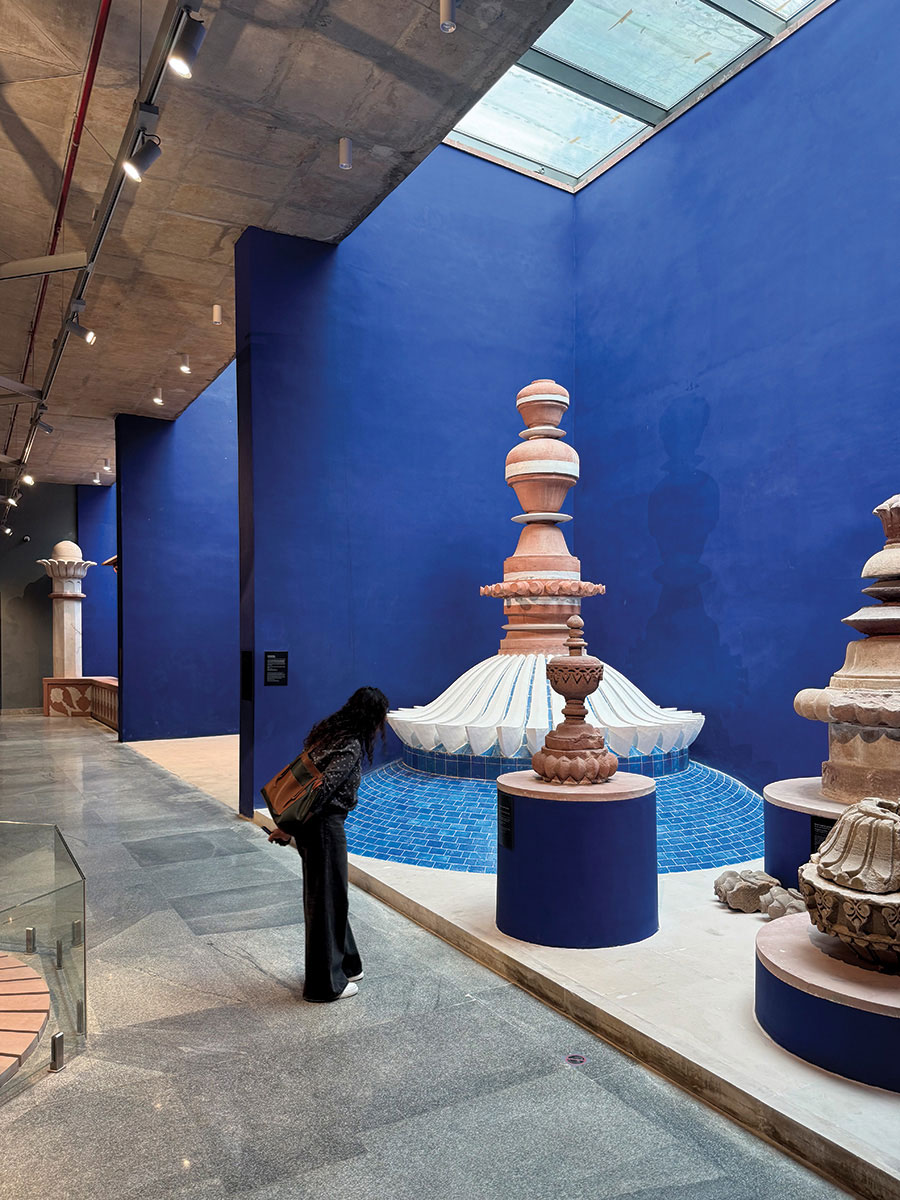
Skylights brighten the galleries (1), which are topped by a plaza (2). Photos © Lokesh Dang, click to enlarge.
Over the centuries, a checkered fate awaited all the monuments around the Basti. Humayun’s Tomb suffered particularly at the time of partition, when it was overrun by refugees, first Muslims waiting to leave India, then Hindus and Sikhs arriving from Pakistan. UNESCO’s 1993 designation of the mausoleum as a World Heritage Site spurred the launch, in 1997, of a 16-year restoration campaign, undertaken by the Aga Khan Trust for Culture (AKTC) in cooperation with the Archaeological Survey of India. That was followed, in 2013, by the Nizamuddin Urban Renewal Initiative (NURI), which saw the AKTC undertake restoration projects in both the Basti and next-door Sunder Nursery—a 90-acre park containing six World Heritage garden tombs—and implement schemes aimed at improving the quality of life for resident communities. The NURI program included construction of the 125,000-square-foot museum on the edge of the Humayun’s Tomb precinct. As well as interpreting the site’s context and history, the new institution was tasked with explaining the craft techniques employed in the restorations and providing essential visitor services such as restrooms, a café, a restaurant, and a small auditorium. In 2013, after visiting the built works of a number of architecture firms, the AKTC appointed Vir.Mueller Architects to lead the project.
3
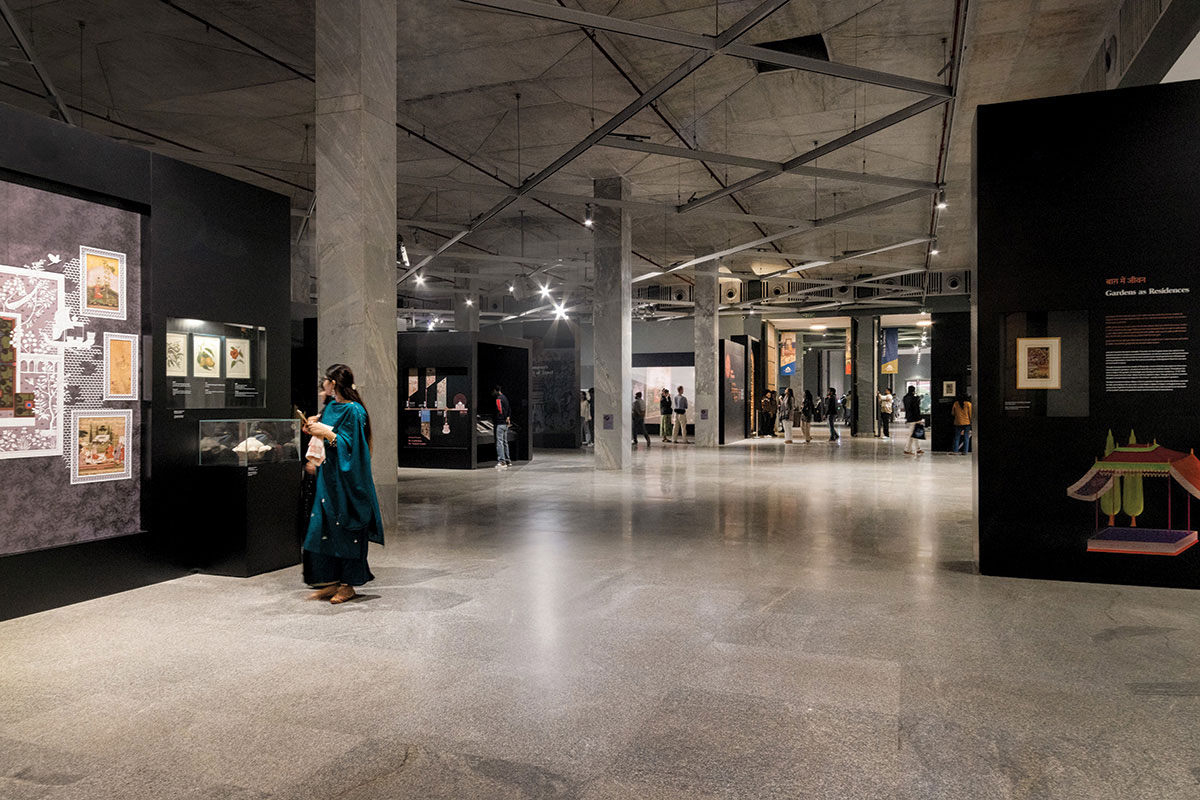
A planted court (4) runs adjacent to the minimally detailed galleries (3). Photos © Lokesh Dang
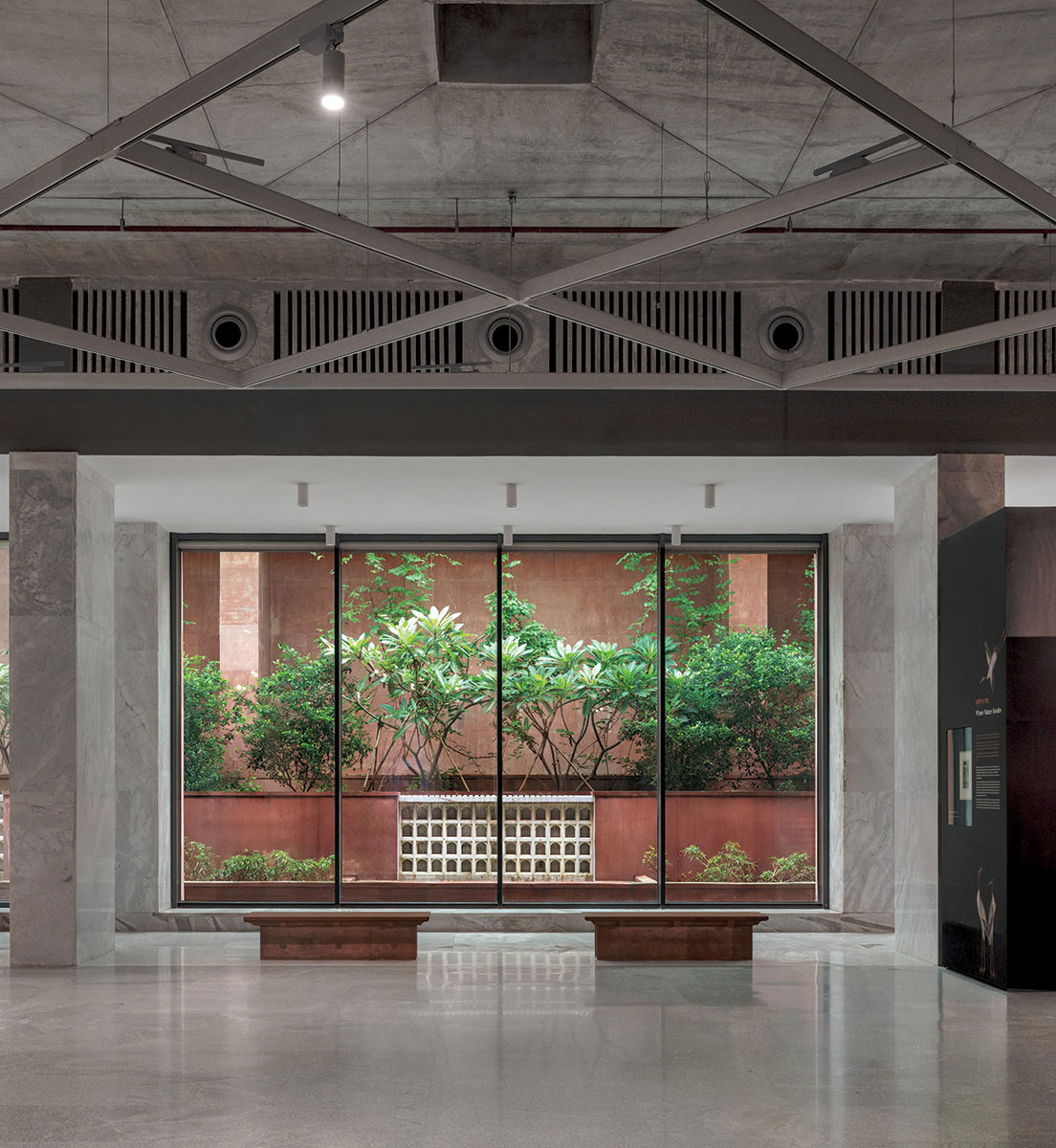
4
Faced with a construction budget of just $7 million, “we asked ourselves, ‘How can we design the most simple and robust building that makes visitors feel comfortable?’” says Vir Gupta. The site was awkward, divided in two by the service road running between the precinct and Sunder Gardens, and dotted with mature trees that could not be felled without a permit. Moreover, World Heritage Site guidelines forbade any new structure from rising more than 3 feet aboveground, with the caveat that, on the northern half of the plot, above-grade buildings could supplant existing asbestos-sheet structures serving as storage for garden supplies. The architects consequently chose to concentrate the services aspect of the program there, and to dig underground galleries in the southern part of the plot, connecting the two halves via tunnels under the road. This required a special dispensation, since Delhi’s construction code, drafted in wariness of the city’s uncontrollable crowds, does not allow the use of basements for anything other than machinery or storage. As for the trees, some of which are over 100 years old, Vir.Mueller considered them an asset, and set out to preserve any whose trunk diameter was 6 inches or more. After carefully mapping out their location and the spatial requirements of their roots, the firm devised a below-grade visitor route that swells and contracts in response to their proximity.
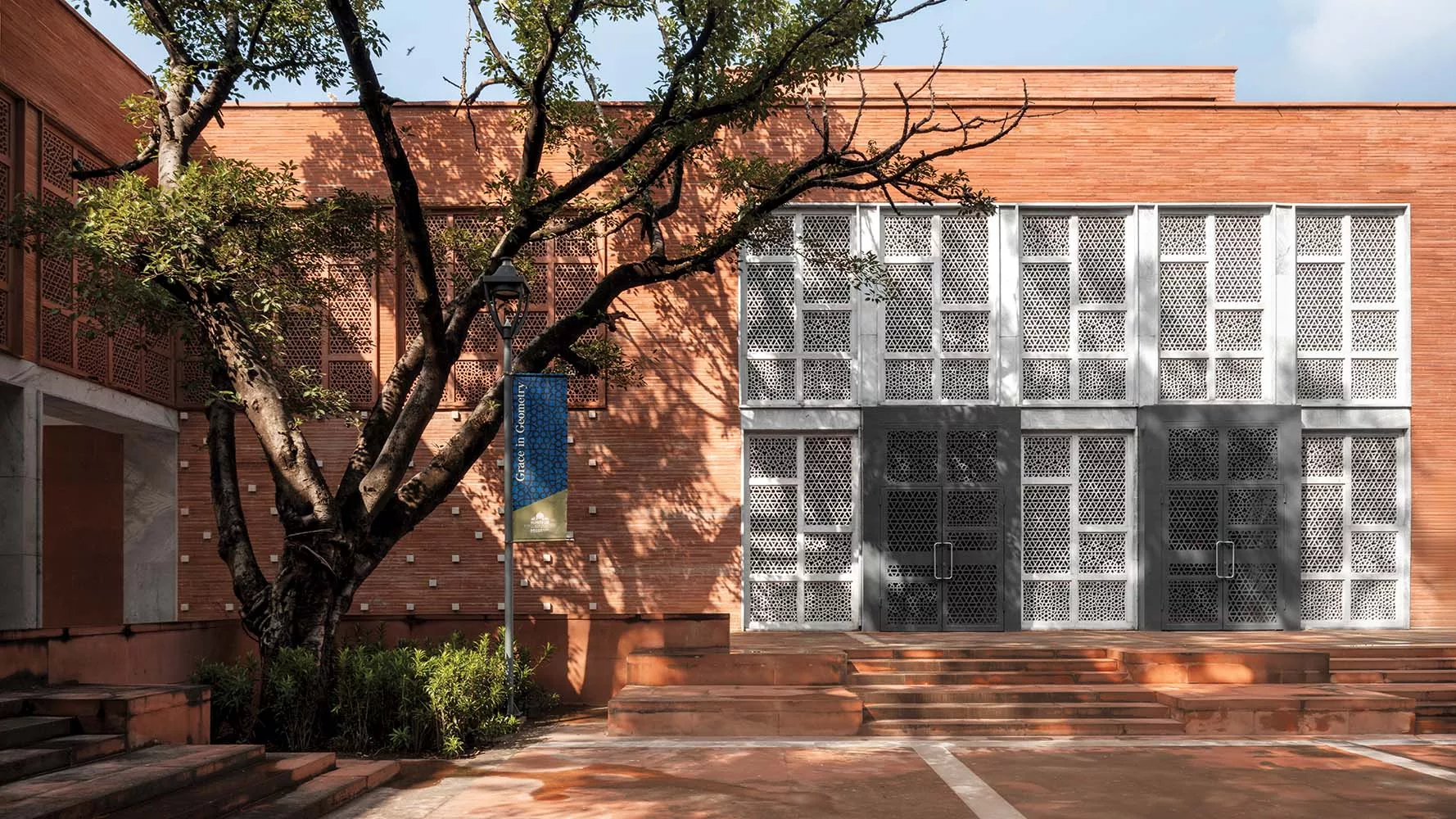
Since Delhi is a seismic zone, and the water table very high, only concrete construction offered the necessary resistance. For the service part of the program, Vir.Mueller designed a two-story U-shaped block enclosing a courtyard shaded by imposing ficus trees. The firm initially intended to clad the structure in flat panels of the same red sandstone as Humayan’s Tomb, until the day the site manager happened to mention that vast quantities of sandstone waste from the restoration were going to be dumped. “That was a eureka moment,” recalls Mueller. Back in the studio, the architects devised a method of resizing the fragments so they could be laid in narrow strips, like Roman brickwork, and had the craftspeople from the restoration carry out the work, thereby prolonging their employment by a year. These masons also carved the sandstone and marble screens, which add a very Mughal touch, as well as the 5-inch Makrana-marble cubes studding certain facades, which are also restoration offcuts.
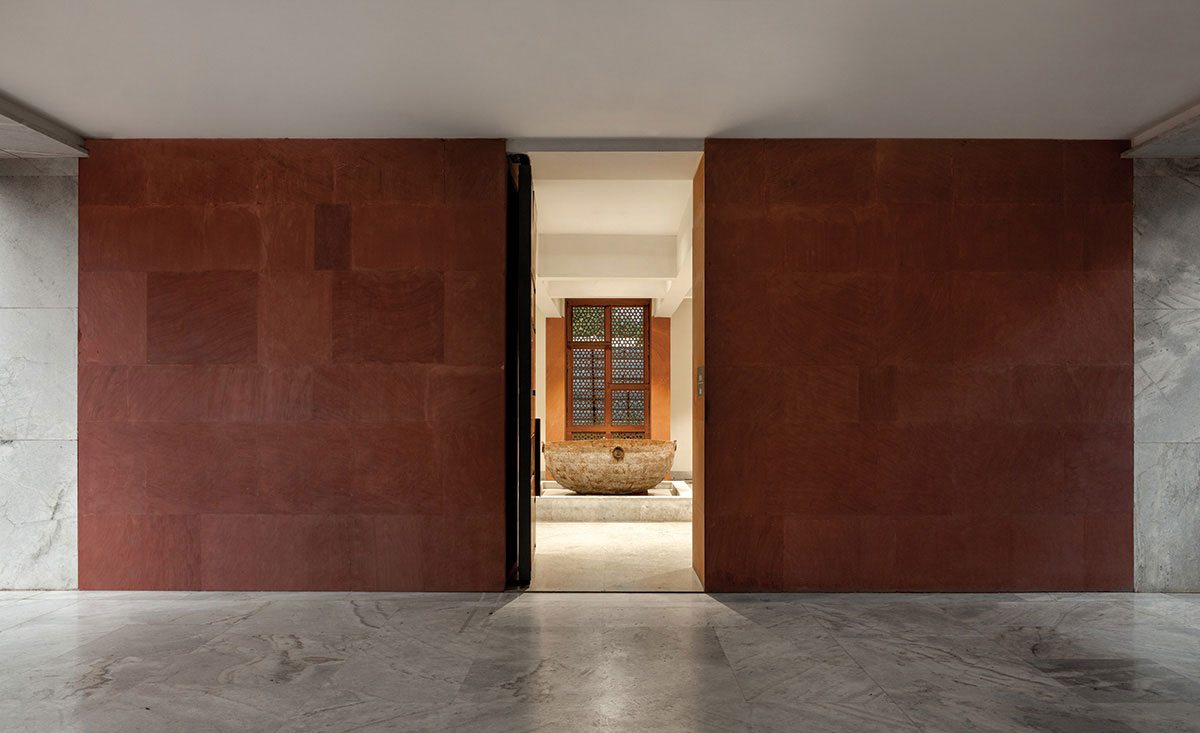
5
Masonry screens filter light entering the aboveground structure (5 & 6). Photos © Lokesh Dang
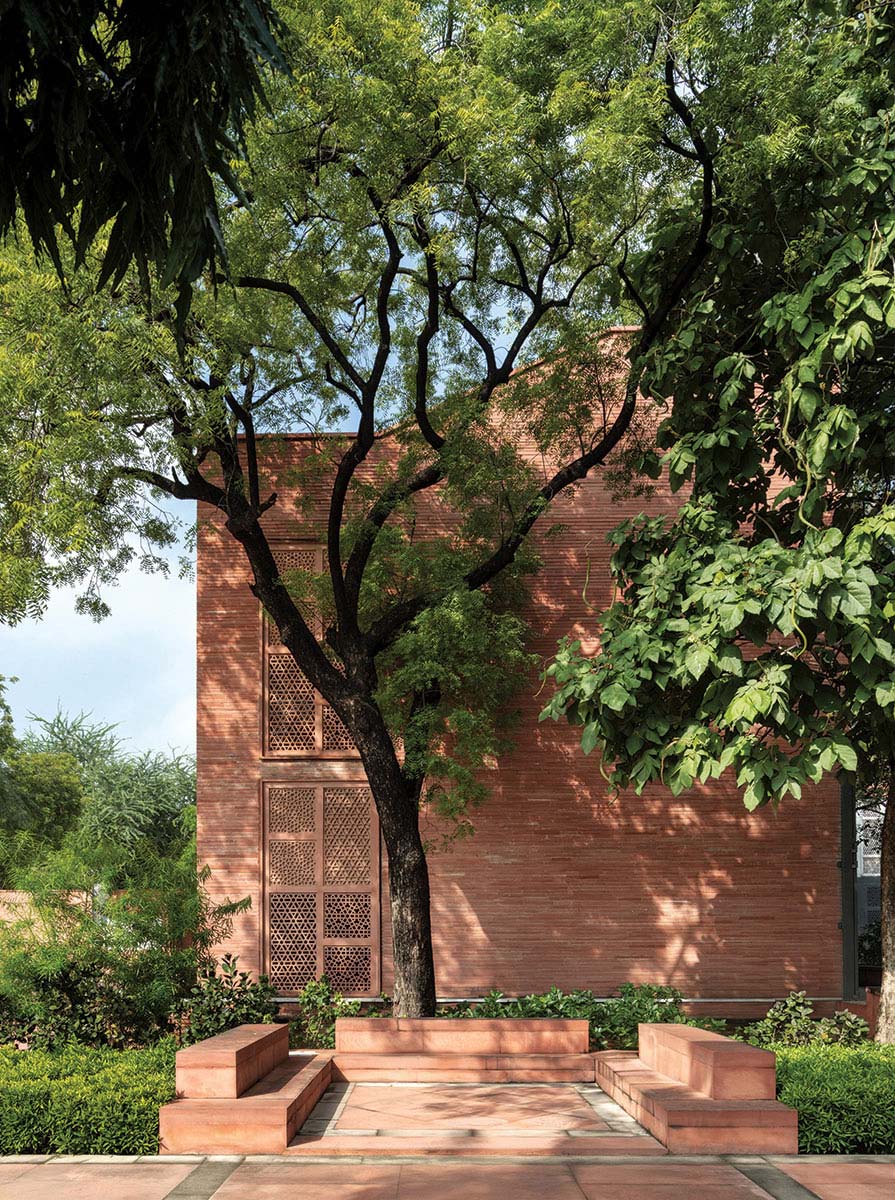
6
When designing the galleries, Vir.Mueller had little indication of what form the displays would adopt, the only certainty being that the tomb’s 20-foot-high gilded-copper finial, felled by a 2014 storm, would take center stage. (Too fragile to return to the dome’s summit, it has been replaced by a replica.) This determined the ceiling height, while for safety reasons the firm lined the galleries up in enfilade, to allow easy orientation in an emergency. When engineering their underground structure, Vir.Mueller sought to minimize steel reinforcement while increasing weight to counterbalance groundwater pressure. The result is an architecture of tectonics, with the floor in two layers—a 24-inch-thick reinforced slab above 23 inches of unreinforced ballast—and the ceiling pared away around the lines of force, giving it a graphic character that recalls the geometric planning of Humayun’s Tomb. To dispel the subterranean gloom, small skylights punctuate the gallery spaces, with a glass-walled sunken garden running alongside the largest. Throughout the complex, materials are kept to a hard-wearing, low-maintenance minimum: stone, concrete, and timber, the latter in the form of teak offcuts used for monumental paneled doors.
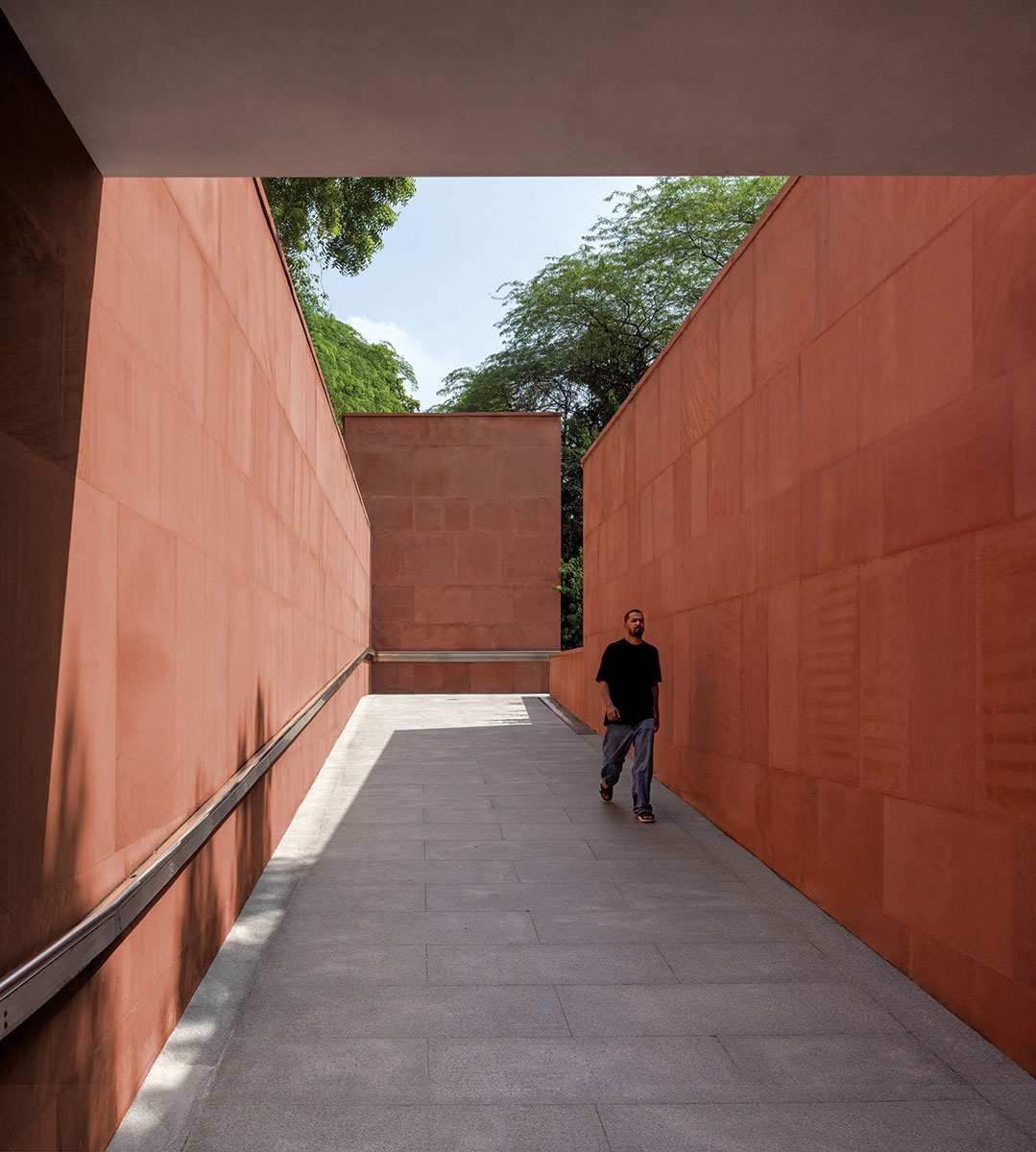
Ramps guide visitors through the site. Photos © Lokesh Dang
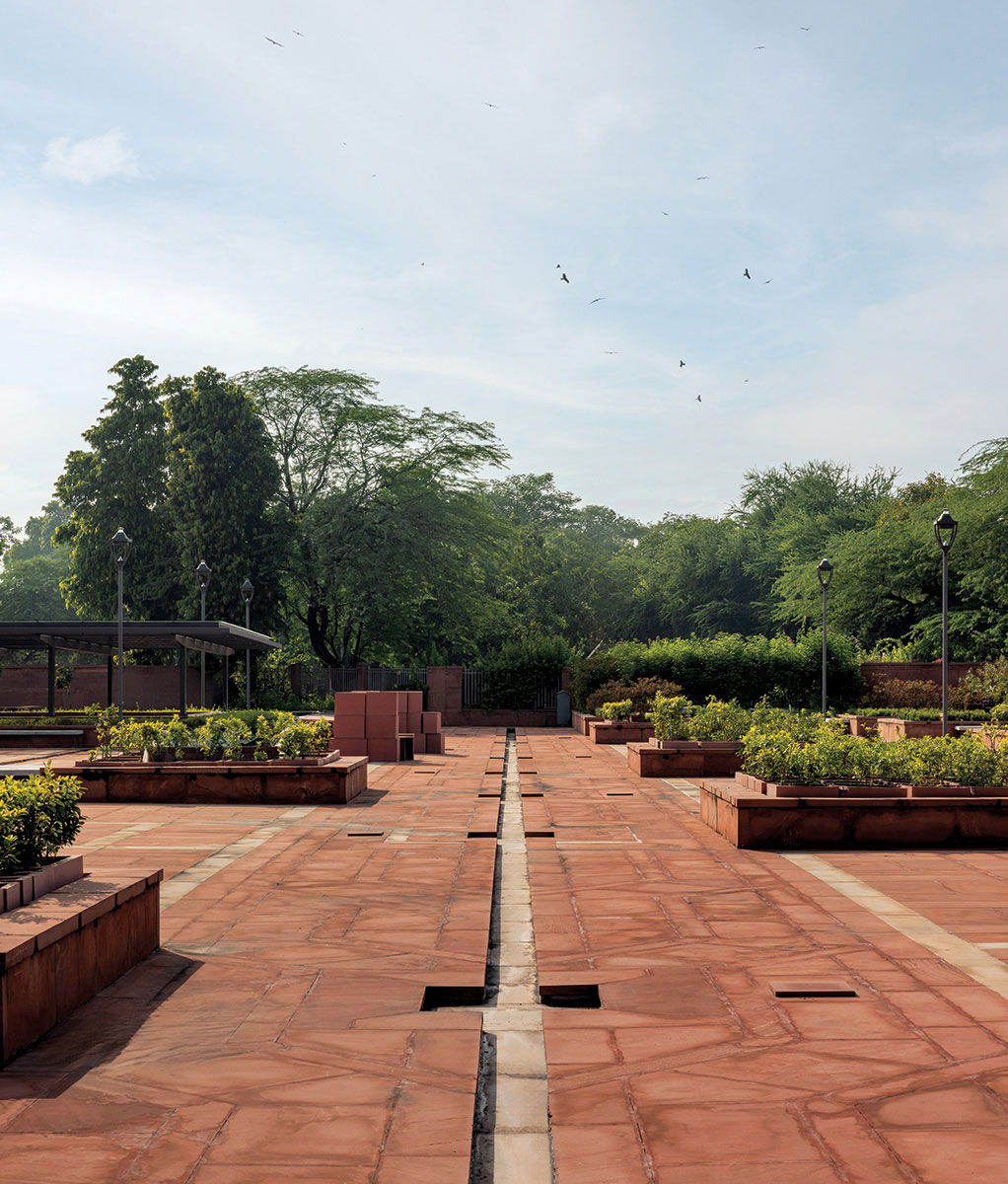
To get visitors down to the galleries, Vir.Mueller designed three open-air ramps, one adjacent to the services building at the galleries’ western end, the other two at their eastern extremity; the northern one allows access from Sunder Nursery, while the southern connects to the tomb precinct. “The client kept saying, ‘Why are you making these long ramps? Just build a stair!’” says Vir Gupta, laughing. “But it wasn’t only about accessibility; it was also about stretching out the crowd on busy days.” There was, in addition, a philanthropic intent. “In our first meeting with him, Prince Karim [Aga Khan] asked us, ‘Can you make a museum that not only fulfills the cultural program but also fits into the socioeconomic context?’” recalls Vir Gupta. For, as well as living in great poverty, the next-door community of 25,000 is made to feel very unwelcome by the Hindu-nationalist regime that has ruled India since 2014. “Christine and I spent a lot of time talking to slum dwellers in the Basti,” Vir Gupta explains. “They told us, ‘We need a place to sit. We need a place where we can feel that we belong. We need a place where we can wash our hands with clean water.’” Since Basti residents can access the museum for a mere 10 rupees (11 cents), the architects set out to offer them some of the services they lack. “Many people come here just to be quiet, because there are 14 of them living in one room,” explains Mueller. “We said to ourselves, ‘How many living rooms can we make?’” It is in this spirit that the Sunder Nursery ramp, lined up on the axis of a Mughal garden tomb, spirals around a tranquil water feature; that the gallery roof forms a stone carpet where Basti families can picnic; and that the first and last facilities encountered are very generous marble-lined washrooms. “In a Western museum, you’d never imagine this being part of the conversation,” says Vir Gupta, “but for us it was an opportunity to make a difference.”
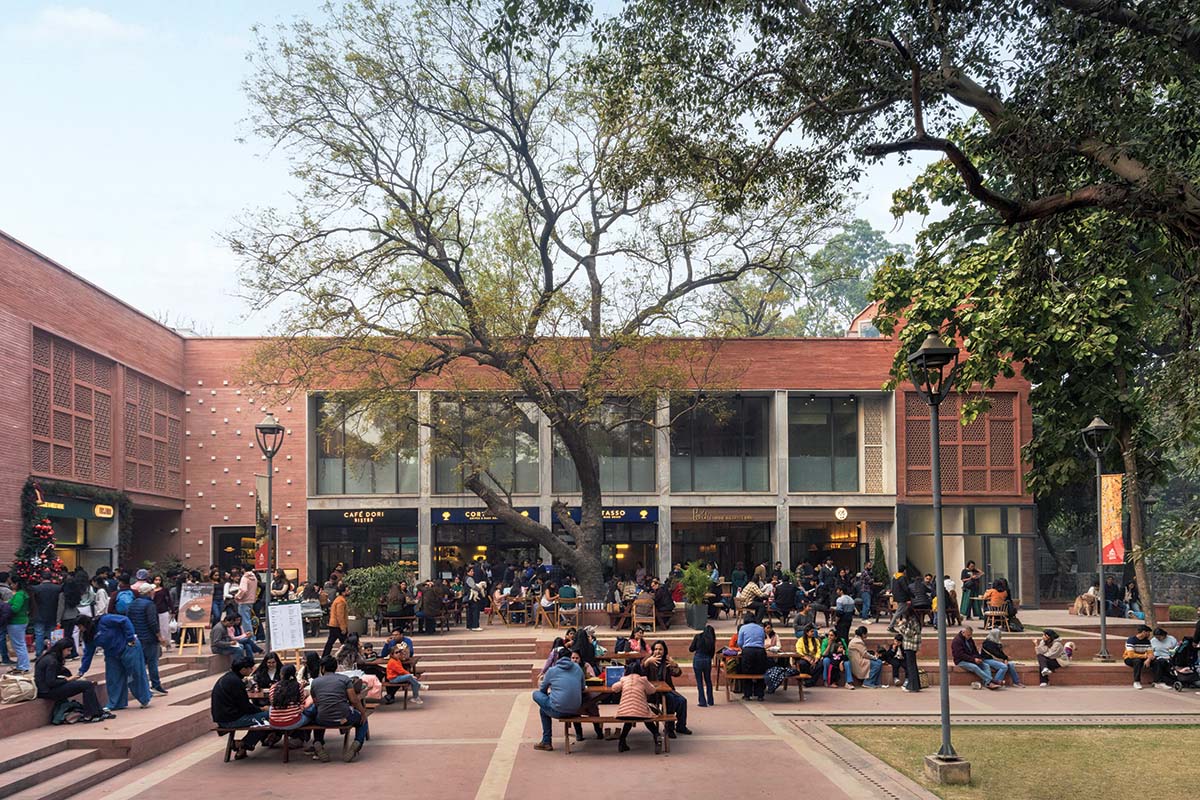
The grounds are used as a public space. Photo © Lokesh Dang
The Humayun’s Tomb interpretation center was a labor of love for Vir.Mueller, requiring constant vigilance during a long, fraught, and piecemeal construction process—the complex opened in two phases, in August 2024 and December 2025. Though the firm lost money on the job, its principals have no regrets. “This is one of very few places in Delhi where all sectors of society gather together,” declares Mueller. “It’s truly democratic, which was always our intent, but it’s remarkable to actually see it.”
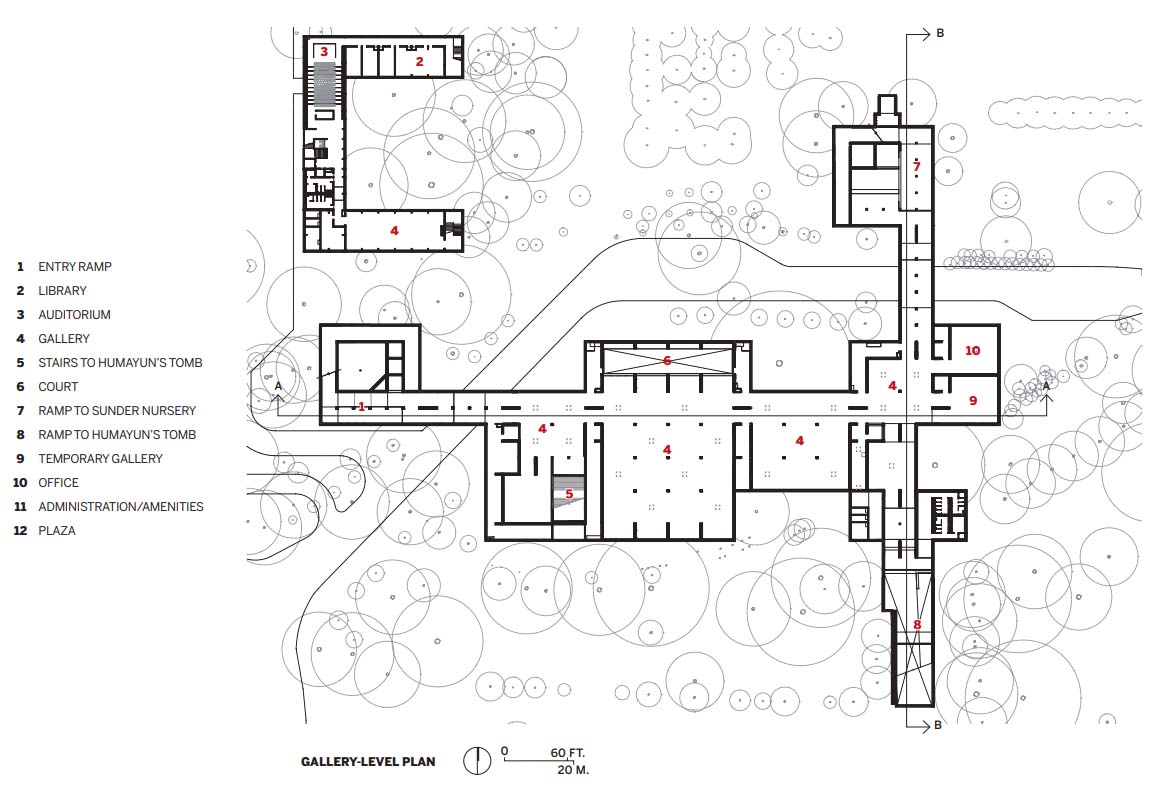
Image courtesy Vir.Mueller Architects
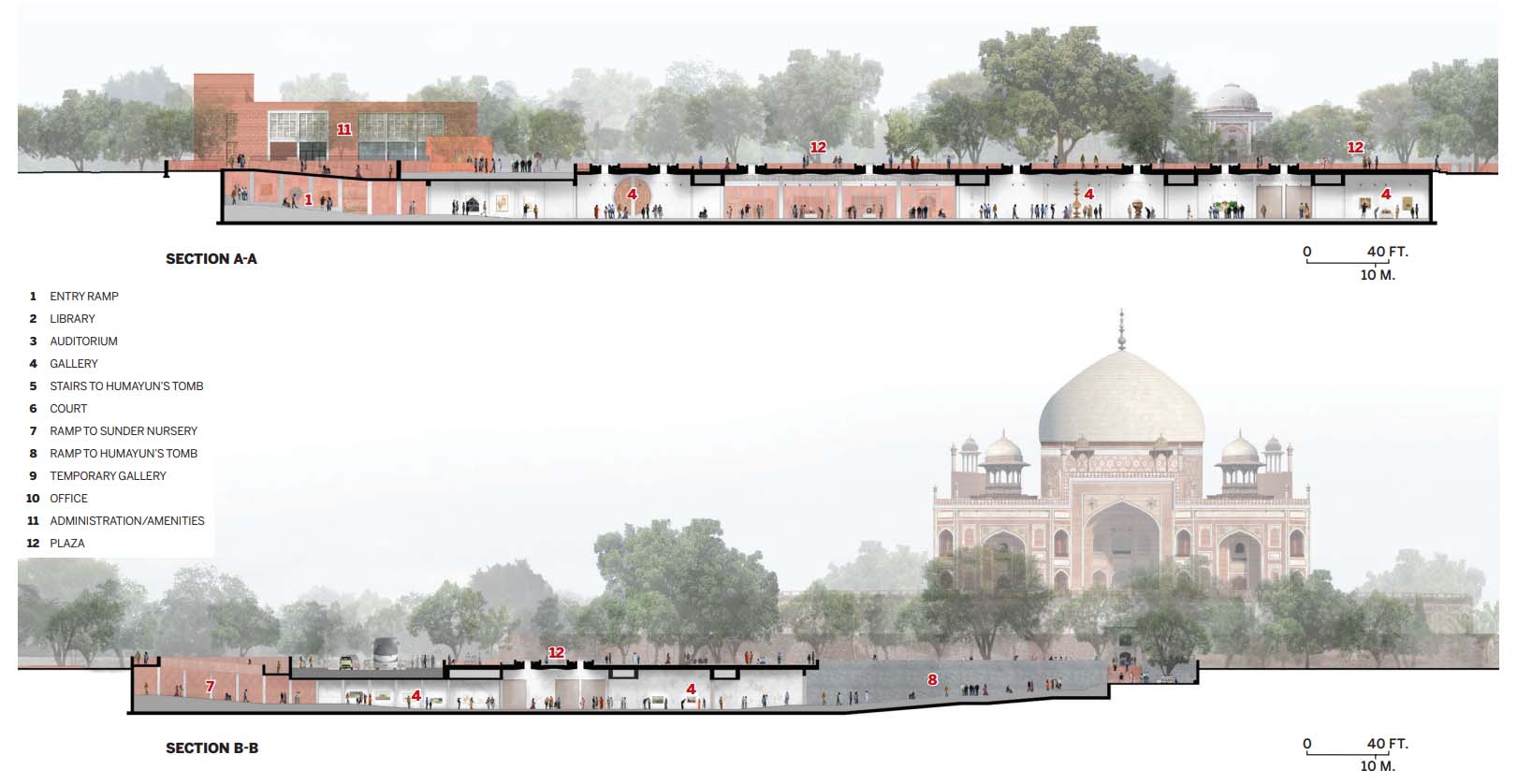
Image courtesy Vir.Mueller Architects
Credits
Architect:
Vir.Mueller Architects — Pankaj Vir Gupta, Christine Mueller, partners in charge; Kapil Shokeen, project architect; Mansi Maheshwari, Avneet Kaur, Matthew Pinyan, Prashant Singh Hada, Saurabh Jain, Utsav Jain, Monisha Nasa, Ranu Singh, Puja Pillai, Nishtha Vishnoi, project team
Engineers:
Himanshu Parikh (structural); Jhaveri Associates (MEP)
Consultants:
Shaheer Associates (landscape); Fifth Dimension Technologies (lighting, acoustics)
General Contractor:
Globe Civil Projects
Client:
Ministry of Culture, Government of India & The Aga Khan Trust for Culture
Owner:
Archaeological Survey of India
Size:
105,650 square feet
Cost:
$7.4 million (construction)
Completion:
September 2025
Sources
Curtain Wall & Windows:
Schüco
Roofing Membrane:
Grace Bituthene
Glazing:
Saint-Gobain
Metal Ceiling Grid:
Armstrong
Plumbing:
Kohler
Looking for quick answers on architecture and design topics?
Try Ask RECORD, our new smart AI search tool.
Ask RECORD →
Looking for a reprint of this article?
From high-res PDFs to custom plaques, order your copy today!