From the RECORD Archives: ‘Rakow Research Library, Corning, New York’
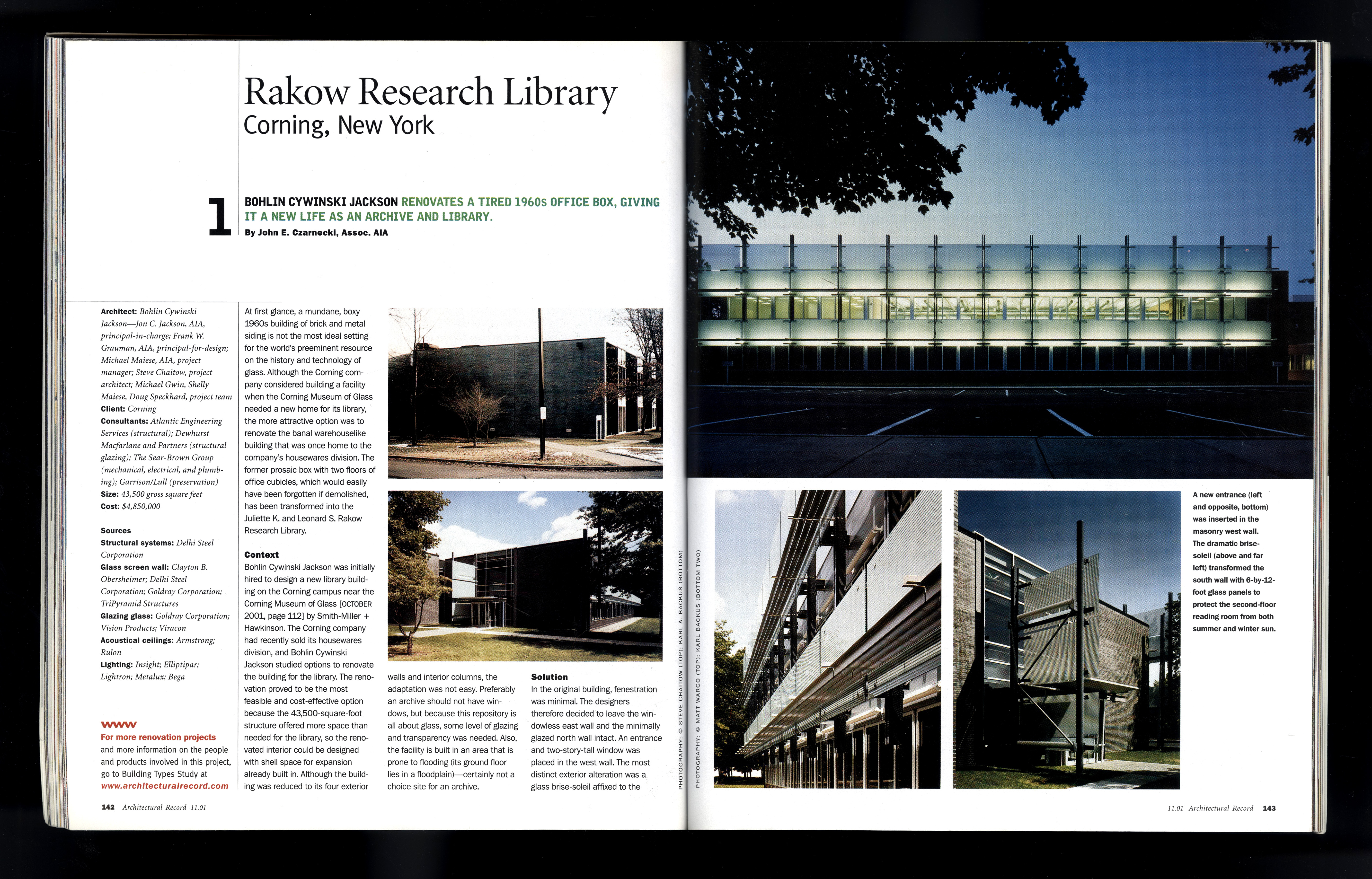
Photo © Architectural Record, November 2001
✕
“Rakow Research Library, Corning, New York”
By John E. Czarnecki, Assoc. AIA
Architectural Record, November 2001 Bohlin Cywinski Jackson renovates a tired 1960’s office box, giving it a new life as an archive and library At first glance, a mundane, boxy 1960s building of brick and metal siding is not the most ideal setting for the world’s preeminent resource on the history and technology of glass. Although the Corning company considered building a facility when the Corning Museum of Glass needed a new home for its library, the more attractive option was to renovate the banal warehouselike building that was once home to the company’s housewares division. The former prosaic box with two floors of office cubicles, which would easily have been forgotten if demolished, has been transformed into the Juliette K. and Leonard S. Rakow Research Library.

Photo © Architectural Record, November 2001
Bohlin Cywinski Jackson was initially hired to design a new library building on the Corning campus near the Corning Museum of Glass (RECORD, October 2001) by Smith-Miller + Hawkinson. The Corning company had recently sold its housewares division, and Bohlin Cywinski Jackson studied options to renovate the building for the library. The renovation provided to be the most feasible and cost-effective option because the 43,500-square-foot structure offered more space than needed for the library, so the renovated interior could be designed with shell space for expansion already built in. Although the building was reduced to its four exterior walls and interior columns, the adaptation was not easy. Preferably an archive should not have windows, but because this repository is all about glass, some level of glazing and transparency was needed. Also, the facility is built in an area that is prone to flooding (its ground floor lies in a floodplain)—certainly not a choice site for an archive. Solution
In the original building, fenestration was minimal. The designers therefore decided to leave the windowless east wall and the minimally glazed north wall intact. An entrance and two-story-tall window was placed in the west wall. The most distinct exterior alteration was a glass brise-soleil affixed to the south wall. The brise-soleil, with 6-by-12-foot panels of 5/8-inch-thick tempered glass on steel masts about 5 feet from the existing facade, acts as an environmental sculpture that celebrates the full range of the material’s properties: clarity, translucency, opacity, refraction, and structural strength. A ceramic frit is on the side of the brise-soleil glass that faces the building, with acid-etched lines on the front. Its top panels filter light from summer sun, and lower panels protect the reading room from winter sun angles.

Photo © Architectural Record, November 2001
A prime example of transforming an indistinct building in a beautiful space, this renovation urges architects to ponder what can be done with newer structures that have outlived their original purpose. Frank Grauman, AIA, Bohlin Cywinski Jackson design principal for this renovation, said, “This solution was quite gratifying because it is grounded in how the world has changed. We have a whole generation of bland, joyless buildings out there and we really should, as a society, figure out what to do with them.”
Looking for a reprint of this article?
From high-res PDFs to custom plaques, order your copy today!