Capital Planning Commission Approves Trump’s White House Ballroom Amid Legal Battle

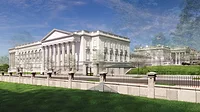
Washington D.C.’s powerful National Capital Planning Commission (NCPC) voted yesterday 8-1 in favor of approving the Trump administration’s planned 90,000-square-foot White House State Ballroom. The lone dissenting vote came from longtime D.C. Council Chairman Phil Mendelson, who voiced concerns about the scale of the contentious neoclassical ballroom complex, officially known as the East Wing Modernization Project. He also lamented the unusually swift speed in which the $400 million effort is moving through the design and planning process.
“I’m trying to be nice here—it’s just too large,” Mendelson said in his remarks. “If we can get the same program but not as tall, where the building is not competing in height with the main structure and has a condensed footprint, we are better for that.”
The commissioners who voted to approve the project are staunch allies of the President, including chairman Will Scharf, a former personal lawyer of Trump who currently serves as assistant to the President and White House staff secretary. In lieu of voting for or against the project, both appointees of D.C. Mayor Muriel Bowser voted “present.” The meeting, which reviewed several other high-profile projects, did not include a presentation of the recently revised design of the ballroom by architect Shalom Baranes Associates.
On February 20, the U.S. Commission of Fine Arts, similarly packed with Trump appointees, also gave its blessing to the project. Yesterday’s final vote from the NCPC, which functions as an independent executive branch agency, marks the last procedural hurdle needed for Trump’s ballroom, which has multiplied in size and capacity, ballooned in cost, switched architects, and been subject to both widespread confusion and criticism since it was first teased last summer ahead of the shock demolition of the White House’s East Wing (which was carried out without the required NCPC review.)
The project has also, not surprisingly, been subject to legal action, namely a lawsuit filed by the National Trust for Historic Preservation, which is one of eight cultural heritage and architecture groups also suing Trump over his planned revamp of the John F. Kennedy Center for Performing Arts. That lawsuit has a hearing date of April 29.
Earlier this week, just two days before the NCPC vote, Republican-appointed U.S. District Court Judge Richard Leon ruled that construction on the ballroom “must stop until Congress authorizes its completion.” Although Leon granted the National Trust’s request for a preliminary injunction that would bring work to a standstill, he delayed enforcement for two weeks anticipating a quick appeal from the Trump administration. The National Trust suit, Leon said, "is likely to succeed on the merits because no statute comes close to giving the President the authority he claims to have.”
Leading off what he described as “a barnstormer of a meeting,” the NCPC’s Scharf noted that Leon’s ruling does not impact the proceedings of the commission. In his opening argument for the ballroom, Scharf provided a comprehensive history of the many alternations and architectural interventions that have occurred on the White House grounds over the decades, noting that many were initially met with skeptical press and public condemnation but went on to be embraced as integral parts of the historic complex’s fabric. Trump’s ballroom, he said, will in time “be considered every bit as much of a national treasure as the other key components of the White House.”
Looking for quick answers on architecture and design topics?
Try Ask RECORD, our new smart AI search tool.
Ask RECORD →
“My core point is that the White House is ever-changing and evolving to meet the programmatic needs of an ever-changing and evolving United States presidency,” said Scharf. “Any argument that relies on the idea that the White House is unchangeable, or should be unchangeable, flies in the face of the very history of the structure such critics claim they are trying to protect.”
Scharf and other commission members defended the project—and Trump’s intentions—in their remarks, dismissing much of the uproar over the ballroom as being “unserious” and political in nature. Scharf said he personally read every public comment submitted to the commission and that the negative ones were “frankly unresponsive” and dealt with “issues beyond the scope of this commission” including interior decor and the project’s private funding. “Considering issues of this sort is not within our mandate,” said Scharf. “We are not some sort of free-ranging ballroom Justice Commission.”
“I think it is an unfair besmirching of the architect,” said another commissioner, Michael Blair, of criticism being lobbed at prolific D.C. architect Shalom Baranes, who replaces Trump’s original ballroom designer, James C. McCrery. Nevertheless, critics have called the design’s deployment of classicism misguided, and in some cases functionally incoherent.
“Further, the president, who obviously has had a hand in this design, is a builder himself, and he too has won architecture awards for buildings he has built over the years, as well as hospitality awards,” Blair continued. “I think that's worth noting, because the purpose of the ballroom blends these two things: great architecture with great hospitality, which is something the President cares deeply about, because it represents the American people.”
Trump’s gusto for hospitality also plays into the plans for his future presidential library, which was unveiled on social media earlier this week. Planned for downtown Miami, AI-generated renderings of the grandiose project depict a soaring waterfront skyscraper that will likely double as a hotel and include the requisite gleaming escalators, at least two golden statues of Trump raising his fist, and a Boeing 747, courtesy Qatar, parked in the lobby.
Looking for a reprint of this article?
From high-res PDFs to custom plaques, order your copy today!

.webp?height=200&t=1765378565&width=200 "White House Ballroom Model")