RECORD Forum
The White House Ballroom and the Phantom of Modernization

Since the Trump administration tore down the East Wing of the White House to make space for a new ballroom, public debate has fixated more on the demolition of the old structure than the design of the new one. The project first surfaced in July 2025 and has existed in perpetual flux ever since. Capacity figures shifted—650 guests, then 999, then 1,350, then 1,000. Architectural elements appeared and vanished: porticoes multiplied, column counts changed, stairs rose only to terminate abruptly. Even architects came and went. Amid this instability, two seemingly antithetical things remained constant: a classical vocabulary and a claim to modernity. The White House has promoted the project as the “East Wing Modernization Project”—invoking the same term used in 1902, when Theodore Roosevelt expanded and revamped the complex. If Roosevelt’s Beaux-Arts intervention and Trump’s “big, beautiful ballroom”—both neoclassical and over a century apart—can claim the title of “modernization,” what does the term really mean?
That tension is not new. Thomas Jefferson envisioned the Capitol as a “model of antiquity” and the President’s House as a “modern mansion.” James Hoban’s 1792 design delivered a restrained Georgian residence, scaled deliberately as a house rather than a palace. When Theodore Roosevelt commissioned McKim, Mead & White in 1902, the architects aimed “to modernize” the original scheme—“to provide all those conveniences which now are lacking” and “to secure comfort, safety, and necessary sanitary conditions.” Electricity replaced gas-powered lighting; steel reinforced timber; an elevator supplemented stairs; heating, plumbing, telecommunications, and fire-safety systems were installed. For Charles McKim, trained at the École des Beaux-Arts, classicism was not a nostalgic revival but the contemporary language, capable of absorbing these new technologies while maintaining formal coherence. Montgomery Schuyler’s 1903 RECORD review recognized this achievement: “What the original architect might be supposed to have done, if he had had modern means to work with.”
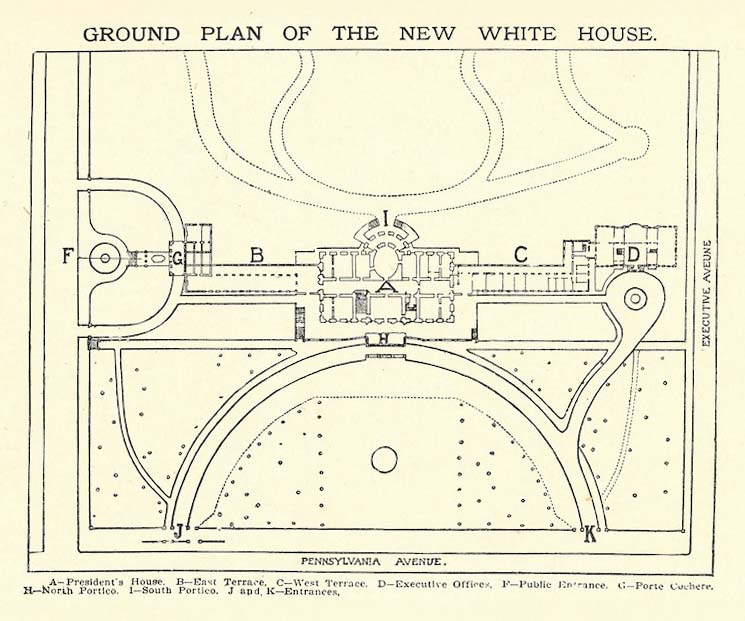
The April 1903 issue of RECORD featured a site plan including the East Terrace. Image © Architectural Record, click to enlarge.
By 1942, Franklin D. Roosevelt’s expansion responded to wartime imperatives. Architect Lorenzo S. Winslow transformed McKim, Mead & White’s single-story East Terrace into a two-story wing. The official justification—accommodating staff—concealed the primary purpose: the creation of a fortified underground bunker, the Presidential Emergency Operations Center, designed to withstand aerial bombardment and enable secure operations. The project embodied the national security priorities of its time. The wing also housed the First Lady’s offices, institutionalizing a role that Eleanor Roosevelt was redefining as advocate for labor, civil rights, and women’s participation in public life. While Winslow maintained neoclassical continuity externally, modernization manifested in technological systems and institutional adaptation—architecture serving immediate necessities through concealed infrastructure rather than ceremonial display.
This relationship between architecture and political authority reconfigured as “modernism” consolidated over the 20th century. Daniel Patrick Moynihan’s 1962 “Guiding Principles for Federal Architecture” insisted that government buildings should “avoid official style” and draw on “contemporary architectural thought.” Design, Moynihan argued, “must flow from the architectural profession to the Government. And not vice versa.” Architectural legitimacy shifted from symbolic representation to disciplinary consensus. Postmodernism extended this pluralism, recoding classical forms as historical citations—objects of irony or critique rather than normative expression. By the early 21st century, as architectural discourse has prioritized systems over style, the state reasserted a more explicit claim over architectural meaning. The 2020 executive order under Trump’s first presidency, “Make Federal Buildings Beautiful Again,” mandated classical style as “preferred and default,” reversing discourse that had defined modernity through rupture, experimentation, and critical distance. Classicism became official decree, inverting the republican ideals it once embodied in America.
In those early months of Trump’s first term, writing in Log on what would define the architecture of his presidency, I anticipated kitsch, not classicism. His developments were contemporary, if uneven, and rarely nostalgic in style. What I failed to anticipate was not the reduction of architecture to image but the redeployment of classicism as political technology. This logic had appeared before. Trump’s 2005 proposal to rebuild the World Trade Center “the same way, a little bit taller, a lot stronger, just plain better” promised restoration where none was possible. The East Wing ballroom operates similarly. It is not revival but compensation—classical form mobilized to stage the return of an imagined past. Architecture becomes the instrument through which political authority performs continuity, stability, and historical inevitability, even as the conditions that once gave those forms meaning have vanished.
McCrery Architects’ initial scheme for the East Wing Modernization project revealed a classical vocabulary: a portico on the east facade, Corinthian columns rising to an entablature and pediment, arched windows punctuating the elevations, and a grand double stair descending toward the South Lawn. Yet such elements refused coherence: the portico occupied the building’s long side rather than its short end; it appeared sometimes with six columns, sometimes with eight; and it remained misaligned with the foyer. Successive versions circulated through whitewashed renderings on the White House website, 3D-printed models in the Oval Office, or printed floor plans held aloft by the President, each correcting inconsistencies while introducing new ones. These were not systematic iterations but symptomatic variations of a classical vocabulary without a grammar—elements deployed as stylistic signifiers divorced from the methodical language that once gave them meaning. The inconsistencies were less individual error than an institutional condition: architecture operating under political authority, where form is compelled to signify before it is allowed to organize.
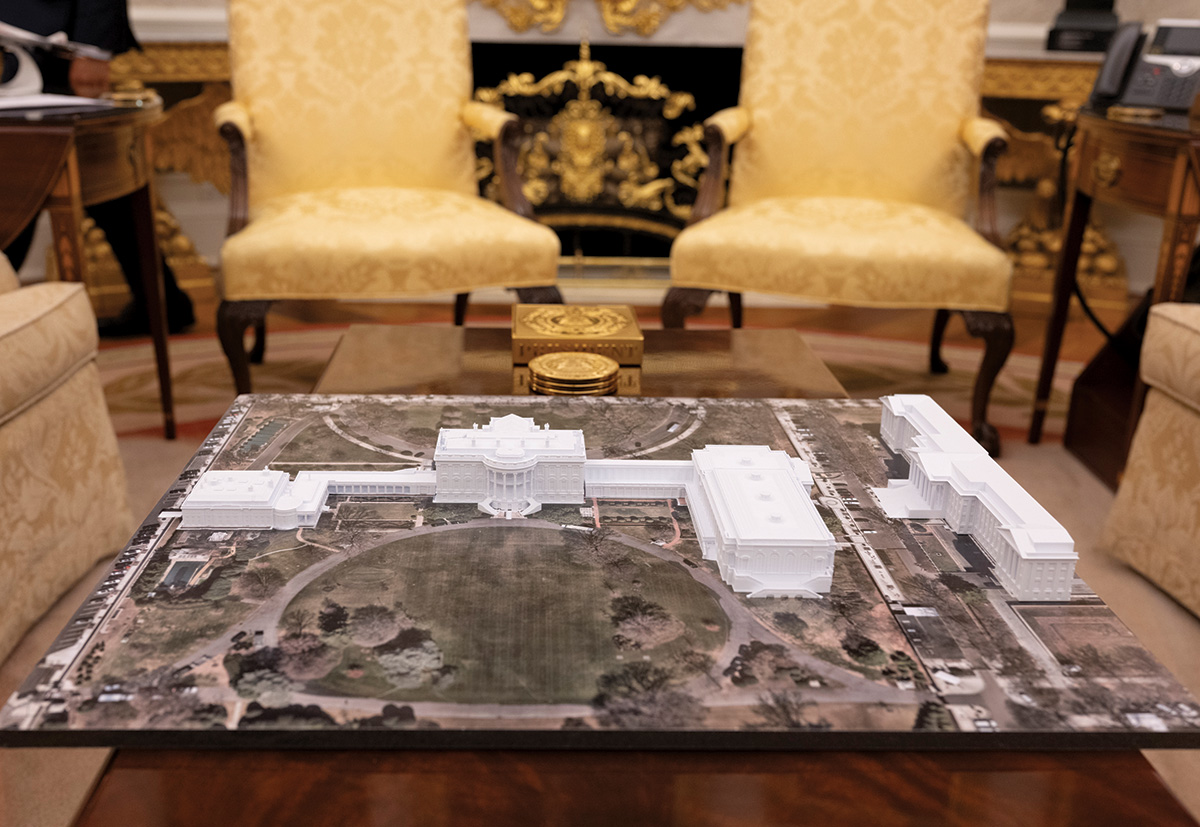
In an Oval Office meeting in October 2025, President Trump showed a model of the proposed ballroom. Photo © White House, Wikimedia Commons
Most revealing was the project’s inadvertent theoretical resonance. The New York Times documented anomalies such as the stairs ascending from the South Lawn to no clear landing, or windows colliding at corners where facades met. These recall poststructuralist experiments—think Peter Eisenman’s inverted stair in House IV, or his floating column at the Wexner Center—deliberately detaching elements from their function. Such elements operate as what Claude Lévi-Strauss called “floating signifiers”: signs divorced from referents, forms without conventional meanings. Here, however, the effect is unintentional. What once functioned as critical strategy reappears as design instability. These errors, paradoxically, are more architecturally interesting than their correction because they expose a project operating through semantics without syntax—form reduced to mere signification.
Looking for quick answers on architecture and design topics?
Try Ask RECORD, our new smart AI search tool.
Ask RECORD →
In November 2025, Shalom Baranes Associates replaced McCrery Architects, who had stepped back after reportedly disagreeing with Trump over the project’s scale. Rather than start anew, Baranes refined one of the schemes, correcting errors and rationalizing what he described as the project’s “labyrinthian” function. Baranes introduced a dipteral decastyle south portico—added at the president’s request—10 Corinthian columns in a double colonnade as the building’s most monumental gesture. Yet this grandest facade serves no function: the stair terminates at a mid-level terrace, unable to connect to either floor. The portico announces entry where none exists. Access operates through two disconnected systems: dignitaries will enter from the White House via the East Colonnade at ballroom level; visitors will enter through the east portico one level below, ascending stairs to reach the foyer. Circulation along the west side grows increasingly convoluted—stairs, terraces, and colonnades connecting circuitously—rationalized as necessary for emergency egress. Baranes justified the design through formal subordination: cornice aligning with the Executive Residence, trees concealing building mass, materials “painted white to match the White House.” It is bureaucratic assembly masquerading as neoclassical architecture, a decorated shed without postmodern self-awareness.
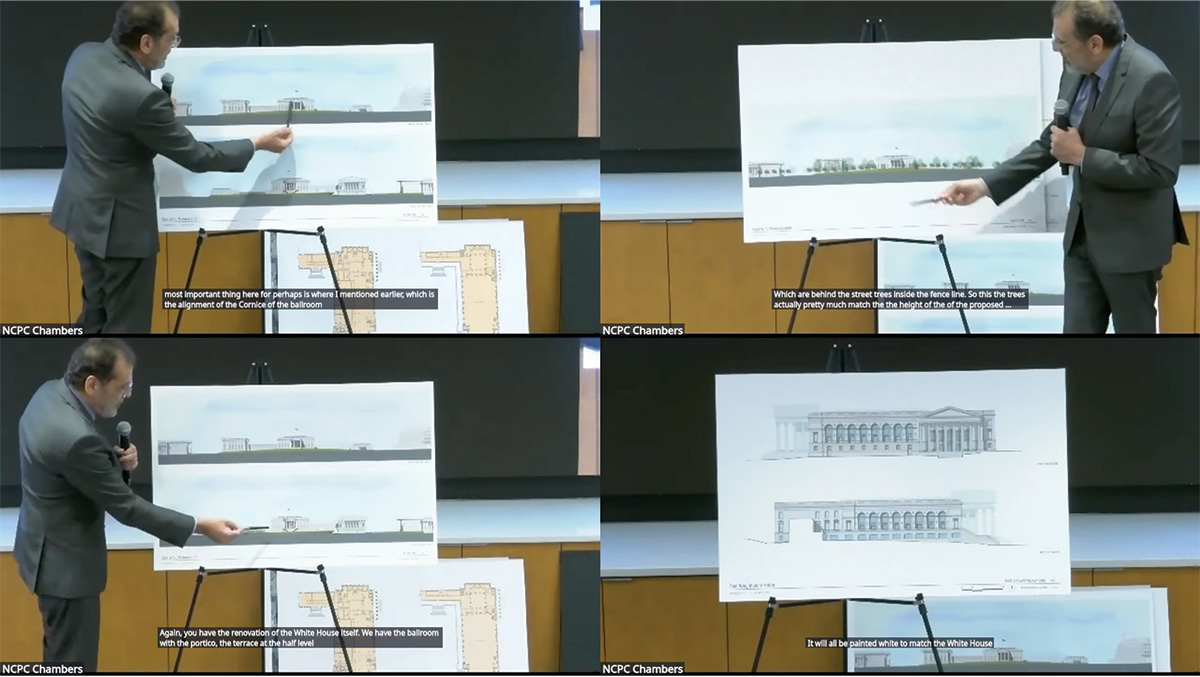
Architect Shalom Baranes presented drawings in a live-streamed NCPC meeting on January 8, 2026. Photo © National Capital Planning Commission
On January 8, 2026, the National Capital Planning Commission convened for a live-streamed “information presentation” on the East Wing Modernization project—a procedural courtesy requiring neither vote nor public testimony. The commission, one of two federal panels with design review authority over White House construction, included members appointed by the president. The discussion was orderly and civil. Following an introduction by White House official Joshua Fisher, Baranes presented plans for the 90,000-square-foot addition, declaring that the building would grow no larger. The program includes a 22,000-square-foot ballroom accommodating approximately 1,000 guests on the upper level, with a commercial kitchen, First Lady’s offices, and a movie theater below. The project was justified repeatedly through compliance with, for instance, Secret Service standards, accessibility requirements, life-safety codes, and as “resilient, adaptive infrastructure aligned with future mission needs.” The most revealing feature of the meeting was not disagreement but consensus. Commissioners asked about massing, materials, sightlines. Most praised the architect’s “good taste” and contextual sensitivity. Architecture was discussed exhaustively without ever being discussed as architecture. No one invoked concept, form, civic representation, or historical precedent. Procedure displaced discourse; compliance stood in for critique. Nobody asked how the ballroom will serve as “the powerful symbol of American democracy, leadership, and history.” Nobody asked why a 21st-century structure relies on 18th-century neoclassicism. It was the dog that didn’t bark.
Classical architecture operates through systematic relationships: the orders function not as ornamental types but as grammatical methods—proportional rules enabling elements to be reproduced, varied, recombined coherently. From Andrea Palladio to Claude Perrault and Jean-Nicolas-Louis Durand, classical elements were codified as a language system where meaning resided less in vocabulary than in grammatical operations. Classical architecture became modern precisely through this codification—the transformation of natural or divine laws into rational rules, a shift that fueled the 17th-century quarrel between ancients and moderns. The East Wing ballroom deploys classical vocabulary without classical grammar, elements as stylistic signifiers divorced from the language system that once gave them coherence.
In All That Is Solid Melts into Air, Marshall Berman defined modernity as perpetual transformation—living in what he called “the maelstrom of modern life,” where constant creative destruction promises rupture and becoming. The ballroom represents the opposite: stasis disguised as novelty. The project proceeds through substitution rather than transformation: it invokes history without historical understanding, deploys technology as compliance rather than innovation, stages ceremony as performance rather than civic ritual. Neither antimodern nor postmodern, the project embodies an a-modern condition in which historical consciousness has dissolved entirely. Evacuated of temporal depth, material integrity, and social purpose, architecture is condemned to the present tense—both semantically and ontologically. Modernity has become what it once promised to overcome: eternal return disguised as transformation.
This is not merely architecture’s predicament. The East Wing Modernization Project reveals an epistemological crisis today: it exists where neither classicism nor modernism retains critical content, where form operates as preference divorced from historical logic or material necessity. What Michel Foucault once described as a “critical ontology of ourselves” reappears not as critique but as administration—modernization reduced to compliance, upgrades, procedural maintenance. Between Roosevelt’s 1902 and Trump’s 2025 projects lies modernization’s full arc: emergence, maturation, evacuation. What once anchored transformation and progress now circulates as empty presentness, the word without its referent. Modernity has become a floating signifier.
Looking for a reprint of this article?
From high-res PDFs to custom plaques, order your copy today!
.webp?height=200&t=1765378565&width=200 "White House Ballroom Model")