Close Up
A Multifaceted Foundation Uses Timber to Turn a Former Metalworks into an Experimental Outpost in Madrid
Madrid

Created in 2010, the Paris-based Fondation Daniel & Nina Carasso champions both sustainable food production and “art and culture as forces of citizenship and collective emancipation.” This unusual combination reflects the couple’s individual passions: Nina (1921–2007) was a keen art collector, while Daniel (1905–2009) developed the food-and-beverage giant Danone, founded by his father, Isaac, in Barcelona in 1919. In honor of Carasso’s Iberian connections, the foundation has a branch in Madrid that, last December, opened a new center in the Delicias neighborhood of the Spanish capital. Baptized Infinito Delicias, this mixed-program venue—a cooking and art hub with a restaurant and coworking spaces—is the result of an ambitious adaptive-reuse scheme by a duo of Madrid-based architecture offices, Husos (founded by Colombians Diego Barajas Castillo and Camilo García Barona) and Elii (headed by Spaniards Eva Gil Lopesino, Uriel Fogué Herreros, and Carlos Palacios Rodríguez). Among the project’s multiple aspirations, reducing the center’s carbon footprint to a minimum was a driving design objective.
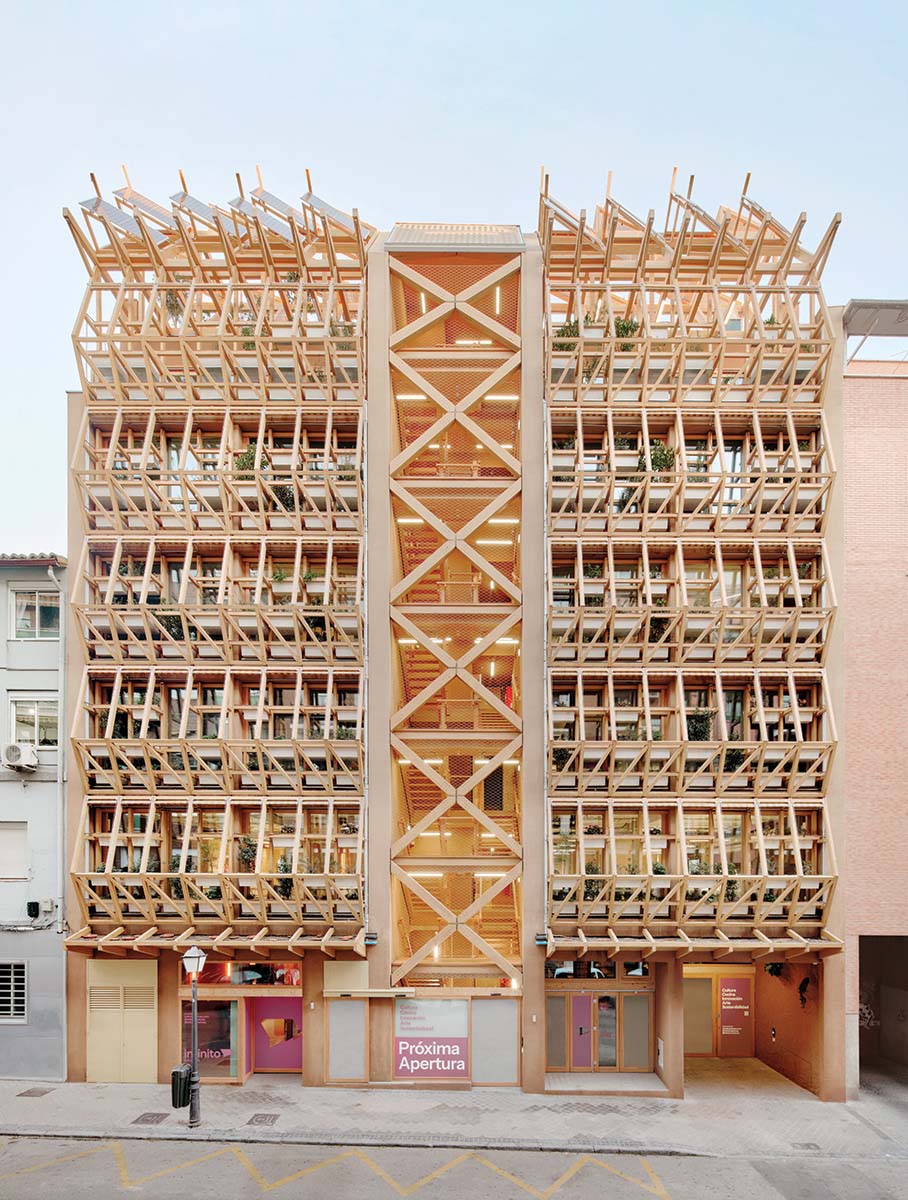
1
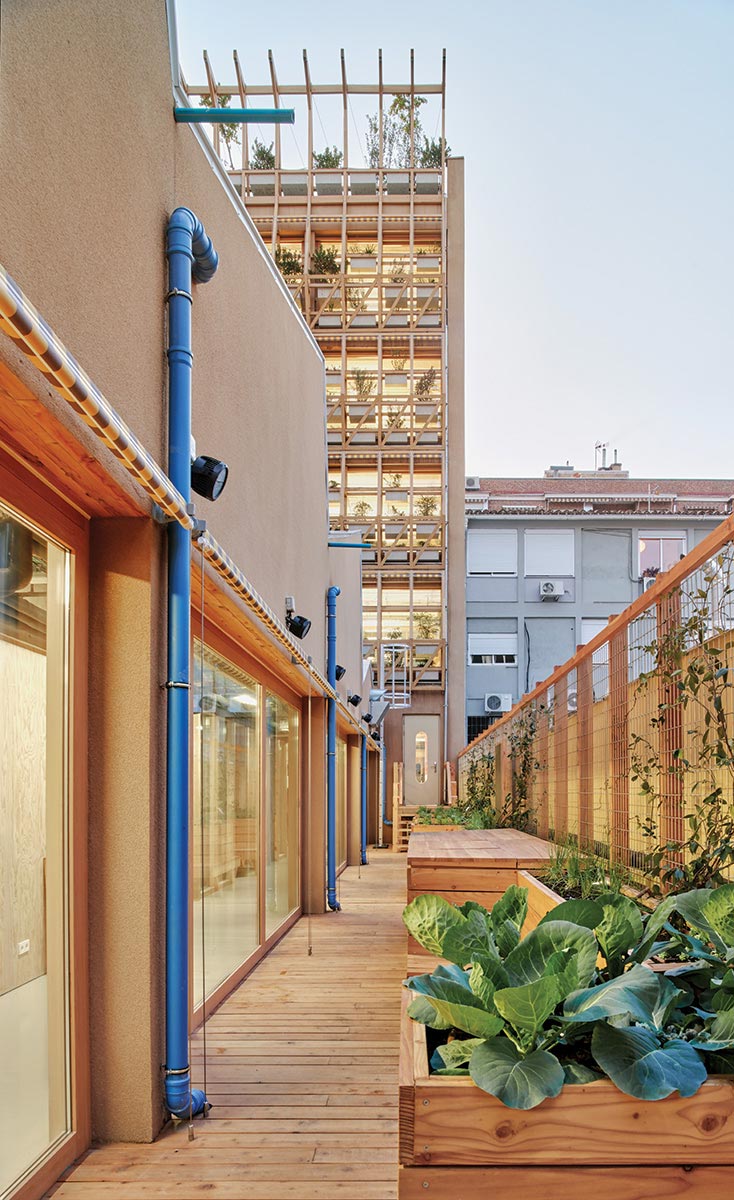
2
Exposed timber framing, on the street-facing elevation (1) and the rear one (2), reinforces the original building. Photo © José Hevia, click to enlarge.
“It wasn’t an architectural contest,” says Barajas of the Fondation Carasso’s 2018 selection process, “since there was no site. Instead, the foundation asked us to investigate feasibility and develop a methodology, a program, a business model, and a team-building proposal.” In partnership with the Madrid-based design consultancy Ultrazul, Husos and Elii prevailed against the likes of Pritzker Prize–winner RCR Arquitectes and Deloitte. Two years and nine volumes of research later, the architects were ready to seek a suitable building, one of their recommendations being that the foundation reduce its CO2 emissions by converting an existing structure. The property they identified—a 1965 metalworks by Enrique Simonet Castro—offered the ideal spatial mix, with a six-story office block on the street and sawtooth-roofed workshops at the rear. Located between central Madrid and the working-class south, the formerly industrial Delicias is undergoing rapid change—indeed, when Husos and Elii found it, the metalworks had just been bought by a housing developer who planned to demolish it. After the foundation negotiated the building’s purchase, conversion began in 2023.
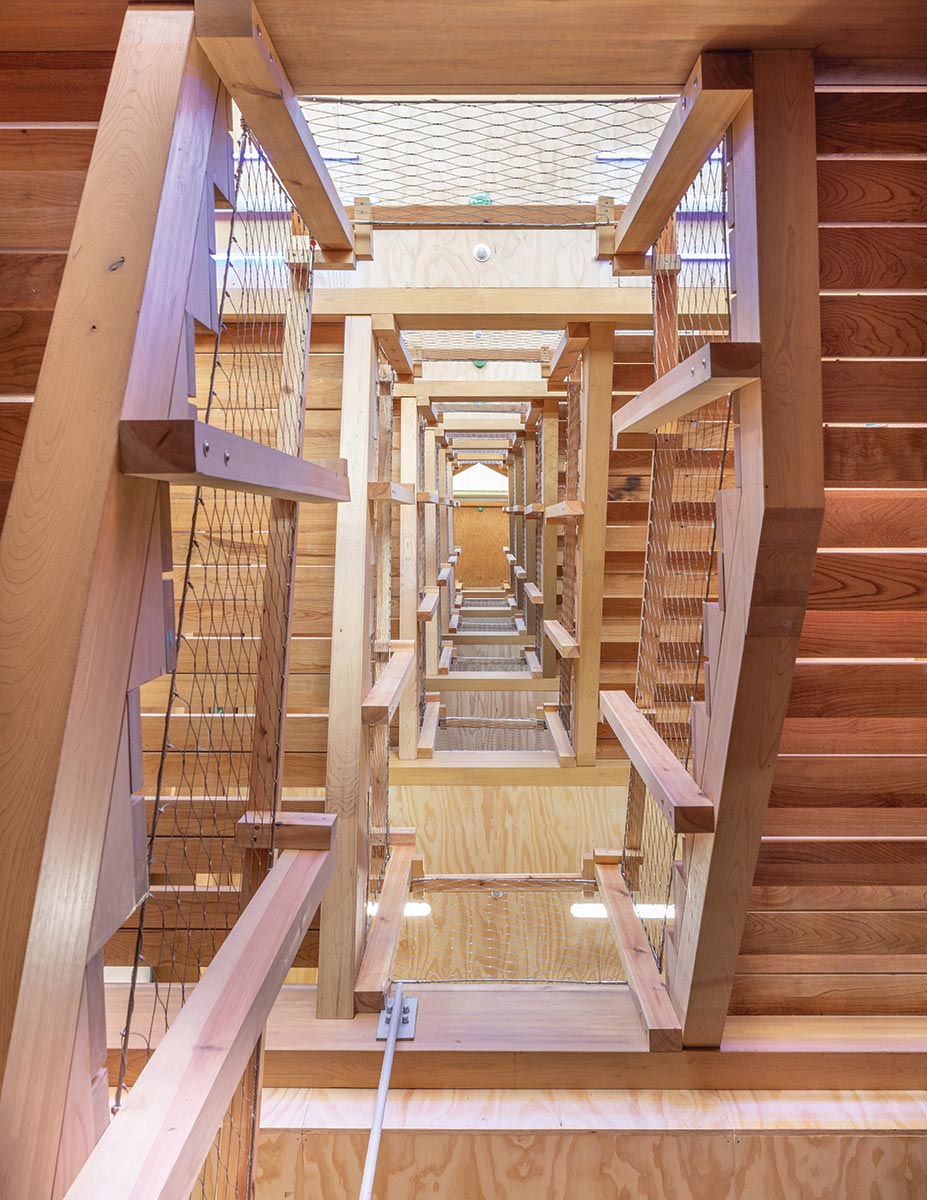
An original staircase was demolished and rebuilt in wood. Photo © Impresiones Cotidianas
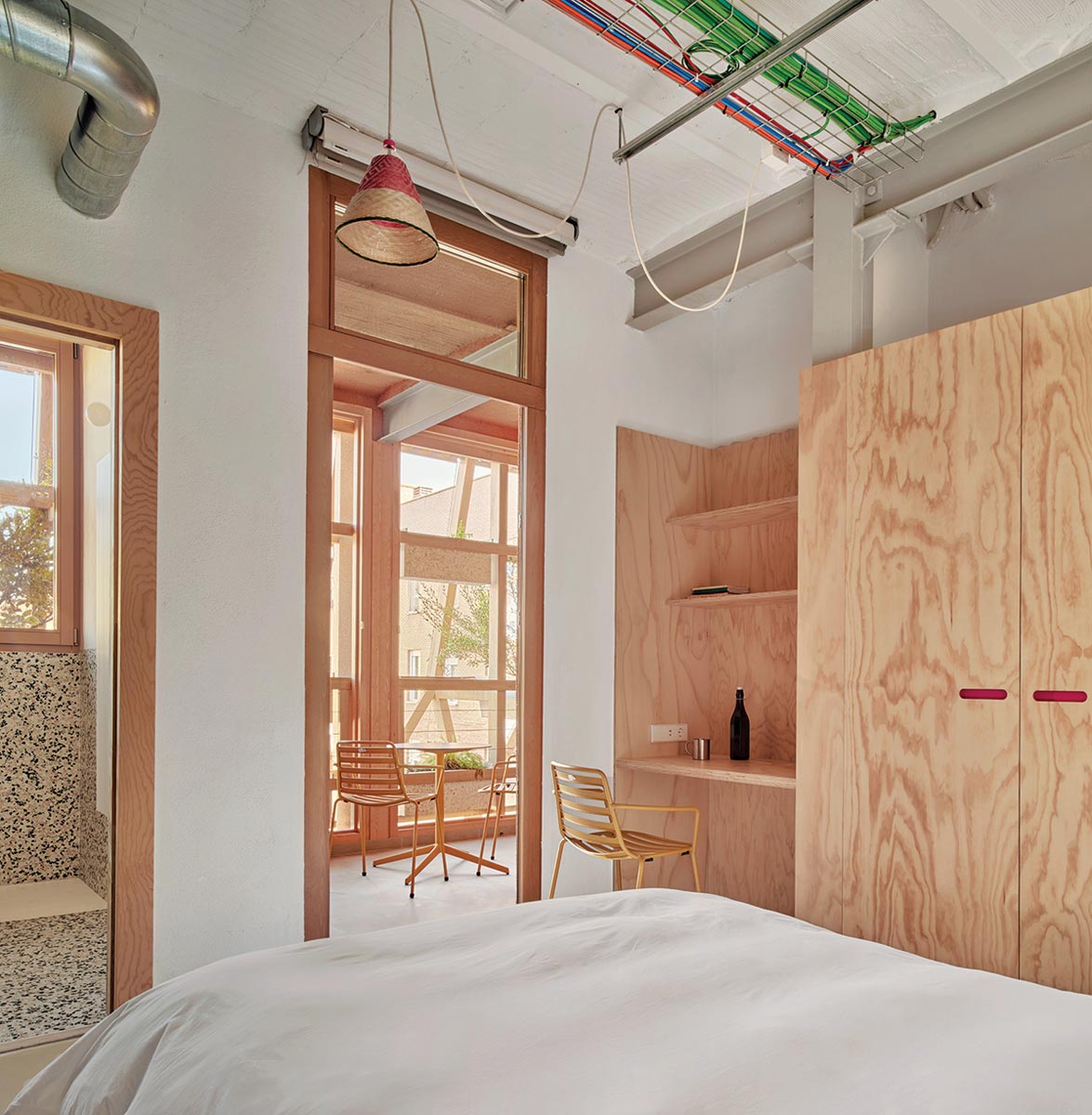
Apartments are in the tower. Photo © José Hevia
The architects’ first task was to reinforce the rather shoddily built steel-and-brick structure and connect the workshops to the office block, which involved demolishing the original stair and elevator shaft. Wherever possible, they used chestnut beams and trusses to do this, sourced from sustainably managed forests in northern Spain. The result is immediately visible in the entrance facade, where hefty timber members cross-brace the central stair shaft, which has been left open to the air to satisfy fire regulations. Zigzagging up the building on either side, a self-supporting chestnut-framed “thermal cushion” is fitted with blinds and planters, the latter filled with perennials that reduce the effects of summer heat while allowing the sun through after winter dieback. “Timber has become the building’s visual identity,” says Fogué, “though its use was a purely technical decision, because its environmental toll is less than steel’s.”
Wood is also very present inside, where the eclectic program includes a kitchen and restaurant for budding eco-chefs to test their concepts; another kitchen for TV and online broadcasting; an auditorium; multipurpose spaces for exhibitions, performances, and workshops; accommodation and a studio for artists in residence; and offices for the foundation and kindred organizations to which it leases space. This disparate population can mix in the plant-filled main atrium, a large unprogrammed area spilling out from beneath the office block into the first three bays of the workshops. Accessed from the former vehicle ramp in the street, the atrium is intended for community-building, connecting Infinito Delicias to the neighborhood and marking the beginning of a U-shaped circuit that the architects call “the ring,” which links the street to the rear patio. In addition to the greenery on the office-block facades, plants cover the rebuilt sawtooth roof, helping its solar panels work better through their cooling effect, while insect hotels and birdbaths attract nonhuman neighbors. On the northern arm of the ring (an outdoor walkway), vegetable planters supply produce for the kitchens.
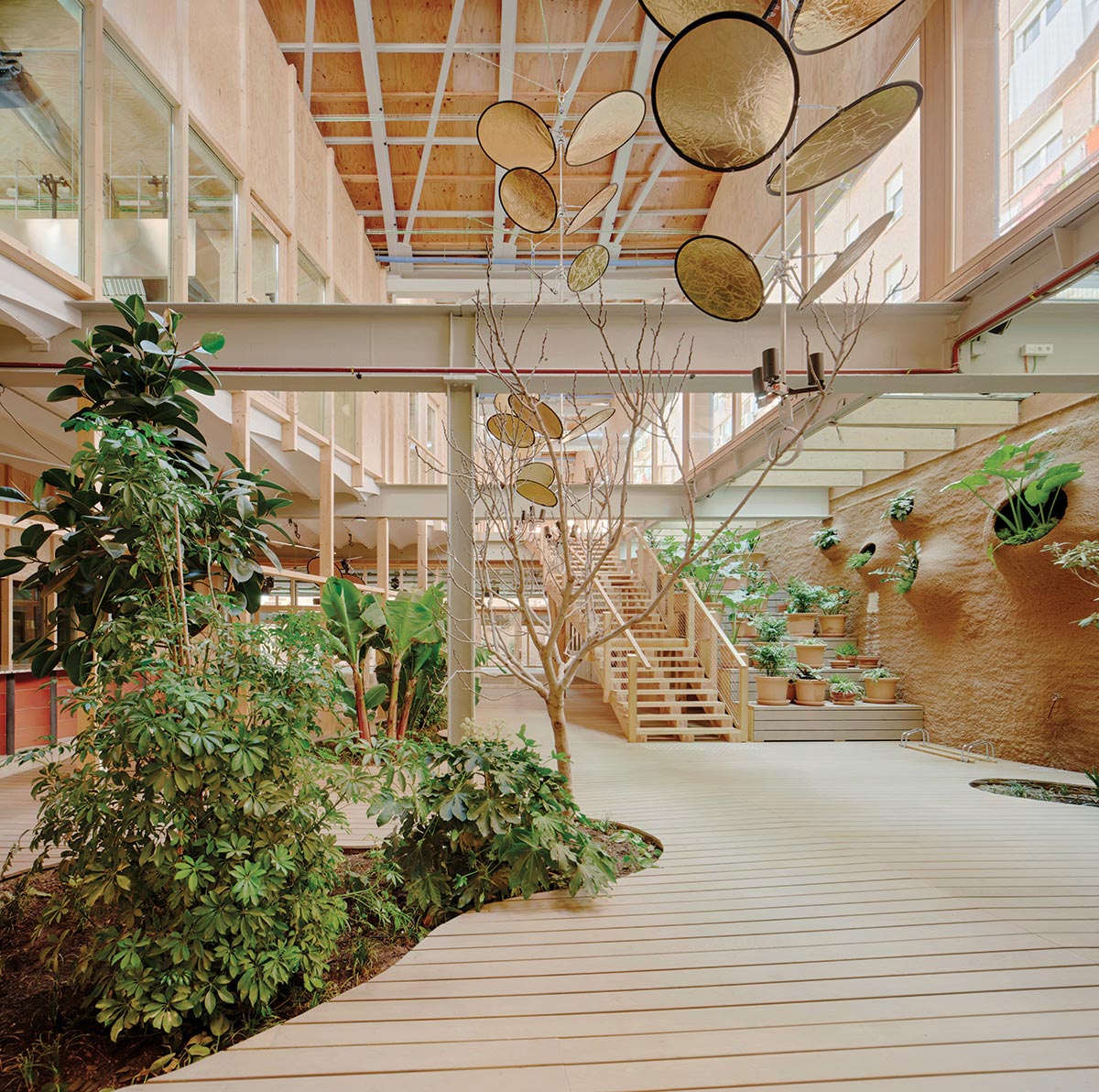
3
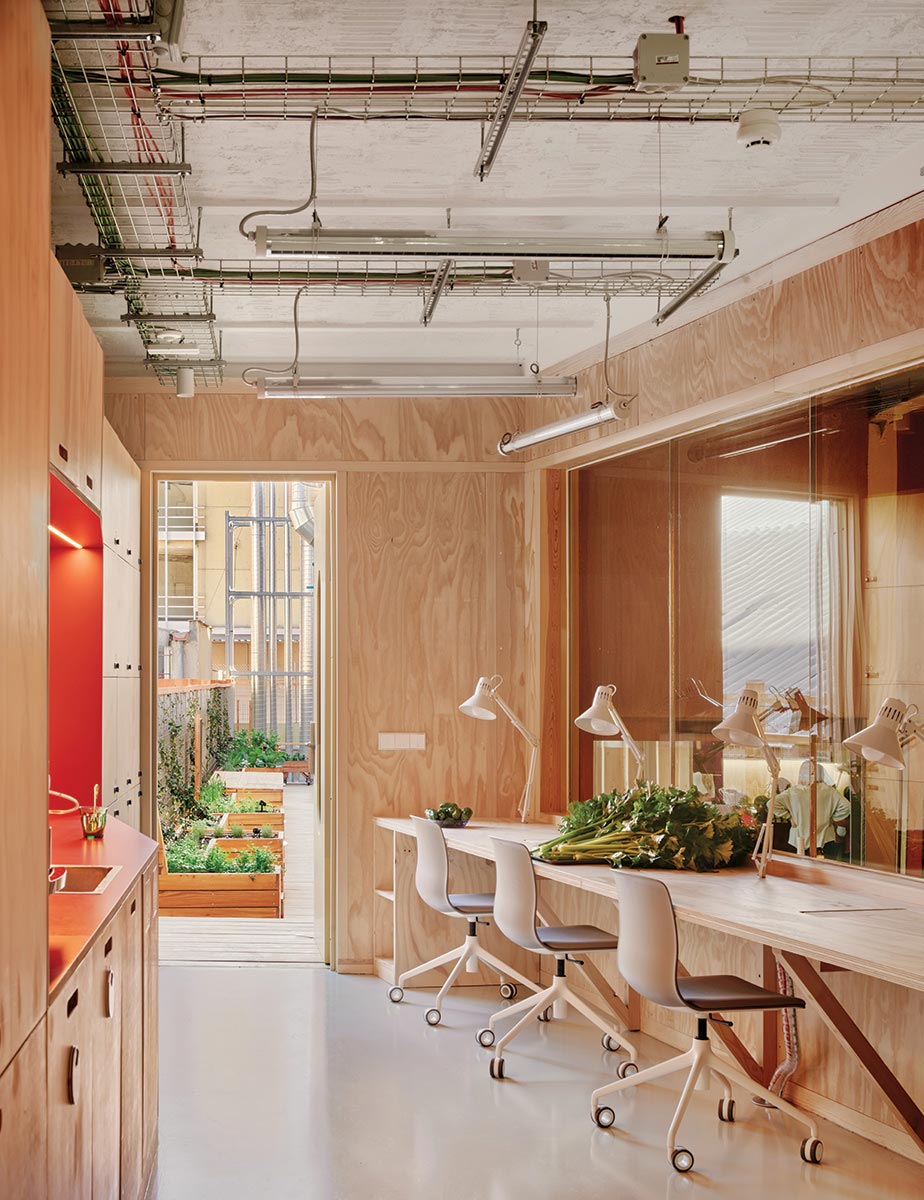
Spaces for different uses dot the building: socializing (3), food (4), and desk work (5). Photos © José Hevia
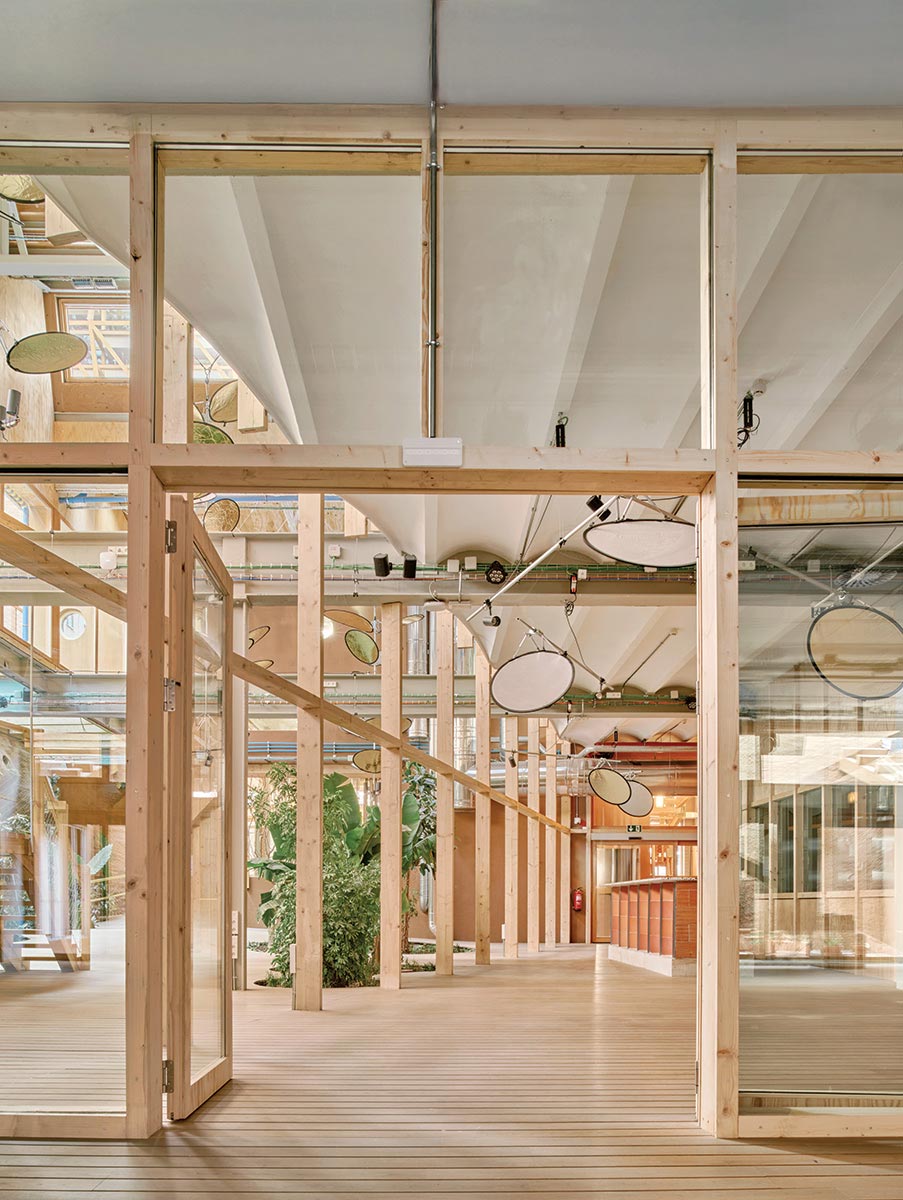
4
5
Alongside the bioclimatic systems, geothermal and heat pump technologies regulate the interior temperature, while air change is ensured mechanically, but only because code requires it (as far as the architects are concerned, natural ventilation would suffice). Though largely steered by technical concerns, “aesthetics were fundamental” to the project says García. “It had to show that environmentally driven design can be welcoming and seductive.” For Fogué, this meant exploring “the sexiness of roughness,” with no extraneous finishes except when acoustics required them. Everywhere else, structure, ducting, wiring, wood grain, and cork-spray insulation all remain exposed. In the Spanish context, this did not come cheap—$13.7 million for 29,930 square feet, including furniture that the architects either specified or designed themselves (except in the restaurant and atrium, for which local design star Lucas Muñoz Muñoz created bespoke pieces). Rather than cost reductions, the foundation sought exemplarity, proposing “a vision of how to do things differently,” explains García. To this end, it will monitor the building’s environmental performance over the coming years.
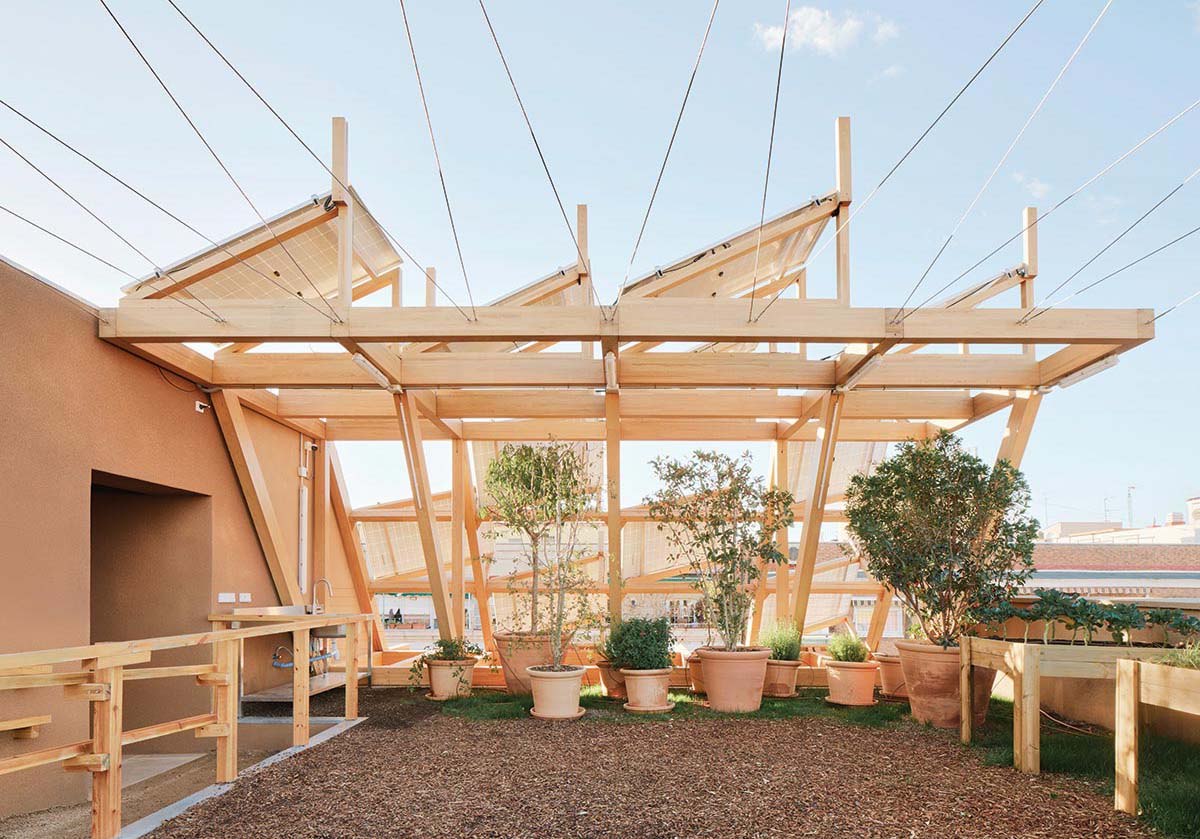
The frame creates a pergola on the roof. Photo © José Hevia
One of the fundamental ways the foundation did things differently was by involving the architects right from the start (a tactic it no doubt learned from its home city’s Réinventer Paris program, which solicited innovative ideas for redeveloping challenging sites). Back in the 1970s, Ove Arup coined the term “total design” to describe how the Centre Pompidou’s creators invented everything from structural components down to doorknobs. Here the idea takes on a far wider meaning: rather than responding to a predetermined program, the architects were instrumental in drawing up the brief, as well as in selecting the site and developing the project’s sociocultural ecosystem. In other words, Infinito Delicias was an exercise in world-building.
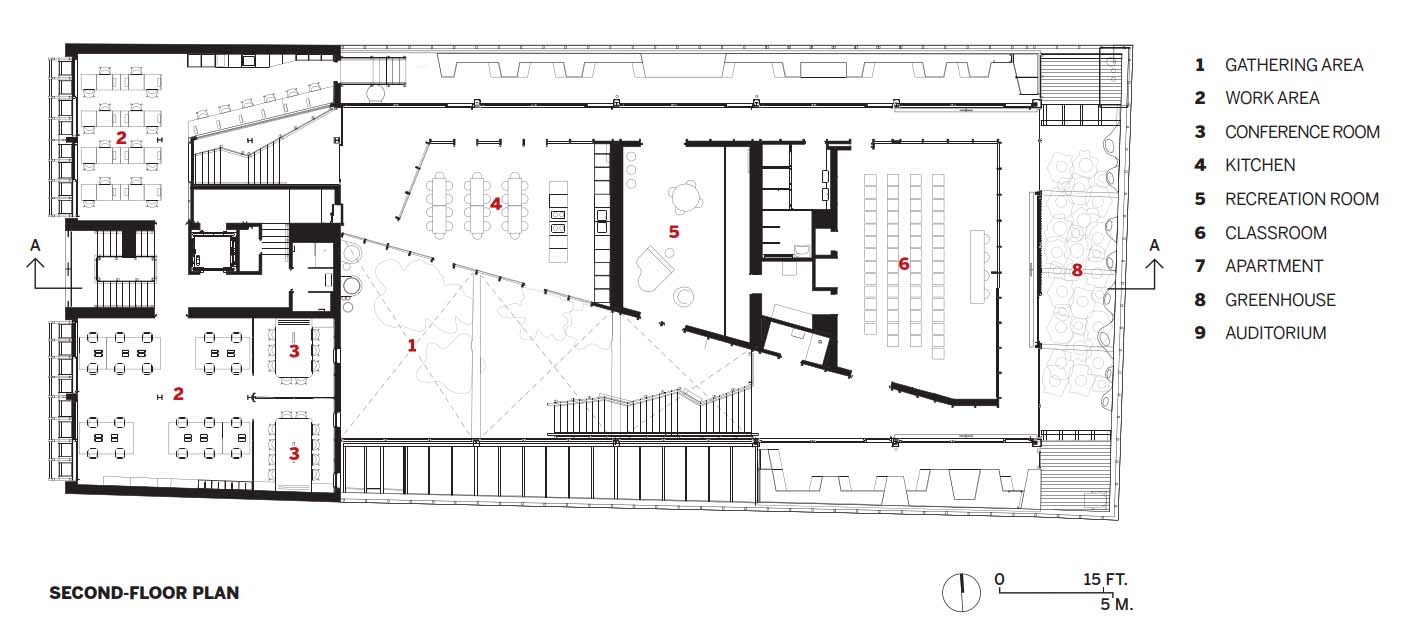
Image courtesy Husos, Elii
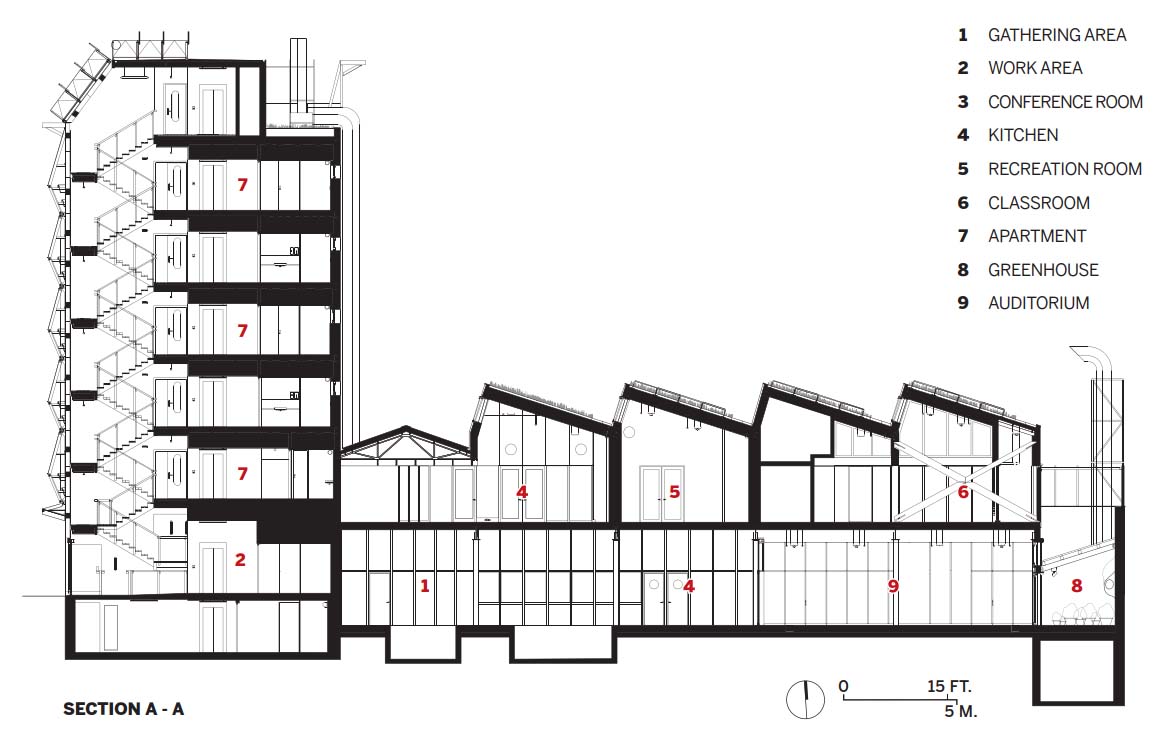
Image courtesy Husos, Elii
Credits
Architects:
Husos, Elii
Engineers:
Socotec, Aiguasol (structural)
Consultants:
Heliconia, Tierra (agronomy); Azul Telecom, Fluge (AV)
General Contractor:
Fermín Montequín
Client:
Fundación Daniel & Nina Carasso
Size:
29,930 square feet
Cost:
$13.7 million (construction)
Completion:
October 2025
Sources
Cladding:
Siero Lam, Carpinterías Benito, Albura Estudio (timber); Bandalux (screens)
Glazing:
Velux (skylights)
Hardware:
Saltos
Conveyance:
Schindler
Interior Finishes:
Mateca, Echojazz (ceilings); Barnacork (wallcoverings); Weberfloor, Mateca, Mosaic factory (flooring)
Lighting:
Philips, Lucas Muñoz Muñoz, Faro
Looking for quick answers on architecture and design topics?
Try Ask RECORD, our new smart AI search tool.
Ask RECORD →
Looking for a reprint of this article?
From high-res PDFs to custom plaques, order your copy today!