Tall Buildings 2026
Bermúdez Arquitectos Builds a Vertical Campus in Central Bogotá
Bogotá, Colombia

Architects & Firms
“It looks like an alien walking around the city,” says Ramón Bermúdez, partner at Bermúdez Arquitectos in Bogotá, Colombia. But, rather than wreaking havoc, as in a giant-monster movie, the 16-story educational building that seems to have landed in the center of the sprawling South American metropolis is a result of its rapid growth and may offer a glimpse of more urban development to come.
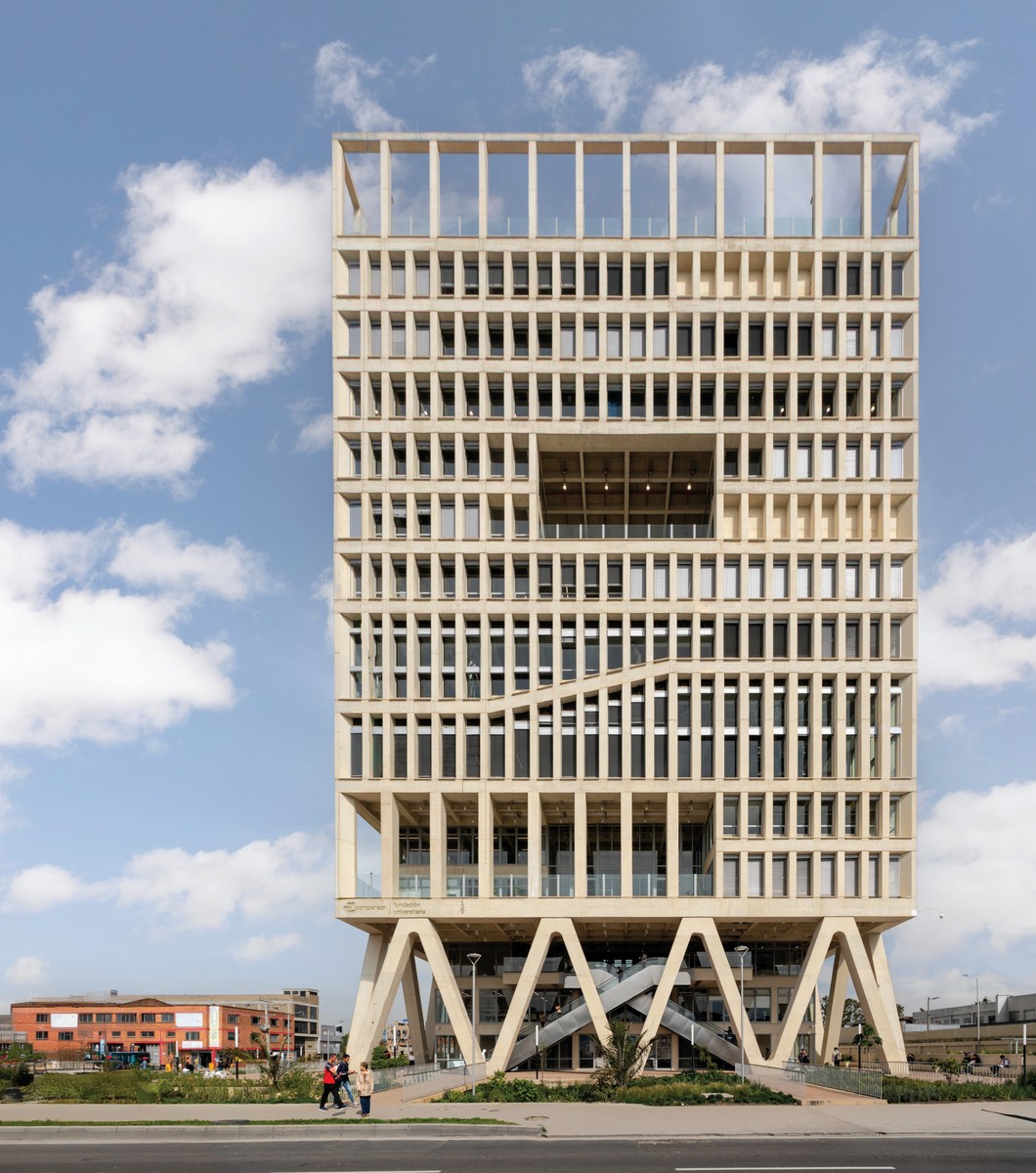
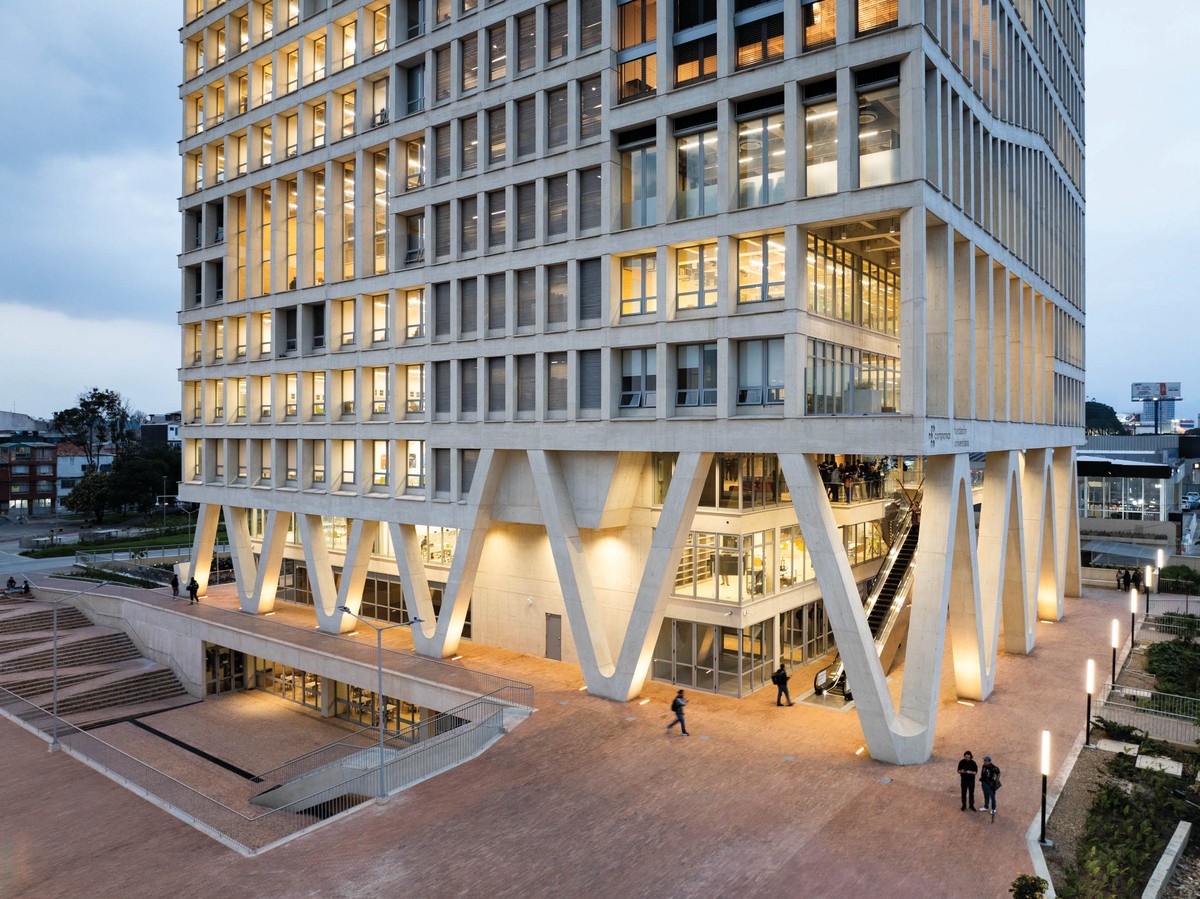
The 16-story vertical campus stands out among Bogotá’s low-lying buildings (above and top of page). Photo © Jairo Llano, click to enlarge.
The Colombian capital has rocketed from approximately 6 million residents at the turn of the millennium to just under 12 million today. Projections suggest further but tapering growth over the next few decades driven largely by internal migration from the countryside. This rise in population, coupled with Bogotá’s uniquely constrained geography—nearly 9,000 feet above sea level on a plateau in the Andes Mountains—has led to its being one of the densest cities in the Americas. Apart from a cluster of towers downtown, this urban density has taken the form of mostly low-lying development.
In 2013, Bermúdez Arquitectos—a family business founded by Daniel Bermúdez, the father of Ramón and his younger architect and landscape architect brothers—won a private competition to design the new vertical campus for Fundación Universitaria Compensar. This is the third location for the post-secondary school, which is a public-private institution that prioritizes technical training and certifications. Located on a major thoroughfare near Simón Bolívar Park, Bogotá’s “Central Park,” the tower was only possible because of changes in zoning ordinances implemented by the mayor, anticipating the need to densify the urban fabric. However, the project was delayed for six years while these laws were contested and adjudicated in court. The resolution of the case ultimately led to the tower’s needing to be redesigned in 2019 to fit within revised setbacks before construction could begin in 2022.
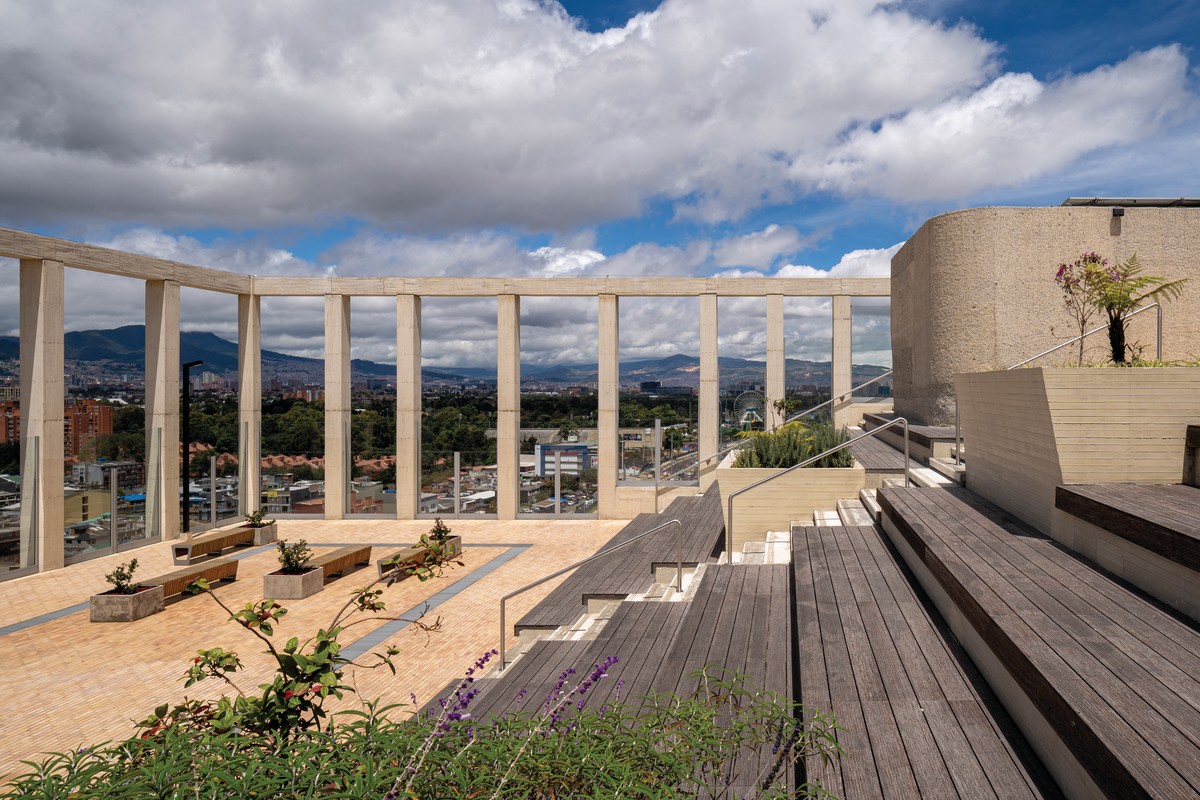
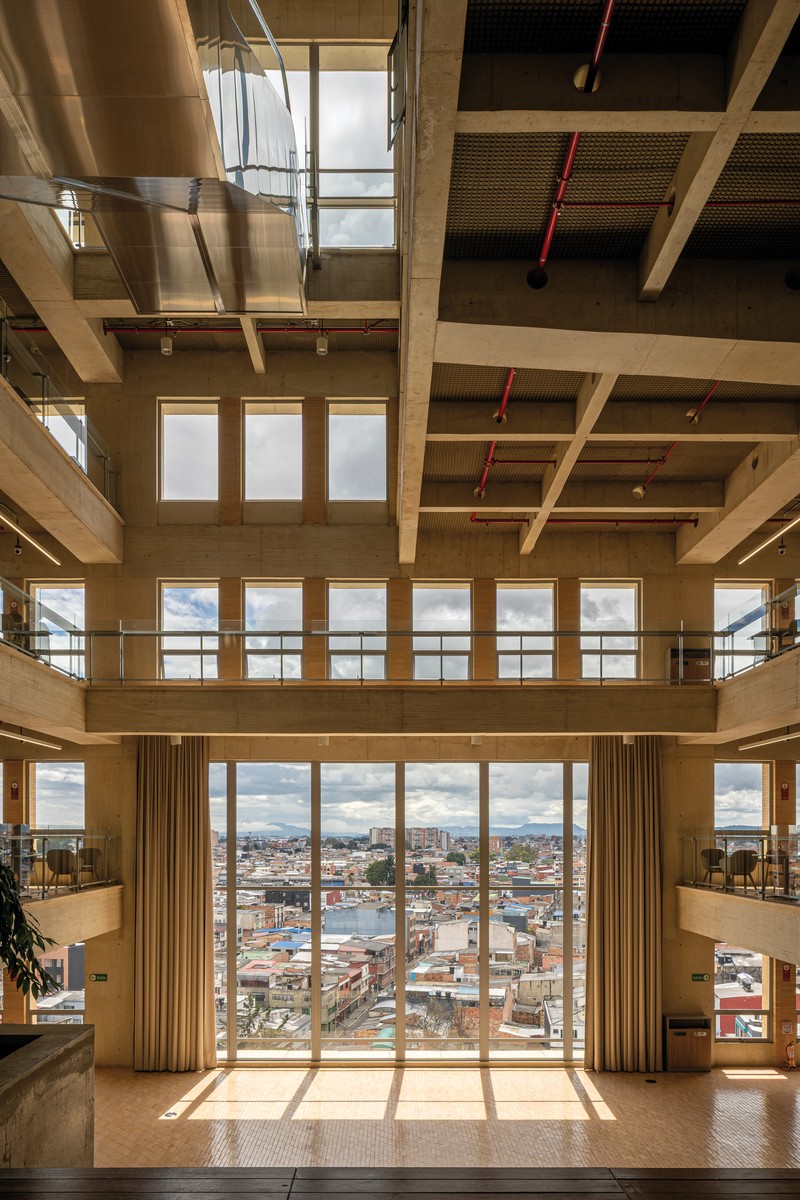
The roof terrace offers panoramic views. Photo © Bé Estudio
Both the original proposal and what would eventually be built seem to hark back to midcentury-modern sensibilities. The design prioritized the composition of an ordered facade rhythm, where programmatic elements inside are evident on the exterior, as well as concerns for how the heft of the structure meets the ground and engages the sky. “It’s quite a rational building,” Ramón explains, “with just a few architectural gestures that work within the program.” V-shaped columns around the base—like the many legs of an alien creature—leave the corners cantilevered, either making the mass feel weightless or as if it might rampage through the city. Although constructed almost entirely out of rough cast-in-place concrete, the béton brut isn’t reviving brutalism for the sake of style but responding to local constraints. “When constructing in Colombia,” explains Ramón, “you have to be very specific about what the conditions you have to build with are, the materials available to you, and the knowledge of how to build with them.”
1
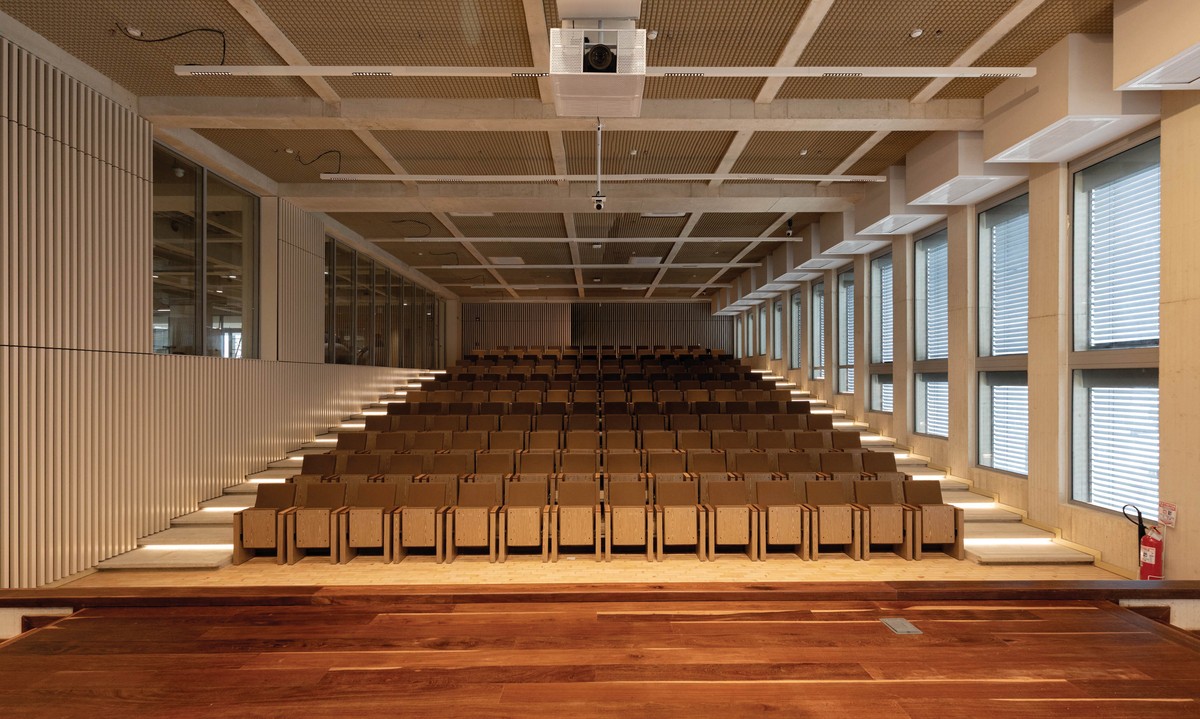
Acoustic paneling on the walls and soffits mitigates echoes in mostly cast-in- place concrete spaces (1 & 2). Photos © Jairo Llano (1), Bé Estudio (2)
2
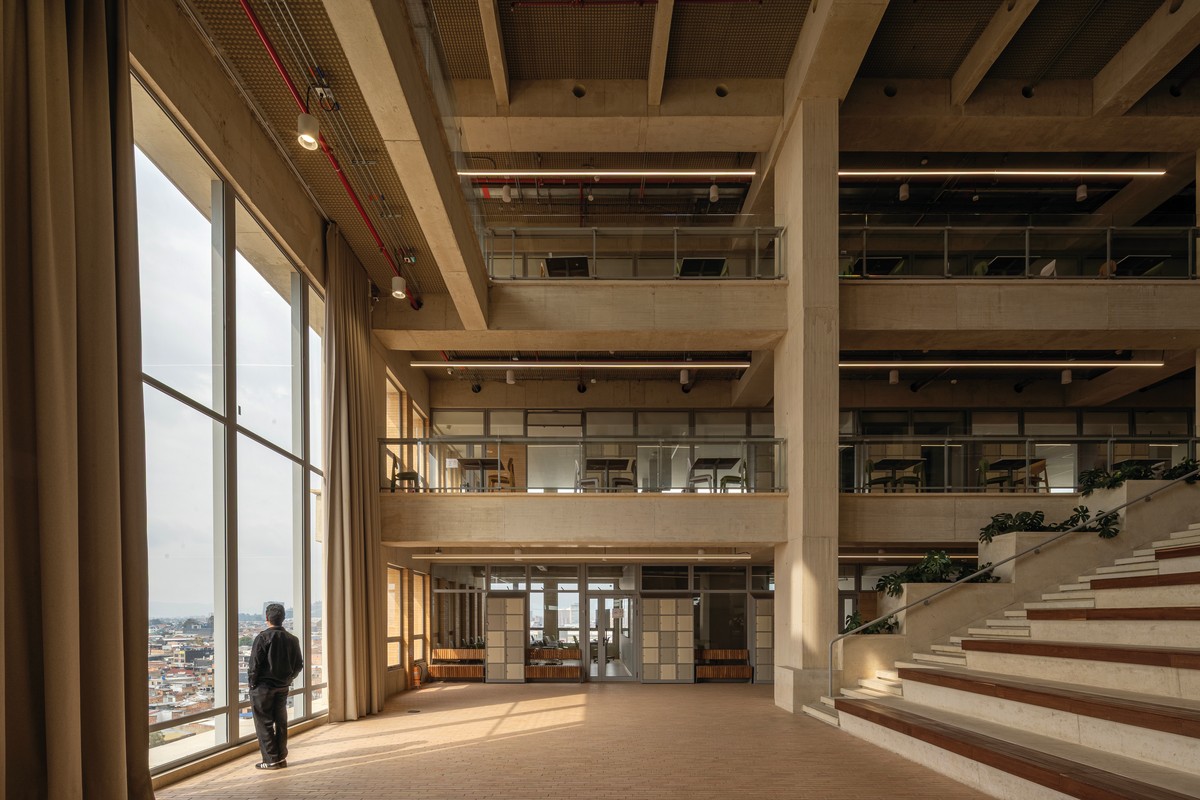
Vertical campuses aren’t common in Colombia, so Bermúdez Arquitectos looked to KPF’s 14-story William and Anita Newman building at Baruch College in New York City. Like the KPF structure, Compensar organizes classrooms, laboratories, lecture halls, and administrative offices around a soaring atrium that acts as a university commons. Unlike its precedent, local fire codes allow the atrium to run through the full height of the structure. As a commuter school, an important part of the Compensar program was to foster a sense of community, so this stair-filled “vertical promenade,” as Ramón calls it, is punctuated by lobbies, outdoor terraces, and flexible spaces where students are encouraged to spend time studying, eating, and connecting with classmates. This stack of public spaces culminates in a rooftop that offers panoramic views of the city and the surrounding mountains. The building has a capacity of 4,300 students and faculty combined, and “the idea is to provide places for them to all be there and to stay,” says Ramón.
3
A sunken plaza (3) and stadium seating lined in local flor morado wood in the building’s continuous atrium (4) provide students with flexible public spaces. Photos © Jairo Llano (3), Bé Estudio (4)
4
The structure is mostly unconditioned. Bogotá’s high altitude competes against its near-equatorial latitude to produce a tierra fría climate, a brisk perpetual autumn with mild humid days and cool nights. While some mechanical air handling is required for laboratories, where students might be learning to work with toxic chemicals, for much of the building, the atrium acts as a thermal chimney, allowing heat to rise and escape through the roof while drawing in cooler fresh air at the base. Operable windows and shades are enough to maintain comfortable temperatures in classrooms and offices. Even the bathrooms are naturally ventilated, with louvers rather than windows regulating airflow.
Bogotá’s Andean geography also comes with intense seismic activity. Since every floor is different, with unique configurations of rooms and public spaces fitting around the atrium on each level, the earthquake-resistant strategy relies on a balance of stiffness and ductility. Two vertical cores withstand lateral forces, while the concrete envelope acts as a rigid structural cage.
Looking for quick answers on architecture and design topics?
Try Ask RECORD, our new smart AI search tool.
Ask RECORD →
Just as the city is planning for continued growth, the design of the tower accommodates the school’s further expansion. On the west facade, the vertical members between each floor are made of a yellow brick that will be easier to deinstall than the uniform concrete elsewhere. The V-shaped columns at the base are abruptly cropped. These anticipate a second phase that is planned to begin construction in 2029 and will increase the capacity to approximately 6,600 students and faculty.
For now, Compensar is the only tall building in the area, but it is unlikely to be the last. “If the city continues to grow and to be more prosperous,” Ramón says, “more buildings of this size will reshape the urban profile.”
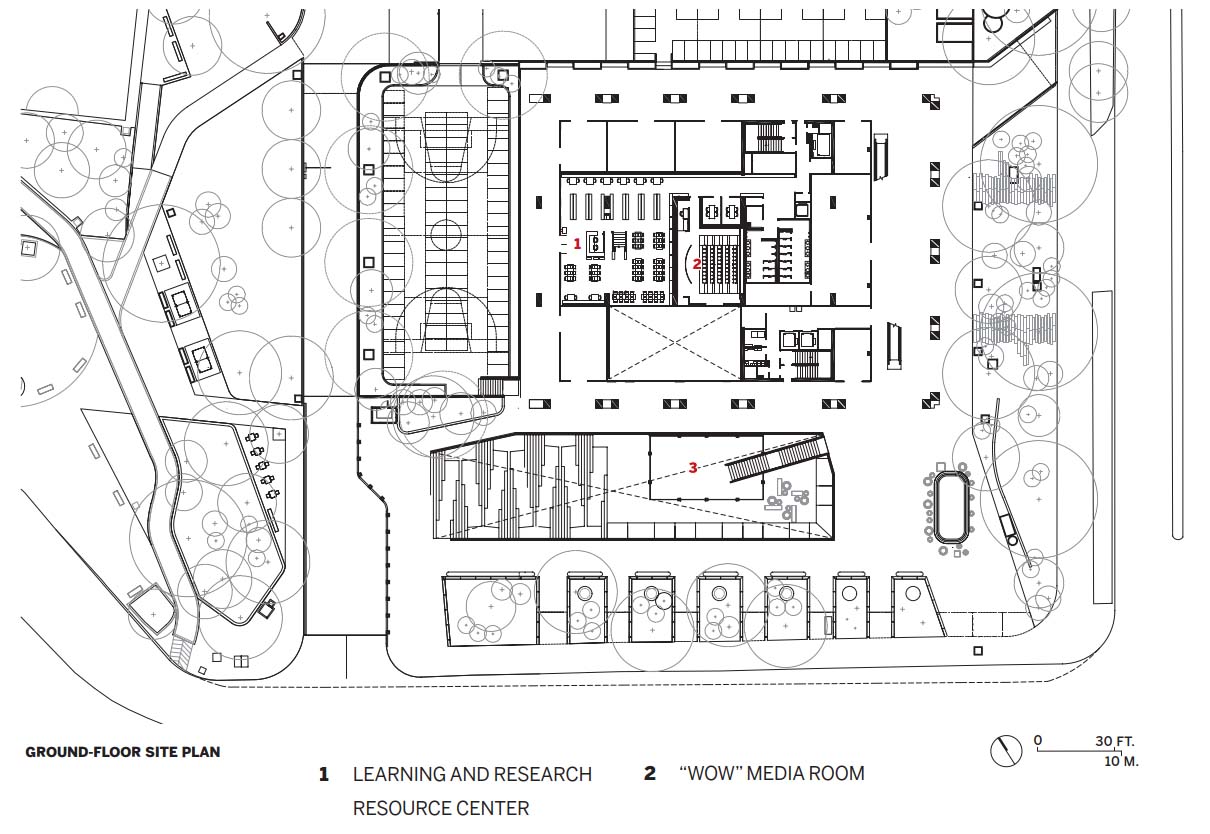
Image courtesy Bermúdez Arquitectos
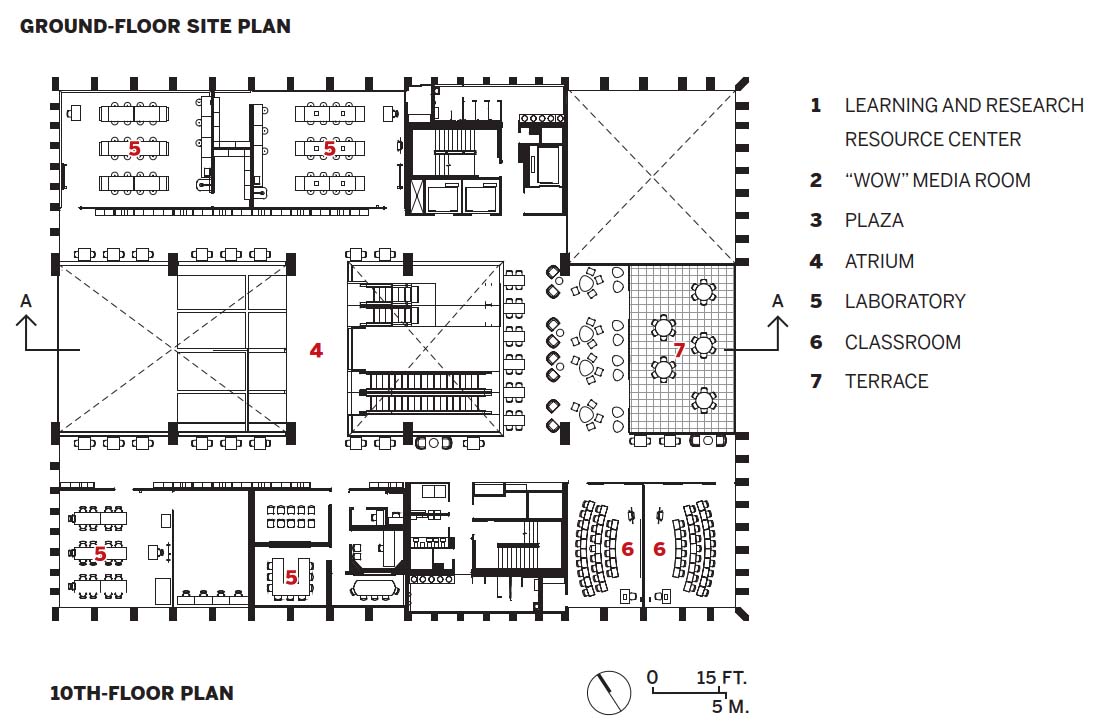
Image courtesy Bermúdez Arquitectos
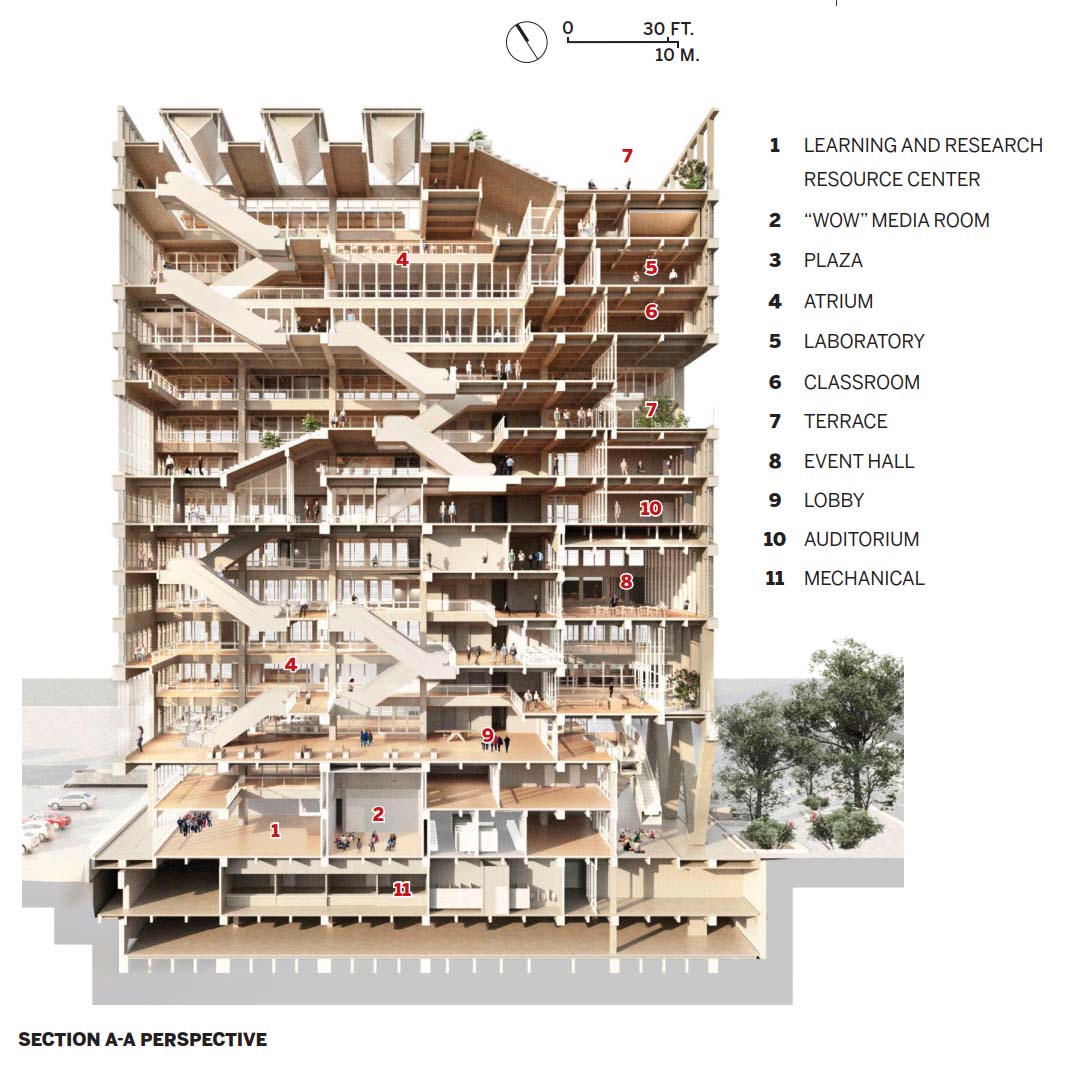
Image courtesy Bermúdez Arquitectos
Credits
Architect:
Bermúdez Arquitectos
Engineers:
Aycardi Estructural (structural); E y R Servicios Geotécnicos (geotechnical); A Gamboa Ingeniería (mechanical); Plinco (plumbing); Semger (electrical)
Consultants:
Payc (cost and scheduling); Abacus (renewable energy); Miguel Sánchez Alferez (topography)
General Contractor:
Constructora Obreval
Client:
Fundación Universitaria Compensar
Size:
318,500 square feet
Cost:
Withheld
Completion:
June 2025
Sources
Masonry:
Ladrigres, DS Soluciones, Zamora Martinez, Hunter Douglas de Colombia
Custom Woodwork:
Dimalcco
Looking for a reprint of this article?
From high-res PDFs to custom plaques, order your copy today!