Tall Buildings 2026
On a Complex Site in Boston, Sasaki Reimagines the Seaport District's Tower Typology
Boston

Architects & Firms
Not so long ago, Boston’s Seaport District was an expanse of abandoned warehouses, surface parking lots, and crumbling piers. Now the once desolate landscape has been replaced by a neighborhood of shiny office buildings and glittering apartment towers. But there is a predictability to this development, at least according to some critics. Typical Seaport buildings, they say, have a sameness about them: they tend to have podiums that extend all the way out to the property line and then, to maximize leasable square footage, unimaginatively extrude straight up.
The developer Boston Global Investors (BGI) and Sasaki, its architect, sought to do something different with 10 World Trade, a recently completed 600,000-square-foot, 17-story commercial lab and office building. It sits on an oddly shaped 1.1-acre parcel circumscribed by an interstate exit ramp, Congress Street (a major traffic artery running from the Financial District to South Boston), and World Trade Center Avenue (a viaduct elevated 26 feet above grade). “There is a lot going on here,” says Victor Vizgaitis, Sasaki’s principal in charge. “But the complexities gave us reason to be creative.”
The footprint of the resulting 252-foot-tall building—the maximum height allowed due to the proximity of Logan International Airport—pulls away from the site’s edges at the ground. Within the structure’s convex and angled glass facades, each successive floor plate is slightly larger than the one below it, producing a flared, sculptural tower without an apparent back or front.
The goal, however, was not to create a building that would be merely different or eye-catching. The idea was to give some of the site to the public realm—a requirement of the 2018 RFP from the land’s owner, the Massachusetts Port Authority. The RFP also included a stipulation that the project provide a way for pedestrians to ascend from Congress Street to World Trade Center Avenue, and that this route be accessible 24/7. BGI wanted to consider these demands “holistically,” says John Hynes IV, the company’s vice president. “We didn’t think of them as just boxes to check.”
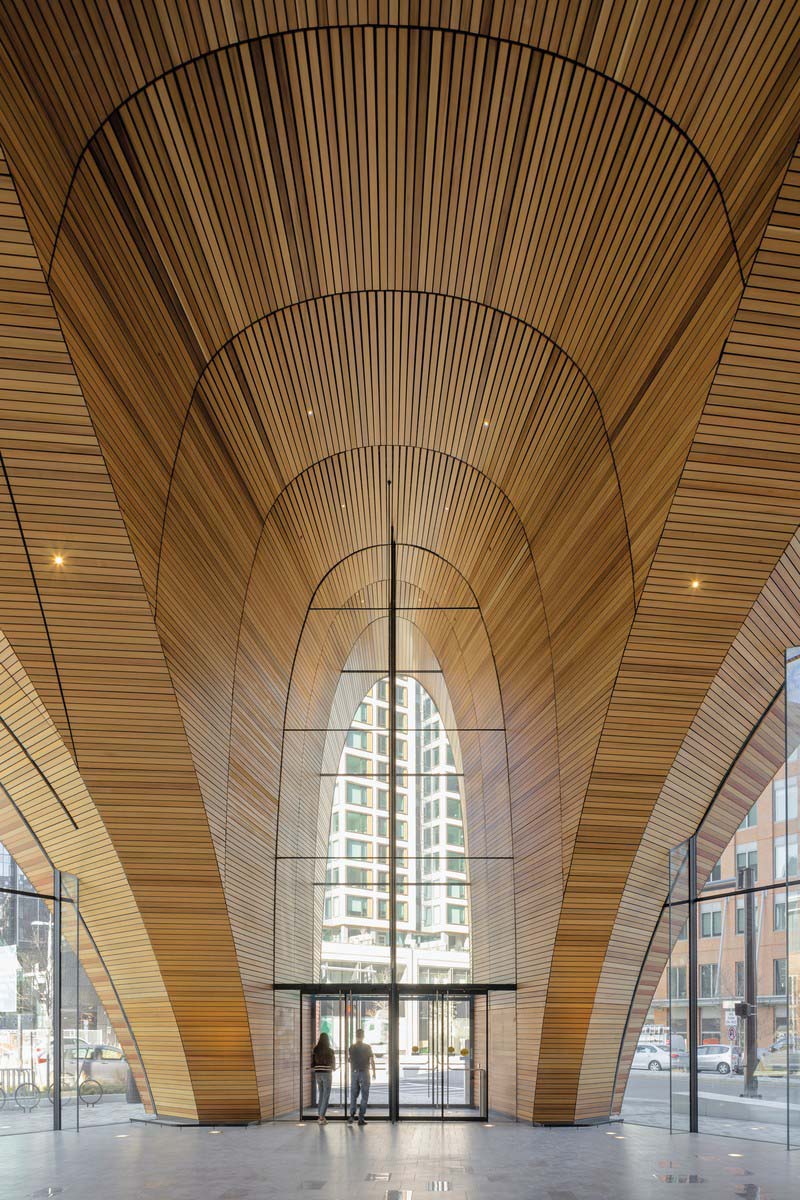
Steel-trussed arches are concealed behind the great hall’s curved western red cedar–clad acoustical ceiling. Photo © Michael Grimm, click to enlarge.
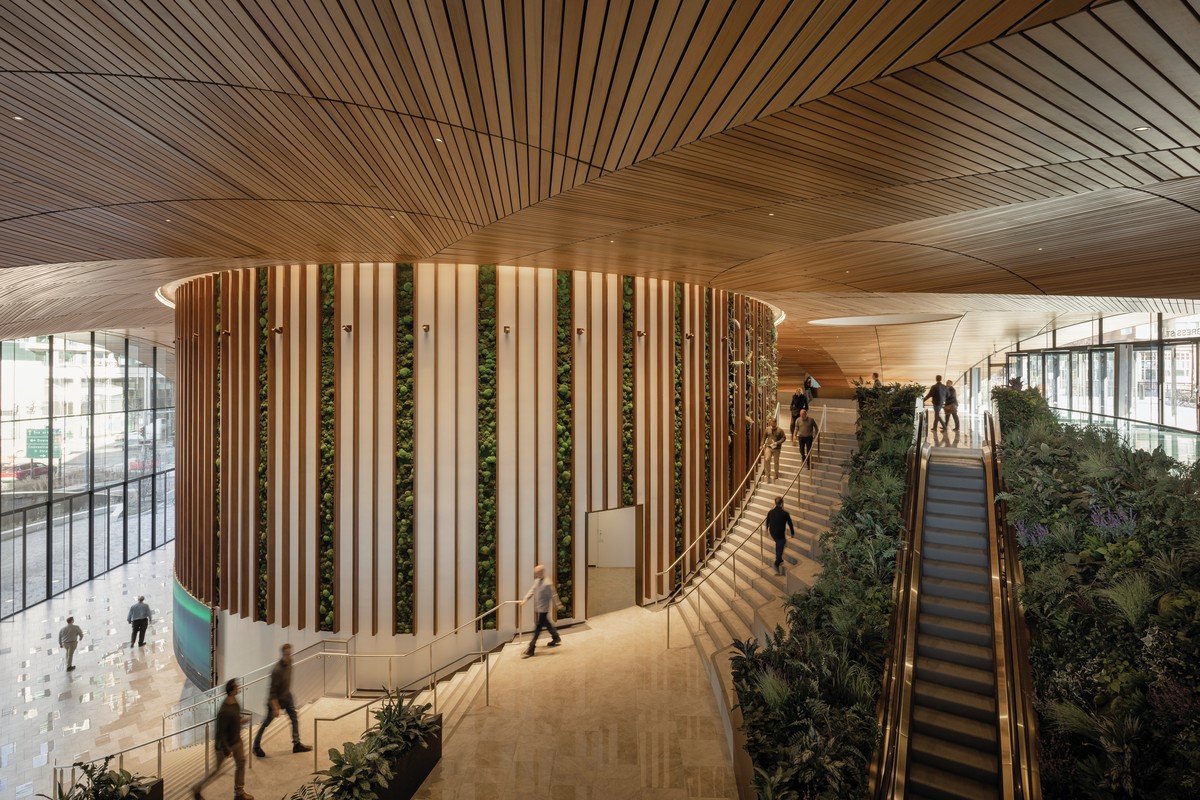
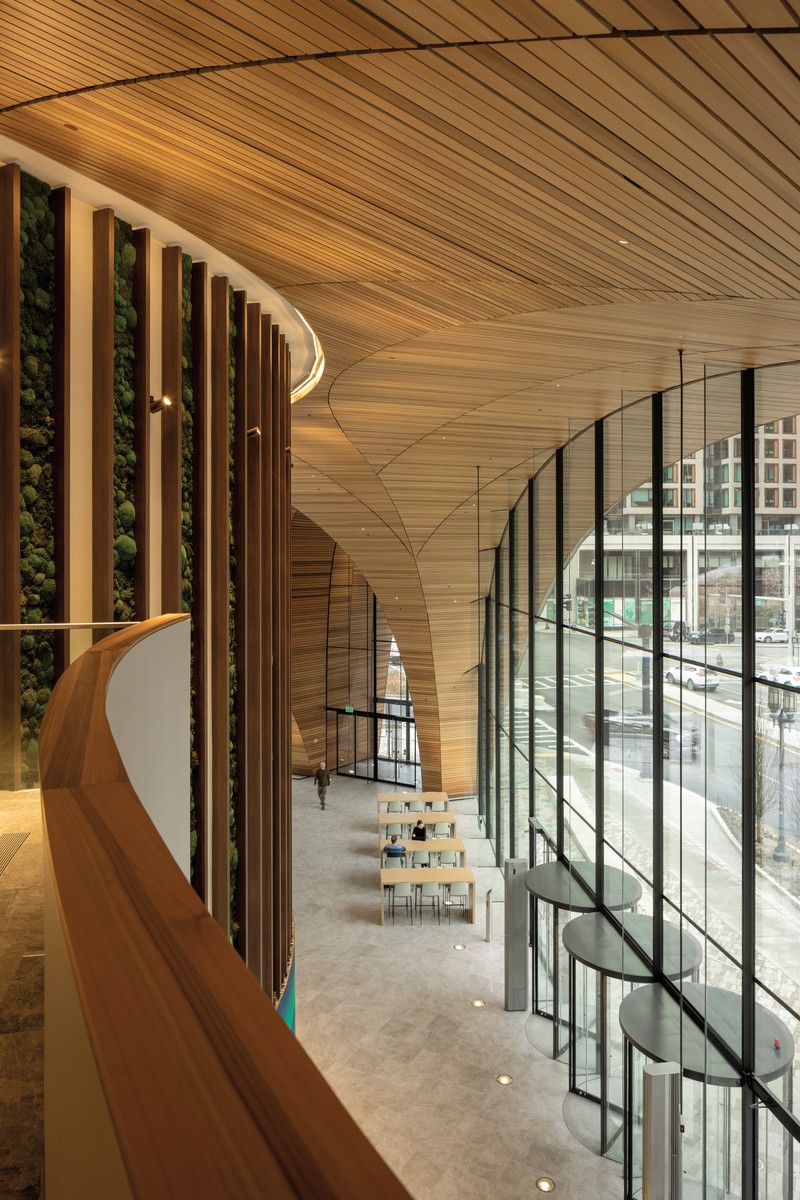
In response to the RFP and BGI’s desires, Sasaki designed a 42-foot-tall “great hall” at the tower’s base below a curved, wood-clad ceiling defined by a series of intersecting arches springing from the building’s corners. The dramatic three-story space was envisioned as more than a lobby or the usual office-building dining options (though it will probably include such amenities), but also as a venue for community events such as celebrations, performances, and exhibitions. In addition, it was planned as a way for pedestrians to traverse the site’s grade change, any time of day or night, and be protected from the elements, either via an elevator or by way of a grand stair wrapping the central core and bordered by a lushly planted seating area. The scheme also incorporates another lot—half an acre and triangular, on the opposite, west side of the highway ramp—connected to the tower by a pedestrian bridge. The small area, landscaped, includes terraced steps and a zigzagging sloped pathway, offering yet another way to travel between Congress Street and World Trade Center Avenue. Below this “triangle park” is a sheltered area that could serve for any number of functions, suggests Vizgaitis, such as food vending, or as a basketball court. In all, the project provides about 2 acres of public space, both indoors and out.
1
The great hall (1 & 2) includes a grand stair wrapping the core. Photos © Michael Grimm
2
The arched great hall is, in part, a structural response to the site’s complexities, which, in addition to irregular boundaries and a significant grade change, include a tunnel for the city’s Bus Rapid Transit system that runs directly below the building’s footprint. The tunnel’s presence restricted the locations of structural touch-down spots, making steel-framed arches an ideal option for the tower’s base. But that solution was far from straightforward. “There were a lot of gymnastics on this one,” says Stephen Craven, a vice president at Thornton Tomasetti, the project’s structural engineer. Just one example of the ingenuity involved is the diaphragm between the great hall and the fourth floor (the first full tenant level). This robust horizontal truss was necessary, says Craven, due to the significant loads created by the arches, which lean outward and curve. At the building’s top, an indoor running track provides views of the harbor, but had to be acoustically isolated so that footfalls aren’t transmitted to the floor below. The structure of the levels between is more conventional, he explains, with composite slabs of concrete on metal deck.
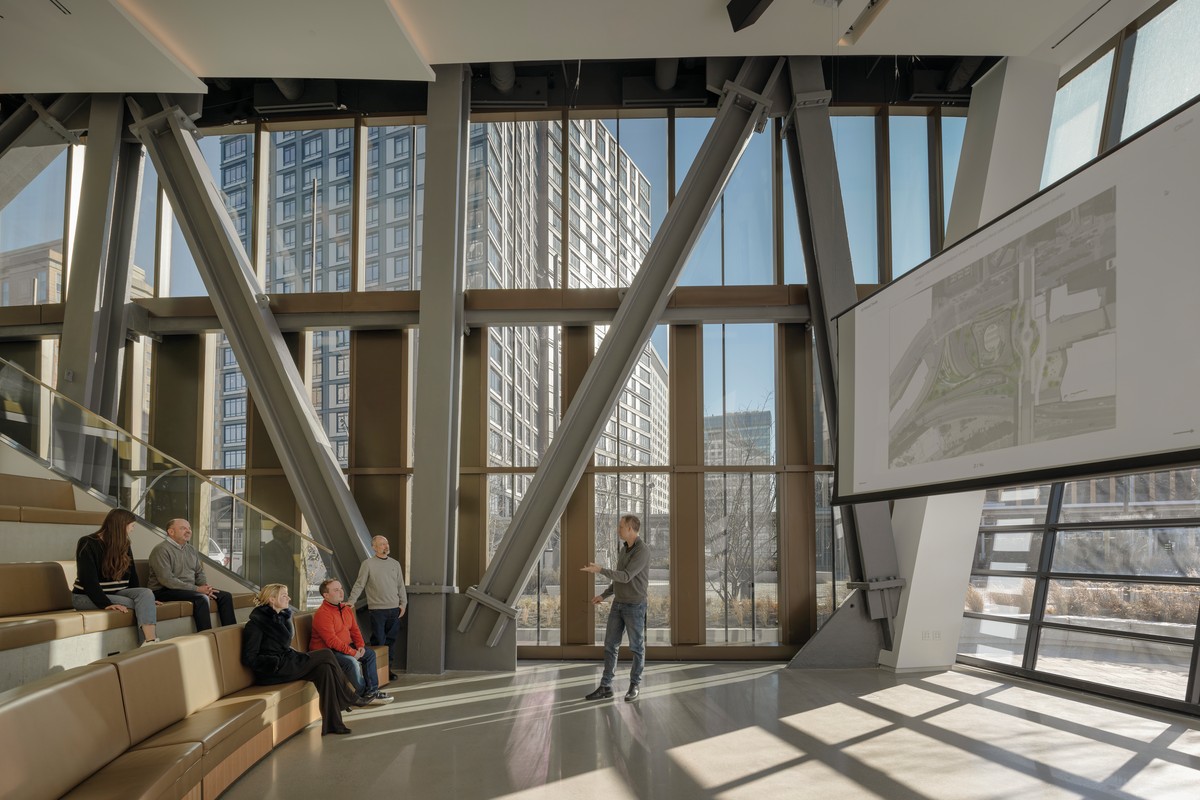
A 150-seat auditorium will be available for tenant and community use. Photo © Michael Grimm
The plans of all the tenant floors are almost identical, with a central core and nearly column-free space surrounding it. (The only interior columns are one near the north corner of the core and another at the south corner, to keep span dimensions reasonable, says Craven). However, the floor-to-floor height at the laboratory levels (14½ feet) is 2 feet taller than the office floors, to accommodate the laboratories’ considerable mechanical needs.
Looking for quick answers on architecture and design topics?
Try Ask RECORD, our new smart AI search tool.
Ask RECORD →
Somewhat surprisingly, 10 World Trade was originally conceived as an 18-story, office-only tower. But in the spring of 2020, when it seemed as if in-person office work might be a thing of the past, 10 World Trade’s financing fell through. BGI gave the project team 90 days to revise the scheme to include laboratories. The life-sciences market was still “white-hot,” explains Hynes. But because the project had already gone through Boston’s arduous public-review process, designers were instructed to alter it as little as possible. The outcome was a building combining more than 200,000 square feet of lab space and over 255,000 square feet of office space. It looks nearly identical to early renderings, but with one floor fewer. The strategy allowed BGI to secure new financing and close on the ground lease, says Hynes.
After 3.5 years of construction, 10 World Trade is complete and ready for tenants. But, in a twist of fate, the Boston-area life-sciences market now has a higher vacancy rate, at 34 percent as of the last quarter of 2025, than its office market, at 18.2 percent. While the building may take longer to lease than BGI had hoped—given current conditions—its imaginative approach, civic gestures, and contributions to the urban realm offer a compelling model for the district’s remaining open sites. Other developers should take note. The Seaport would be the better for it.
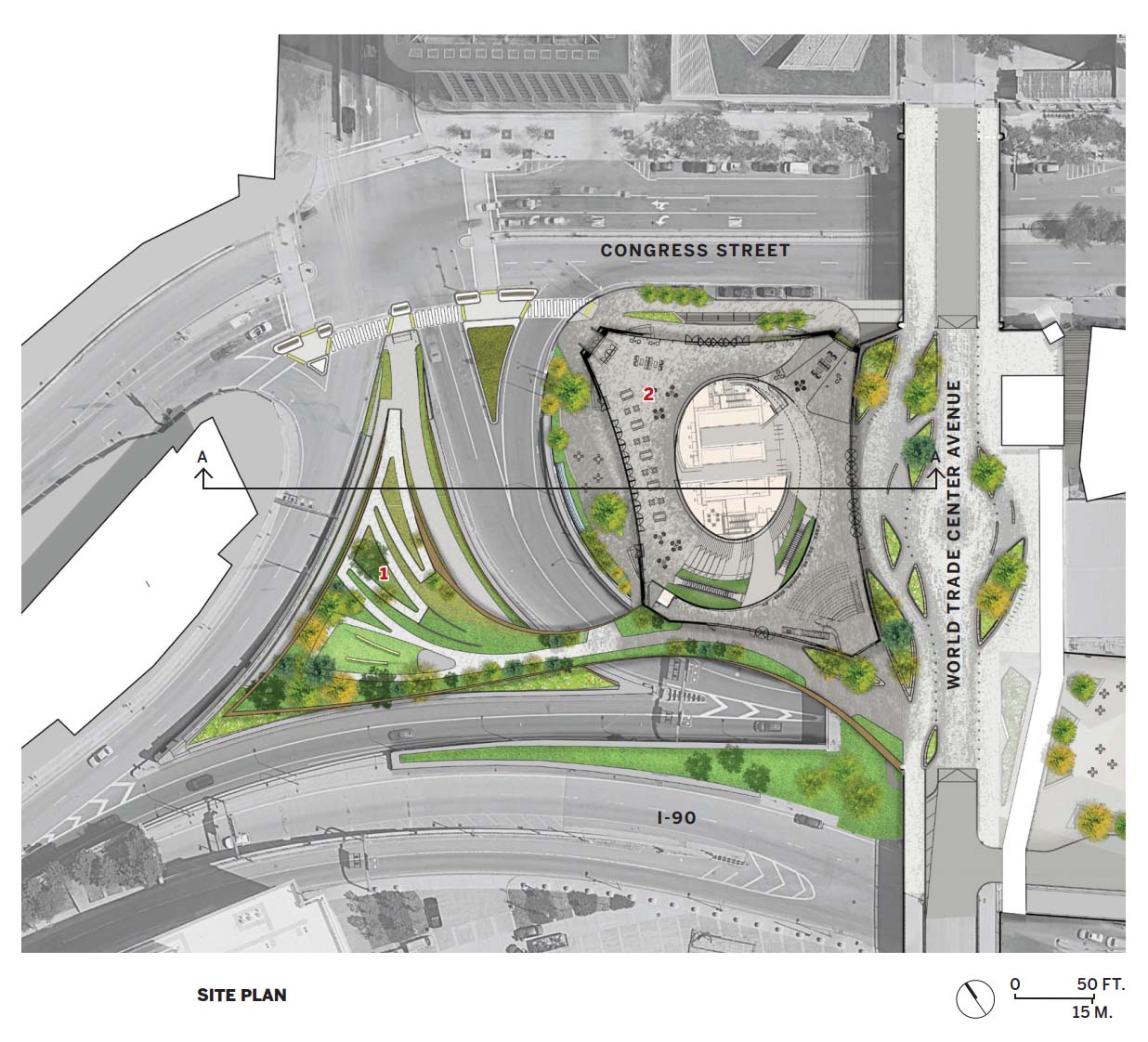
Image courtesy Sasaki
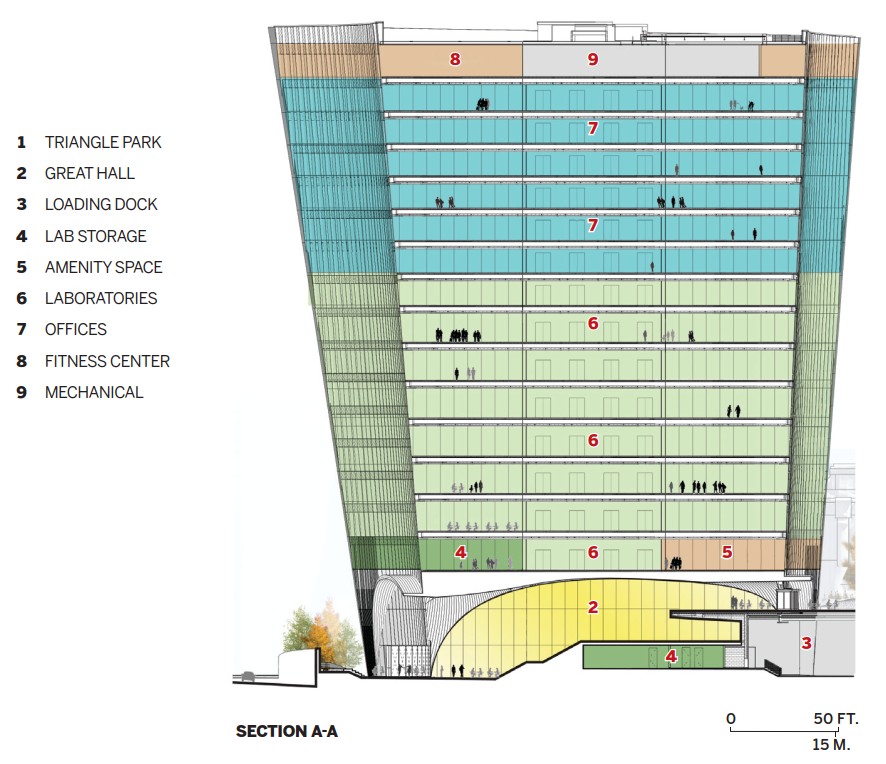
Image courtesy Sasaki
Credits
Architect:
Sasaki — Victor Vizgaitis, principal in charge; Kate VanHeusen, senior project designer; Yifaat Ayzenberg-Shoshan, Meredith McCarthy, project managers; Philip Dugdale, principal, landscape architecture; Victoria A. Steven, senior project architect; Steven Walz, senior sandscape architect; Cecilia Hardy, senior interior designer; Kira Sargent, Jordan Pulling, Grace Lehrbach, Theodor Stojani, Robert Titus, Kyle Richard, Phyllis Zhou, Ilaria Giardiello, project team
Consultants:
Thornton Tomasetti (structural); Rimkus (MEP/FP); Haley & Aldrich (geotechnical); Nitsch Engineering (traffic, civil, bridge structure); Socotec, Eckersley O’Callaghan (envelope); HLB Lighting Design (lighting); Acentech (acoustics)
General Contractor:
Suffolk Construction
Client:
Boston Global Investors
Size:
600,000 square feet
Cost:
$370 million (construction)
Completion:
August 2025
Sources
Dynamic Glazing:
View
Wood Ceiling:
Radius Track, Acoustics Inc.
Structural-Glass Walls:
Island Facades
Entrances:
FHC
Fire-Control Doors:
Won-Door
Resilient Flooring:
Forbo, Tarkett, Roppe
Carpet:
Mohawk Group, Interface
Green Roof Assemblies:
Sika (American Hydrotech)
Looking for a reprint of this article?
From high-res PDFs to custom plaques, order your copy today!