House of the Month
On a Sloping Site in Ontario, UUfie Extends the Roof of a Chalet to Create a Playful Retreat
Belfountain, Ontario
Architects & Firms
The concept diagram for the Belfountain House, a renovation and addition recently completed by Toronto-based UUfie (a 2017 Design Vanguard), depicts a simple house shape in section with a lengthened roofline on one side running parallel to the steeply sloping site. Scribbled trees overlap this extended portion indiscriminately, suggesting a coalescence with nature. The scheme fulfilled the needs of the clients—a philosopher and an artist with two young children—who engaged the architects to create a more open interior that would accommodate the family’s downtime and better serve as a retreat nestled amid a lush forest.
1
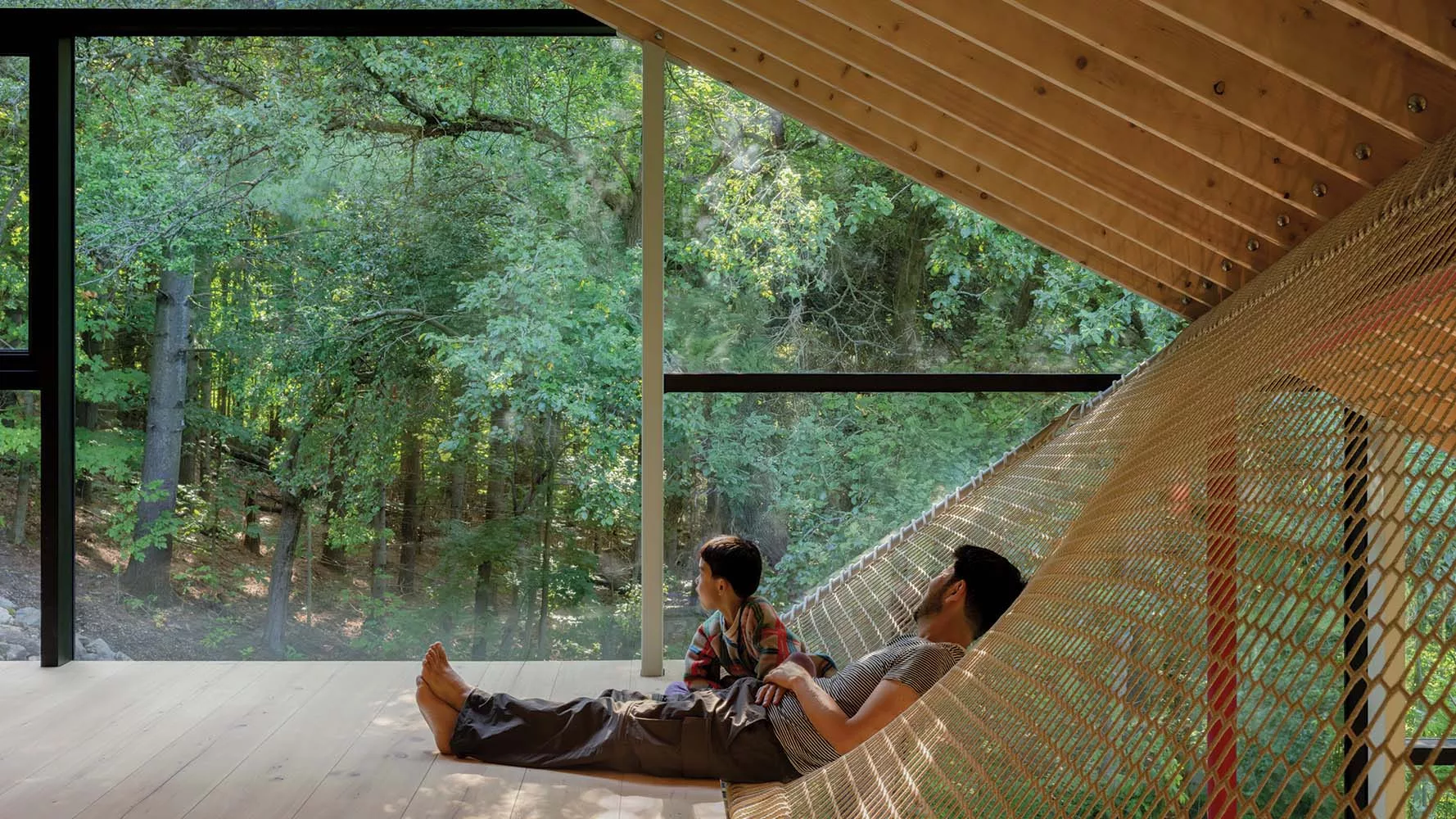
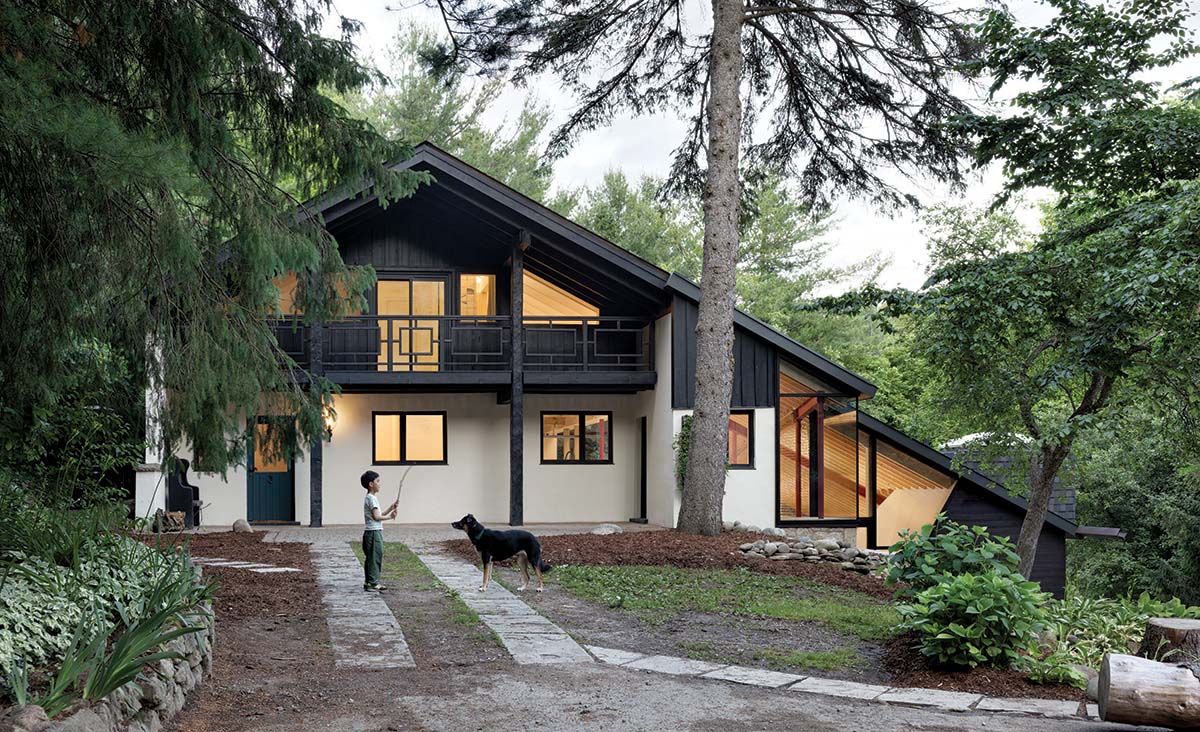
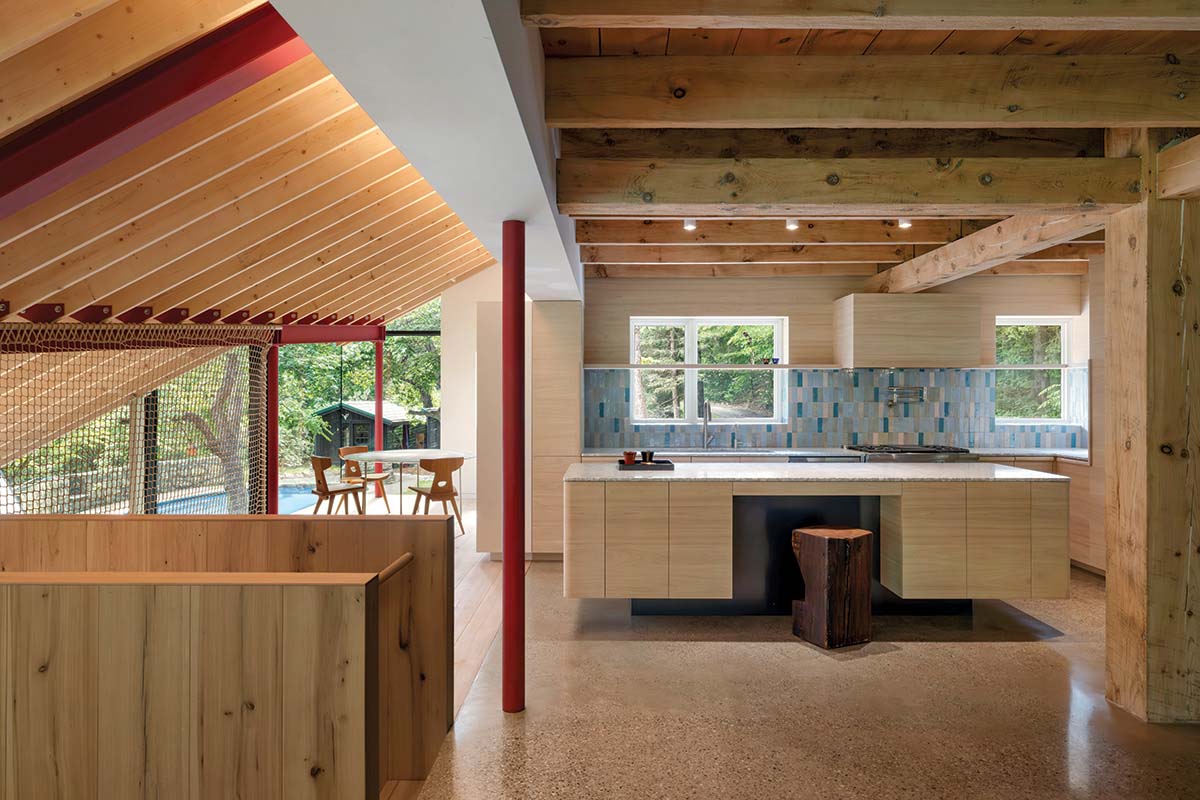
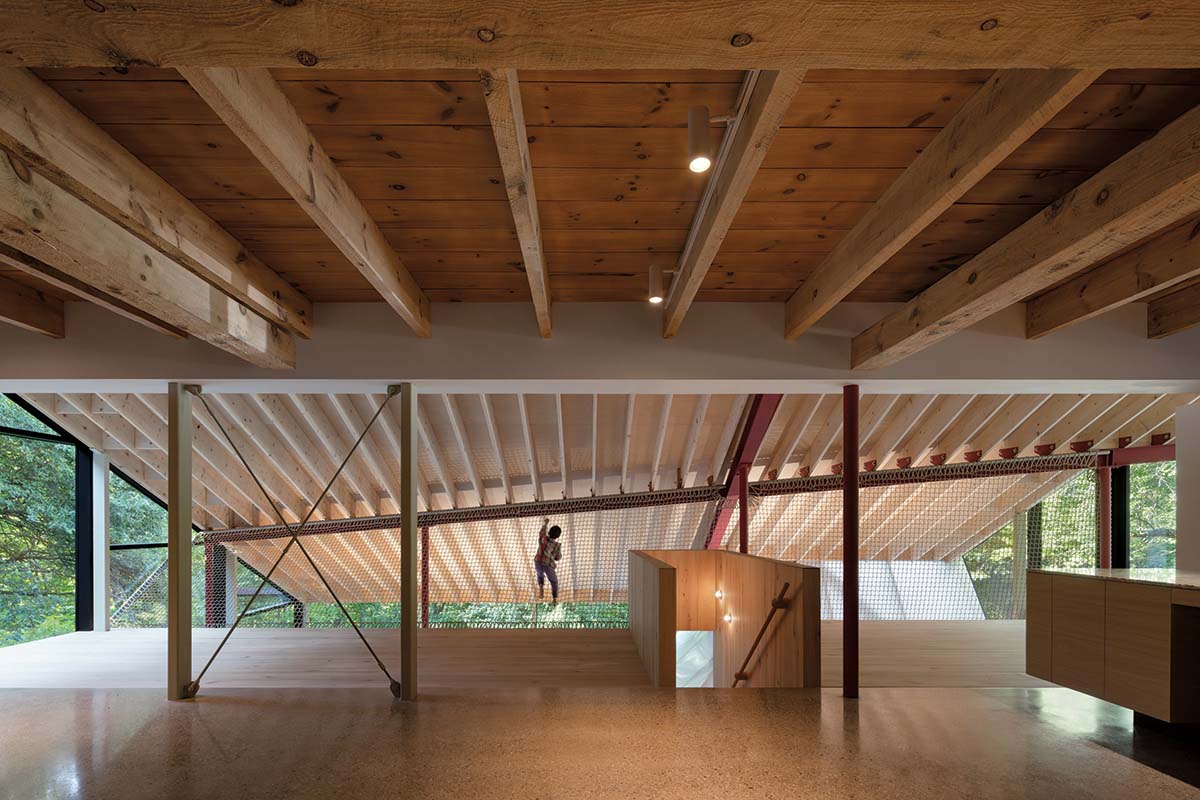
Extending the roof of the existing chalet (1), the architects removed partitions between the living spaces (2) and inserted a playful net guardrail/ hammock/jungle gym (3). Photos © Ema Peter, click to enlarge.
2
3
The picturesque hamlet of Belfountain, Canada, is located on the Niagara Escarpment, an arc-shaped ridge that forms Niagara Falls and then cuts through southern Ontario to Michigan’s Upper Peninsula before terminating in Wisconsin. The 3.2-acre woodland site is about an hour’s drive north of Hamilton, where the husband teaches philosophy. To the south of the house are the Credit River, a nature reserve surrounding it, and a scenic drive that twists and turns through the park—well-known as a destination for leaf peeping in fall. To the north, a small ski club offers winter recreation in the Greater Toronto Area. Perhaps responding aesthetically to the nearby lodge and this “Alpine” context, the existing house was designed in the 1970s as a two-story ersatz Swiss chalet, with thick walls, painted heavy timber framing, and sparse small windows. At some point, two additions were tacked on, limiting whatever southern exposure and sunlight the original structure had.
Given the idyllic landscape, “the day one priority for the clients was to create a connection between the building and nature,” says Eiri Ota, who cofounded UUfie with life and professional partner Irene Gardpoit in Tokyo in 2009 (they relocated to Toronto in 2013). To achieve this porousness, the architects adopted an approach of subtracting and simplifying. UUfie demolished the additions, which cascaded down two levels, and extended the roofline of the chalet over their former footprint. The architects then enclosed the volume primarily with glazing. On the original structure’s ground floor, they removed walls between the kitchen, living, and dining rooms. This strategy of allowing for “general openness led to a more communal family environment,” notes Gardpoit. Spanning from the living areas, over the intermediate level that houses a gym and sauna, and down to the recreation room on the lowest level 14½ feet below, the result is a unified, light-filled space sheltered under a sloping roof and surrounded by greenery.
While UUfie’s intervention is defined by its simple gestures, that does not mean it avoids playfulness. An interstitial structure was required to support the extended length of the roof. The architects inserted a steel beam that would span the longest distance possible along the existing foundations while minimizing the number of posts needed—a diagonal line transecting the otherwise orthogonal space—and then they painted it a bold red. Another red beam, running in line with the joists, intersects it in the center of the space. Stretching from the dining room over the lower-level hallway, the diagonal beam then became an armature for a rope net that serves as a vertical guardrail at one end and twists into an almost horizontal hammock at the other.
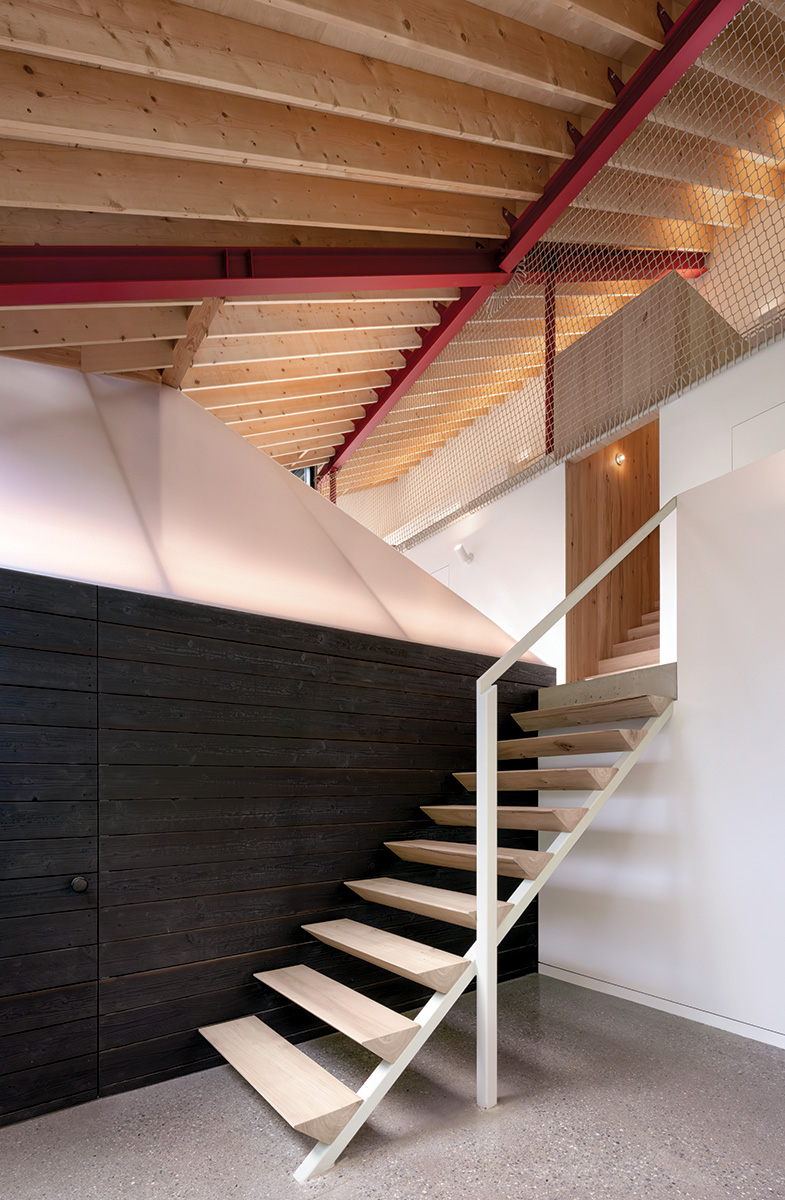
A guest room on the lowest level acts as a counterpoint to UUfie’s approach to the airy addition. The 20-foot-tall discrete volume of the room pokes through the extended roof plane at its southeast corner and is wrapped in black wood—charred in the Japanese yakisugi method. This natural finish echoes, without replicating, the chalet’s black-painted board-and-batten siding. The cave-like space inside is completely enclosed and capped by a polycarbonate shell that leads up to a skylight, allowing diffuse light in during the day and, at night, glows like a lantern.
4
5
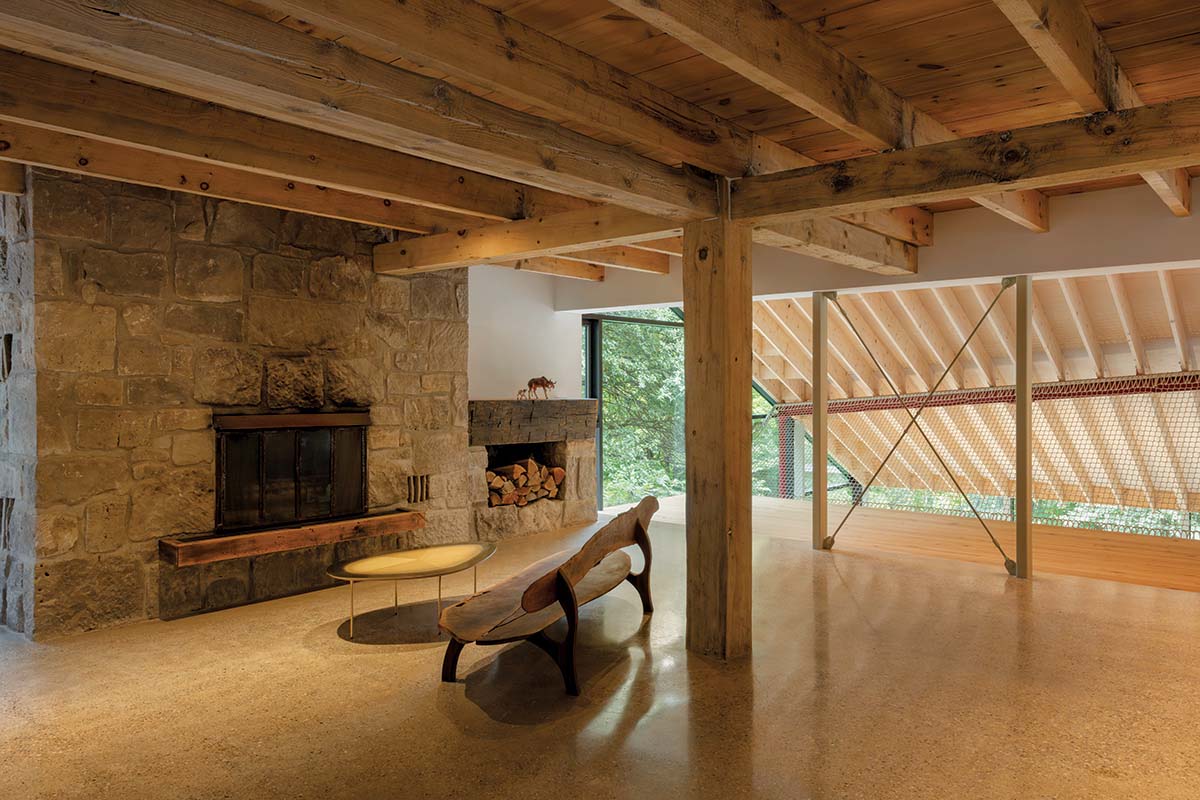
Charred wood encases the guest room (4), echoing the existing siding, as the spruce lumber pairs with the original heavy timber (5). Photos © Ema Peter, click to enlarge.
In the living areas of the existing house, the architects stripped the heavy timber columns, beams, and girders of their paint, exposing the wood grain. They replaced the floors with new polished-concrete ones that include radiant heating. Upstairs, the primary and children’s bedrooms are all white, with minimalist integrated millwork. In the addition, the floors are either concrete or a locally sourced reclaimed elm. The redesigned custom kitchen is finished in elm as well. The ceiling under the extended roof is also exposed wood, albeit spruce lumber that is more delicate and muted than the heavy timber original. While UUfie’s work fits in with the existing structure, there’s no attempt to match or camouflage. “The new is new,” says Ota. From the exterior, the original house still looks like a Swiss chalet, but now with a distinct half that is more connected to its surroundings.
Throughout its work, from similar cottages and residential renovations to public artworks, UUfie has often explored the Japanese philosophy of wa. The term can be translated as “harmony,” but it also conveys an awareness of one’s place in the world. In 2017, for example, the architects set 130 convex security mirrors in a University of Toronto lawn that reflected the sky and the undersides of trees, provoking passersby to reconsider their relationship to the landscape. With the Belfountain House—an extension that coexists with the original chalet and infuses nature into family life—UUfie has done something similar.
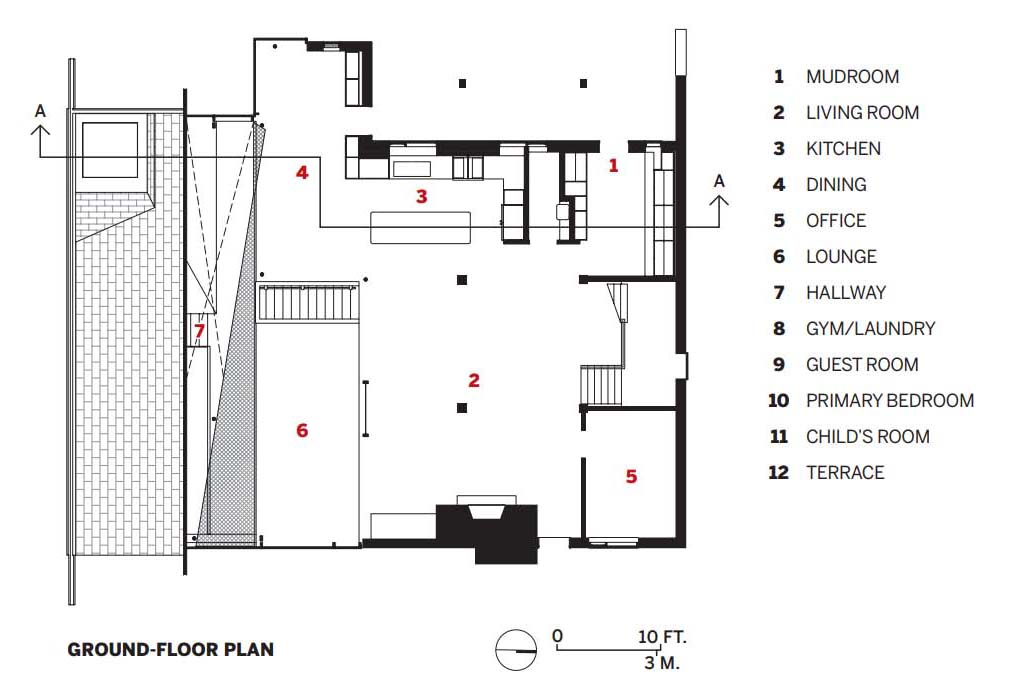
Image courtesy UUfie
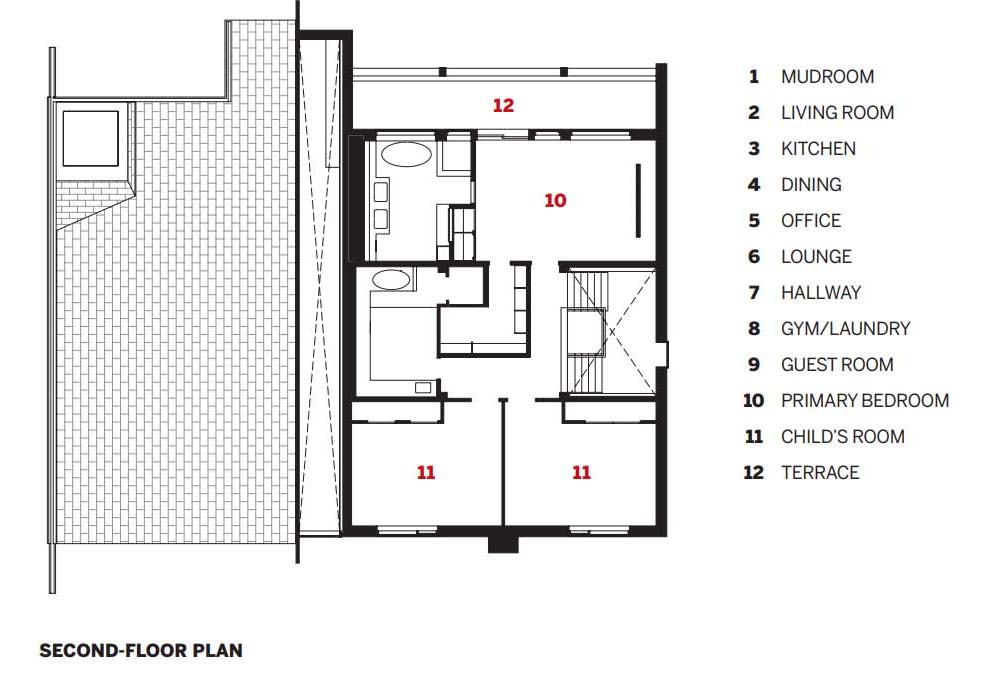
Image courtesy UUfie
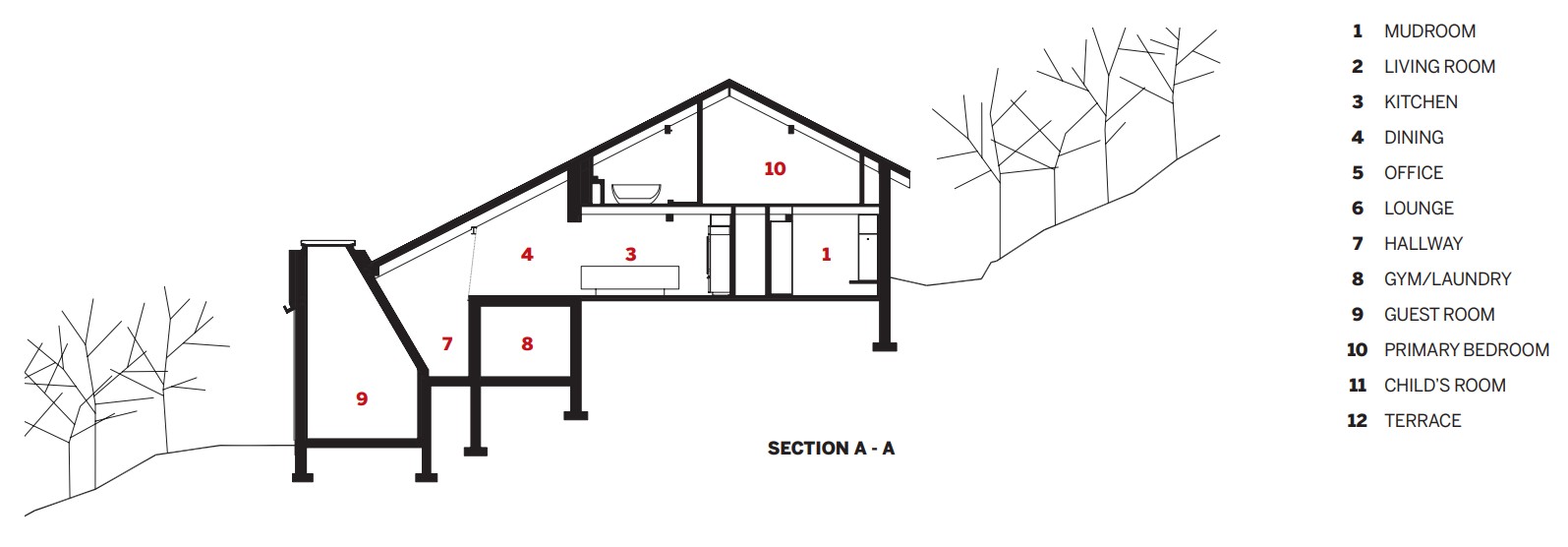
Image courtesy UUfie
Credits
Architect:
UUfie — Irene Gardpoit, Eiri Ota
Engineers:
Moses Structural Engineers (structural); Hayward Consulting & Design (MEP)
General Contractor:
North Arrow
Client:
Withheld
Size:
4,630 square feet
Cost:
Withheld
Completion:
October 2025
Sources
Wood Cladding:
Nakamoto Forestry
Curtain Wall:
Zenith Aluminum Systems
Roofing:
Owens Corning
Skylights:
Velux
Custom Woodwork:
North Arrow
Wood Flooring:
Century Wood Product
Netting:
Jakob Rope System
Lighting:
Bocci, Kendal Lighting
Plumbing:
TOTO, Hansgrohe
Looking for quick answers on architecture and design topics?
Try Ask RECORD, our new smart AI search tool.
Ask RECORD →
Looking for a reprint of this article?
From high-res PDFs to custom plaques, order your copy today!