Books
Glenn Kurtz Tells the Stories of the Workers Who Constructed the Empire State Building
‘Men at Work: The Empire State Building and the Untold Story of the Craftsmen Who Built It’ by Glenn Kurtz
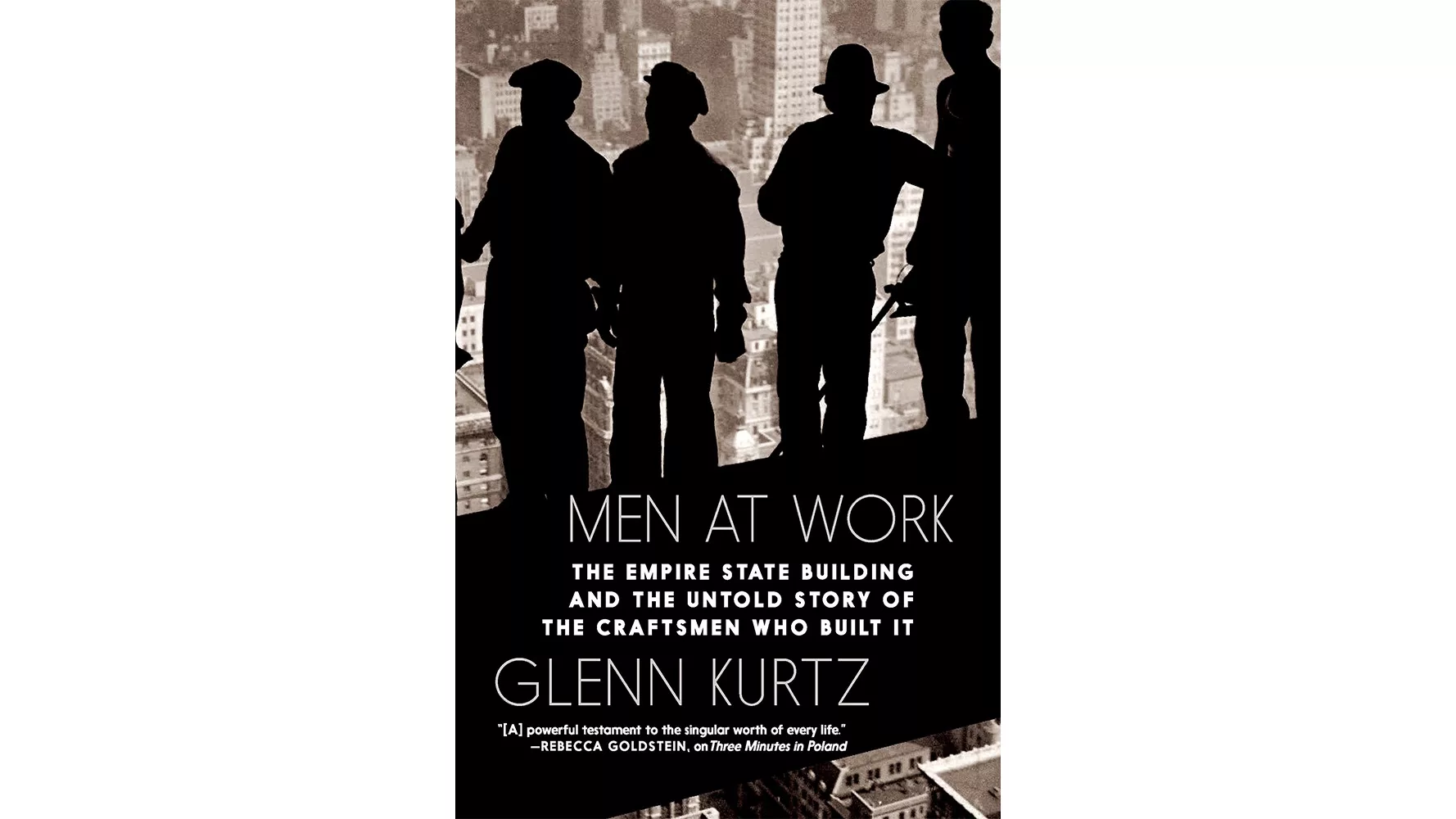
Men at Work: The Empire State Building and the Untold Story of the Craftsmen Who Built It, by Glenn Kurtz. Seven Stories Press, 352 pages, $35.
The Empire State Building opened in New York City 95 years ago today, May 1, which also marks the launch of our latest issue with its special project section focused on tall buildings.
The Midtown Manhattan office tower stood as the world’s tallest building for four decades until it was surpassed by the World Trade Center in 1971. Like the Eiffel Tower in Paris, Big Ben in London, or the Colosseum in Rome, the Empire State Building quickly became a city-defining icon, but given its untimely completion during the lowest point of the Great Depression, it also resonated as an enduring symbol of American resilience, ingenuity, and aspiration. This narrative was reinforced by Lewis W. Hine’s famous on-site portraits of the working-class men who constructed it. These largely anonymous laborers are the focus of Glenn Kurtz’s 2025 book, in which he pieces together their stories by exploring census, immigration, and union records as well as contemporaneous journalism and conducting interviews with their descendants. Following is an excerpt from chapter one, titled “The Named and the Unnamed.”
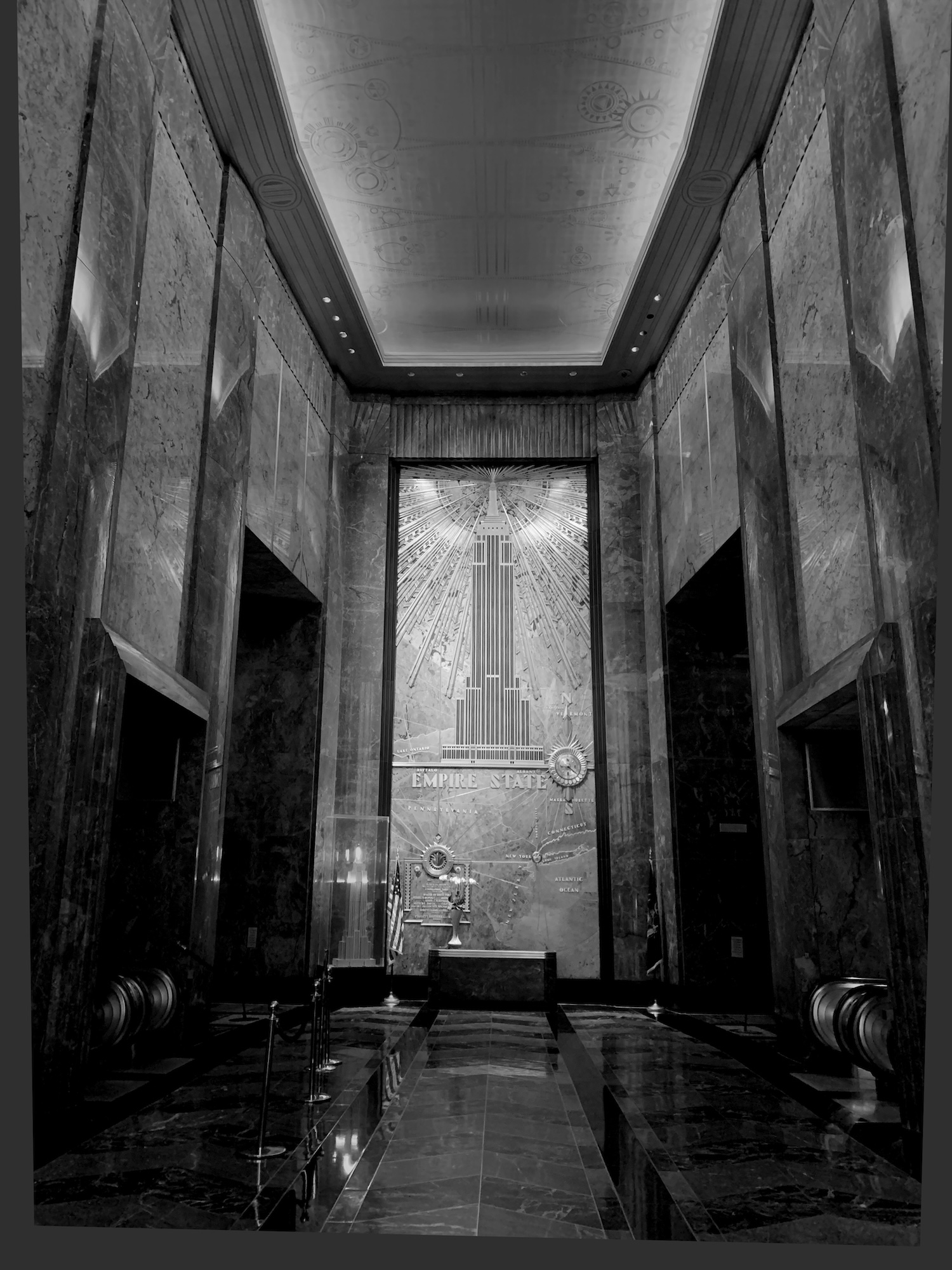
The grand lobby of the Empire State Building. Photo courtesy the author
Walk into the Empire State Building through its imposing Fifth Avenue portal today, and you will find the symbolic narrative built into the lobby architecture. As you emerge through the revolving doors, the first thing you see at the opposite end of the cathedral-like space, is a two-story, stainless-steel depiction of the monumental structure itself. Pause here for a moment. Feel how the design of this marble gallery propels you forward, toward the giant, illuminated representation. On the floor, three rows of alternating black-and-gray chevrons channel your steps, like strobing arrows set in stone. On either side, the three-story, gray marble walls, flickering with streaks of flaming red, rise to a heaven of Machine Age planets and stars. A gold-leaf Milky Way splashes across the ceiling mural, drawing your attention the length of the great hall. Near the end, floor and walls angle inward to converge on the stately, reeded columns that frame the silver profile of New York’s most audacious marvel. In this depiction, the building rises in sharp, metallic lines over a marble map of New England. At its peak, the skyscraper’s golden, Art Deco dirigible mooring mast—itself a striking gesture toward a future “when Zeppelins are expected to swarm on the New York horizon”—penetrates the sun, unleashing a blaze of stainless-steel rays that flash over the landscape. These rays—perhaps sunbeams, radio waves or, prophetically, television signals—broadcast an unmistakable message to the nation and to the Old World beyond. This is the Empire State Building, tallest building in the world, bold, gleaming symbol of modern America.
Standing at the foot of this haloed representation, you can take in the monumental structure at a glance, experiencing for yourself what John Jakob Raskob hoped the building would symbolize. With your feet on the ground, you feel drawn skyward by the structure’s euphoric aspiration.
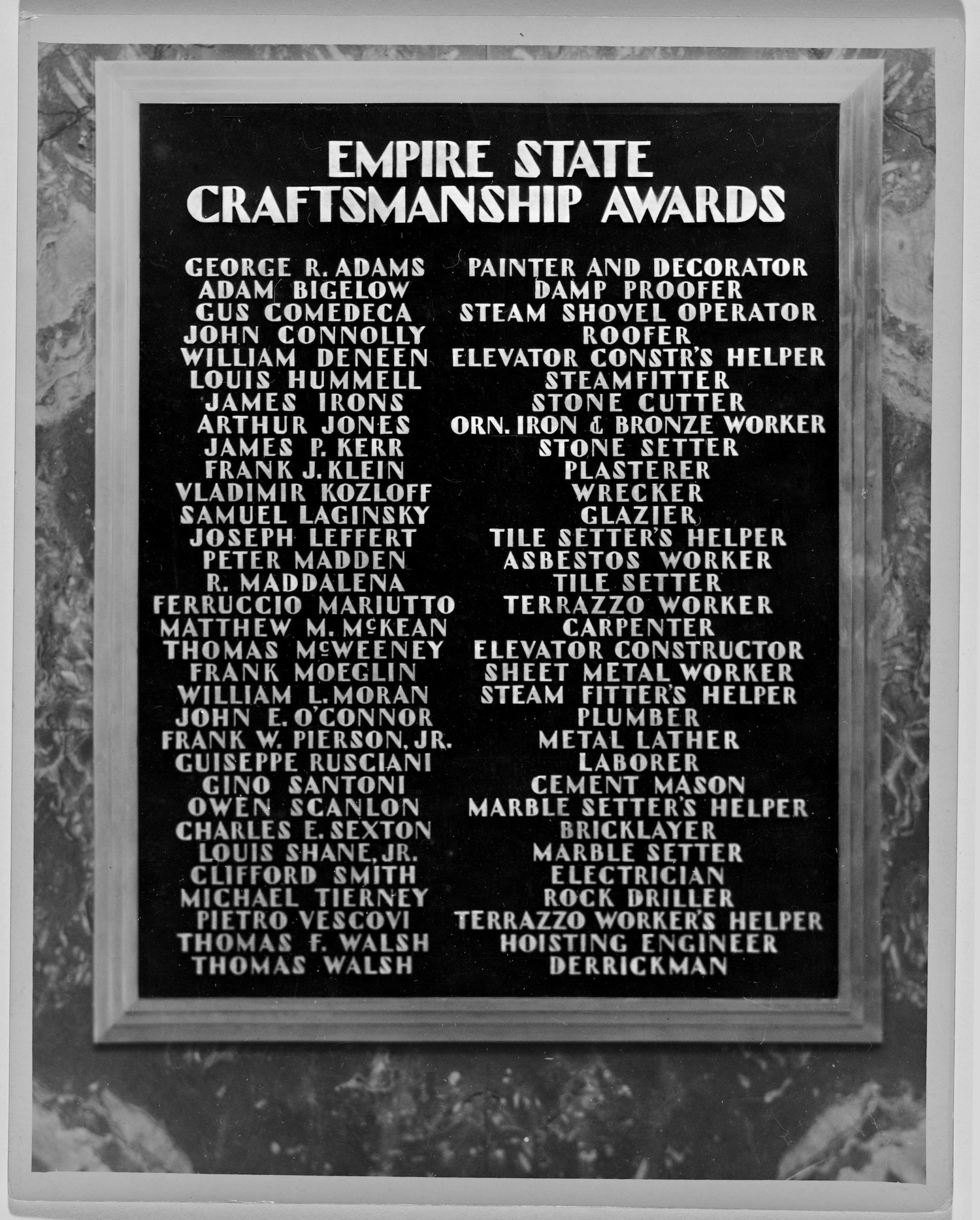
The Craftsmanship Awards plaque. Photo courtesy the George Eastman Museum
If your neck grows tired as you gaze upward, however, you might turn your glance to the right. There, 10 steps beyond the black marble information desk, around a structural hump in the lobby design and perched inconspicuously above a radiator grille, you will discover a bronze plaque, mounted at eye level. Although not part of the architectural design, I think this plaque is symbolic, too. It measures 22 by 26 inches, tiny compared to the giant rendering of the building with which it shares the wall. Unadorned, it lists the names of 32 men, laborers who contributed to the building’s construction and who received Certificates of Superior Craftsmanship, awarded by the New York Building Congress. The plaque is unlit, and the passageway where it hangs is dark. When I visited in March 2025, a posted sign, “Entry Beyond This Point Is Limited to Tenants and Their Invited Guests,” warned visitors against approaching it. But if a guard doesn’t stop you, you can still step up and read the names of these men embossed in hand-drawn, Art Deco lettering against a plain black background. Among them are Michael Tierney, rock driller; Gus Comedeca, steam shovel operator; James P. Kerr, stone setter; Charles E. Sexton, bricklayer; James Irons, stonecutter; Frank Moeglin, sheet metal worker; Vladimir Kozloff, wrecker; Ferruccio Mariutto, terrazzo worker; Samuel Laginsky, glazier; Peter Madden, asbestos worker.
Here, in the lobby of the Empire State Building itself, are two competing symbols of the majestic skyscraper’s history and significance, one familiar and one forgotten.
In the shining steel outline, you have the Empire State Building as the American superlative. The tallest man-made structure, built in record-breaking time, it towers as a beacon, radiating ambition, self-confidence, and modernity. “The skyscraper is the most distinctively American thing in the world,” wrote Colonel William A. Starrett, one of the builders, “so far surpassing anything ever before undertaken in its vastness, swiftness, utility, and economy that it epitomizes American life and American civilization.” As the loftiest skyscraper, the epitome of the epitome, the Empire State Building is the focal point, not just of the lobby, but of New York City and State, of the nation and nations overseas, of the solar system—perhaps, if we recall the ceiling mural awash with stars, the fulcrum of the whole galaxy. It’s not too much to say that, in this wall relief, the Empire State—and with it, the rising American superpower— are imagined as the center of the universe. Civic and national pride, enthusiastic journalism and publicity, heroic images of the construction, and almost a century of popular culture all converge like the architecture on this central, symbolic representation of the structure.
Looking for quick answers on architecture and design topics?
Try Ask RECORD, our new smart AI search tool.
Ask RECORD →
When we think of the Empire State Building, this is what we think of, and not the office tower long since overshadowed by newer, taller competitors. There’s a reason Tom Hanks and Meg Ryan meet there in the 1993 film Sleepless in Seattle, and not at Chicago’s Willis Tower, formerly the Sears Tower, then the country’s tallest building. Skyscrapers are “expressions in steel of the passion of the twentieth century,” wrote critic Philip N. Youtz in 1929. No other peak in America attains the Empire State’s height of passion, its emblematic grandeur and romance.
From the start, the romantic story of the building as the symbol of American ascent has been told in correspondingly impressive language. “Insofar as a single building may be said to typify and represent the progress and dignity of the great city, EMPIRE STATE is New York,” claimed the owners in a New Yorker advertisement from April 1931, weeks before the building opened. Contemporary journalists went much further. “As you shoot up and up, floor after floor, you are boosted straight into the future,” wrote one. “The Empire State building pierces the clouds and goes beyond them. At the top you’re just a little lower than the angels,” wrote another.
To those engaged in creating and burnishing the grand story, the building is an “airy tower of limitless aspiration.” It is “a temple of paralleled silver shimmering between earth and sky.” It is “poetry, mysticism and inspiration,” “the lantern of Manhattan,” the “First Wonder of a New World.” “The Empire State Building,” concluded John Tauranac in his 1995 history of its construction, “is the twentieth-century New York building.”
Innumerable books, films, cartoons, advertisements, photographs, and crystal, metal, wooden, and plastic souvenirs attest to and celebrate the potency and durability of this Empire State Building, proof of American hopefulness, vigor, achievement, and power.
I want to tell the other story, the forgotten story of the plaque with the workers’ names, the story of the Empire State Building and the ordinary men who built it. Like the commemorative plaque itself, this history of the Empire State is off the main path, overlooked, and only dimly legible. And yet, as if hidden in plain sight, the story of the men named on the Craftsmanship Awards plaque offers a singular window onto a neglected dimension of the famous building. This neglect is not accidental. On the contrary, it betrays a pattern of selective attention that is as telling and definitive of American culture as the Empire State Building itself.
Looking for a reprint of this article?
From high-res PDFs to custom plaques, order your copy today!