After 20 Years, Herzog & de Meuron’s Triangle Tower Finally Tops Out
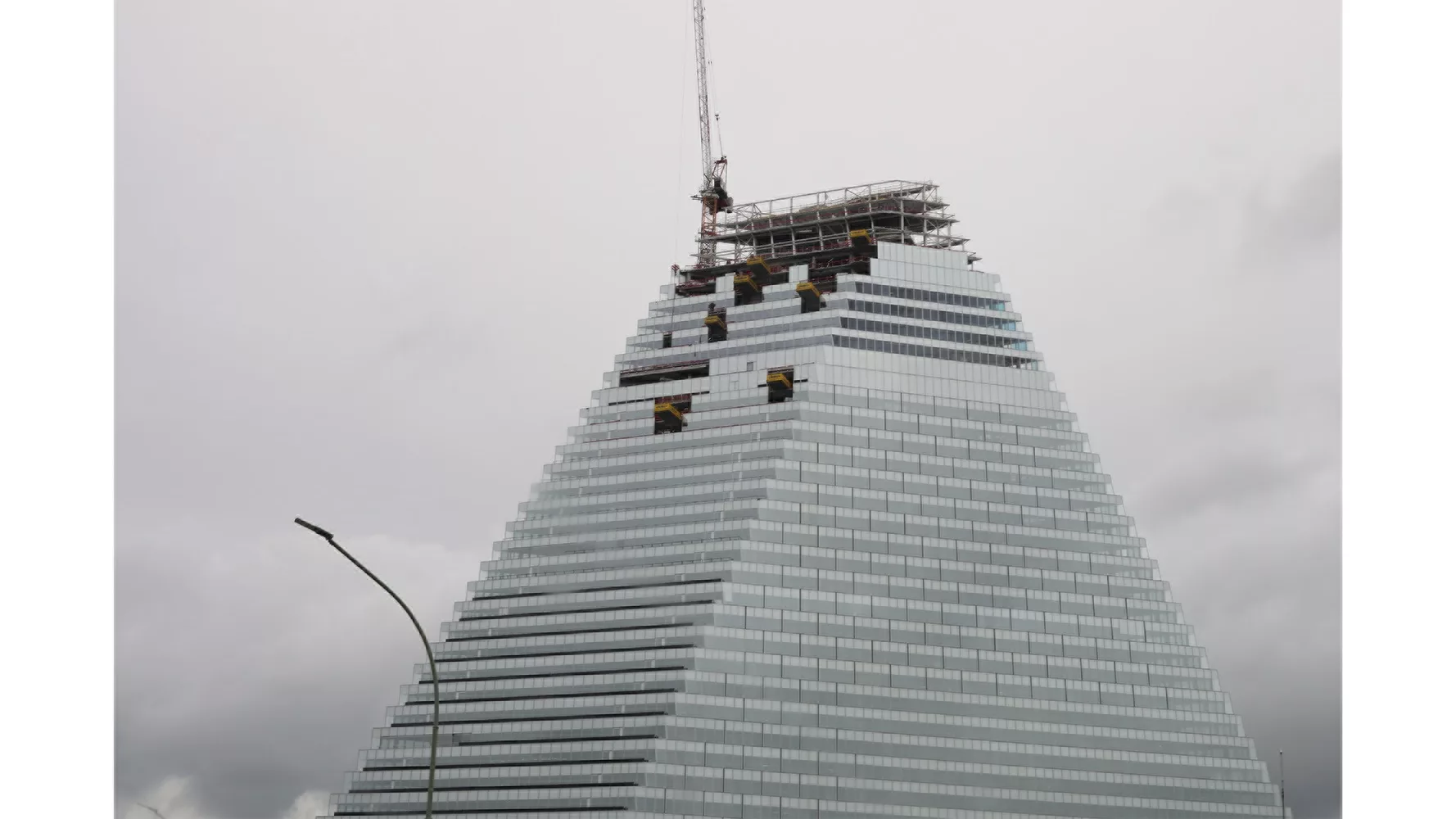
Tour Triangle pictured on a cloudy day in early April 2026 as construction nears completion.
“It will be exceptional; it will be beautiful,” declared Bertrand Delanoë in September 2008, when, as mayor of Paris, he announced construction of a new Herzog & de Meuron–designed skyscraper, which the Swiss firm had begun designing two years earlier, in 2006. Twenty years on, the highly controversial Triangle—at 180 meters, or 590 feet, the city’s third tallest building after the 984-foot Eiffel Tower and the 686-foot Tour Montparnasse—finally topped out this April, and is expected to open next spring. When it does, the 44-story irregular pyramid will house, among others, a conference center, a three-story hotel, a shopping mall, a panoramic restaurant, and over 750,000 square feet of office space. Delayed by more than a decade of contestation, it arrives in a context of years of oversupply that has resulted in an extraordinary 64.5 million square feet of office accommodation currently standing empty in the Paris region.

The under-construction tower, as seen from Tour Montparnasse, in early 2026. Photo by Franck Legros/Shutterstock
Located on the city’s periphery in the 15th arrondissement, the all-glass tower was programmed as part of the renovation of the Parc des Expositions, Paris’s municipally-owned trade-fair hub. Occupying a sliver of land on the avenue Ernest-Renan, right next to the city’s orbital highway, the $820 million building features wide facades facing northwest and southeast, with narrower elevations giving onto the highway to the southwest and the rue de Vaugirard to the northeast. The triangular form, says Herzog & de Meuron, minimizes the shadow cast on neighboring buildings, while its orientation ensures it does not constitute a barrier between Paris and its suburbs. According to the developer, Unibail-Rodamco-Westfield, the facades will achieve a 33-percent energy saving in comparison to standard Paris office buildings, and while the firm tacitly admits that tall buildings’ carbon footprints are higher than those of lower-rise typologies, it claims this will be offset by a reduction in travel-related emissions due to Triangle’s excellent public-transport connections.
Initially announced for 2012, the tower proved very difficult to get through the planning process. First, the city’s building code had to be changed, since height restrictions enacted in 1977 forbade any structure in Paris from rising more than 37 meters, or 121 feet. (An exception was made, in the early 90s, for Dominique Perrault’s National Library, whose towers rise 80 meters, or 262 feet.) In 2010, the city council voted to loosen the limit for certain peripheral areas, a bid on Delanoë’s part to modernize the city’s image and attract international investment in the context of increased global competition at the time of the Great Recession. But it says something about the ambient hostility to very tall buildings that, since then, just three have been completed: in addition to Triangle, Renzo Piano’s courthouse (2017), which rises 525 feet, and Jean Nouvel’s Duo Towers (2022), the taller of which is the same height as Triangle.
Besides residents’ associations, who fought Triangle in the courts, its most ferocious opponents were the Ecologist Party members of Delanoë’s own coalition, who denounced the project as an aberration in an era of global warming. Under Delanoë’s successor, Anne Hidalgo (who inherited his coalition), they sided with the opposition in the 2014 city-council vote that initially saw the tower’s permit refused. Thanks to a technicality, Hidalgo was able to organize a new vote in 2015, and this time the tower passed. But the lawsuits dragged on, delaying the start of construction until late 2021. The most recent legal action—launched that same year and still not concluded—accuses the city of favoritism when attributing the contract to Unibail-Rodamco-Westfield.
For its detractors, Triangle is a project from a bygone age that leaves a stain on Hidalgo’s legacy; for its champions, it symbolizes the city’s dynamism and supplies the first-rate, state-of-the-art offices that Paris currently lacks. Whatever its merits and drawbacks, it will be the city’s last skyscraper, at any rate for the foreseeable future: in 2023, the city council—which counted a higher number of Ecologist Party members following the 2020 municipal elections—voted to bring the maximum building height back down to 37 meters. That restriction does not apply to the business district of La Défense, however, where skyscraper construction continues.
Looking for quick answers on architecture and design topics?
Try Ask RECORD, our new smart AI search tool.
Ask RECORD →
Looking for a reprint of this article?
From high-res PDFs to custom plaques, order your copy today!

.webp?height=200&t=1759411598&width=200 "Vancouver_Art_Gallery_(39595096015).jpg")