National WWII Museum in New Orleans, After 20 Years, Completes Final Phase

The origin story of the National World War II Museum in New Orleans’s Warehouse District seems to have as many twists and turns as the events it tries to untangle and exhibit. Now an affiliate of the Smithsonian, the once-humble institution was founded in 2000 as the D-Day Museum after an arduous grassroots campaign by historians Stephen Ambrose and Nick Mueller. Just three years later, Congress passed a law designating it “America’s National World War II Museum,” necessitating a major expansion well beyond the scope of that single fateful day in June 1944.
A video tour shows the major elements of the phased—and now complete—expansion of the National WWII Museum in New Orleans. Video © Thomas Damgaard
That expansion, realized on a six-acre site across the street from the original museum building, was recently completed by New York–based Voorsanger Architects in partnership with local firm Mathes Brierre. It brings an end to a decades-long effort dating to 2003, when the two firms were selected following a competition organized by Lord Cultural Resources that saw some 45 practices vie for the project.

The Liberation Pavilion, the final component of the master plan to be completed, dramatically juts into the courtyard like the prow of a ship, while a blade like canopy, which can be lit in the evening, looms large overhead. The space is pictured above and below. Photo © Thomas Damgaard

Photo © Thomas Damgaard
As founder Bartholomew Voorsanger tells it, his strong aversion to an axonometric drawing in the competition brief—and his firm’s response—sealed the deal. “It totally flabbergasted me. Nobody ever presumed to suggest a conceptual idea of what a project should be in any of the competitions we’ve been involved in,” he explains. “Typologically, they were suggesting a retail mall with a head house on one end and a garage on the other.” Fortunately for him, the other competitors followed that exact strategy.
“Wars—and particularly World War II—are metaphorically indeterminate,” says Voorsanger, who served as a training officer in the U.S. Army in the 1960s. “You’re constantly moving through crises, tragedies, and successes. The geometry of this museum could not be consciously orthogonal,” he continues. The forms that he and his team instead proposed were aptly sharp and angular, with a tough exterior envelope, evoking the very battleships and matériel integral to the war effort.

The chapel offers a place of reflection and prayer. Photo © Thomas Damgaard

Several restored aircraft—all models used during World War II—hang from the ceiling of the Freedom Pavilion. Photo © Thomas Damgaard
The National World War II Museum consists of five sequentially constructed pavilions—the first of which opened in 2009—that wrap around and enclose the “parade grounds,” a courtyard named after the semi-honorific spaces where military units gather. A bladelike canopy of structural steel and fiberglass looms large overhead, marking the skyline and shrouding the museum in an ever-changing dance of shadow. Inside, the architects accommodated a complex program of display spaces, theaters, administrative offices, a store, a café, a research institute, and more. The somber chapel, lined with faceted precast concrete panels and a scrim of perforated aluminum, and capped by multiple gilded planes, is especially moving. Other spaces more overtly exhibit technological prowess, as in the Freedom Pavilion, where a restored Boeing B-17 Flying Fortress and a North American P-51 Mustang, among other aircraft, dramatically hang from the ceiling.
Although the fragmentary forms of the museum seem to share a common lineage with the Deconstructivist architecture of the 1980s and ’90s, Voorsanger notes that he eschews the term when describing the work, and avoided delving too deeply into that philosophy while designing it. “My anxiety about this issue, which I thought about a lot, was about moving too far into the Deconstructivist mode,” he says. If taken too far, such a strategy could lead visitors to misread the architecture as a portrayal of the actual consequences of war, and destroy the metaphor about uncertainty, he explains.
.jpeg)

Jagged panels of aluminum and concrete shape space and frame views. Photos © Thomas Damgaard
The pavilioned massing, which was also part of Voorsanger’s competition-winning scheme, came with several pragmatic benefits. Breaking down the museum into discrete volumes negates fatigue for visitors who come to explore nearly 80,000 square feet of exhibitions—or, as he puts it, recontextualizes a complex story into more digestible episodes or “paragraphs.” (Today, some 800,000 museumgoers visit each year.) But the scheme also allowed phased construction and growth, and was thus instrumental to realizing the master plan from the start. “You need to train a large staff, build a national board, and fundraise. Phasing allowed the museum to do this organically, and it came with naming opportunities for each of the pavilions,” Voorsanger says. The constituent parts, which carefully snake around historic buildings on Magazine Street, take up much of a city block.
Looking for quick answers on architecture and design topics?
Try Ask RECORD, our new smart AI search tool.
Ask RECORD →
Some may ask: Why New Orleans? What is the Big Easy’s relationship to World War II when other places—such as Pearl Harbor in Hawaii—might more immediately come to mind. The answer has to do with the LCVP (or the landing craft, vehicle, and personnel) boat, which was developed by American businessman Andrew Higgins. It was built in the city and was tested on the waters of Lake Pontchartrain. Allied forces deployed this vehicle in numerous amphibious landings—including the invasion of German-occupied Normandy on D-Day and the crossing of the Rhine. President Dwight D. Eisenhower, who served as General of the Army during World War II, even went so far as calling Higgins “the man who won the war for us” in a 1964 interview.

In addition to display spaces, the museum features administrative offices and meeting rooms. Photo © Thomas Damgaard
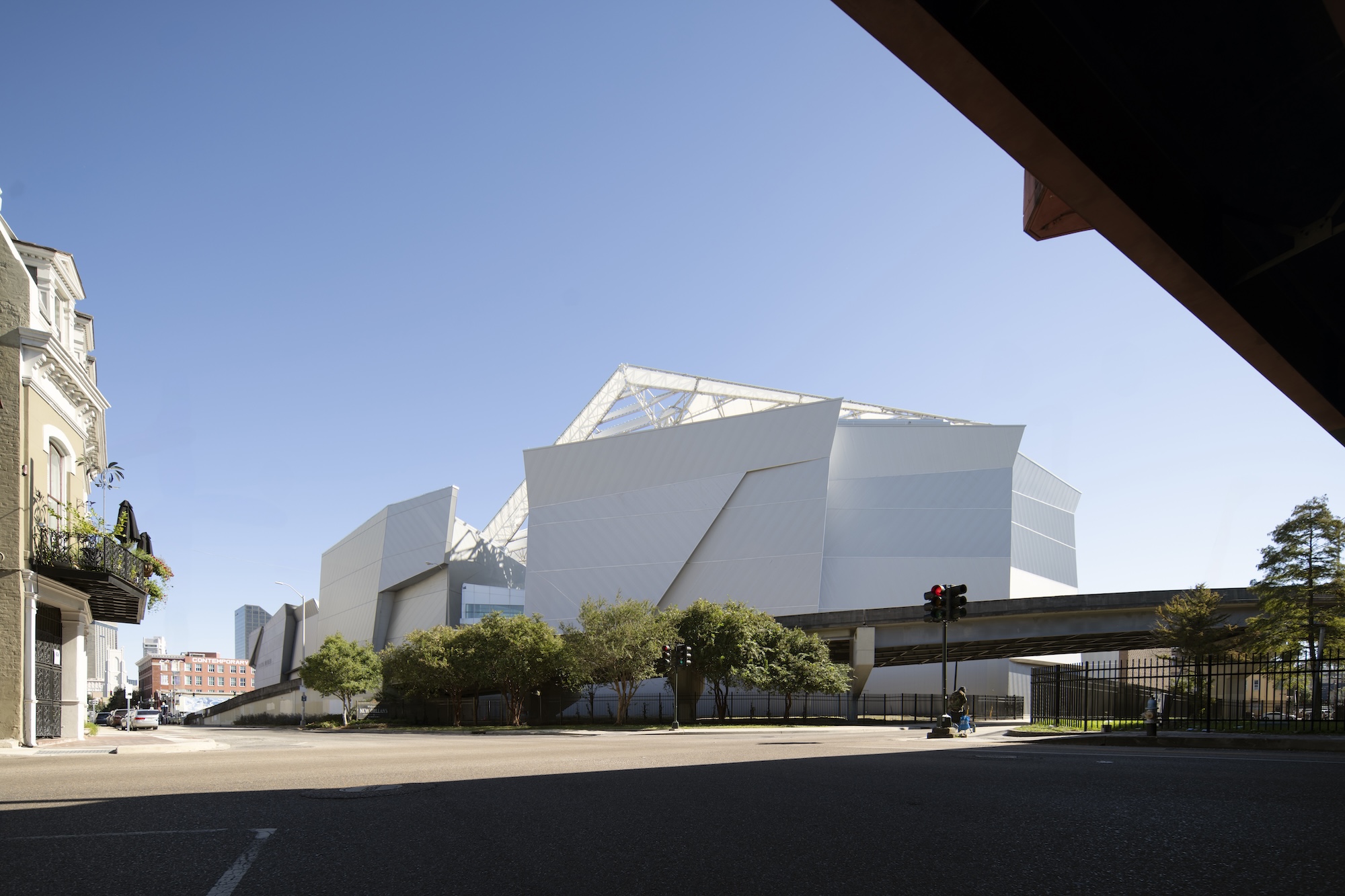
The National World War II Museum occupies a full-block site in New Orleans’s Warehouse District, near an exit ramp from U.S. Route 90. Photo © Thomas Damgaard
The National World War II Museum, having taken shape slowly over decades, had to endure many storms, both literal and figural—including Hurricane Katrina in 2005, which touched down just before construction, the 2008 financial crisis, and the onset of the Covid-19 pandemic in 2020. Therein lies an important lesson about patience and progress in today’s fast-paced world. “The duration of the project led to a kind of universal commitment for its many participants, none more than me,” says Voorsanger. “It involved chronicling the nation’s participation, recognizing our values and dedication to valor, and the endurance of a country’s effort. We’ve all been involved in projects we feel are particularly relevant, even transformative—but this was a gift for one’s lifetime.”
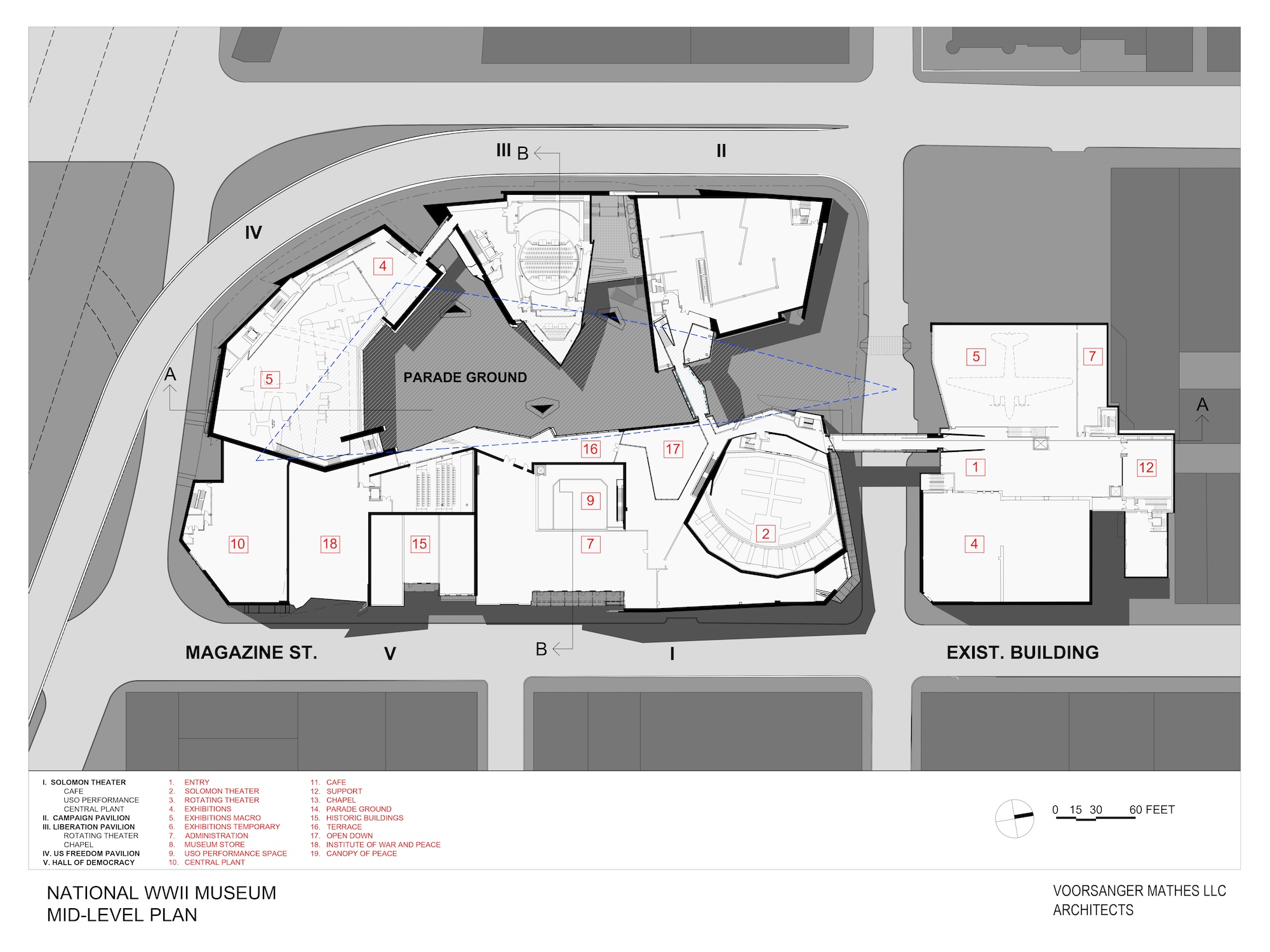
Drawing courtesy Voorsanger Architects; click to enlarge
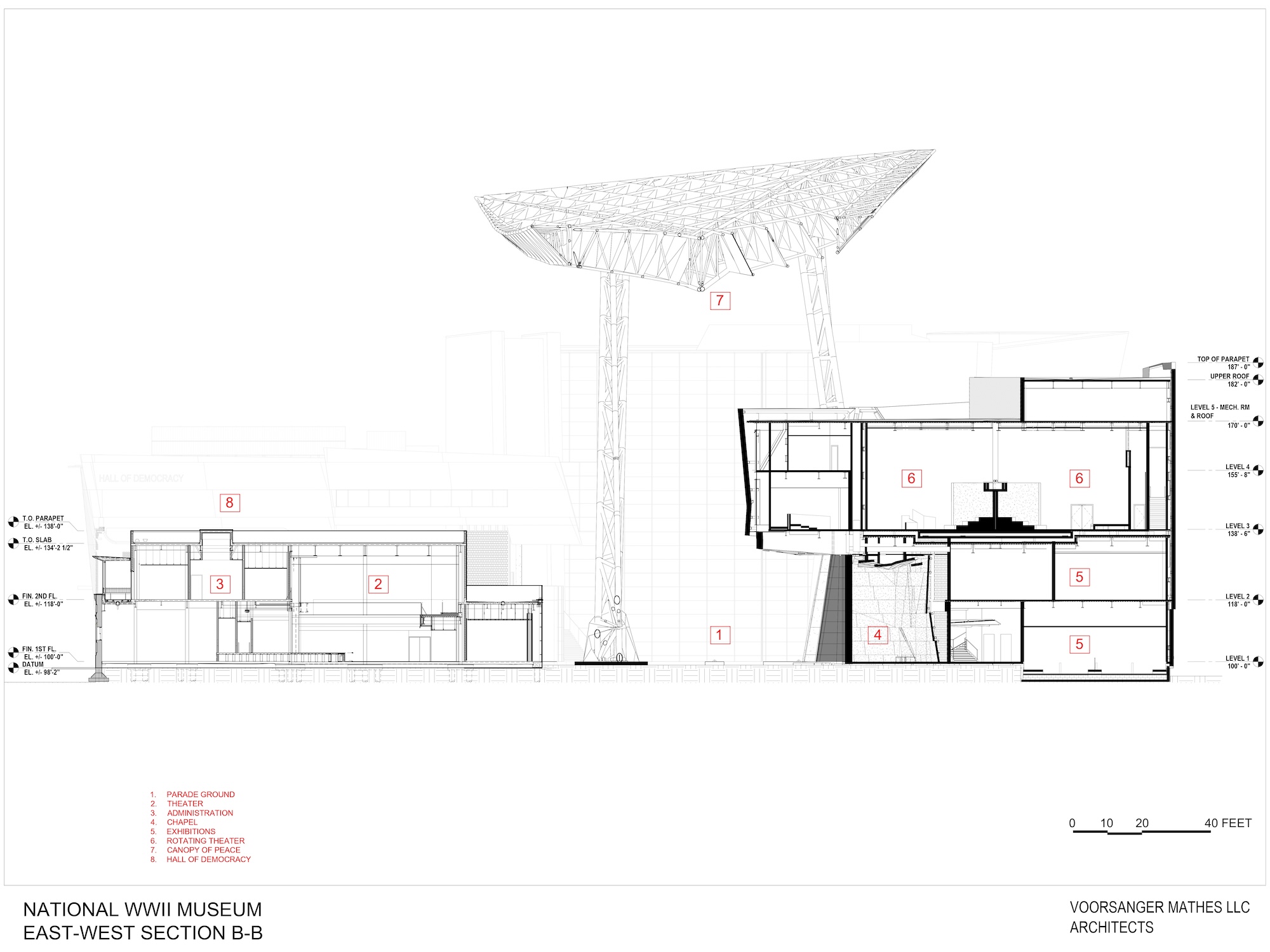
Drawing courtesy Voorsanger Architects
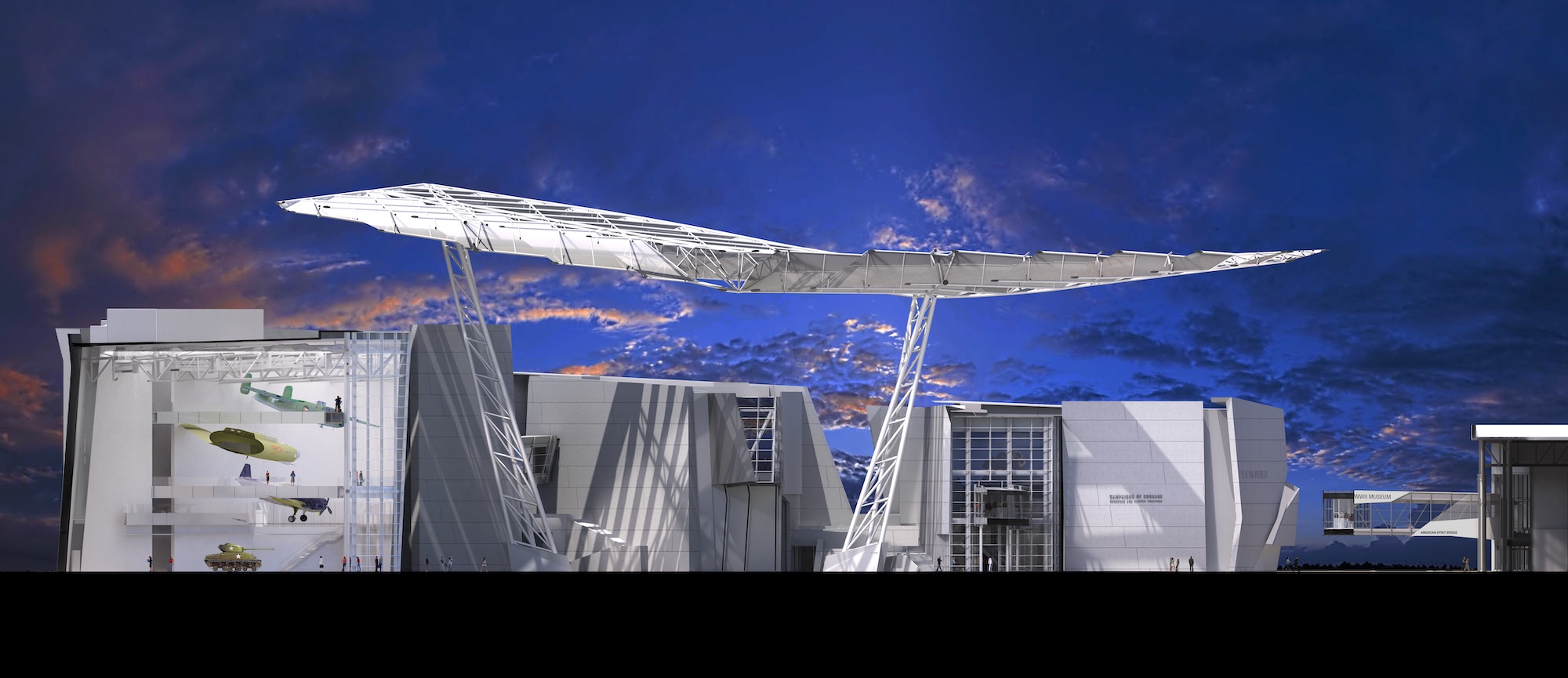
Image courtesy Voorsanger Architects
Credits
Design Architect:
Voorsanger Architects – Bartholomew Voorsanger, design principal; Martin Stigsgaard, Masayuki Sono, design leads;
Louis Dobday, Peter Miller, Van Hsin-Hung Tsao, Radoslaw Krysztoflak, Kyle Proefke, Andrea Wiedermann, Mark Wagner, Reema Pathak, Isse Suma, Won Jun Jung, design team
Associated Architect:
Mathes Brierre Architects — Edward Mathes, principal; Peter Priola, Scott Evans, Tony Alfortish, Joyce Bergman, Nichole Chauvin, CH Palm, Angela Morton, Jim Opitz, Josie Robin, Megan Williams, Elizabeth Chen, Jason Weyland, Vivien Yu, Suzanne Herzog, Keith Scarmuzza, team
Architect of Record
Voorsanger Mathes LLC
Interior designer
Voorsanger Mathes LLC
Engineers:
Structure: Thornton Tomasetti, Weidlinger Associates, Inc. (structural); Altieri, Altieri Sebor Wieber LLC (m/e/p/f); Morphy Makofsky (civil)
Consultants:
Landscape: Olin Partnership, Voorsanger Mathes LLC, Cashio Cochran (landscape); Avaliable Light & Solomon Group, Fisher Marantz Stone (lighting and AV); Gallagher and Associates (exhibit design); The Hettema Group (theater design); Jaffe Holden Acoustics, Inc. and Talaske (acoustics); Steven R. Keller and Associates, Inc., M & E Consulting, Inc; Security Design Solutions (security); Musso Architects (sustainability); Beck TV (media consultant)
General Contractors (phased construction): Bosworth Steel (Canopy); Brice Building Company (Campaigns Pavilion); CM Combs (Higgins Bridge, LA Pavilion Entry); MAPP (Liberation Pavilion, Parade Ground); Satterfield & Pontikes Construction (Theater, USO Pavilion); Woodward Design+Build (Freedom Pavilion); Roy Anderson (Hall of Democracy); Trimark Construction (Infill Building, American Sector)
Client:
The National WWII Museum
Size:
310,000 square feet
Cost:
Withheld
Completion:
June 2024
Looking for a reprint of this article?
From high-res PDFs to custom plaques, order your copy today!