Parks & Recreation 2026
A Combined Velodrome and Community Recreation Hub Reinforces the Character of an Existing Park in Edmonton
Edmonton, Canada
A velodrome, with cyclists streaming around a precision-engineered banked track at top speeds of over 50 miles an hour, is one of the most technically demanding facilities to design in the world of sport. It’s also inherently insular: a closed loop that cannot be crossed. And it’s big: at 820 feet in circumference, elite-standard velodromes are not a building type that lands easily in an existing city park, especially one that’s already home to significant works by major architects. But the new Coronation Park Sports and Recreation Centre, by HCMA Architecture + Design and Dub Architects in a joint venture, in collaboration with velodrome experts FaulknerBrowns, pulls it off: integrating a high-performance cycling facility into a community recreation hub to the benefit of both, while also strengthening the park itself.
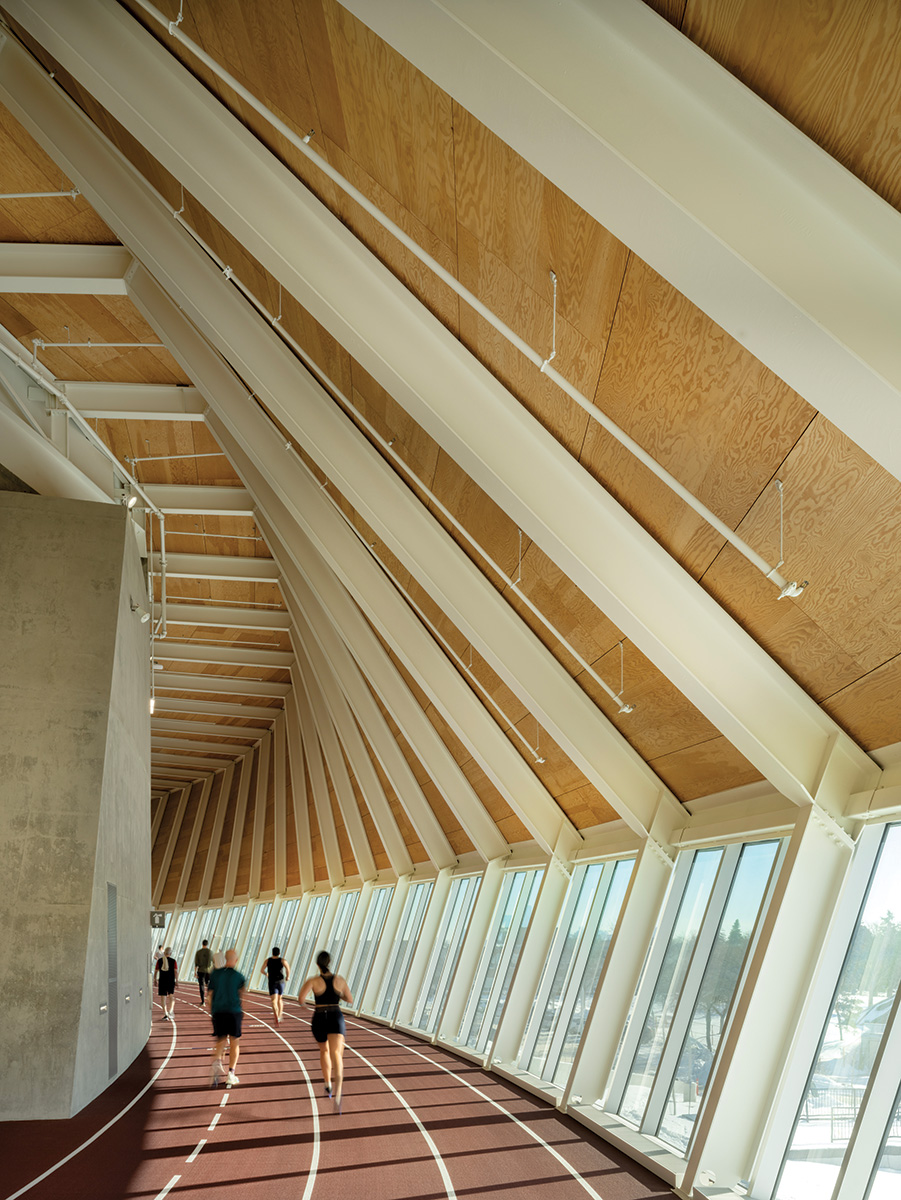
Steel ribs support the tilted and curved mass-plywood roof. Photo © Nic Lehoux
Located in a mature suburb of Edmonton, Canada, and completed in late 2025 for $112 million, the 179,000-square-foot, two-story facility provides much-needed indoor opportunities for exercise and connection year-round. The building’s siting and alignment emerge from the logic of the 86-acre park’s original scheme, built in 1953, which had become fractured by the insertion of other buildings over time. “It really was a landscape move that started it,” says Darryl Condon, a principal in the Vancouver office of HCMA. “It came from our examination, understanding, and desire to reinforce the park.” The design of the new center also relates to its neighbors, such disparate examples of organic modernism as the 1967 Peter Hemingway Fitness and Leisure Centre (formerly Coronation Pool, renamed for its architect in 2005) and a science center (1984) by Douglas Cardinal.
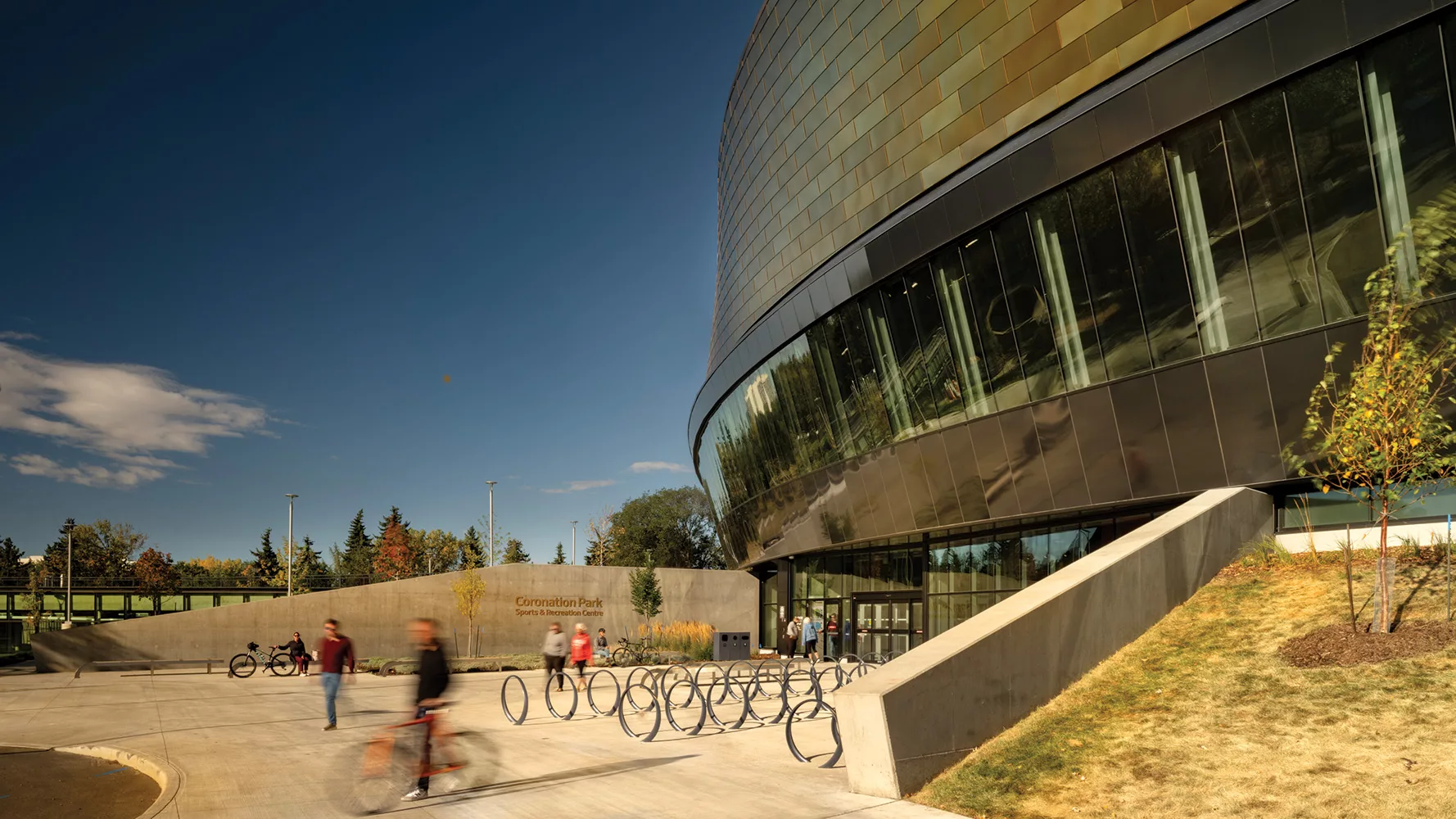
Even more than the Hemingway and Cardinal works—“created topographies,” as Condon describes them—the new building reads as a landform. A dynamically skewed elliptical volume with a low-slung roof, it’s set into large berms banked against the ground floor; concrete-sided embrasures cut through the berms at entrances and window walls. With the single simple move of this literal created topography, the design achieves three goals: it reduces the structure’s apparent volume; it relates to the other architecture on the site (especially the Hemingway building, to which the new facility connects via a bermed passage); and it grounds the center within the park. The landscape design, by Vancouver-based PFS Studio, extends this work of integration and repair into the park as a whole, clarifying its structure while expanding its program.
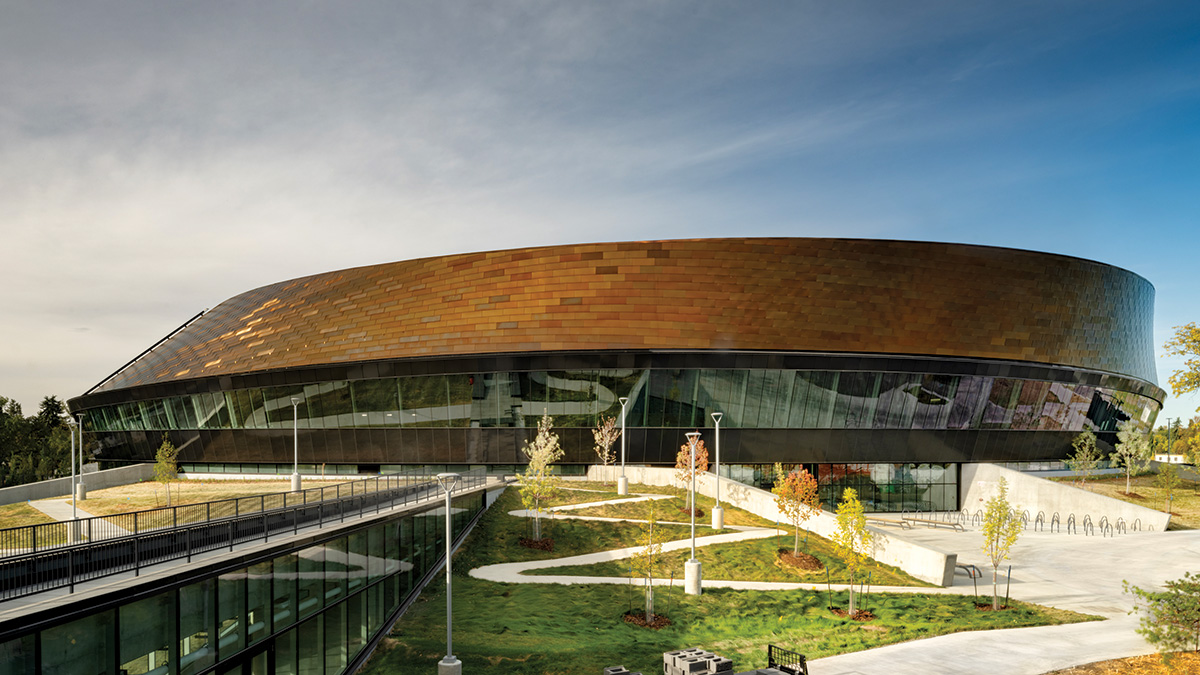
The roof’s copper-tinted stainless-steel cladding shifts in color with the angle of the sun. Photo © Nic Lehoux
The building’s torsional massing, inspired by cycling’s fast and tilted motion, results from a 90-degree rotation of its clear-span roof. The twisted surface is constructed using straight radiating steel ribs and an exposed mass-plywood diaphragm, all supported on four massive concrete columns. (The mass-plywood panels, over 2 inches thick and up to 36 feet long, perform predictably under torsion, rare in a wood product.) The roof sides, hovering above a ribbon of glazing, are clad with copper-tinted stainless steel that shifts color with the angle of the sun. Viewed longitudinally, the envelope tilts inward, reducing the perception of mass and becoming continuous with the berm; viewed transversely, the envelope tilts out, expansive, ceremonial, and welcoming. “From one angle it can seem like a background building, and from another it’s a foreground building,” says principal Michael Dub of the Edmonton-based practice. “It’s remarkable, given the nature and scale of the building, that it can be both.”
1
2
3
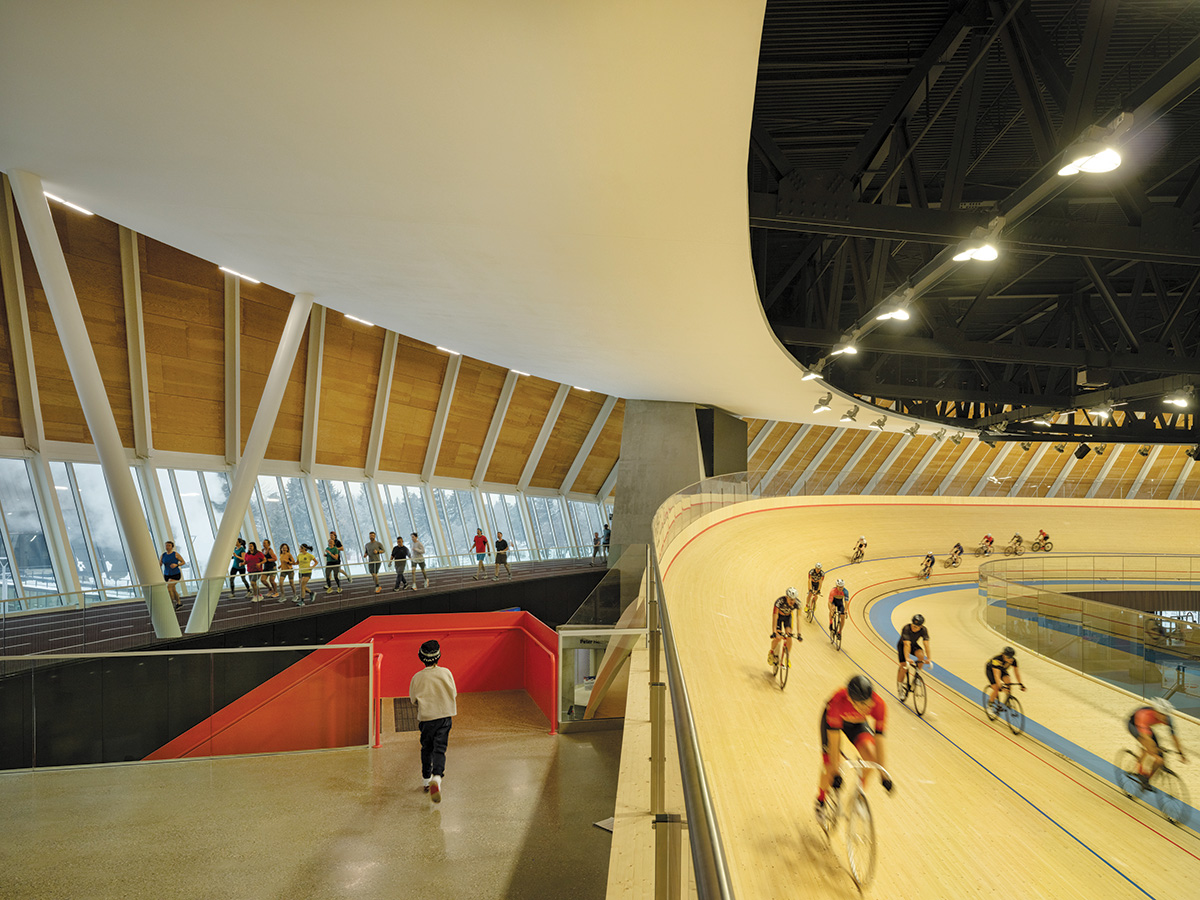
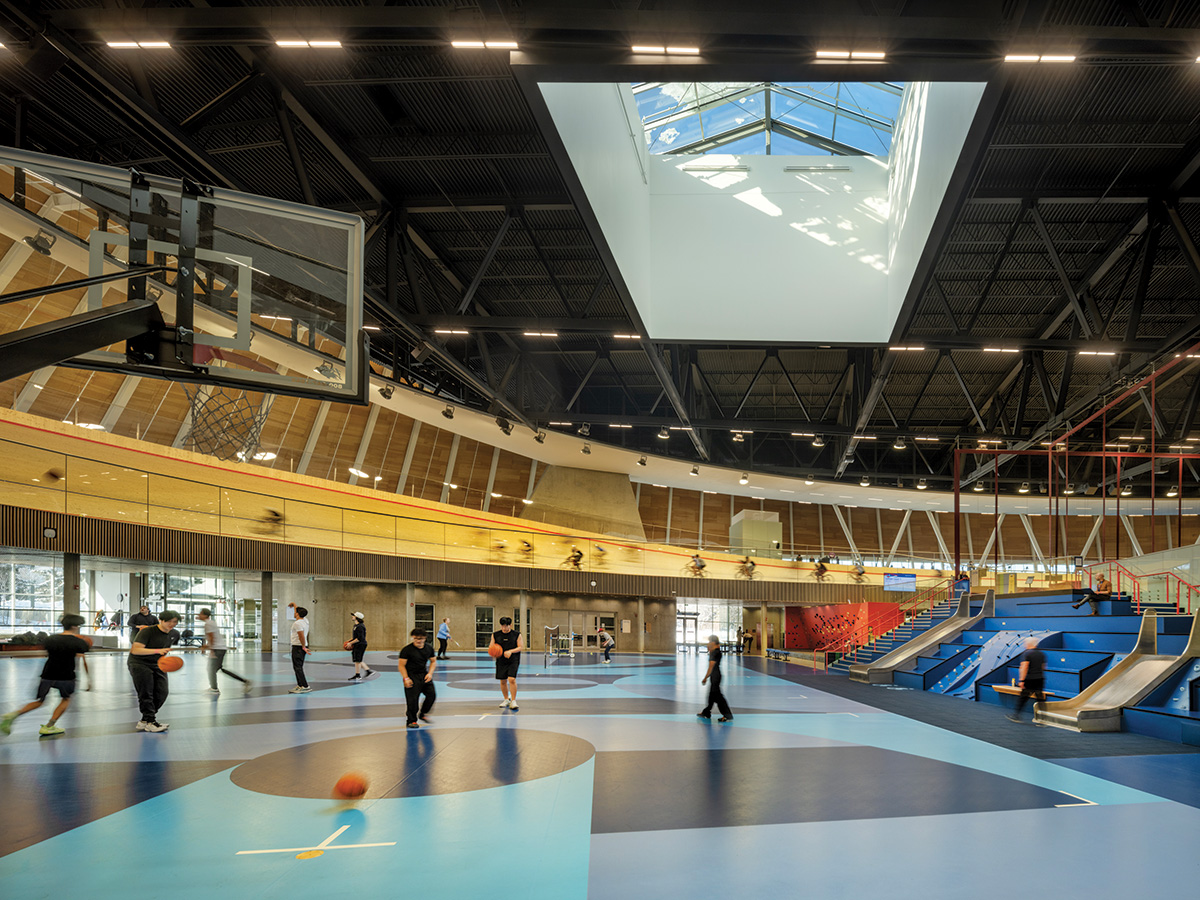
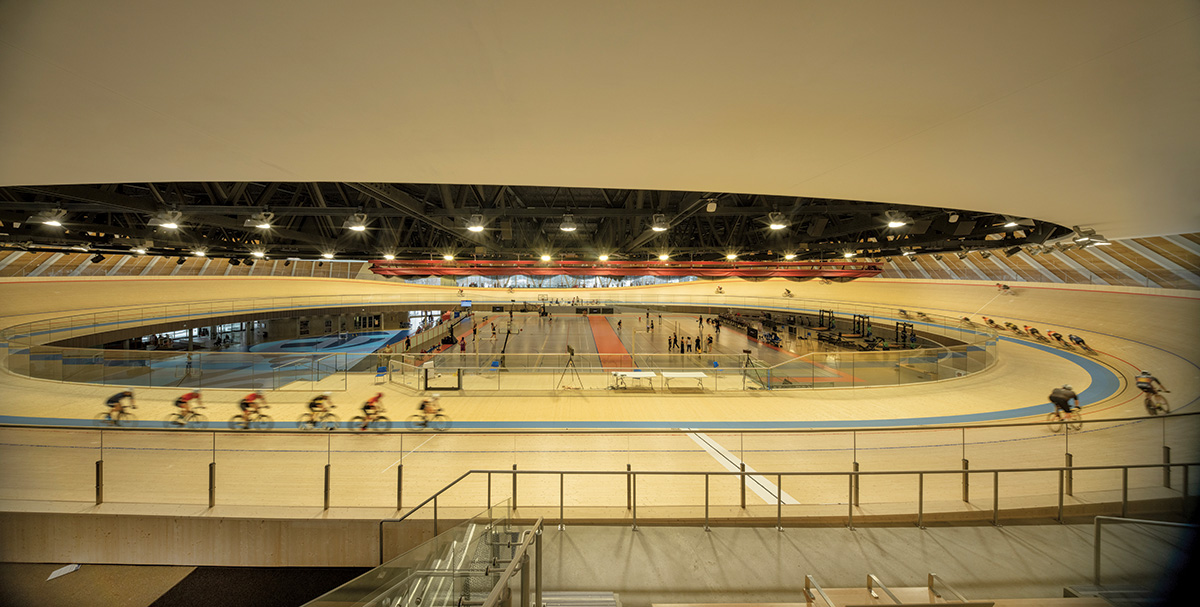
The perimeter running track encircles the cycleway (1). A lower-level “urban court” supports pickup games (2), while two basketball courts sit in the cycling track’s infield (3). Photos © Nic Lehoux
Linking the zones inside and outside the closed loop of the cycle track presented the designers with the project’s defining programmatic challenge. Velodromes typically make the connection either by tunneling beneath the track and resurfacing, which disorients visitors and offers a poor welcome, or by elevating the track completely, which isolates the sport from the rest of the facility. Here, says Condon, “we took the infield—a vital staging area in competitive mode—and split it into two levels, so that in daily use the informal activity of the park can flow through the building and up into that central area,” a move, he says, that connects the heart of the cycle track with the community.
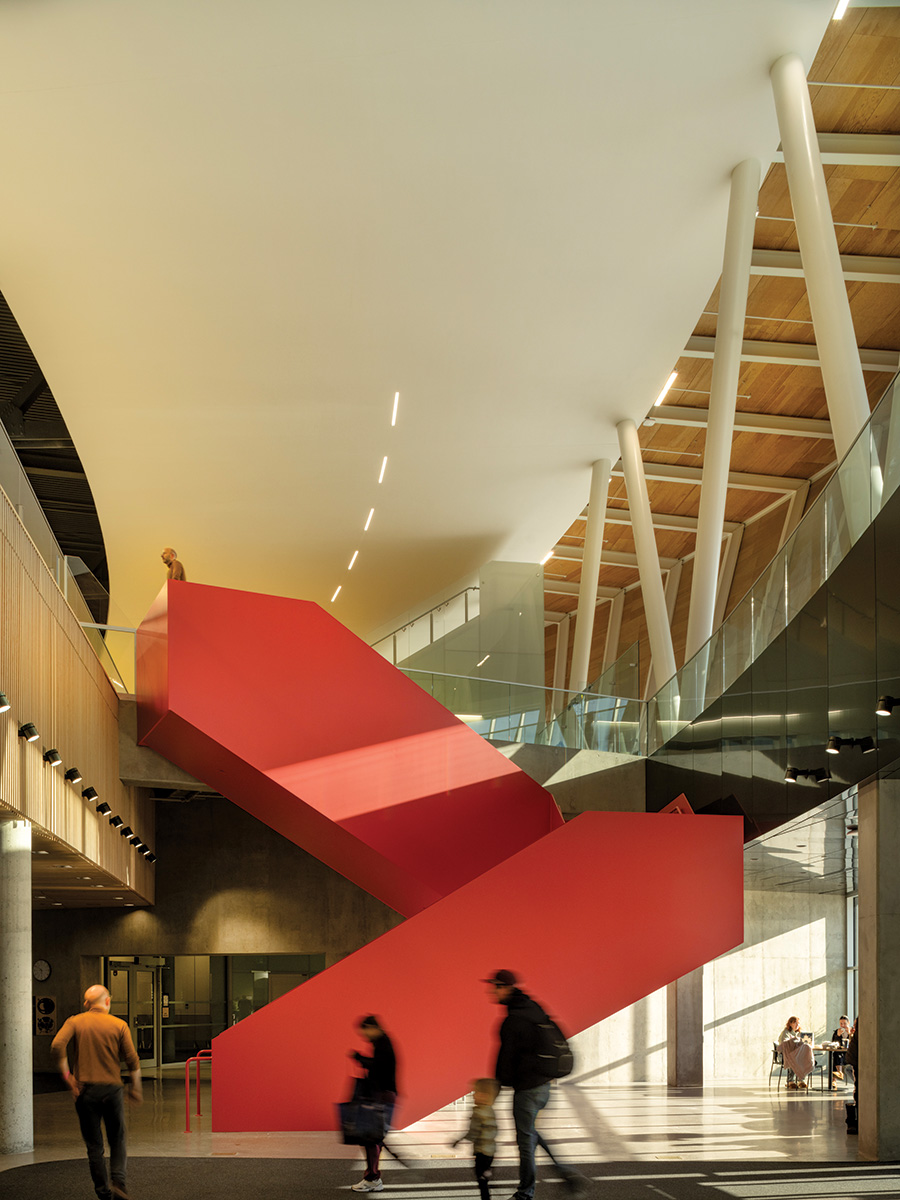
A double-height lobby greets visitors Photo © Nic Lehoux
Two basketball courts occupy the upper-level infield, while a third, “urban court,” on the lower level supports casual drop-in use as a year-round extension of the park. Connecting the two floors are a wide social stair, bleachers, and—in a fun move—two slides. Activity rooms, such as fitness studios and an indoor playground, are located along the ground-level windows, while changing rooms are tucked under the upper courts. Encircling the cycleway, on the upper level, a four-lane running track follows the ribbon of perimeter glazing. As runners pace along it, they animate the building—and, in turn, the surrounding landscape—their efforts rewarded with 360 degrees of views of the renewed park.
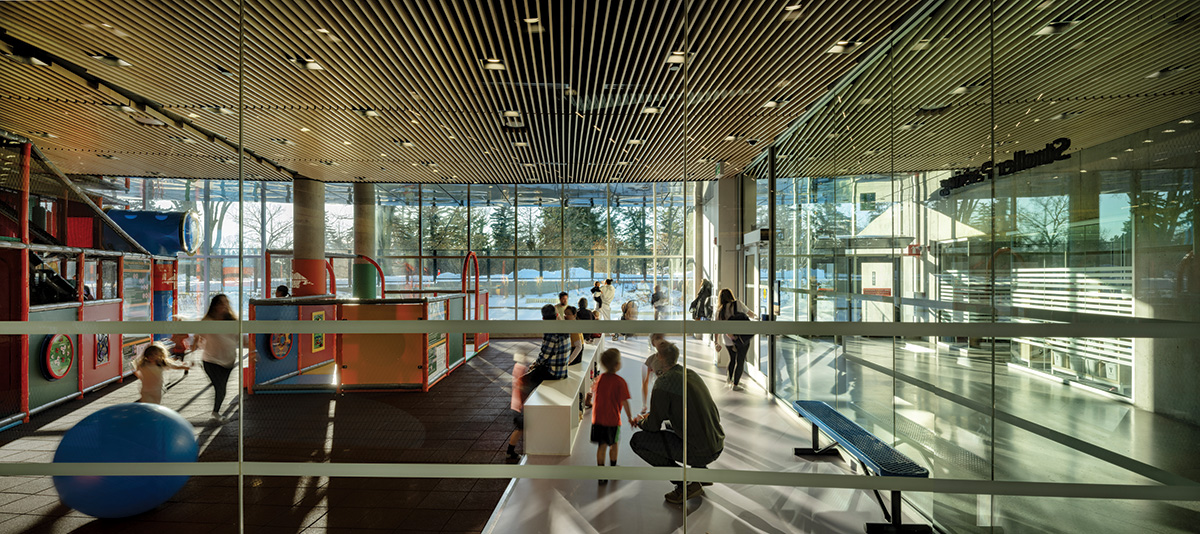
A children’s play area enjoys a direct visual connection to the park. Photo © Nic Lehoux
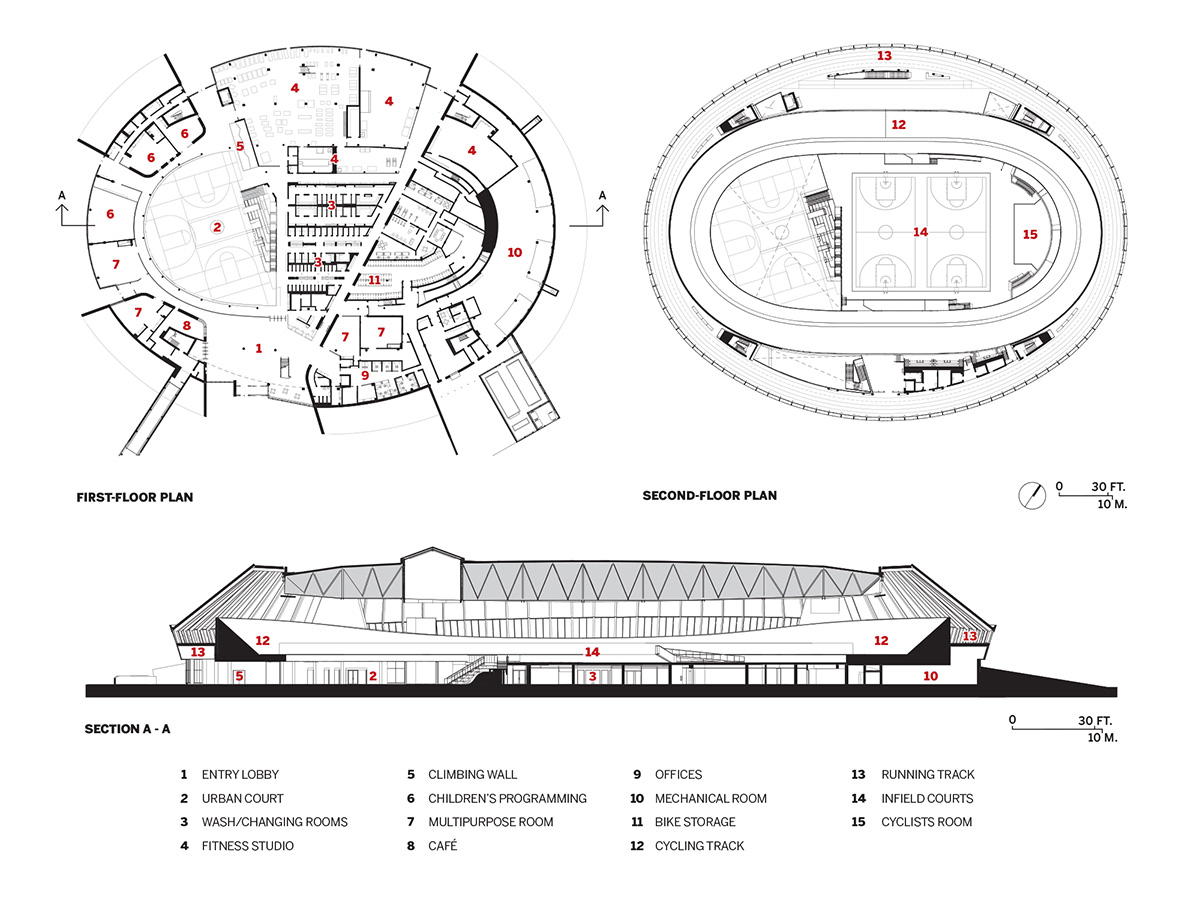
Image courtesy HCMA Architecture + Design and Dub Architects, click to enlarge
Credits
Architect:
Joint venture by HCMA Architecture + Design and Dub Architects — Darryl Condon, Michael Henderson, principals in charge (HCMA); Michael Dub, principal in charge (Dub); Paul Fast, advising principal (HCMA); Michael Rivest, project architect (HCMA)
Associate Architect:
FaulknerBrowns
Consultants:
Fast + Epp (structural); Williams Engineering (mechanical, electrical); WSP (civil); RJC (envelope); RWDI (acoustic); PFS Studio (landscape)
General Contractor:
Clark Builders
Client:
City of Edmonton
Size:
179,000 square feet
Cost:
$112 million (total)
Completion:
January 2026
Sources
Metal Cladding:
Rimex Metals, Alucobond
Curtain Wall:
Kawneer
Glazing:
Vitro Architectural Glass, Garibaldi Glass, Ultisol International
Insulation:
Rockwool
Moisture Barrier:
Soprema
Doors and Hardware:
Kawneer, Spalding, Stanley, SDI, MobilFlex, TGP, C.R. Laurence, Dormakaba, Schlage, Assa Abloy, Von Duprin, Camden Door Controls, Entrematic
Acoustical Ceilings:
Gemetrik, Fellert, USG
Solid Surfacing:
Corian
Resilient Flooring:
Forbo
Fixed Seating:
Landscape Forms
Looking for quick answers on architecture and design topics?
Try Ask RECORD, our new smart AI search tool.
Ask RECORD →
Looking for a reprint of this article?
From high-res PDFs to custom plaques, order your copy today!