Books
A New Book by Harry Francis Mallgrave Explores the Evolution of American Architectural Discourse
'Writers on Architecture in America: From Jefferson to Giedion' by Harry Francis Mallgrave
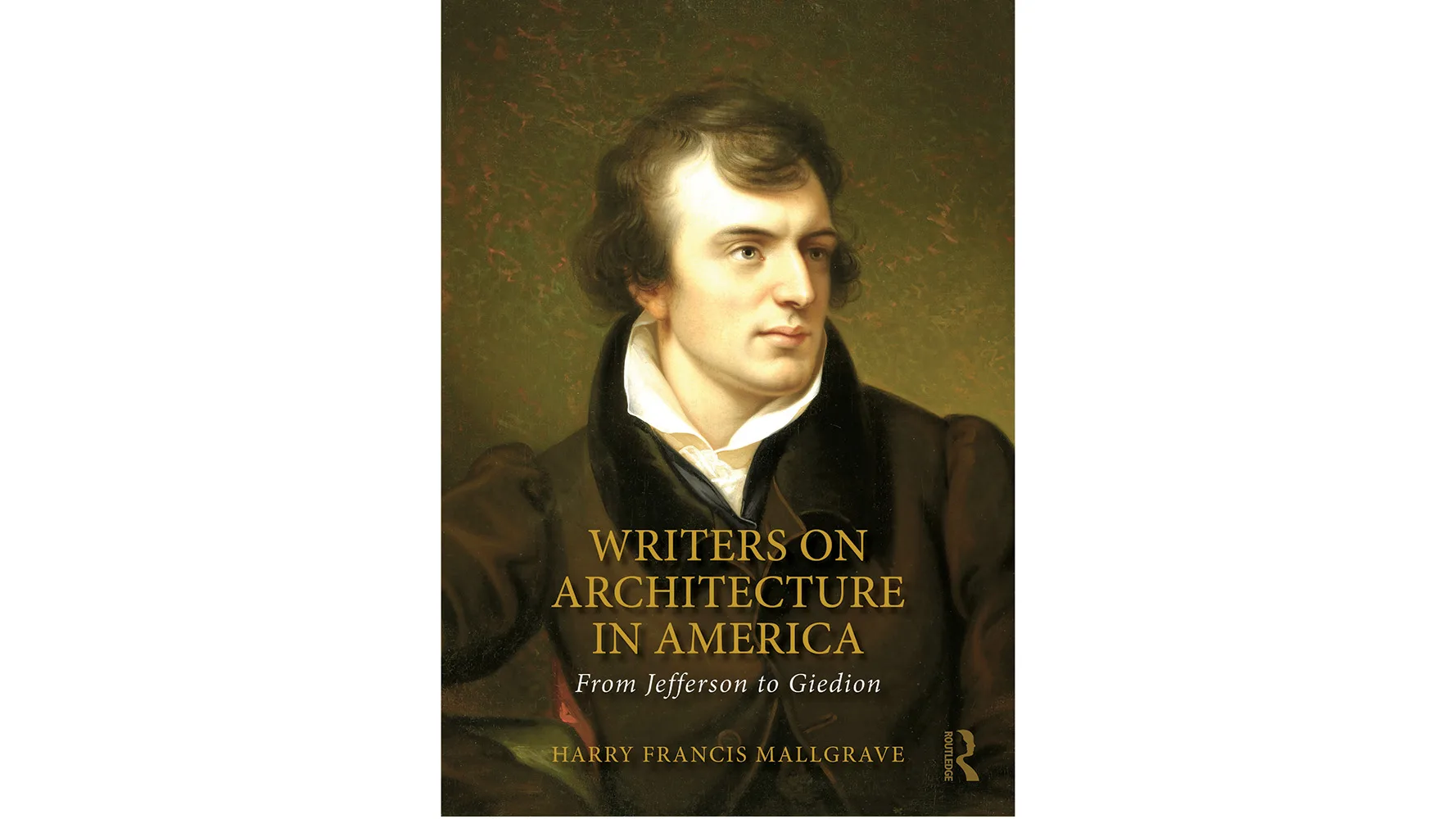
Writers on Architecture in America: From Jefferson to Giedion, by Harry Francis Mallgrave. Routledge, 278 pages, $58
When the Founding Fathers gathered in Philadelphia 250 years ago this summer to declare the nation’s independence, it was Thomas Jefferson, an architect, who drafted the document. The ideas of architects expressed through the written word can therefore be said to be an integral part of the American experiment. Rather than retrace the well-trodden history of specific buildings in the United States, or the culture that produced them, in his new book, Harry Francis Mallgrave explores the evolution of architectural discourse in this country. Starting with Jefferson, Mallgrave moves through notable figures including H.H. Richardson, Louis Sullivan, and Catharine Beecher, to name a few, and nominally ends with Sigfried Giedion (a lengthy epilogue extends the discussion into the 1980s and Kenneth Frampton). Following is an excerpt from chapter eight, on perhaps America’s most famous architect and his first publication in RECORD.
In 1906, Wright, notwithstanding the quality of work he had produced over a decade, had relatively little national recognition. The most significant survey of a few works had come in the previous year when Herbert Croly devoted an issue of record to domestic design that featured his article “The Work of Frank Lloyd Wright; its Influence.” Croly noted that Wright’s houses “imperatively claim attention, not only because of their startling qualities, but also because of the influence they have had,” and thus Wright “stands out more prominently than does any other Western architect.” Croly even likens Wright’s work to the “new art” appearing in France and Germany, in which one seeks “to secure a more truthful relation between structure and design, a franker expression of the quality of the material in its treatment, and a basis for architectural ornament, less stereotyped and artificial than that which the majority of architects use.” He reports that Wright’s “designs are neither bizarre nor academic,” and he cites his preference for “low long buildings, fitted tight to the ground by heavy overhanging roofs,” which create deep shadows and a picturesque effect. His exteriors “are certainly highly interesting; and they are so because every mass, surface, shadow, and detail contribute to one consistent and spectacular effect.” He tempered his praise by noting how Wright’s low rooflines limit the natural light admitted into the interior. He sums up the architect’s work as “sufficiently popular as well as legitimate and original; and whatever its influence has been in the past, it will be even more efficacious in the future.”
Wright’s major breakthrough came in March of 1908 when record offered him an abundance of space to articulate his design philosophy and illustrate it with 87 images. Wright penned a now classic defense of his work, in which he wraps his philosophy in the transcendental mantle of “Nature” and Sullivan’s creed of democracy. He defines the idea of the “organic” as “indispensable to the architect,” the relationship of form and function that nature herself displays. He also—following his trip to Japan in 1905—points to the refinements of Japanese artists who knew this school of nature “more intimately than that of any people.”
Their key concept, he writes, is the word edaburi, which he elucidates as “the formative arrangement of the branches of a tree. We have no such word in English—we are not yet sufficiently civilized to think in such terms—but the architect must not only learn to think in such terms, but he must learn in this school to fashion his vocabulary for himself and furnish it in a comprehensive way with useful words as significant as this one.”
The tree metaphor leads him to define six guiding principles of the “New School of the Middle West,” which he praises as larger than himself by noting the work of [Robert] Spencer, Myron Hunt, and Dwight Perkins, among others. His design principles are interrelated. Styles are as many as there are people, and a house should have sincerity and integrity. Earth-tone colors should be muted in their use, and one should exploit the true nature of materials. A house should be integrated with its site (low, gently sloping, quiet rooflines on the prairie); simplicity and repose also call for as few rooms as possible with openings integral with the design. The home should have less detailing, built-in furnishings, and walls without pictures. Windows have major importance. He not only rejects cutting holes in the wall for the “poetry-crushing characteristics of the guillotine window” but also makes casement windows a “must take them or leave the rest” proposition for any prospective client, which has led more than a few of his suitors to employ “the other fellow.”
Another insight into his design thinking is the importance he places on “atmosphere,” which he defines as the quiet and simple dignity that should be sought in every design. “This is the modern opportunity,” he writes, “to make of a building, together with its equipment, appurtenances, and environment, an entity which shall constitute a complete work of art, and a work of art more valuable to society as a whole than has before existed because discordant conditions endured for centuries are smoothed away.”
He refers to this process as “an idealization of the common need” that is in itself uplifting and helpful. His architecture is not “thrown up” in the artistic exercise of creating a floor plan and then designing the elevations; rather, his “schemes are conceived in three dimensions as organic entities.”
Looking for quick answers on architecture and design topics?
Try Ask RECORD, our new smart AI search tool.
Ask RECORD →
Looking for a reprint of this article?
From high-res PDFs to custom plaques, order your copy today!