Converting a Store and a Warehouse into Schools for a Tornado-Ravaged Missouri Town
 |
One of the replacement schools was a supermarket that had been empty for 10 years. Another structural conversion reconfigured a warehouse. |
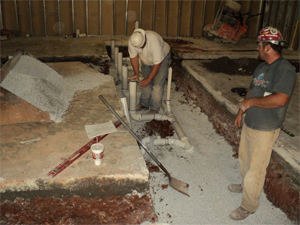
It took just minutes for a tornado packing 200-mph winds to level a third of Joplin, Mo.'s public schools last spring. In a remarkable turnaround, it took less than three months to bring the schools back on line in time for the new school year.
On Aug. 17, classroom sessions resumed on schedule in Joplin, even as construction crews continued cleaning up from the May 22 tornado, an EF5 event that cut a mile-wide swath through a six-mile stretch of the city, killing more than 150 residents and injuring another 1,000.
The tornado destroyed six of 19 school buildings and severely damaged three others, leaving school administrators scrambling to locate and renovate replacement facilities, some of which will function as fully operating schools for up to three years.
Many of the facilities initially were constructed for uses far different from schooling. Joplin High School houses 11th- and 12th-grade students in an 80,000-sq-ft Shopko store that stood vacant for 10 years, while East Middle School is operating in a 50,000-sq-ft warehouse in an industrial park.
“There was huge demand for space in the days following the tornado,” recalls assistant superintendent Angie Bessendorfer. “People find it interesting we've converted a Shopko to a high school, but the reality is, the store was the only 80,000-sq-ft space available. We didn't want our students returning to trailers in a field.”
Once FEMA agreed to fund 75% of project costs, the decision to proceed with replacement facilities was immediate, with contracts calling for work to conclude no later than Aug. 10. To help expedite construction, Missouri Gov. Jay Nixon waived the bidding requirements required for public projects.
Bessendorfer says the majority of designers and builders involved in the projects were closely associated with Joplin's school district as a result of past or pending projects.
Kevin Greischar, principal with Overland Park, Kan.-based DLR Group, design architect for the high school, arrived in Joplin on June 3 and, with a staff of six, set up shop in a classroom in one Joplin's remaining school buildings. Schematics for the $5.5-million project were performed on June 8 and the morning of June 9, then presented to administrators that afternoon.
“We supplied a simplified floor plan, knowing we were flying the airplane at the same time we were building it,” says Greischar. Columbus, Kan.-based general contractor Crossland Construction began demolition of storage and back-office space on June 11.
“All we had were four walls and a roof,” says Crossland project superintendent Aaron Shnurbusch. “A similarly scaled school would have required a year to a year and a half to complete. Here, we had about eight weeks, so we handpicked subcontractors we'd had long relationships with and who we knew had the manpower and expertise to pull it off. The floor plan allowed us to begin by building out interior walls, with the understanding that the locations of doors and such might later be modified.”
Final design documents were completed three weeks after schematics, on June 30.
Scheduling for the $4.5-million middle school was no less forgiving.“We first learned about the project on June 3, a Friday, and developed schematics over the weekend,” says Kyle Denham, principal with Joplin-based PLJBD Architects, the project's designer. Crossland, also contractor for middle school, began work on June 13.
When workers arrived on-site, they encountered a spec pre-engineered metal building with gravel flooring and exposed metal walls and supports. With the project similar to the high school job, workers had little more in hand than a floor plan. “All we could do was make assumptions about what we were going to need,” says Crossland project manager Tad Johnson.
Although workers initially busied themselves by pouring a 40,000-sq-ft slab, a task requiring about a week, scheduling constraints later dictated they re-roof the building at the same time they performed interior work. “We removed only those section we could replace in a day to ensure interior conditions remained weather-tight,” says Johnson.
On any given day, 100 to 125 tradesmen were on-site, with concrete workers following behind plumbers and electricians as they installed equipment, piping and conduit underground. “Because work was prevailing wage, we didn't want to build a lot of overtime into the schedules,” says Johnson. “As a result, we selected subcontractors we knew could supply the required manpower.”
Interior systems and finishes for the middle school and high school were selected on the basis of availability, as well as the ability to remove them once permanent replacement facilities are constructed.
On the day construction commenced on the high school, representatives from Crossland, DLR Group, local architect Corner Greer and Associates and Joplin-based electrical contractor Bill Electric traveled to Carthage, 30 miles north of Joplin, to evaluate high-efficiency lighting fixtures for an existing ceiling grid. “Two days later, we had 450 fixtures on-site,” says Greischar. “Every material we used was selected on the basis of how quickly we could get it.”
“In addition to 100 doors and related hardware, we required Sheetrock, carpet, floor tiles, ceiling tiles and a host of finishes, so we met weekly to coordinate and stay on top of our delivery schedules,” says Shnurbusch.
While project members generally preferred modular or prefabricated systems, “we found it was faster and quicker and cheaper to use metal studs and prefinished drywall than demountable partitions,” says Greischar. Wall finishes include vinyl, Polygal sheeting and transparent polycarbonate plastic. Exposed trays extending along walls route data cabling.
Final construction costs for the high school totaled $50 to $55 per square foot, significantly less than costs typically associated with similar buildings, a savings Greischar attributes to the sound condition of the building's mechanical system, a combination of duct furnaces and a chiller.
“There wouldn't have been time to repair or replace a mechanical system,” says Shnurbusch. Alterations were relatively minor. Because the system was designed for retail use, split systems were introduced to offices to promote air flow.
Elsewhere, walls fall one to three feet short of ceiling heights to promote circulation.
While the high school is designed to house 1,000 students, the middle school can accommodate up to 600, though it is unclear how many students displaced by the tornado will eventually return.
“Beginning the school year on time will help restore a sense of normalcy to those who do return,” says Bessendorfer.
Looking for a reprint of this article?
From high-res PDFs to custom plaques, order your copy today!