Architectural Record
search
cart
facebook twitter linkedin youtube
  • Sign In
  • Subscribe
  • Sign Out
  • My Account
Architectural Record
  • NEWS
    • Latest News
    • Awards
    • Interviews
    • Obituaries
    • Podcasts
      • Design:Ed Podcast
      • Sponsored Podcasts
  • OPINION
    • Book Reviews / Excerpts
    • Exhibition Reviews
    • Forum
  • EXCLUSIVES
    • Videos
    • Design Vanguard
    • Top 300 Firms
    • Sponsored Content
    • Sponsored eBooks
    • From the Archives
  • CONTINUING ED
    • Editorial Continuing Ed
    • CE Center
    • CE Academies
  • PROJECTS
    • Buildings By Type
    • Reuse & Renovation
    • Museums & Arts Centers
    • Colleges & Universities
    • Multifamily Housing
    • Interiors
    • Lighting
    • Kitchen & Bath
  • HOUSES
    • Record Houses
    • House of the Month
    • Featured Houses
  • PRODUCTS
    • Products by Category
    • Record Products of the Year
    • Latest Products
  • EVENTS
    • Dates & Events
    • Record on the Road
    • Innovation Conference
    • Sustainability in Practice
    • Women In Architecture
    • Webinars
    • Ad Excellence Awards
    • Submit an Event
  • CONNECT
    • Ask RECORD AI
    • Newsletters
    • Contact
    • Advertise
    • Editorial Calendar
    • Store
    • Customer Service
  • SUBMIT
    • Submission Guidelines
    • RECORD Competitions
  • MAGAZINE
    • Subscribe
    • My Account
    • Digital Edition
    • Current Issue
    • Firm Pass
    • Historic Archive
Architecture News

Exhibition Review: A Confederacy of Heretics: The Architecture Gallery, Venice, 1979
By Sarah Amelar
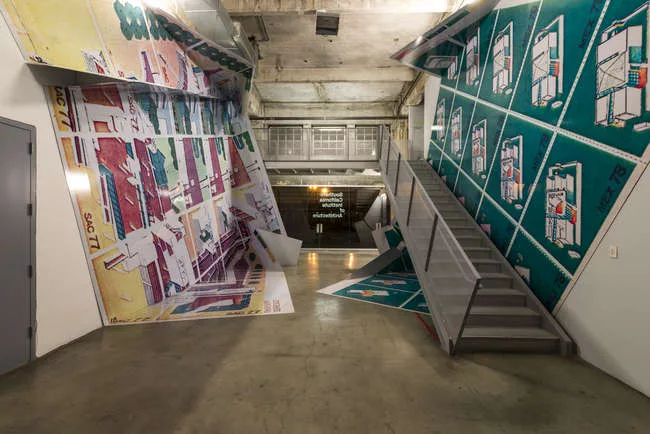
Zago Architecture, the exhibition designers, wrapped the entry zone in skewed, blown-up reproductions of Morphosis' mock postage stamps &#8211; a clever riff on <em>Graphic Wrap</em>, one of the six s
Exhibition Review: A Confederacy of Heretics: The Architecture Gallery, Venice, 1979
Zago Architecture, the exhibition designers, wrapped the entry zone in skewed, blown-up reproductions of Morphosis' mock postage stamps – a clever riff on Graphic Wrap, one of the six spatial strategies the curators identified in the featured work, most notably Eric Owen Moss' Fun House.
Photo © Joshua White
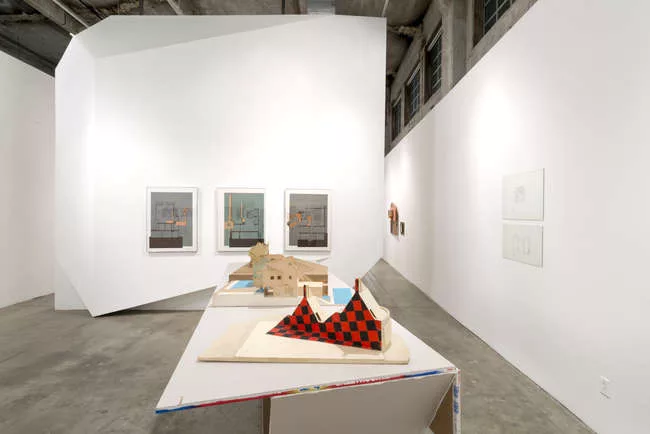
Eric Owen Moss' unrealized <em>Fun House</em> (1980), as it appears in a vintage model, plays semi-severed sculptural forms against a graphic wrap. On the wall, Morphosis' <em>Sixth Street House</em>
Exhibition Review: A Confederacy of Heretics: The Architecture Gallery, Venice, 1979
Eric Owen Moss' unrealized Fun House (1980), as it appears in a vintage model, plays semi-severed sculptural forms against a graphic wrap. On the wall, Morphosis' Sixth Street House (1986-92) in Venice is depicted in finely detailed seriliths integrating metal foil.
Photo © Joshua White
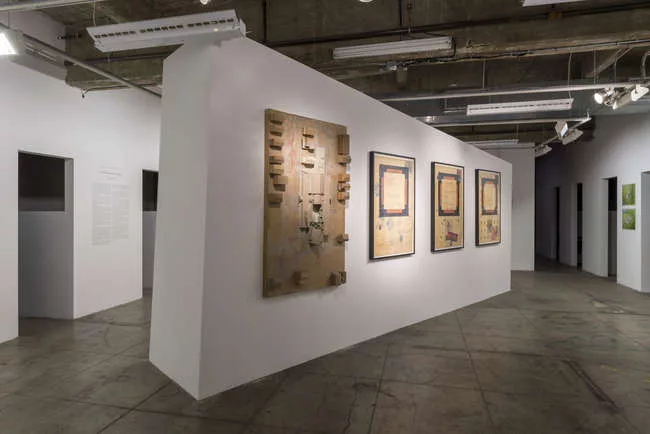
In a model and elaborate drawings, Studio Works' <em>South Side Settlement</em> (1975-80), built in Columbus, Ohio, is featured in SCI-Arc's Library Gallery (though much of the exhibition fills the sc
Exhibition Review: A Confederacy of Heretics: The Architecture Gallery, Venice, 1979
In a model and elaborate drawings, Studio Works' South Side Settlement (1975-80), built in Columbus, Ohio, is featured in SCI-Arc's Library Gallery (though much of the exhibition fills the school's main gallery, one floor below).
Photo © Joshua White
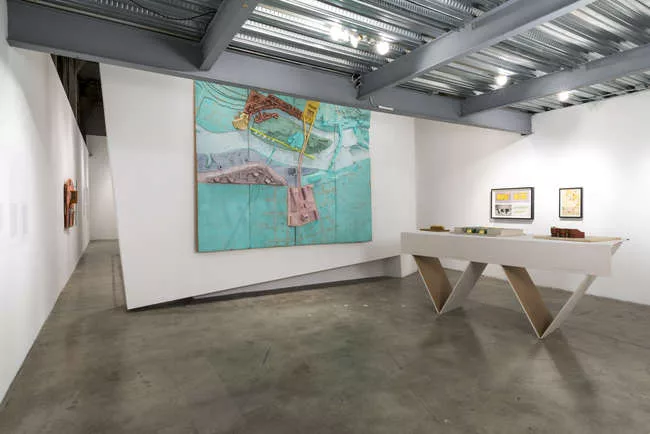
The installation includes an original 1976 model of <em>The RIver and the City</em>, a scheme by Studio Works (Craig Hodgetts and Robert Mangurian) for Minneapolis' Nicollet Island. The diagonal table
Exhibition Review: A Confederacy of Heretics: The Architecture Gallery, Venice, 1979
The installation includes an original 1976 model of The RIver and the City, a scheme by Studio Works (Craig Hodgetts and Robert Mangurian) for Minneapolis' Nicollet Island. The diagonal table, with models by Eric Owen Moss, recalls that architect's 1979 installation.
Photo © Joshua White
Zago Architecture, the exhibition designers, wrapped the entry zone in skewed, blown-up reproductions of Morphosis' mock postage stamps &#8211; a clever riff on <em>Graphic Wrap</em>, one of the six s
Eric Owen Moss' unrealized <em>Fun House</em> (1980), as it appears in a vintage model, plays semi-severed sculptural forms against a graphic wrap. On the wall, Morphosis' <em>Sixth Street House</em>
In a model and elaborate drawings, Studio Works' <em>South Side Settlement</em> (1975-80), built in Columbus, Ohio, is featured in SCI-Arc's Library Gallery (though much of the exhibition fills the sc
The installation includes an original 1976 model of <em>The RIver and the City</em>, a scheme by Studio Works (Craig Hodgetts and Robert Mangurian) for Minneapolis' Nicollet Island. The diagonal table
May 1, 2013

Zago Architecture, the exhibition designers, wrapped the entry zone in skewed, blown-up reproductions of Morphosis' mock postage stamps – a clever riff on Graphic Wrap, one of the six spatial strategies the curators identified in the featured work, most notably Eric Owen Moss' Fun House.

In the fall of 1979, Los Angeles’ first gallery for architecture came into being in Thom Mayne’s home in Venice, California. Here, in a loft that doubled as his design studio, the temporary “Architecture Gallery” lived out an intense, 10-week run, staging a different exhibition each week. Though makeshift, the series proved pivotal, limelighting a local cast of independent, mostly young and emerging practitioners (all men), some on the cusp of bigger things: Thom Mayne and Michael Rotondi, of Morphosis; Craig Hodgetts and Robert Mangurian, of Studio Works; Eric Owen Moss; Peter de Bretteville; Frederick Fisher; Eugene Kupper; Frank Dimster; Coy Howard; and two slightly older, more established architects, Roland Coate, Jr. and Frank Gehry. In the spirit of improvisation and energetic experimentation that characterized architectural culture on the city’s Westside, each practice mounted its own five-day show, paired with a lecture at nearby SCI-Arc. (A scratchy video of the talk-of-the-week played on a TV monitor at every show.) Almost simultaneously, architecture critic John Dreyfuss reviewed each installation in the Los Angeles Times, providing a running commentary that amplified the bang of this grass-roots production. This compelling and little-known story is the subject of A Confederacy of Heretics, an exhibition at SCI-Arc’s current home in downtown Los Angeles.

Curated by SCI-Arc faculty Todd Gannon and Andrew Zago, with Ewan Branda, the show is part of the Getty-sponsored Pacific Standard Time Presents: Modern Architecture in L.A., 1940-1990, with exhibitions at 17 venues across the region this spring and summer. If a Los Angeles-specific architecture truly emerged from the city’s unique circumstances and culture (arguably in more than one incarnation between 1940 and 1990), then this moment in the late 1970s was a game-changer. But brewing here was not a Los Angeles, but a Venice, architecture, rising from what was then a gritty, edgy, God-forsaken neighborhood, where virtually every architect in the series had migrated.

“There was a palpable Venice-versus-Downtown tension,” says Gannon. While local corporate firms churned out bland office towers for the metropolis’ new nodes, these young Turks at the fringe, most of whom had built very little, “produced their own universe,” he points out, “and that evolved into what the rest of the world came to see as L.A. architecture.” By most accounts, the guerilla pack of 1979 was a casual alliance. Mayne, who was in charge of SCI-Arc’s lecture series that year, says he drew up the participant list “spontaneously, in about an hour… with a few odd choices in the mix” and curious omissions, like Frank Israel. Unlike the East Coast’s “Whites” and “Greys” or Southern California’s “Silvers” and “L.A. 12,” these architects, Hodgetts recalls, “never thought of ourselves as a group, never published a monograph or manifesto. But, in retrospect,” he adds, “I think we had far more coherency than anyone recognized at the time.”

Many experimented with a raw material sensibility, integrating corrugated metal, exposed plywood, and other echoes of Venice’s rough patchwork. Nearly all had local architecture school affiliations: USC, UCLA, or the scrappiest, most rebellious alternative, SCI-Arc, founded in 1972. These architects—beginning to rack up P/A Awards for unrealized work—seemed driven to rethink convention and experiment with what writer Michael Franklin Ross termed “indulgent complexity.” As SCI-Arc’s founding director, Ray Kappe, later observed, “the drawings almost became a thing in itself for these guys.” They were, he continued, “just drawing the hell out of these projects,” in ways “obviously not necessary for construction… or even to understand the building.”

Some of those remarkable drawings, models, and drawing-model hybrids (“Drawls,” as Howard called his) form the core of Confederacy of Heretics. The exhibition is by no means a re-enactment of the earlier shows. The curators sifted discerningly through huge quantities of miraculously surviving artifacts, sometimes uncovering items never before shown, such as an eloquent sketch by Eric Owen Moss on a dog-eared scrap of trace paper, or highlighting more mature, but closely related, projects by the same designers. The show also includes some architects omitted in 1979, like Howard, who, for unexplained reasons, contributed only the opening and closing lectures.
Most strikingly, the Confederacy curators never fall back on secondary and lifeless documentary photos of buildings, offering us, instead, only genuine artifacts: each a work of art, study, or reinterpretation in its own right.

Grant Mudford’s vintage black-and-white photographs of Frank Gehry’s home, for example, are interpretive and spectacular. Hidden away for decades, the prints bear thumbtack holes from the 1979 show. And Roland Coates’ 1974 Alexander House, in Montecito, stars (in construction) in a short by the filmmaker Jesse Alexander, who commissioned the house. The other items on display, many of them extraordinary, include original models presented bare, without plastic lids—retaining the almost tactile immediacy they must have had in the 1979 shows.

In a bold move, the curators also brought to light little-known sheets of mock postage stamps by Morphosis. Just as the renegade Gallery created its own universe, these playful and exquisitely designed stamps, featuring Morphosis’s own work, willfully deviate from the U.S. Postal Service’s officially endorsed, “great architecture” commemoratives. The Confederacy’s installation, designed by Zago Architecture, incorporates a jaunty, contemporary riff on that faux-postage. By wrapping the entry zone in skewed, 3D-folded blow-ups of these sheets, Zago cleverly recasts language from the featured architecture.

The main offering, however, is immersion in the works—a great gift in itself—but the show stops short of explicitly conveying a curatorial viewpoint. Six rather arcane diagrams with texts analyze various spatial strategies upfront, but it’s up to the viewer to connect them with the items on display. The curators guard the objects’ visual purity and shun didacticism to the point of excluding identifying wall labels. (Instead, you can consult the list provided in a brochure.) Beyond a brief synopsis about the Architecture Gallery, commentary is embodied primarily, and implicitly, in the selection itself. There are also subtle spatial clues, like the long dining table that runs diagonally through the galleries, alluding to the skewed “buffet” of architectural models in Moss’s original installation.

To view the objects within a cultural framework or retrospective interpretation, though, requires delving into SCI-Arc’s accompanying offerings: panel discussions, symposia, web links to the 1979 lectures, and the scholarly catalog due out in June. Like the short-lived, high-impact Architecture Gallery, so intertwined with activities surrounding it, A Confederacy of Heretics is, in many respects, a springboard for further conversation. If you’re inspired and willing to make that additional investment, the exhibition’s rich fare is a great entree. Otherwise, you may emerge visually well fed, conceptually intrigued, but still hungry for more direction or conclusions.

This history, with all the original players still around, is still in flux. When the Gallery closed in late 1979, Howard prophetically commented, “Things don’t bloom full grown. This group is developing. Some will sell out. Some will drop out. And three or four will be significant.” Propelled by the rapid-fire momentum of events and the power of the press, those 10 weeks set off a tectonic shift in the architectural culture of Los Angeles, and, 34 years later, the aftershocks, though no longer so shocking, are still being felt.

Share This Story

Looking for a reprint of this article?
From high-res PDFs to custom plaques, order your copy today!

Sarah Amelar is a Los Angeles–based contributing editor at Architectural Record.

Post a comment to this article

Report Abusive Comment

Subscription Center
  • Create an Account
  • Start a Subscription
  • Manage My Account
  • Sign Up for Newsletters
  • Visit Customer Service
  • Update Preferences

More Videos

Sponsored Content

Sponsored Content is a special paid section where industry companies provide high quality, objective, non-commercial content around topics of interest to the Architectural Record audience. All Sponsored Content is supplied by the advertising company and any opinions expressed in this article are those of the author and not necessarily reflect the views of Architectural Record or its parent company, BNP Media. Interested in participating in our Sponsored Content section? Contact your local rep!

close
  • TAMLYN XtremeTrim Exterior Trim
    Sponsored byTamlyn

    Designing Cleaner Panel Facades: Why Exterior Trim Details Matter

  • Building with Vapor Barriers
    Sponsored byReef Industries, Inc.

    Vapor Barriers Help Control Moisture in Tighter Building Designs

  • Duct Interior with Prodeq System
    Sponsored byHenry, a Carlisle Company

    Designing Resilient Water Containment Systems

DESIGN:ED Podcast
Listen to Architectural Record’s DESIGN:ED Podcast

Events

June 10, 2026

Rethinking Stormwater – The Power of Porous Paving

Credits: 1 AIA LU/HSW; 1 AIBD P-CE; 0.1 ICC CEU

Learn how porous paving systems support stormwater management, reduce heat island effects, and enhance sustainable site design performance.

June 11, 2026

Very Early Warning Fire Detection for Mission-Critical Facilities

Credits: 1 AIA LU/HSW; 1 AIBD P-CE; 0.1 ICC CEU

Examine advanced fire detection strategies that support uptime and enhance safety in data centers and other mission-critical facilities.

View All Submit An Event

Products

2026 Architect's Square Foot Costbook

2026 Architect's Square Foot Costbook

See More Products

Popular Stories

Practice Matters illustration

What’s in a (Firm’s) Name? Thinking About Succession and Legacy

Coronado Bridge

The Architect’s Guide to San Diego

Practice Matters illustration

By the Numbers: Counting America's Architects

Riverdale House by Studio Lau

Riverdale House by Studio Lau

House on a Hill

Design Vanguard 2026: Forma

Broader Sustainability of CMU - Free Webinar - May 21, 2026

Related Articles

  • Exhibition Review: A Los Angeles We Never Knew

    See More
  • Exhibition Review: Designing A Presidential Legacy

    See More
  • Exhibition Review: Close Encounters at the Lisbon Architecture Triennale

    See More

Related Products

See More Products
  • reuse.jpg

    Resource Salvation: The Architecture of Reuse

  • arch concept.jpg

    The Architecture Concept Book

  • experience of arc.jpg

    The Experience of Architecture

See More Products
×

The latest news and information

#1 Source for Architectural Design, News and Products

SUBSCRIBE
  • RESOURCES
    • Advertise
    • Contact Us
    • Submit
    • Store
  • ACCOUNT CENTER
    • Create an Account
    • Start a Subscription
    • Manage My Account
    • Sign Up for Newsletters
    • Visit Customer Service
    • Update Preferences
  • PRIVACY
    • PRIVACY POLICY
    • TERMS & CONDITIONS
    • DO NOT SELL MY PERSONAL INFORMATION
    • PRIVACY REQUEST
    • ACCESSIBILITY
  • SERVICES
    • Marketing Services
    • Reprints
    • Market Research
    • List Rental
    • Survey/Respondent Access
  • STAY CONNECTED
    • Linkedin
    • Facebook
    • Instagram
    • YouTube
    • X (Twitter)

Copyright ©2026. All Rights Reserved BNP Media, Inc. and BNP Media II, LLC.

Design, CMS, Hosting & Web Development :: ePublishing