Architectural Record
search
cart
facebook twitter linkedin youtube
  • Sign In
  • Subscribe
  • Sign Out
  • My Account
Architectural Record
  • NEWS
    • Latest News
    • Awards
    • Interviews
    • Obituaries
    • Podcasts
      • Design:Ed Podcast
      • Sponsored Podcasts
  • OPINION
    • Book Reviews / Excerpts
    • Exhibition Reviews
    • Forum
  • EXCLUSIVES
    • Videos
    • Design Vanguard
    • Top 300 Firms
    • Sponsored Content
    • Sponsored eBooks
    • From the Archives
  • CONTINUING ED
    • Editorial Continuing Ed
    • CE Center
    • CE Academies
  • PROJECTS
    • Buildings By Type
    • Reuse & Renovation
    • Museums & Arts Centers
    • Colleges & Universities
    • Multifamily Housing
    • Interiors
    • Lighting
    • Kitchen & Bath
  • HOUSES
    • Record Houses
    • House of the Month
    • Featured Houses
  • PRODUCTS
    • Products by Category
    • Record Products of the Year
    • Latest Products
  • EVENTS
    • Dates & Events
    • Record on the Road
    • Innovation Conference
    • Sustainability in Practice
    • Women In Architecture
    • Webinars
    • Ad Excellence Awards
    • Submit an Event
  • CONNECT
    • Ask RECORD AI
    • Newsletters
    • Contact
    • Advertise
    • Editorial Calendar
    • Store
    • Customer Service
  • SUBMIT
    • Submission Guidelines
    • RECORD Competitions
  • MAGAZINE
    • Subscribe
    • My Account
    • Digital Edition
    • Current Issue
    • Firm Pass
    • Historic Archive
Architecture News

Exhibition Review: Ai Weiwei on Alcatraz
By Sarah Amelar
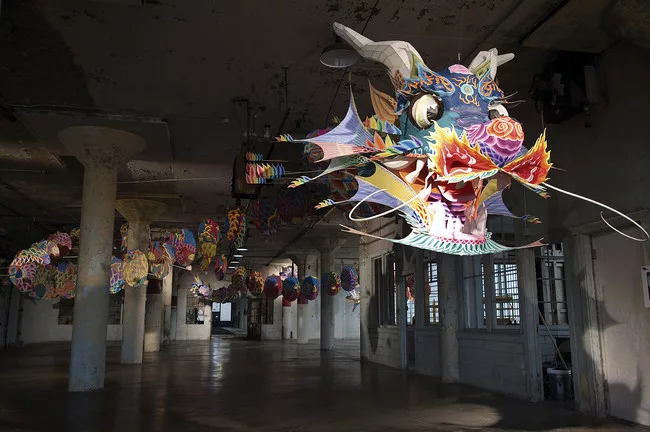
One of seven installations that is part of Ai Weiwei's <em>@Large</em> on Alcatraz, <em>With Wind</em> snakes through the front room in the New Industries Building.
Exhibition Review: Ai Weiwei on Alcatraz
One of seven installations that is part of Ai Weiwei's @Large on Alcatraz, With Wind snakes through the front room in the New Industries Building.
Photo © Jan Sturmann, courtesy FOR-SITE Foundation
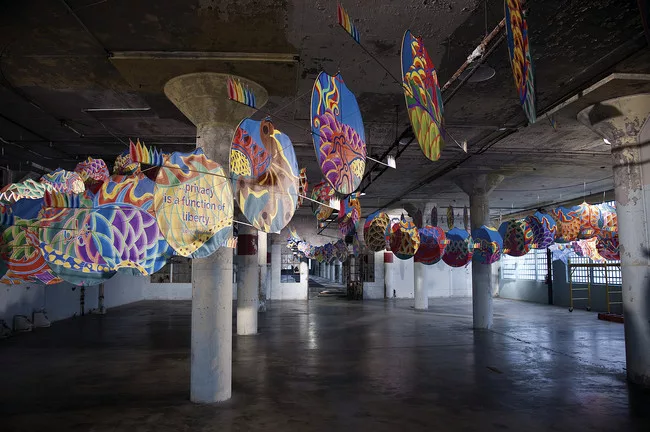
The patterns in <em>With Wind</em>'s fabric include renderings of birds and flowers representing nations that have severely restricted human rights and civil liberties, among them Cameroon, China, Rus
Exhibition Review: Ai Weiwei on Alcatraz
The patterns in With Wind's fabric include renderings of birds and flowers representing nations that have severely restricted human rights and civil liberties, among them Cameroon, China, Russia, Uzbekistan, and Saudi Arabia.
Photo © Jan Sturmann, courtesy FOR-SITE Foundation
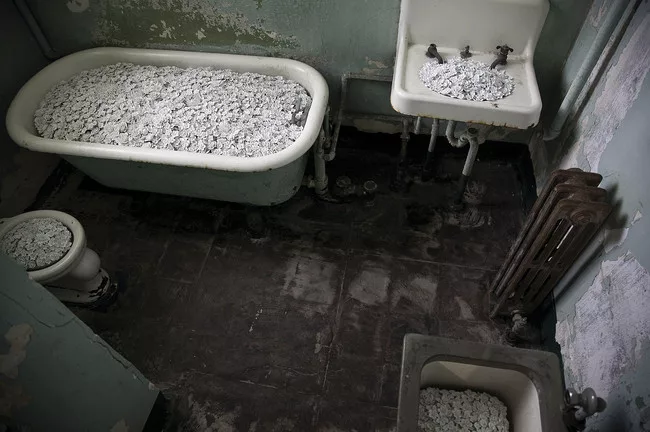
In some of the hospital cells, the artist has filled dilapidated toilets, sinks, and tubs with profusions of white porcelain flowers (<em>Blossom</em>). Like flourishing life poised to wash down the d
Exhibition Review: Ai Weiwei on Alcatraz
In some of the hospital cells, the artist has filled dilapidated toilets, sinks, and tubs with profusions of white porcelain flowers (Blossom). Like flourishing life poised to wash down the drain, these brittle blooms evoke Mao’s Hundred Flowers Campaign of 1956, when a brief period of illusory tolerance for free expression set the scene for ruthless government crackdown.
Photo © Jan Sturmann, courtesy FOR-SITE Foundation
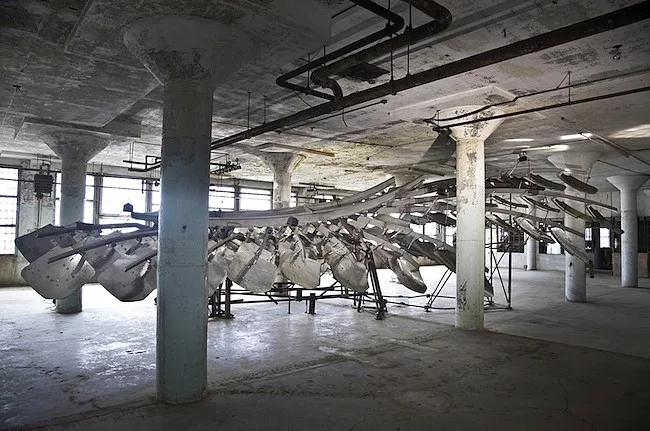
In the dank lower level of the New Industries Building, the bird of freedom is not merely tethered like a kite, but virtually leaden. Here, <em>Refraction</em> presents an abstract bird wing, weighing
Exhibition Review: Ai Weiwei on Alcatraz

In the dank lower level of the New Industries Building, the bird of freedom is not merely tethered like a kite, but virtually leaden. Here, Refraction presents an abstract bird wing, weighing more than five tons, cobbled together from cheap Tibetan cookware and solar cooking panels.
Photo © Jan Sturmann, courtesy FOR-SITE Foundation
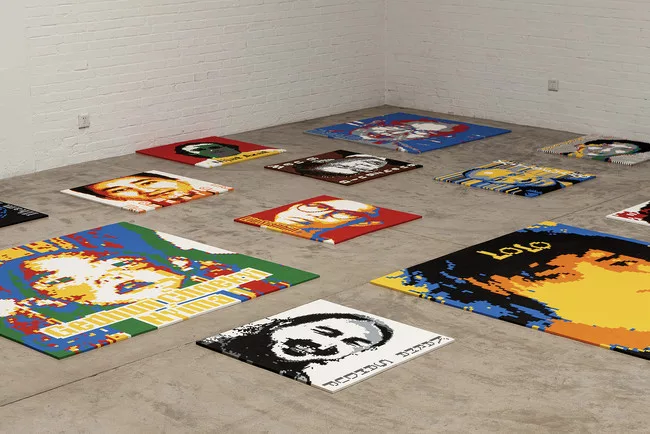
For <em>Trace</em>, the artist paved the large concrete hall of the New Industries Building with 176 Lego portraits of political exiles and prisoners.
Exhibition Review: Ai Weiwei on Alcatraz
For Trace, the artist paved the large concrete hall of the New Industries Building with 176 Lego portraits of political exiles and prisoners.
Photo © Jan Sturmann, courtesy FOR-SITE Foundation
Ai Weiwei at his studio in Beijing.
Exhibition Review: Ai Weiwei on Alcatraz
Ai Weiwei at his studio in Beijing.
Photo © Jan Sturmann, courtesy FOR-SITE Foundation
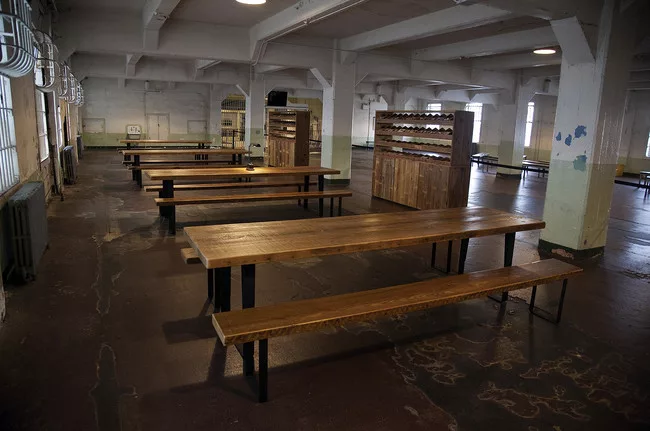
In the prison dining room, <em>Yours Truly</em> invites Alcatraz&#8217;s visitors to write messages on postcards pre-addressed to prisoners of conscience around the world.
Exhibition Review: Ai Weiwei on Alcatraz
In the prison dining room, Yours Truly invites Alcatraz’s visitors to write messages on postcards pre-addressed to prisoners of conscience around the world.
Photo © Jan Sturmann, courtesy FOR-SITE Foundation
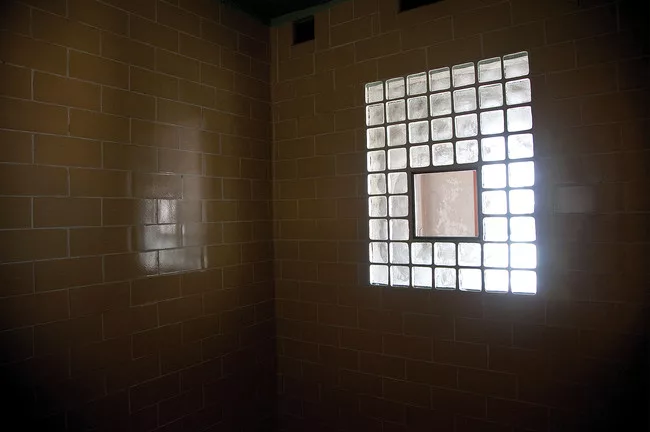
<em>Illumination</em> pipes sound into the pair of inhumanly small psychiatric observation chambers in the prison hospital. Recorded chants of exiled Tibetans resonate with the Hopi tribal song playin
Exhibition Review: Ai Weiwei on Alcatraz
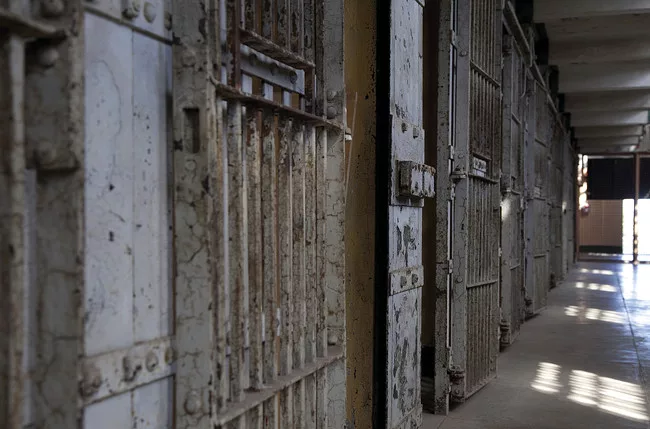
Illumination pipes sound into the pair of inhumanly small psychiatric observation chambers in the prison hospital. Recorded chants of exiled Tibetans resonate with the Hopi tribal song playing in the adjacent cubicle. The simultaneous incantations give voice to oppressed minorities. The piece also illuminates a particularly dark chapter in Alcatraz’s history: its late 19th century confinement of Hopi men for their refusal to send their children to federally mandated, native culture-expunging schools. (Other prisoners of conscience on this island included faith-honoring pacifists during World War I.)
Photo © Jan Sturmann, courtesy FOR-SITE Foundation
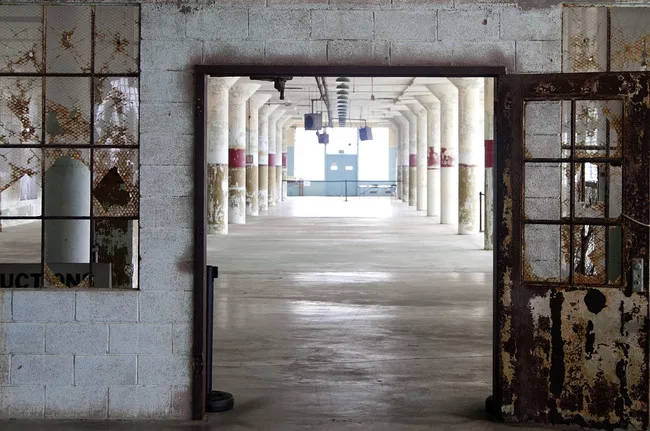
The first floor of Alcatraz's New Industries Building.
Exhibition Review: Ai Weiwei on Alcatraz
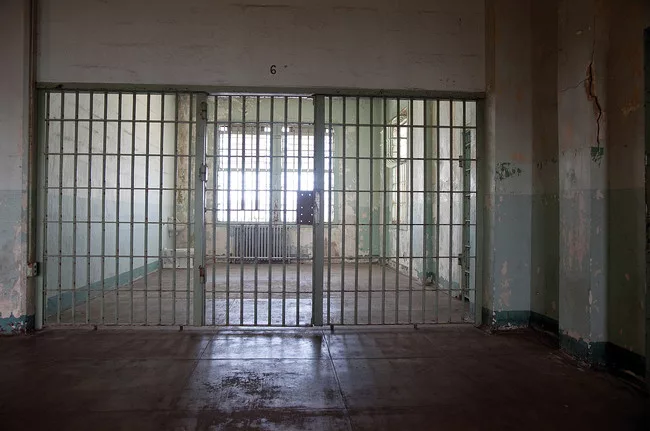
The first floor of Alcatraz's New Industries Building.
Photo © Jan Sturmann, courtesy FOR-SITE Foundation
Cell doors of A Block.
Exhibition Review: Ai Weiwei on Alcatraz
Cell doors of A Block.
Photo © Jan Sturmann, courtesy FOR-SITE Foundation
A hospital cell.
Exhibition Review: Ai Weiwei on Alcatraz

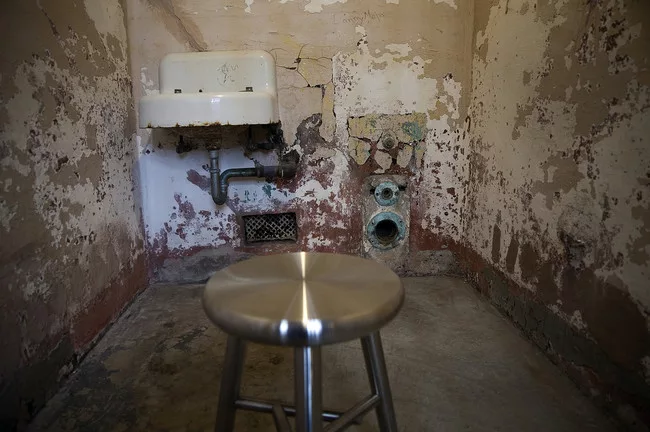
A hospital cell.
Photo © Jan Sturmann, courtesy FOR-SITE Foundation
<em>Stay Tuned</em>, in the early 19th century A-Block cells, intensifies our perception of the existing prison by playing sound against space. This installation ushers us inside a series of prison ce
Exhibition Review: Ai Weiwei on Alcatraz
Stay Tuned, in the early 19th century A-Block cells, intensifies our perception of the existing prison by playing sound against space. This installation ushers us inside a series of prison cells, where we sit alone, each time on a cold, stainless-steel stool, directly confronting the confinement and isolation of these grim cages (an unsettling experience not offered on the regular Alcatraz tour). Through a decrepit wall grate in each cell, voices of prisoners of conscience from around the world—including the Tibetan singer Lolo and Russia’s Pussy Riot—sing or read a poem or speech. The impact is visceral.
Photo © Jan Sturmann, courtesy FOR-SITE Foundation
Alcatraz
Exhibition Review: Ai Weiwei on Alcatraz
Alcatraz
Photo © Ben Fash
One of seven installations that is part of Ai Weiwei's <em>@Large</em> on Alcatraz, <em>With Wind</em> snakes through the front room in the New Industries Building.
The patterns in <em>With Wind</em>'s fabric include renderings of birds and flowers representing nations that have severely restricted human rights and civil liberties, among them Cameroon, China, Rus
In some of the hospital cells, the artist has filled dilapidated toilets, sinks, and tubs with profusions of white porcelain flowers (<em>Blossom</em>). Like flourishing life poised to wash down the d
In the dank lower level of the New Industries Building, the bird of freedom is not merely tethered like a kite, but virtually leaden. Here, <em>Refraction</em> presents an abstract bird wing, weighing
For <em>Trace</em>, the artist paved the large concrete hall of the New Industries Building with 176 Lego portraits of political exiles and prisoners.
Ai Weiwei at his studio in Beijing.
In the prison dining room, <em>Yours Truly</em> invites Alcatraz&#8217;s visitors to write messages on postcards pre-addressed to prisoners of conscience around the world.
<em>Illumination</em> pipes sound into the pair of inhumanly small psychiatric observation chambers in the prison hospital. Recorded chants of exiled Tibetans resonate with the Hopi tribal song playin
The first floor of Alcatraz's New Industries Building.
Cell doors of A Block.
A hospital cell.
<em>Stay Tuned</em>, in the early 19th century A-Block cells, intensifies our perception of the existing prison by playing sound against space. This installation ushers us inside a series of prison ce
Alcatraz
October 20, 2014

Playful yet menacing, the fangs of a grinning dragon greet you as you enter @Large, dissident Chinese artist Ai Weiwei’s extensive installation at Alcatraz, the notorious former prison in San Francisco Bay. Despite the brilliantly colored whorls and cheerful floral patterns of this huge serpent and its surrounding flock of birdlike kites, the ensemble (entitled With Wind) soon reveals darker messages. These lofty creatures are essentially caged, hovering in a chamber bound by barred windows and a gun-ready surveillance perch. And the jaunty kite fabric, you soon discover, subtly integrates such imagery as skeletal hands gripping twisted rebars (references to prison grating, as well as the shoddy school construction that trapped thousands of children who perished in China’s 2008 Sichuan quake). Other somber details include feather-light segments of the serpent’s body bearing such weighty words as, “Every one of us is a potential convict,” setting the tone for an exhibition loaded with provocative juxtapositions and contradictions.

Prompting questions about human rights, freedom of speech, and the value of incarceration, @Large was clearly colored by the artist’s own experience. Punished for the activism of his father, the poet Ai Qing, his family lived in exile during his childhood. Now an unflinching and outspoken critic of the government of China, Ai was imprisoned there for 81 days in 2011, in solitary confinement on vaguely defined charges. Though released three years ago, he remains stripped of a passport, effectively under “country arrest.”

So, in late 2011, when Ai’s friend and colleague Cheryl Haines, director of the For-Site Foundation—a San Francisco nonprofit dedicated to contemporary, place-based art—casually offered him “a prison to work with,” he accepted the challenge of generating site-specific art for a place he couldn’t visit. This would not, however, be the first time Ai would create installations for spaces where he’d never set foot: For the 2013 Venice Biennale, he re-enacted scenes from his own incarceration in large, iron-clad dioramas inside a Venetian church; and, earlier this year, his solo show in Berlin transformed 18 rooms and a sunken courtyard at the Martin-Gropius-Bau. His capacity to visualize such projects from thousands of miles away, says Haines, attests to “Weiwei’s extraordinary understanding of space and the built environment.” (Though not formally trained as an architect, he collaborated with Herzog & de Meuron on the Birds’ Nest stadium for the 2008 Olympics in Beijing and also designed and built live-work compounds for artists on the city’s outskirts.)

But offering a prison is one thing, and delivering it quite another. Haines’s first hurdle was to obtain permission from the National Parks Service (NPS) and Golden Gate National Parks Conservancy (GGNPC), the agencies that oversee the former penitentiary (decommissioned in 1963)—and regularly turn down proposals for artistic interventions there. While NPS superintendent Frank Dean and GGNPC president Greg Moore instantly gravitated to the idea of an Ai Weiwei installation at Alcatraz, Dean prudently sought State Department approval. “We didn’t want an international incident to emerge from what we thought was a good idea,” he explains. (Though the exhibition’s specific content was yet undetermined, Washington issued its go-ahead within days.)

Then came the daunting task of familiarizing Ai with a penitentiary 6,000 miles from his studio in Beijing. That process involved walk-through videos, Skype conferences, detailed 3-D drawings, vintage photos, in-depth research, and multiple trips to Beijing by Haines (who stuffed her suitcases with everything from Hollywood movies about Alcatraz to a facsimile prison key). She also raised $3.5 million, mostly from private sources, to cover the show’s costs.

One of the real achievements of @Large, a seven-part installation in various parts of the historic buildings, is how it alters and heightens our perception of an already powerful venue. And the title @Large, coined by the artist, does not merely nod to essential role of the Internet in his (and much of today’s) political activism, but also ironically borrows a phrase that can mean “at liberty” or, conversely, “escaped and not yet captured.” At Alcatraz, the artist was permitted to engage spaces usually off limits to visitors (partly for the practical reason of keeping his installation from interfering with the regular, ongoing penitentiary tour). Among those newly opened venues are the prison hospital; New Industries Building; and A-Block Cells, the only unaltered, early 19th-century cell block from Alcatraz’s days as a military prison, prior to its conversion, in 1934, to a federal penitentiary. Holders of ferry tickets to the island are permitted to enter all permanent and temporary exhibitions there, free of additional charge.

The New Industries structure—once bustling with guarded convicts laundering barge-loads of military uniforms, on an island with no water source of its own—houses three of Ai’s most ambitious installations: With Wind, Trace, and Refraction. Illumination and Blossom are sited in the prison hospital, Stay Tuned in the A-Block cells, and Yours Truly in the penitentiary dining hall.

For Trace, he paved a large, raw industrial space with 176 blown-up portraits of political exiles and prisoners constructed from 1.2 million Legos. As the title suggests, many of these people have vanished with barely a trace, other than a grainy photo. Here, the mix of images—snapped together, according to the artist’s blueprints, by a legion of local volunteers—includes such celebrated historic figures as Nelson Mandela and Martin Luther King, Jr., along with current, little-known prisoners of conscience across Asia, Africa, Latin America, and the Mideast, as well as such controversial Americans as Edward Snowden and Chelsea Manning. This grouping—audaciously presented on United States federal property—spares no distinction between our government and the world’s most brutal regimes.

Trace is a display as bluntly unvarnished as a mug shot, yet at the same time, like the paper dragon in the next room, it enlists pleasurable children’s toys to expose turbulent themes. In an interview conducted by Haines, available on line, Ai describes some of his intentions: “To carry the essential ideas about freedom, to let everybody, even children, appreciate it, we have to make it beautiful, we have to make it fly.”

But in the bowels of the New Industries Building, the bird of freedom is not merely tethered like a kite, but virtually leaden. Here, Refraction presents an abstract bird wing, weighing more than five tons, cobbled together from cheap Tibetan cookware and solar cooking panels, all trapped in this nearly sunless space. We are never actually permitted to enter that room, but view it only through broken glass and grates from a surveillance gallery once manned by armed guards. Generating an uneasy tension, this vantage point casts the viewer in the controlling role of authority, while simultaneously confining us, like prisoners, within this narrowly claustrophobic passageway.

Risk-taking and streaked with irreverence, the exhibition sometimes verges tacitly on moralizing. But at its best, this work focuses our attention, almost viscerally, on little-known political prisoners and what Ai has described as the great irony “that people fighting for freedom are being incarcerated.” And here, as Moore points out, “we have an historical place that was considered inescapable, hosting an artist currently under house arrest—whose work has traveled the world.”

KEYWORDS: Ai Weiwei prisons

Share This Story

Looking for a reprint of this article?
From high-res PDFs to custom plaques, order your copy today!
Sarah Amelar is a Los Angeles–based contributing editor at Architectural Record.

Post a comment to this article

Report Abusive Comment

Subscription Center
  • Create an Account
  • Start a Subscription
  • Manage My Account
  • Sign Up for Newsletters
  • Visit Customer Service
  • Update Preferences

More Videos

Sponsored Content

Sponsored Content is a special paid section where industry companies provide high quality, objective, non-commercial content around topics of interest to the Architectural Record audience. All Sponsored Content is supplied by the advertising company and any opinions expressed in this article are those of the author and not necessarily reflect the views of Architectural Record or its parent company, BNP Media. Interested in participating in our Sponsored Content section? Contact your local rep!

close
  • TAMLYN XtremeTrim Exterior Trim
    Sponsored byTamlyn

    Designing Cleaner Panel Facades: Why Exterior Trim Details Matter

  • Building with Vapor Barriers
    Sponsored byReef Industries, Inc.

    Vapor Barriers Help Control Moisture in Tighter Building Designs

  • Duct Interior with Prodeq System
    Sponsored byHenry, a Carlisle Company

    Designing Resilient Water Containment Systems

DESIGN:ED Podcast
Listen to Architectural Record’s DESIGN:ED Podcast

Events

June 10, 2026

Rethinking Stormwater – The Power of Porous Paving

Credits: 1 AIA LU/HSW; 1 AIBD P-CE; 0.1 ICC CEU

Learn how porous paving systems support stormwater management, reduce heat island effects, and enhance sustainable site design performance.

June 11, 2026

Very Early Warning Fire Detection for Mission-Critical Facilities

Credits: 1 AIA LU/HSW; 1 AIBD P-CE; 0.1 ICC CEU

Examine advanced fire detection strategies that support uptime and enhance safety in data centers and other mission-critical facilities.

View All Submit An Event

Products

2026 Architect's Square Foot Costbook

2026 Architect's Square Foot Costbook

See More Products

Popular Stories

Practice Matters illustration

What’s in a (Firm’s) Name? Thinking About Succession and Legacy

Practice Matters illustration

By the Numbers: Counting America's Architects

House on a Hill

Design Vanguard 2026: Forma

Crane Cove, ONO

Design Vanguard 2026 Winners

KRESA by DLR

In Kalamazoo, DLR Group Completes a Mass-Timber Hub for Career and Technical Education Programs

Broader Sustainability of CMU - Free Webinar - May 21, 2026

Related Articles

  • Exhibition Review: Ai Weiwei at the Royal Academy of Arts, London

    See More
  • Ai Weiwei

    Ai Weiwei's New 'Fences' Exhibition Grapples with Borders, Migration, and Belonging

    See More
  • Ai Weiwei: Art and Architecture

    See More

Related Products

See More Products
  • Architectural Record - May 2026

    Architectural Record May 2026 Issue

See More Products

Events

View AllSubmit An Event
  • October 7, 2025

    AI-Driven Transformation in Data Center Design and Construction

    NOW ON DEMANDCredits: 1 AIA LU/HSW; 1 AIBD P-CE; 0.1 ICC CEU; 0.1 IACET CEUThis webinar examines how these trends are redefining the modern data center.
  • February 12, 2026

    Your Next Hire Might Not Be Human: How AI and Outsourcing Are Rewriting the Rules

    NOW ON DEMANDCredits: 1 AIA LU/Elective; 1 AIBD P-CE; 0.1 ICC CEU; 0.1 IACET CEUExamine how AI, automation, and alternative staffing models are reshaping firm growth and learn when to hire, outsource, or automate while maintaining trust, culture, and creativity.
View AllSubmit An Event
×

The latest news and information

#1 Source for Architectural Design, News and Products

SUBSCRIBE
  • RESOURCES
    • Advertise
    • Contact Us
    • Submit
    • Store
  • ACCOUNT CENTER
    • Create an Account
    • Start a Subscription
    • Manage My Account
    • Sign Up for Newsletters
    • Visit Customer Service
    • Update Preferences
  • PRIVACY
    • PRIVACY POLICY
    • TERMS & CONDITIONS
    • DO NOT SELL MY PERSONAL INFORMATION
    • PRIVACY REQUEST
    • ACCESSIBILITY
  • SERVICES
    • Marketing Services
    • Reprints
    • Market Research
    • List Rental
    • Survey/Respondent Access
  • STAY CONNECTED
    • Linkedin
    • Facebook
    • Instagram
    • YouTube
    • X (Twitter)

Copyright ©2026. All Rights Reserved BNP Media, Inc. and BNP Media II, LLC.

Design, CMS, Hosting & Web Development :: ePublishing