Architectural Record
search
cart
facebook twitter linkedin youtube
  • Sign In
  • Subscribe
  • Sign Out
  • My Account
Architectural Record
  • NEWS
    • Latest News
    • Awards
    • Interviews
    • Obituaries
    • Podcasts
      • Design:Ed Podcast
      • Sponsored Podcasts
  • OPINION
    • Book Reviews / Excerpts
    • Exhibition Reviews
    • Forum
  • EXCLUSIVES
    • Videos
    • Design Vanguard
    • Top 300 Firms
    • Sponsored Content
    • Sponsored eBooks
    • From the Archives
  • CONTINUING ED
    • Editorial Continuing Ed
    • CE Center
    • CE Academies
  • PROJECTS
    • Buildings By Type
    • Reuse & Renovation
    • Museums & Arts Centers
    • Colleges & Universities
    • Multifamily Housing
    • Interiors
    • Lighting
    • Kitchen & Bath
  • HOUSES
    • Record Houses
    • House of the Month
    • Featured Houses
  • PRODUCTS
    • Products by Category
    • Record Products of the Year
    • Latest Products
  • EVENTS
    • Dates & Events
    • Record on the Road
    • Innovation Conference
    • Sustainability in Practice
    • Women In Architecture
    • Webinars
    • Ad Excellence Awards
    • Submit an Event
  • CONNECT
    • Ask RECORD AI
    • Newsletters
    • Contact
    • Advertise
    • Editorial Calendar
    • Store
    • Customer Service
  • SUBMIT
    • Submission Guidelines
    • RECORD Competitions
  • MAGAZINE
    • Subscribe
    • My Account
    • Digital Edition
    • Current Issue
    • Firm Pass
    • Historic Archive
Architecture News

Unveiled: The High Line's Third Phase
By Fred A. Bernstein
High Line's Third Phase
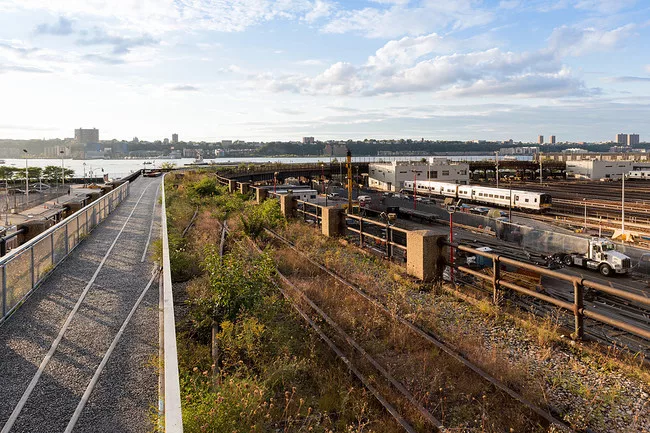
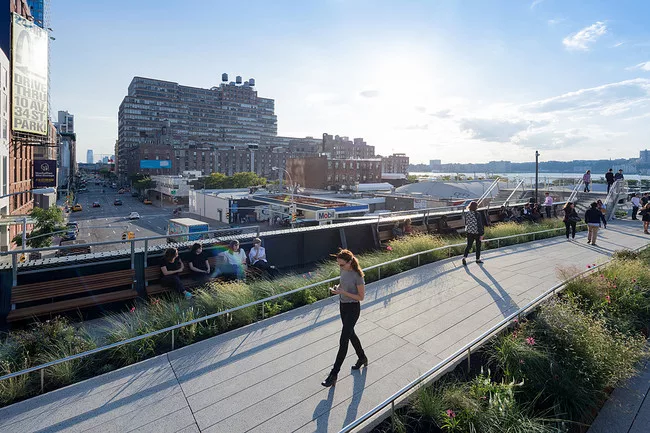
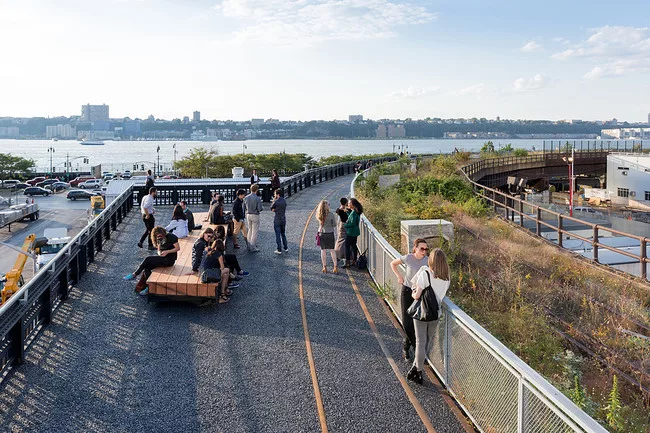
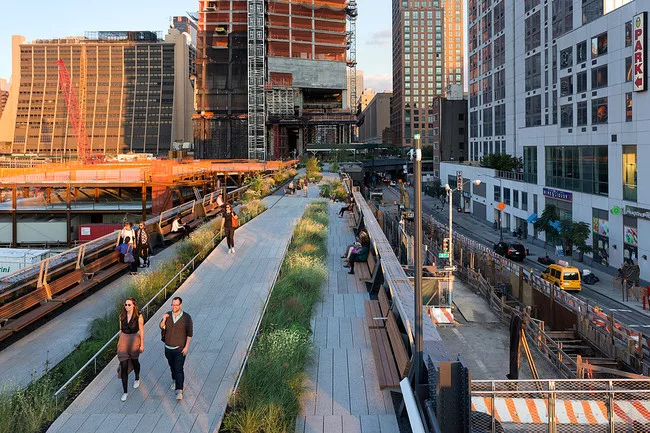
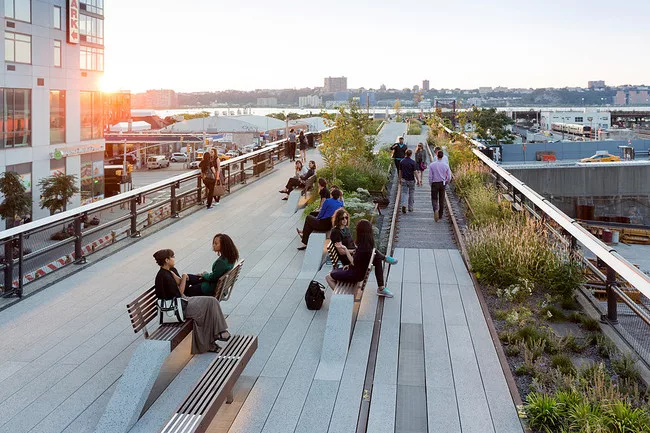
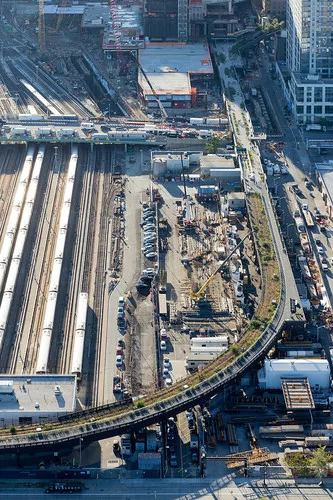
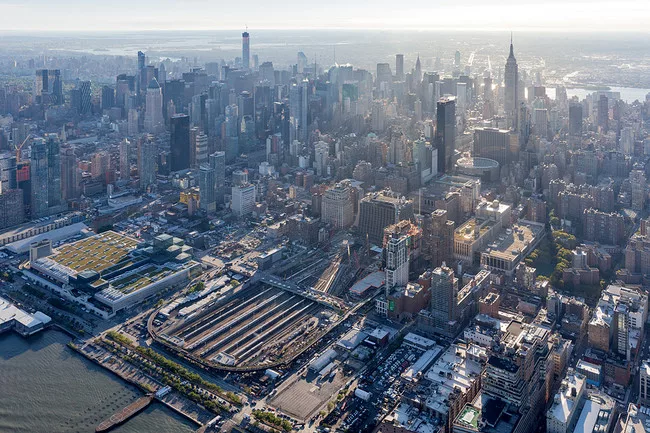
The third phase of the High Line wraps around the Hudson Yards site.
 
Photo © Iwan Baan
High Line's Third Phase
The third phase of the High Line wraps around the Hudson Yards site.
 
Photo © Iwan Baan
High Line's Third Phase
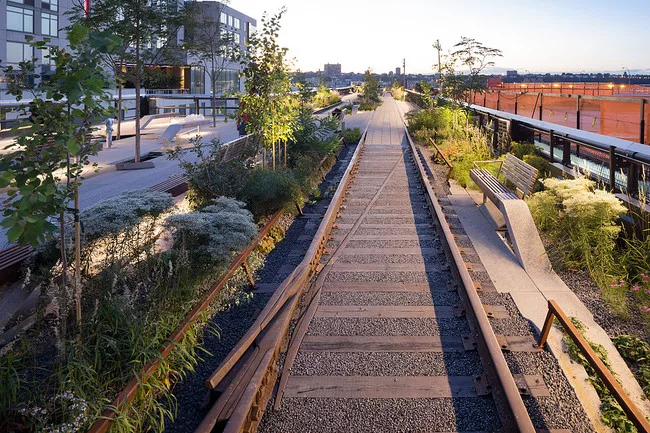
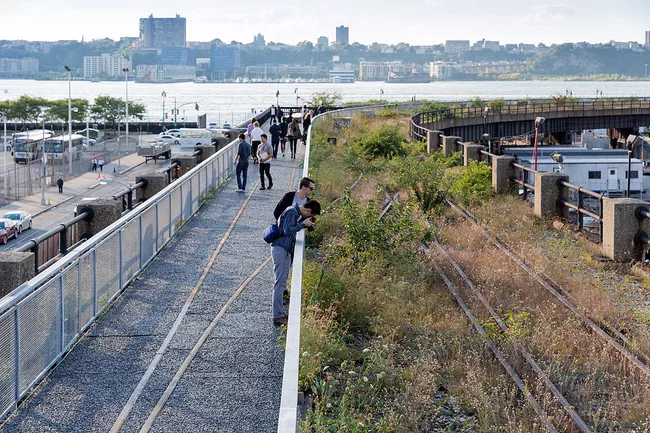
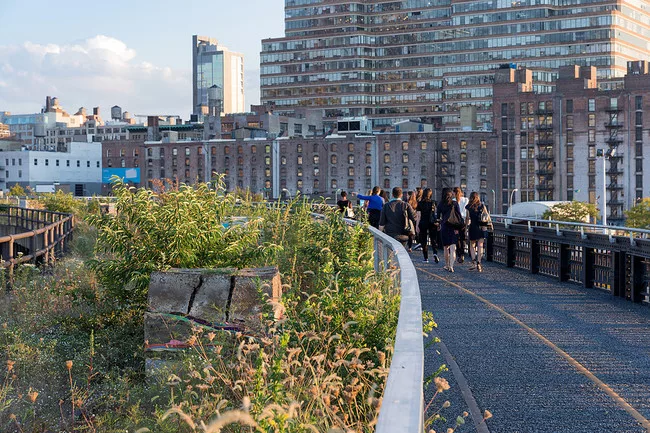
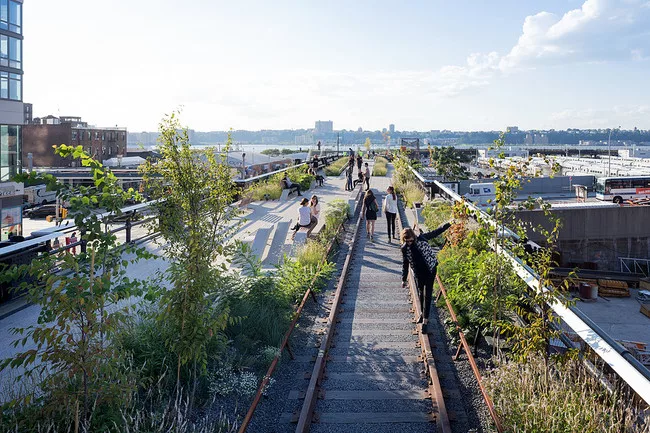
A long stretch of existing flora has been left intact, reminiscent of the “wilderness” that High Line founders Joshua David and Robert Hammond first encountered in the 1990s.
 
Photo © Iwan Baan
High Line's Third Phase
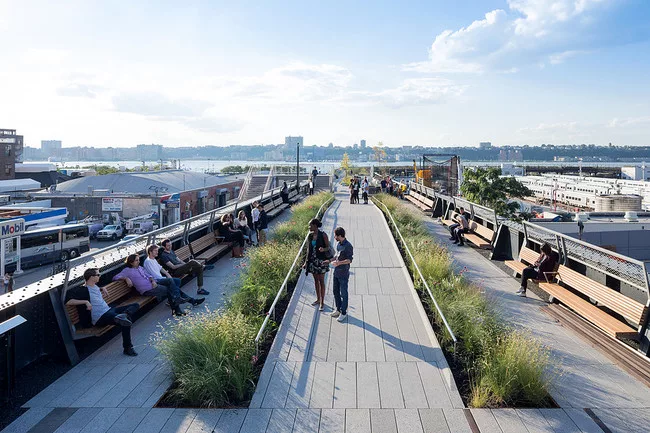
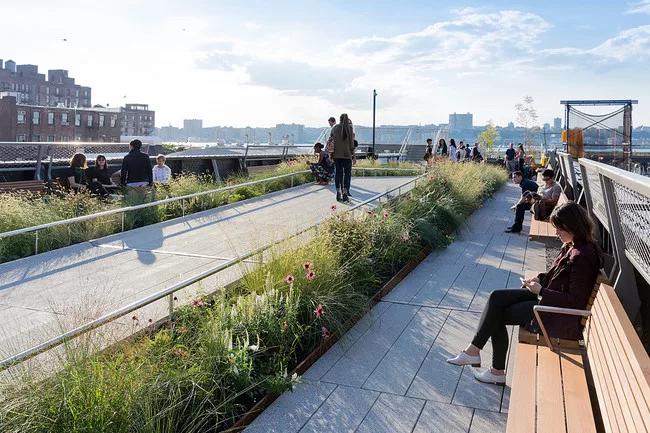
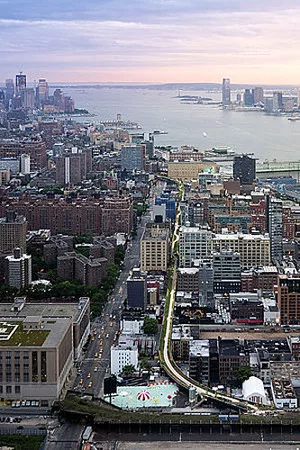
A photo of the High Line in June 2011, when the second phase opened. Stay tuned for photos of the third phase.
 
Photo © Iwan Baan
High Line's Third Phase
A photo of the High Line in June 2011, when the second phase opened. Stay tuned for photos of the third phase.
 
Photo © Iwan Baan
High Line's Third Phase
A photo of the High Line in June 2011, when the second phase opened. Stay tuned for photos of the third phase.
 
Photo © Iwan Baan
High Line's Third Phase
A photo of the High Line in June 2011, when the second phase opened. Stay tuned for photos of the third phase.
 
Photo © Iwan Baan
High Line's Third Phase
A photo of the High Line in June 2011, when the second phase opened. Stay tuned for photos of the third phase.
 
Photo © Iwan Baan
High Line's Third Phase
A photo of the High Line in June 2011, when the second phase opened. Stay tuned for photos of the third phase.
 
Photo © Iwan Baan
High Line's Third Phase
A photo of the High Line in June 2011, when the second phase opened. Stay tuned for photos of the third phase.
 
Photo © Iwan Baan
High Line's Third Phase
A photo of the High Line in June 2011, when the second phase opened. Stay tuned for photos of the third phase.
 
Photo © Iwan Baan
High Line's Third Phase
A photo of the High Line in June 2011, when the second phase opened. Stay tuned for photos of the third phase.
 
Photo © Iwan Baan
High Line's Third Phase
A photo of the High Line in June 2011, when the second phase opened. Stay tuned for photos of the third phase.
 
Photo © Iwan Baan
High Line's Third Phase
A photo of the High Line in June 2011, when the second phase opened. Stay tuned for photos of the third phase.
 
Photo © Iwan Baan
High Line's Third Phase
A photo of the High Line in June 2011, when the second phase opened. Stay tuned for photos of the third phase.
 
Photo © Iwan Baan
High Line's Third Phase
A photo of the High Line in June 2011, when the second phase opened. Stay tuned for photos of the third phase.
 
Photo © Iwan Baan
High Line's Third Phase
A photo of the High Line in June 2011, when the second phase opened. Stay tuned for photos of the third phase.
 
Photo © Iwan Baan
High Line's Third Phase
A photo of the High Line in June 2011, when the second phase opened. Stay tuned for photos of the third phase.
 
Photo © Iwan Baan
High Line's Third Phase
September 19, 2014
A long stretch of existing flora has been left intact, reminiscent of the “wilderness” that High Line founders Joshua David and Robert Hammond first encountered in the 1990s.

The first two phases of the High Line make their way through relatively low-rise sections of Manhattan. But the third phase, which opened to the public this weekend, wraps around the Hudson Yards site, for which 16 skyscrapers, one of them taller than the Empire State Building, are planned.

For a while, the High Line’s designers thought perhaps they had to “go bigger” this time around, to respond to the scale of the new construction, says Peter Mullan, an architect who has worked for Friends of the High Line since 2004 and is currently its executive vice president. But then the team, led by James Corner Field Operations and Diller Scofidio + Renfro, decided to let the High Line be the High Line, extending many aspects of the first two phases to the third, officially titled The High Line at the Rail Yards. Indeed, one planned (and even publicized) feature of Phase 3, an oval amphitheater enclosed by maple and tupelo trees at the corner of 30th Street and 10th Avenue, was dropped because, Mullan says, it was considered “too aggressive a gesture.”

What remains is a stretch of elevated tracks (running east-west just north of 30th street), landscaped with a light touch, and an even longer stretch where the existing flora has been left intact. This gives visitors a taste of the “wilderness” that High Line founders Joshua David and Robert Hammond first encountered in the 1990s. Looking at the thicket that has grown on the elevated railway, which ceased operations in 1980, Mullan compares it to the Galapagos Islands.

Yet unlike the isolated Galapagos, this wildest section of the High Line will be a construction-viewing platform for decades to come. And as the Hudson Yards towers rise, it will cease to be a raised sliver of park between the Hudson River and the tracks below. Instead, it will form the edge of a 26-acre, Canary Wharf-style development on a platform that is higher than the tracks, making it less catwalk than sidewalk. Will it require alterations as the skyscrapers rise? At some point, this section of the High Line will have to be closed for structural repairs, and no one is ruling out redesigns at that juncture.

For now, the section, called the Interim Walkway, is as simple as can be, with pavement of glued-together gravel (technically, bonded aggregate) and a simple, galvanized steel fence separating the hardscape from the Galapagos. The latter will serve as a kind of “natural history” of the High Line site, making clear (in case it isn’t already) that the spectacular gardens to the south required a lot of work on the part of horticulturist Piet Oudolf.

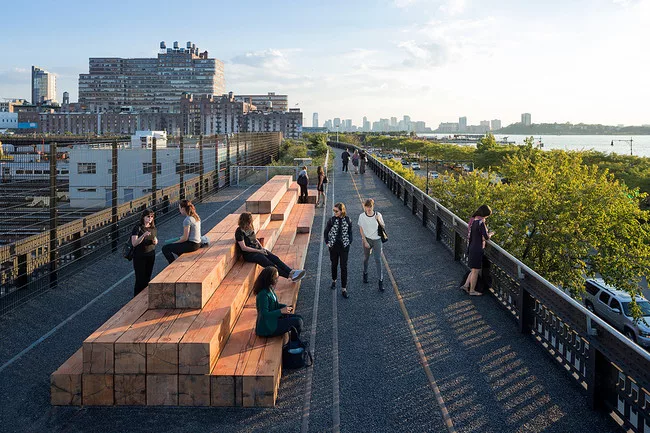
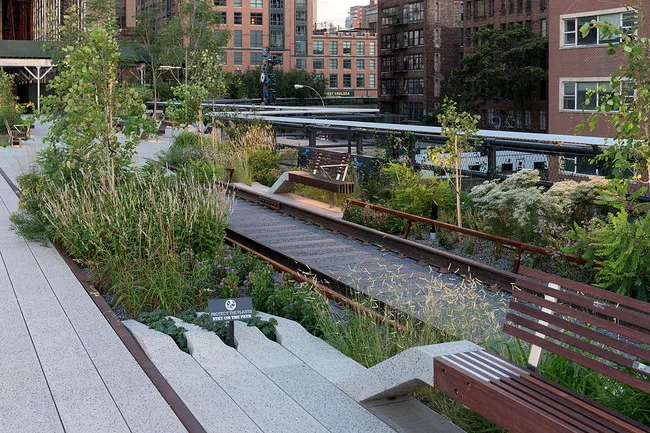
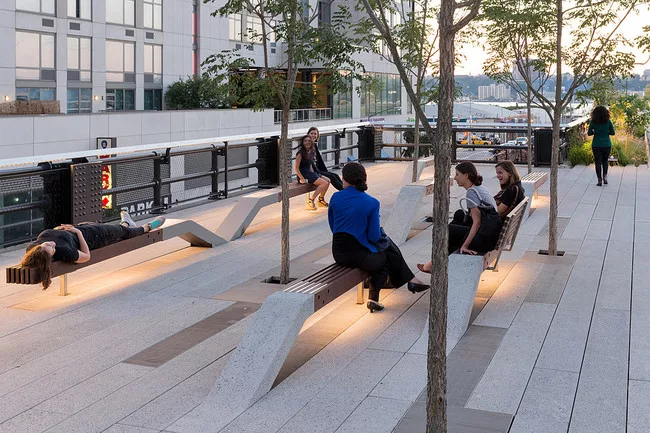
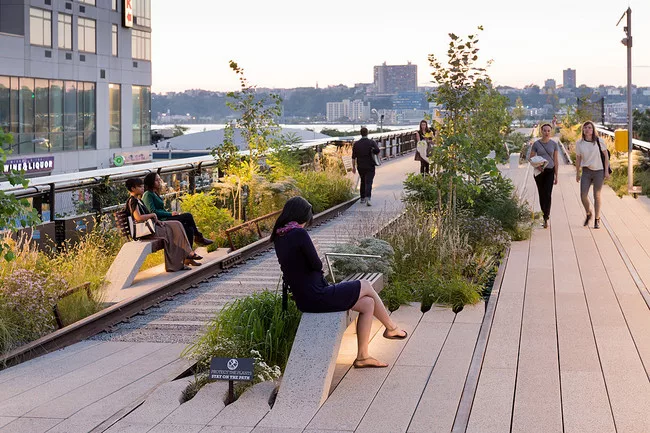
The same can be said for the wide, landscaped portion of Phase 3, near 30th Street. Part of it, now concealed by scaffolding, slips under the Coach Building, a 930-foot tower that KPF designed to overhang the tracks. The swath west of the Coach Building includes a number of features developed for Phases 1 and 2, including “peel up” benches— furniture that emerges from concrete planks—as well as a picnic table and seesaw of roughly the same design. But there are a few surprises, including a stretch where the structure beneath the tracks is revealed and coated in rubber, forming an elevated children’s playground. 

Though the High Line design is credited to formidable firms, a lot of credit goes to High Line staff, including Mullan. In 2000, the Yale-trained architect was working for Polshek Partnership Architects when he volunteered to help keep the High Line from being demolished.  “It was our Penn Station, a chance for our generation to save something significant,” says Mullan, whose first assignment was getting well-known architects to sign a petition. Four years later, he became a full-time employee after being warned that, because the city had not yet committed to saving the High Line, the job might be short-lived. (The northernmost section of tracks was not acquired by the city until 2012.)

Walking around the High Line, seeing what the last decade has brought, Mullan says, “You have to remember how unlikely the whole thing was.”

Disclosure: This article was updated on September 22.

KEYWORDS: Hudson Yards New York City

Share This Story

Looking for a reprint of this article?
From high-res PDFs to custom plaques, order your copy today!

Fred Bernstein studied architecture at Princeton and law at NYU and writes about both subjects.

Post a comment to this article

Report Abusive Comment

Subscription Center
  • Create an Account
  • Start a Subscription
  • Manage My Account
  • Sign Up for Newsletters
  • Visit Customer Service
  • Update Preferences

More Videos

Sponsored Content

Sponsored Content is a special paid section where industry companies provide high quality, objective, non-commercial content around topics of interest to the Architectural Record audience. All Sponsored Content is supplied by the advertising company and any opinions expressed in this article are those of the author and not necessarily reflect the views of Architectural Record or its parent company, BNP Media. Interested in participating in our Sponsored Content section? Contact your local rep!

close
  • TAMLYN XtremeTrim Exterior Trim
    Sponsored byTamlyn

    Designing Cleaner Panel Facades: Why Exterior Trim Details Matter

  • Building with Vapor Barriers
    Sponsored byReef Industries, Inc.

    Vapor Barriers Help Control Moisture in Tighter Building Designs

  • Duct Interior with Prodeq System
    Sponsored byHenry, a Carlisle Company

    Designing Resilient Water Containment Systems

DESIGN:ED Podcast
Listen to Architectural Record’s DESIGN:ED Podcast

Events

June 16, 2026

Focus on the Façade: Exploring Steel, Timber & Fire-Rated Curtain Walls and Channel Glass Systems

Credits: 1 AIA LU/HSW; 1 AIBD P-CE; 0.1 ICC CEU

Explore modern façade and glazing systems that enhance daylighting, fire safety, and thermal performance while expanding architectural design possibilities.

June 18, 2026

Rebooting the Aging Office Building

Credits: 1 AIA LU/HSW; 1 AIBD P-CE; 0.1 ICC CEU; 1 PDH

Explore façade retrofit strategies and award-winning design concepts that can transform aging office buildings into healthier, higher-performing workplaces for today’s hybrid workforce.

View All Submit An Event

Products

2026 Architect's Square Foot Costbook

2026 Architect's Square Foot Costbook

See More Products

Popular Stories

SanDiegoAirport

Top 300 Architecture Firms of 2026

Coronado Bridge

The Architect’s Guide to San Diego

Dusk House

Design Vanguard 2026: ONO

Crystal Bridges Museum of American Art expansion

Safdie Architects Returns to the Crystal Bridges Museum of American Art for Major Expansion

Hikma Community Complex

Design Vanguard 2026: Mariam Issoufou Architects

Focus on the Facade - Free Webinar - June 16, 2026

Related Articles

  • Third Phase of High Line Sets Tone for Neighboring Development

    See More
  • Illicit Photos of the High Line's Second Phase

    See More
  • LEGO my Ego

    Olafur Eliasson's LEGO Cityscape at the High Line

    See More

Related Products

See More Products
  • facade.jpg

    Sustainable Facades: Design Methods for High-Performance Building Envelopes

See More Products
×

The latest news and information

#1 Source for Architectural Design, News and Products

SUBSCRIBE
  • RESOURCES
    • Advertise
    • Contact Us
    • Submit
    • Store
  • ACCOUNT CENTER
    • Create an Account
    • Start a Subscription
    • Manage My Account
    • Sign Up for Newsletters
    • Visit Customer Service
    • Update Preferences
  • PRIVACY
    • PRIVACY POLICY
    • TERMS & CONDITIONS
    • DO NOT SELL MY PERSONAL INFORMATION
    • PRIVACY REQUEST
    • ACCESSIBILITY
  • SERVICES
    • Marketing Services
    • Reprints
    • Market Research
    • List Rental
    • Survey/Respondent Access
  • STAY CONNECTED
    • Linkedin
    • Facebook
    • Instagram
    • YouTube
    • X (Twitter)

Copyright ©2026. All Rights Reserved BNP Media, Inc. and BNP Media II, LLC.

Design, CMS, Hosting & Web Development :: ePublishing