Architectural Record
search
cart
facebook twitter linkedin youtube
  • Sign In
  • Subscribe
  • Sign Out
  • My Account
Architectural Record
  • NEWS
    • Latest News
    • Awards
    • Interviews
    • Obituaries
    • Podcasts
      • Design:Ed Podcast
      • Sponsored Podcasts
  • OPINION
    • Book Reviews / Excerpts
    • Exhibition Reviews
    • Forum
  • EXCLUSIVES
    • Videos
    • Design Vanguard
    • Top 300 Firms
    • Sponsored Content
    • Sponsored eBooks
    • From the Archives
  • CONTINUING ED
    • Editorial Continuing Ed
    • CE Center
    • CE Academies
  • PROJECTS
    • Buildings By Type
    • Reuse & Renovation
    • Museums & Arts Centers
    • Colleges & Universities
    • Multifamily Housing
    • Interiors
    • Lighting
    • Kitchen & Bath
  • HOUSES
    • Record Houses
    • House of the Month
    • Featured Houses
  • PRODUCTS
    • Products by Category
    • Record Products of the Year
    • Latest Products
  • EVENTS
    • Dates & Events
    • Record on the Road
    • Innovation Conference
    • Sustainability in Practice
    • Women In Architecture
    • Webinars
    • Ad Excellence Awards
    • AIA 2026 Videos
    • Submit an Event
  • CONNECT
    • Ask RECORD AI
    • Newsletters
    • Contact
    • Advertise
    • Editorial Calendar
    • Store
    • Customer Service
  • SUBMIT
    • Submission Guidelines
    • RECORD Competitions
  • MAGAZINE
    • Subscribe
    • My Account
    • Digital Edition
    • Current Issue
    • Firm Pass
    • Historic Archive
Architecture News

Architecture 2030 Reveals New Guide to Reduce Consumption

By Alanna Malone
July 18, 2008

Architect Edward Mazria’s Architecture 2030 seeks to convert the building sector from the worst offender of greenhouse gas emissions to an active supporter of global-warming solutions. In an effort to achieve this goal, the non-profit, research organization recently released “Meeting the 2030 Challenge Through Building Codes,” a guide for local governments, states, and industry leaders to significantly reduce greenhouse-gas emissions.
Click on image to view larger.
Architcture 2030
Image © 2008 2030, Inc./Architecture 2030
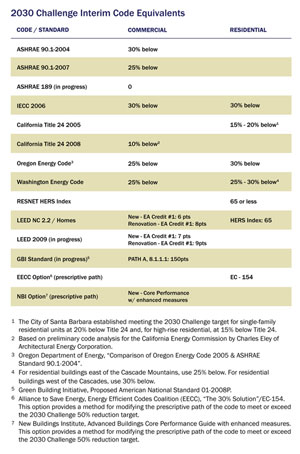
Architecture 2030 has released this chart that allows states and local governments to meet the targets using their current building energy codes and standards as baselines.

The paper shows how buildings can decrease consumption in the swiftest and most efficient way. An ambitious plan for all new buildings, developments and major renovations, the 2030 Challenge plans to decrease consumption by 50 percent by the designated deadline of 2010 and become carbon neutral by 2030. Many different organizations have adopted the Challenge including the US Conference of Mayors, the American Institute of Architects, and the US Green Building Council. Supporters say that the Challenge is aggressive enough to meet the demanding need for change, while still remaining possible—both financially and technically.

The paper seeks to expedite the first stage using existing energy standards. According to Mazria, executive director of Architecture 2030, “Meeting reduction targets through existing codes is the critical ‘missing piece’ to getting major reductions underway immediately.” Architecture 2030 holds that a single chart is the key to cracking building energy codes to help meet the dramatic 50 percent reduction of emissions.  The organization has developed “code equivalents,” which are additional reductions that can be easily incorporated into existing standard requirements. The paper will help local and state governments use original codes, standards, or systems as baselines.

Kent Peterson, the immediate past president of the American Society of Heating, Refrigerator and Air Conditioning Engineers (ASHRAE), thinks the guide is realistic and doable: “I believe that the code based approach is more effective than any other way. Most architects have struggled with how to meet the targets of the 2030 challenge and it’s a great step forward.”

The table lists fourteen codes and standards in the first column followed by the necessary code equivalents for either commercial or residential buildings. “The 2030 Challenge code equivalents listed in Table A provide a simple, practicable solution using existing building energy codes and rating systems,” the paper explains.  Besides the obvious improvements in energy efficiency, other benefits of the Challenge are that it is   cost effective, it creates new jobs and it can be implemented quickly and successfully.

The paper is an “aspirational guide” according to Harvey Sachs, senior fellow at the American Council for an Energy Efficient Economy. “But the devil’s in the details—it’s not just a matter of writing the plan, but how do you design it and the really tricky issue is how you measure performance,” Sachs said. “It’s going to require a constant level of cooperation and coordination among designers, contractors, and clients to achieve such goals.”

Share This Story

Looking for a reprint of this article?
From high-res PDFs to custom plaques, order your copy today!


Post a comment to this article

Report Abusive Comment

Subscription Center
  • Create an Account
  • Start a Subscription
  • Manage My Account
  • Sign Up for Newsletters
  • Visit Customer Service
  • Update Preferences

More Videos

Sponsored Content

Sponsored Content is a special paid section where industry companies provide high quality, objective, non-commercial content around topics of interest to the Architectural Record audience. All Sponsored Content is supplied by the advertising company and any opinions expressed in this article are those of the author and not necessarily reflect the views of Architectural Record or its parent company, BNP Media. Interested in participating in our Sponsored Content section? Contact your local rep!

close
  • 3D configurator
    Sponsored byDoorBird

    How DoorBird’s 3D Configurator Is Redefining Customization Across Residential and Commercial Design

  • interior of modern office
    Sponsored byCurrent

    The Downlight's Second Life: Why Below-Ceiling Serviceability Is the Specification Detail That Matters Most

  • cold storage facility
    Sponsored byCarlisle SynTec Systems

    How Architects Can Design More Continuous Cold Storage Envelopes

DESIGN:ED Podcast
Listen to Architectural Record’s DESIGN:ED Podcast

Events

July 29, 2026

Adaptive Reuse Reimagined: Designing Multifamily Housing from Existing Buildings

Credits: 1 AIA LU/HSW; 1 AIBD P-CE; 0.1 ICC CEU; 1 IIBEC CEH

Examine adaptive reuse envelope strategies that improve energy performance, preserve architectural character, and transform existing buildings into high-performing multifamily housing.

July 30, 2026

Constructing Exterior Walls to Avoid Moisture Issues

Credits: 1 AIA LU/HSW; 1 AIBD P-CE; 0.1 ICC CEU

Examine exterior wall and air barrier system strategies that improve moisture control, energy efficiency, durability, and indoor environmental quality.

View All Submit An Event

Products

Architectural Detailing: Function, Constructibility, Aesthetics, 4th Edition

Architectural Detailing: Function, Constructibility, Aesthetics, 4th Edition

See More Products

Popular Stories

Goldring Woldenberg Park

Continuing Education: Postindustrial Waterfronts

House of the Month - Casa BL

In Chile, Alejandro Beals and Loreto Lyon Revive a 1960s House Designed by a Le Corbusier Disciple

Temple-Emanu-El, San Francisco

AIA California Announces 2026 Design Award Recipients

Herz Rec Center

A Recreation Center by Leddy Maytum Stacy Architects Activates a Rebounding San Francisco Neighborhood

University of Victoria Indigenous Law Wing

Indigenous Law Shapes a Different Kind of Academic Building at the University of Victoria in British Columbia

Adaptive Reuse Reimagined: Designing Multifamily Housing from Existing Buildings - Free Webinar - July 29, 2026

Related Articles

  • Newsmaker: Edward Mazria

    See More
  • Bullitt Center

    Architecture 2030 Launches ‘Zero Code’ Standard

    See More
  • Energy-Advancement-and-Innovation-Center.jpg

    Countdown to 2030: Architecture and Planning Beyond Politics

    See More

Related Products

See More Products
  • movable arch.jpg

    Movable Architecture: A Design Guide to Container Reuse

  • 0470126736.gif

    Modern Sustainable Residential Design: A Guide for Design Professionals

See More Products
×

The latest news and information

#1 Source for Architectural Design, News and Products

SUBSCRIBE
  • RESOURCES
    • Advertise
    • Contact Us
    • Submit
    • Store
  • ACCOUNT CENTER
    • Create an Account
    • Start a Subscription
    • Manage My Account
    • Sign Up for Newsletters
    • Visit Customer Service
    • Update Preferences
  • PRIVACY
    • PRIVACY POLICY
    • TERMS & CONDITIONS
    • DO NOT SELL MY PERSONAL INFORMATION
    • PRIVACY REQUEST
    • ACCESSIBILITY
  • SERVICES
    • Marketing Services
    • Reprints
    • Market Research
    • List Rental
    • Survey/Respondent Access
  • STAY CONNECTED
    • Linkedin
    • Facebook
    • Instagram
    • YouTube
    • X (Twitter)

Copyright ©2026. All Rights Reserved BNP Media, Inc. and BNP Media II, LLC.

Design, CMS, Hosting & Web Development :: ePublishing