Countdown to 2030: Architecture and Planning Beyond Politics

In an era dominated by furthering self-interests and polarizing political debates on climate change, a quiet revolution is taking place, regardless of the political landscape. The transformation of our built environment currently underway stands as one of the most remarkable yet understated stories in the fight against climate change and despair. Far from the international and political spotlight, architects, planners, and builders are revolutionizing how we design and construct the built environment, demonstrating the significant power of architecture and planning to drive greenhouse gas emissions reductions, address community and social well-being, and solve critical local, regional, and global challenges.
Turning Point: Global Building Emissions Begin Declining
Recent data marks a watershed moment: global building sector operating emissions (heating, cooling, lighting, hot water, plug load, etc.) stabilized between 2018 and 2022, decreased by 1 percent in 2023, and are projected to continue falling under government announced pledges, according to the International Energy Agency (World Energy Outlook 2024). This achievement is particularly wrnoteworthy given that the global building stock expanded by approximately 320 billion square feet (29.7 billion m²) from 2018 to 2024—the equivalent of the total building area of the United States. Instead of operating emissions rising alongside this growth, the sector not only stabilized but also began reducing emissions.
Global building energy intensity—the energy required to operate buildings—has also improved steadily since 2010, dropping 13.9 percent as of 2022. These trends are expected to accelerate as buildings become even more efficient, electrified, and the power sector continues its transition to solar, wind, and other renewable energy sources. Currently, 55 percent of global electricity generation comes from non-CO2-emitting sources, further supporting emissions reductions.
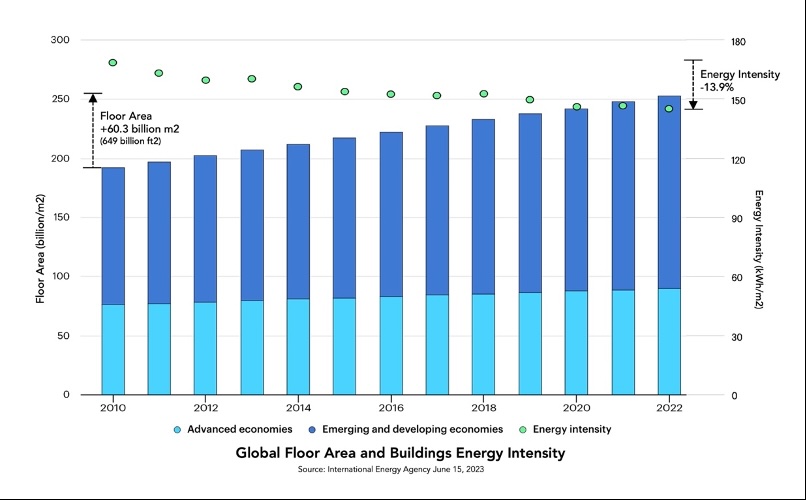
Courtesy Architecture 2030. Click to enlarge
Beyond Politics: A U.S. and E.U. Success Story
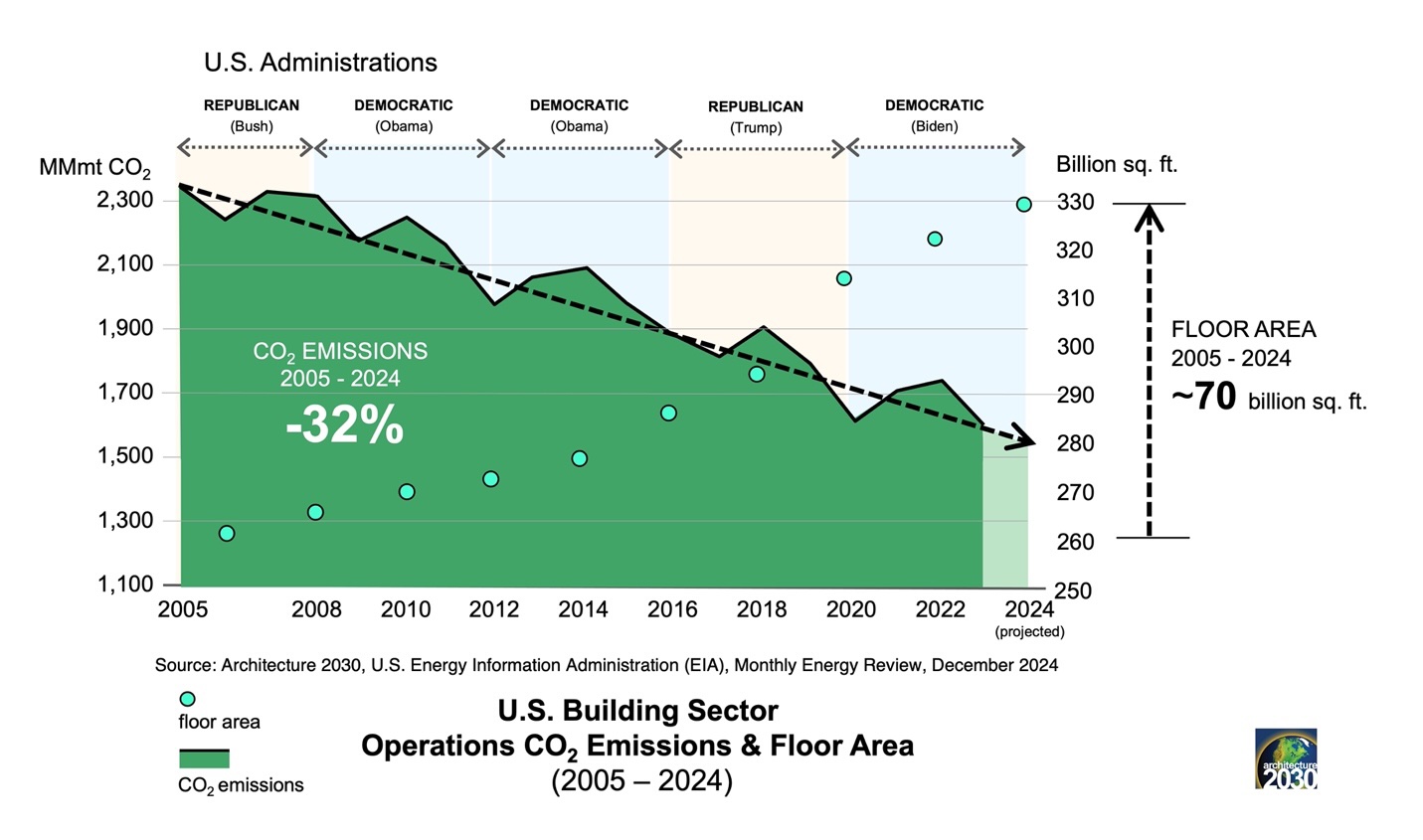
The United States presents an even more compelling narrative. Since 2005, U.S. building sector operations achieved remarkable energy efficiency and emissions reductions regardless of the political climate. Energy intensity steadily
improved, declining by approximately 16 percent.
Even more impressive were the decreases in CO2 emissions intensity from 2005 to 2023: residential buildings dropped by 39.5 percent, and commercial buildings by 47.9 percent. Overall, total emissions from U.S. building operations fell by 32 percent—all while the sector added roughly 70 billion square feet of new construction.
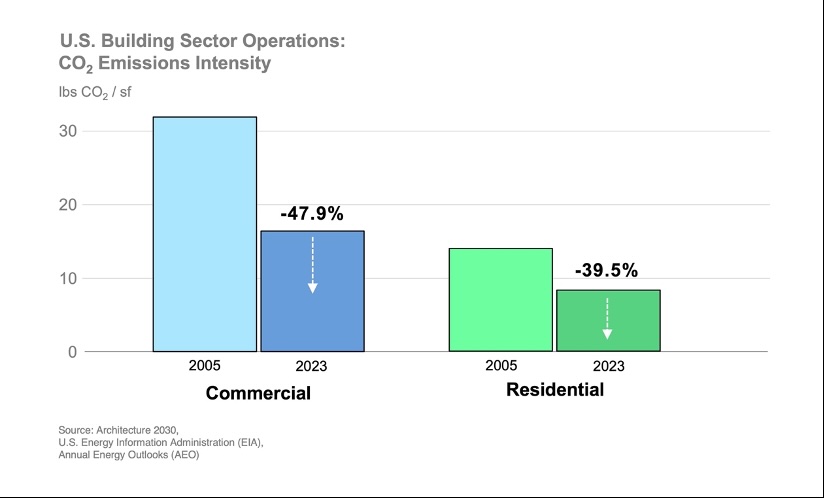
Courtesy Architecture 2030
Courtesy Architecture 2030
Additional evidence of this profound transformation is readily apparent. The European Union is experiencing a similar building sector operations emissions decline of 34 percent between 2005 and 2022, with an additional 5.5 percent drop in 2023.
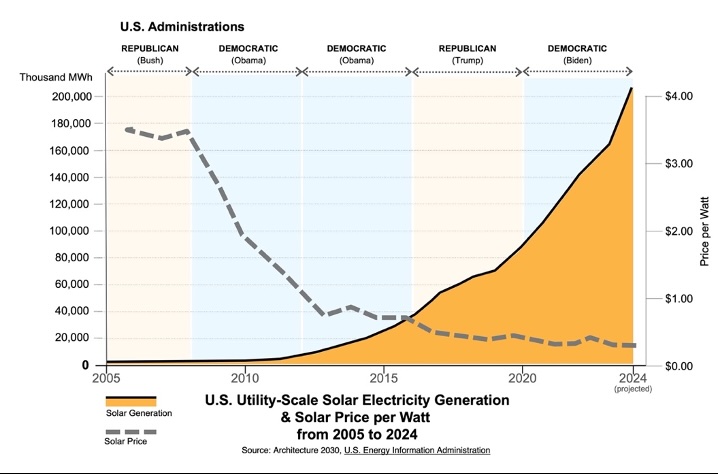
U.S. and European Union renewable electricity generation have been growing as well, driving unprecedented adoption rates through market forces, lower costs, and local initiatives. In 2024, CO2 emissions-free sources generated 42 percent of electricity in the U.S. and 74 percent in the EU, with renewables contributing 23 percent and 50 percent, respectively. This surge in renewable energy adoption is further accelerating the decarbonization of the building sector.
Looking for quick answers on architecture and design topics?
Try Ask RECORD, our new smart AI search tool.
Ask RECORD →
Courtesy Architecture 2030
Design and Planning With Purpose
Building sector progress isn't just from marginal improvements; it stems from deliberate design strategies that have been wholeheartedly adopted and implemented globally to redefine the built environment. The architecture and planning professions are a calling to shape the future, to build a better world. Beyond politics, it is this vision—rooted in passion and purpose—that is presently driving change and inspiring others to coalesce around a shared vision.
One has only to look at recent architecture and planning publications, sector organization priorities and programs, to fully comprehend the extent to which the sector is transforming.
Leading organizations have established ambitious targets and programs as well, such as the COP26 Communiqué, AIA 2030 Commitment, MEP 2040, ASLA Climate Action Plan, RIBA 2030 Climate Challenge, C40 Climate Action Plans, and WorldGBC Net Zero Carbon Buildings Commitment, among many others. These initiatives challenge practitioners to significantly reduce CO2 emissions from buildings, materials and construction, and infrastructure. Additionally, prestigious awards programs increasingly recognize projects and practitioners that exemplify these principles, celebrating work that minimizes environmental impacts while enhancing quality of life.
These combined efforts demonstrate a fundamental shift in the sector towards a more holistic and integrated approach to planning, design and construction. This shift acknowledges the interconnectedness of the built environment with the natural world and the crucial role of architects, planners, and designers.
Countdown to 2030
While we have reached a critical milestone and made significant progress, the pace of transformation in the built environment must accelerate substantially to meet scientific climate targets: a 50 percent to 65 percent reduction in CO2 emissions by 2030 and achieving zero emissions by
2040. Meeting these goals requires rapid, comprehensive action across the entire built environment. As two of the largest two of the largest CO2 emitters, the U.S. and European Union—whose building sectors are among the most advanced in operating emissions reductions—should aim for the higher end of the 2030 target.
The next five years will be crucial for scaling up proven solutions, implementing stronger actions, reducing embodied carbon, and adopting a sufficiency mindset—minimizing demand for energy, land, materials, and water—to drive deeper emissions reductions. Starting this year, we can take decisive steps to meet these critical climate objectives, including:
Compact and Resilient Development
• Promoting growth boundaries, and compact, mixed use, infill development that
minimizes environmental impacts.
• Ensuring that essential community services are within walking and biking distance of housing to reduce automobile reliance.
• Aligning compact, high-density neighborhoods with public transit development.
• Designing human-scaled streets with small blocks that prioritize pedestrian
movement through safe and direct routes.
• Proactively integrating climate resilience strategies to address intensifying hazards like sea level rise, flooding, wildfires, drought, and extreme heat.
Integrated Natural Systems
•Protecting and restoring natural environments, including habitat corridors, parks,living shorelines, and riparian buffers, to foster biodiversity and community wellbeing.
• Preserving agrarian landscapes and heritage sites.
• Minimizing hardscapes and integrating green infrastructure for stormwater
management and enhanced climate resilience (e.g., sponge cities).
• Incorporating carbon-sequestering landscapes such as wetlands, bioswales, urban forests, and green roofs to mitigate climate change impacts.
• Prioritizing water-smart landscapes and urban and peri-urban agriculture to enhance food security.
Zero Carbon New Buildings and Major Renovations
• Prioritizing the reuse, renovation, and restoration of existing and historic buildings.
• Electrifying all buildings and eliminating onsite fossil fuels.
• Incorporating passive heating, cooling, daylighting, shading, and natural ventilation design strategies.
• Integrating on-site and/or off-site renewable energy sources for building operations.
• Using recycled, reclaimed, and locally sourced nature-based, low-to-zero embodied carbon or carbon storing materials.
• Designing buildings, landscapes, and infrastructure for future disassembly, reuse, and circular material flows.
Professional Education
• Integrate the strategies outlined above into all architecture, planning, and design studio briefs and projects to promote a deep understanding of the relationship between built and natural environments.
• Foster interdisciplinary collaboration among students across allied disciplines and professionals to address current and projected climate challenges.
These strategies are particularly critical in the Global South, where rapid urbanization and climate vulnerability are converging. As a significant portion of built environment growth is occurring in these regions, implementing these strategies becomes essential.
The quiet revolution taking place in architecture and planning illustrates that solutions to our greatest challenges already exist and are being implemented every day by professionals who understand that shaping the built environment means shaping our collective future. As transformative practices continue to gain momentum, they illustrate that when vision aligns with action, the power to change the world lies within the hands of those who design it.
As we face an uncertain environmental future, the role of architects, planners, and designers has never been more critical. To all in the field: your work matters, your vision shapes the future, and your efforts lay the foundations for a world where sustainability and human wellbeing are the cornerstones of our legacy.
Looking for a reprint of this article?
From high-res PDFs to custom plaques, order your copy today!