Newsmaker: Newsmaker: Hadrian Predock
|

Design runs in Hadrian Predock’s family. The Santa Monica, California, architect is the son of celebrated New Mexico architect Antoine Predock, FAIA. Not only did the younger Predock inherit an interest in the profession from his father; his family also passed down an approach to practice that combines traditional design work with other art forms.
Antoine Predock trained as a painter before going into architecture, and Hadrian’s mother is a dancer. “When I was growing up in Albuquerque, they would collaborate on pieces together,” he says. “My dad would design set pieces and experimental things for the stage, and my mom would choreograph around them. That was the kind of context I grew up in. A very hybridized, cross-disciplinary situation was somewhat normal for me.”
After finishing his M.A. in Architecture at Harvard, Hadrian Predock, AIA, founded Predock_Frane Architects with John Frane in 2000. In keeping with discipline-blurring family tradition, the Santa Monica-based firm’s first project to win widespread acclaim was not a design for a building, but an installation at the 2004 Venice Biennale. (The work was commissioned by RECORD).
The firm has completed several built projects ranging from a building for a Zen-Buddhist compound in the New Mexico desert to a family-programming space for the J. Paul Getty Center in Los Angeles. But despite a full roster of traditional architecture projects, the firm still makes time to work on installations, and their most recent is a site-specific piece unveiled last week at the Pomona College Museum of Art.
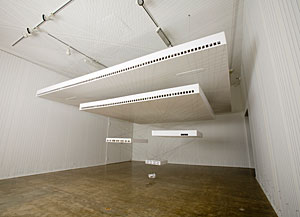
Titled Inland Empire (2008), the installation abstracts key building types found in the Inland Empire, a sprawling area east of Los Angeles with notoriously lax zoning, into a series of six white boxes suspended from a web of wire filament that crisscrosses like freeway network thought the gallery. Predock and Frane’s taxonomy of buildings follows the flow of consumer goods through the region, stacking bedroom-community houses with big-box retail outlets and massive shipping depots to highlight the jarring juxtapositions of scale that occur throughout the area.
I recently spoke with Predock about the project. We discussed his interest in the Inland Empire and the architecture that the region has produced, as well as the role of installation work in his firm’s larger practice.
William Hanley: When the curator, Rebecca McGrew, approached you about doing an installation for the museum, why did you choose the Inland Empire as your subject?
Hadrian Predock: All the pieces that we do are site specific. We got really interested in the Inland Empire, which is made up of small to medium-size suburb cities that stretch on for 60 or 70 miles, because Pomona College is situated basically on the edge of that area of land.
It’s gross out there. There’s bad pollution. It has this history of horrific attributes. But it’s a fascinating landscape at the same time. You end up with these amazing juxtapositions between things and a very strange urban landscape. You find remnants of the precious California—romantic landscapes of orange groves and ranch land—next to two-million-square-foot regional shipping depots. They’re literally across the street. It’s like zoning gone wild.
WH: How did you decide what form the installation would take?
HP: We just stared with Google Earth, and we used that as a kind of visual starting point. We were trying to look at it in an almost scientific way by taxonomizing houses versus mini-malls versus big-box retail.
To a massive extent the Inland Empire is made up of single-family homes, bedroom communities, and “the house.” At the same time, this very, very large building type has evolved because of inexpensive land and proximity to the Long Beach port, and we became interested in the supply and demand relationship between the house and the depot.
WH: Is the research process underpinning the installation similar to the way you begin an architecture project?
HP: It absolutely is. Our process for all the architectural projects begins the same way: With a series of investigations and then mapping and curating our findings. We try to find what defines the locality for us. It could be a particular set of geometries. It could be material conditions. It could be socioeconomic conditions. It depends on the project.
It’s very reciprocal. It’s not like there’s this art practice and their architecture practice. They’re totally stitched into each other.
WH: How does the installation work influence your architecture projects?
HP: The whole depth of process that we’re able to get into with the installation projects really informs the larger practice. For example, we’re working on this house prototype up in Malibu—and I call it a prototype because the location has many different house sites on it—where we’re trying to develop one set of ideas that can be manipulated and evolved depending on where it is on the site.
We’re starting out with this kind of rudimentary set of program blocks that have primitive shapes, primitive origins, and then investigating the effects of different ecological conditions. From the way the landscape is shaped by the fires that sweep through the hills to the instability of the geology of the Santa Monica mountains to solar positions, those things begin to work in tandem to affect these primitive blocks until they start to shape into an architecture that’s responsive to all of them at the same time.
The one thing that ties it all together is that we tend to start with these generic elements and then we like to have a series of complex effects that interface with these generic elements. And that can be found in houses or in the Pomona thing with threads and boxes. They’re all starting with a very basic set of elements.
Looking for a reprint of this article?
From high-res PDFs to custom plaques, order your copy today!