Architectural Record
search
cart
facebook twitter linkedin youtube
  • Sign In
  • Subscribe
  • Sign Out
  • My Account
Architectural Record
  • NEWS
    • Latest News
    • Awards
    • Interviews
    • Obituaries
    • Podcasts
      • Design:Ed Podcast
      • Sponsored Podcasts
  • OPINION
    • Book Reviews / Excerpts
    • Exhibition Reviews
    • Forum
  • EXCLUSIVES
    • Videos
    • Design Vanguard
    • Top 300 Firms
    • Sponsored Content
    • Sponsored eBooks
    • From the Archives
  • CONTINUING ED
    • Editorial Continuing Ed
    • CE Center
    • CE Academies
  • PROJECTS
    • Buildings By Type
    • Reuse & Renovation
    • Museums & Arts Centers
    • Colleges & Universities
    • Multifamily Housing
    • Interiors
    • Lighting
    • Kitchen & Bath
  • HOUSES
    • Record Houses
    • House of the Month
    • Featured Houses
  • PRODUCTS
    • Products by Category
    • Record Products of the Year
    • Latest Products
  • EVENTS
    • Dates & Events
    • Record on the Road
    • Innovation Conference
    • Sustainability in Practice
    • Women In Architecture
    • Webinars
    • Ad Excellence Awards
    • Submit an Event
  • CONNECT
    • Ask RECORD AI
    • Newsletters
    • Contact
    • Advertise
    • Editorial Calendar
    • Store
    • Customer Service
  • SUBMIT
    • Submission Guidelines
    • RECORD Competitions
  • MAGAZINE
    • Subscribe
    • My Account
    • Digital Edition
    • Current Issue
    • Firm Pass
    • Historic Archive
Architecture NewsInterviews

Newsmakers: Kevin Roche and Morrison Heckscher

By Leslie Yudell
June 16, 2009

LY: Another problem with the former design is that people had trouble finding the galleries upstairs. When did you first notice this?

MH: In 1924, when they placed the earliest galleries and period rooms on the top floor. It was always a problem for people to get to the beginning of the sequence. The principal goal of our effort was to clarify patterns of access—pathways for visitors. And the 1980 design did not solve the linkage issue between the 1924 structure and the rest of the building. At that time, they tried to integrate the wing with the main building, but it didn’t work: It was confusing, people got lost. In this redesign, the original building has been more fully isolated: The visitor stays within the American Wing structure, and the links to other parts of the building have been clarified.
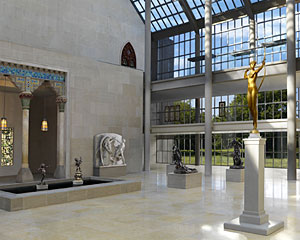
Redesigned Charles Engelhard Court, American Wing View toward the southwest, during installation.
Photo courtesy The Metropolitan Museum of Art
Redesigned Charles Engelhard Court, American Wing: View toward the southwest, during installation.

KR: In 1980, we designed the wing hoping people would enter through the bank facade, with an elevator beyond that to bring people to the upper floors. But people never went through the bank facade; they didn’t see it as an entrance. Gradually, the main entrance became the door to the right of the bank, although it was not intended to be.

LY: So you expanded that entrance and added a new glass elevator where all the levels connect.

MH: The large glass elevator is the key to the new circulation pattern. It slices through the building, like a physical section of it, so you can see where you’re going. And by making it transparent, visitors on the ground level can see people going to the upper floors and follow them.

KR: The elevator is placed at a point of entry to each of the levels, and enables you to go directly to each floor: You can go to the period rooms without going through paintings, for example. Before, it was difficult to get to one area without going through another, and you had to detour or go up or down levels to get to specific galleries. Now the elevator gives you direct access.

LY: The elevator is a large, notably Modern glass-and-steel structure set amid objects from earlier periods. Did you choose it for aesthetic or merely functional reasons?

MH: The elevator was the result of our having experimented with every other imaginable option, including an escalator.

KR: We didn’t want to design a “period” elevator, but we discussed the possibility of using a vintage elevator cab that was available from a building that was being torn down. We considered it, but we decided not to. We chose to create a Modern elevator, and we decided not to close it up, but to make it transparent so people could see where they were going.

MH: We made the whole building transparent: We took down the concrete parapets on the balconies and put up glass railings; we removed a masonry wall in front of the elevator, so you can look from the elevator to the courtyard; and we have created vistas.

KR: Yes, we are creating vistas. But the full effect won’t be evident until the second floor is finished [in 2011]. It will be spectacular: When you come out of the elevator, for instance, you will have a long-distance view of [Emanuel Leutze’s] Washington Crossing the Delaware—from across the room! The final effect will only be clear when the painting galleries open.

LY: The use of glass for its transparency as a wayfinding tool is a theme of this project, but Garry Leonard has also noted that “it is the quietest, most neutral material that could be used structurally and wouldn’t get in the way of the art.” Do you think that museum architecture that calls attention to itself can serve art?

KR: Some recent museum buildings fail because their designs make it virtually impossible to show art. The egocentric nature of that architecture may be good for architecture, but not for art. But it should be possible to serve the purpose of a building without compromising architecture. If you’re designing a museum in a place where there isn’t a major collection and want to bring people there and get publicity, then it’s legitimate to create a building that gets them the press. But the Metropolitan is celebrated for its collections, not its building. In this case, you try to celebrate the collections in the most discreet way without compromising your values in architecture.

MH: This is architecture in the cause of art.

Share This Story

Looking for a reprint of this article?
From high-res PDFs to custom plaques, order your copy today!


Post a comment to this article

Report Abusive Comment

Subscription Center
  • Create an Account
  • Start a Subscription
  • Manage My Account
  • Sign Up for Newsletters
  • Visit Customer Service
  • Update Preferences

More Videos

Sponsored Content

Sponsored Content is a special paid section where industry companies provide high quality, objective, non-commercial content around topics of interest to the Architectural Record audience. All Sponsored Content is supplied by the advertising company and any opinions expressed in this article are those of the author and not necessarily reflect the views of Architectural Record or its parent company, BNP Media. Interested in participating in our Sponsored Content section? Contact your local rep!

close
  • TAMLYN XtremeTrim Exterior Trim
    Sponsored byTamlyn

    Designing Cleaner Panel Facades: Why Exterior Trim Details Matter

  • Building with Vapor Barriers
    Sponsored byReef Industries, Inc.

    Vapor Barriers Help Control Moisture in Tighter Building Designs

  • Duct Interior with Prodeq System
    Sponsored byHenry, a Carlisle Company

    Designing Resilient Water Containment Systems

DESIGN:ED Podcast
Listen to Architectural Record’s DESIGN:ED Podcast

Events

June 10, 2026

Rethinking Stormwater – The Power of Porous Paving

Credits: 1 AIA LU/HSW; 1 AIBD P-CE; 0.1 ICC CEU

Learn how porous paving systems support stormwater management, reduce heat island effects, and enhance sustainable site design performance.

June 11, 2026

Very Early Warning Fire Detection for Mission-Critical Facilities

Credits: 1 AIA LU/HSW; 1 AIBD P-CE; 0.1 ICC CEU

Examine advanced fire detection strategies that support uptime and enhance safety in data centers and other mission-critical facilities.

View All Submit An Event

Products

2026 Architect's Square Foot Costbook

2026 Architect's Square Foot Costbook

See More Products

Popular Stories

Practice Matters illustration

What’s in a (Firm’s) Name? Thinking About Succession and Legacy

Practice Matters illustration

By the Numbers: Counting America's Architects

House on a Hill

Design Vanguard 2026: Forma

Crane Cove, ONO

Design Vanguard 2026 Winners

KRESA by DLR

In Kalamazoo, DLR Group Completes a Mass-Timber Hub for Career and Technical Education Programs

Broader Sustainability of CMU - Free Webinar - May 21, 2026

Related Articles

  • Newsmakers: Kevin Roche and Morrison Heckscher

    See More
  • Kevin Roche Retrospective Opens in New York

    See More
  • Kevin Roche Obit

    Obituary: Kevin Roche, FAIA, 1922-2019

    See More

Related Products

See More Products
  • screen_shot_.png

    Casting Architecture: Ventilation Blocks

See More Products
×

The latest news and information

#1 Source for Architectural Design, News and Products

SUBSCRIBE
  • RESOURCES
    • Advertise
    • Contact Us
    • Submit
    • Store
  • ACCOUNT CENTER
    • Create an Account
    • Start a Subscription
    • Manage My Account
    • Sign Up for Newsletters
    • Visit Customer Service
    • Update Preferences
  • PRIVACY
    • PRIVACY POLICY
    • TERMS & CONDITIONS
    • DO NOT SELL MY PERSONAL INFORMATION
    • PRIVACY REQUEST
    • ACCESSIBILITY
  • SERVICES
    • Marketing Services
    • Reprints
    • Market Research
    • List Rental
    • Survey/Respondent Access
  • STAY CONNECTED
    • Linkedin
    • Facebook
    • Instagram
    • YouTube
    • X (Twitter)

Copyright ©2026. All Rights Reserved BNP Media, Inc. and BNP Media II, LLC.

Design, CMS, Hosting & Web Development :: ePublishing