Economic Engines?
Cities forge ahead with plans for new professional sports venues, despite their high cost and the tepid pace of development.
| Image courtesy Sasaki |
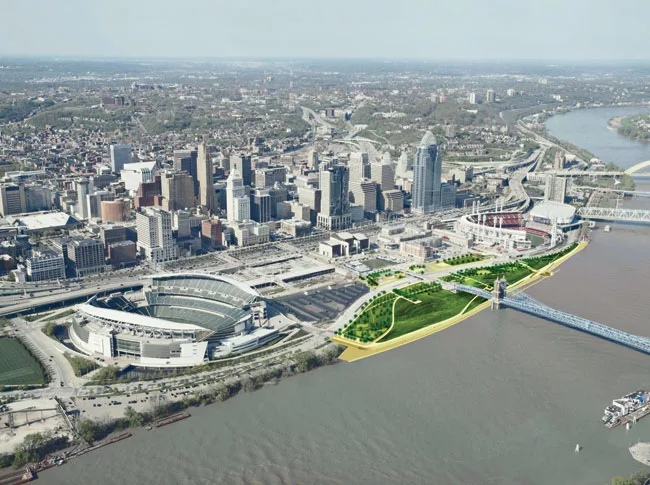
In Cincinnati, the first phase of a waterfront park recently opened. When the second phase is completed, a 45-acre swath of green will link the Paul Brown Stadium and the Great American Ball Park. |
The view of Cincinnati's skyline from the Kentucky side of the Ohio River reveals the alluring, if complicated, relationship of sports facilities and cities. On the western edge of downtown, the $455 million Paul Brown Stadium usually fills to capacity with cheering Bengals fans when the NFL team plays at home. Designed by NBBJ, this brawny cylinder of layered concrete and glass, topped by a grandstand of cable-tensioned steel, preens for motorists cruising around the freeway ramps that wrap it on two sides.
Bookending the city's skyline to the east, the $337 million Great American Ball Park (2003), home of the Cincinnati Reds, nestles deeper into the riverbank, intentionally less obtrusive. At the ballpark, designed by HOK Sport (now Populous) with GBBN Architects, only the spindly lighting towers'everyone in town compares them to toothbrushes'rise high.
The sight of thousands of Bengals fans in their orange jerseys streaming out of the stadium and through the downtown streets serves as a reminder that sports is deeply embedded in the city's identity'even in a corporatized era of millionaire players, billionaire owners, and billion-dollar stadiums. Planners and city boosters everywhere inevitably want to harness that emotional connection as an engine of urban redevelopment, though they have not found it easy.
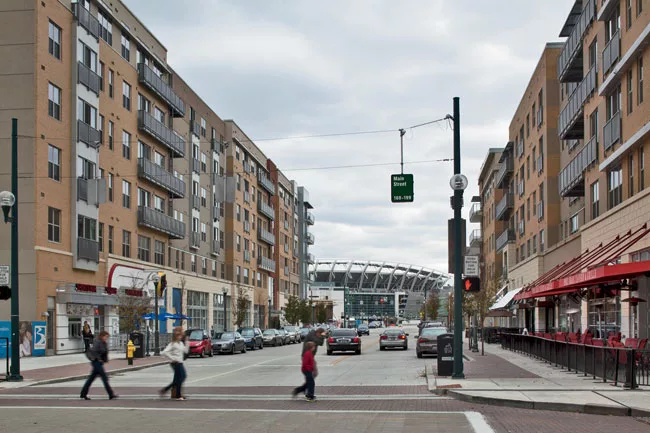
In Cincinnati, a kind of urban glue has belatedly begun to take hold on what was once 18 acres of parking that divided the two stadiums. The first two residential buildings of The Banks have gone up, and include street-level restaurants that extend west from the Great American and cater to fans, residents, and the downtown lunch crowd. The development will someday comprise 300 apartments, 300,000 square feet of office space, and a 200-room boutique hotel.
Nearby, the first phase of what will be the 45-acre Phyllis W. Smale Riverfront Park, designed by Sasaki, opened last spring. It brings the river closer to the city with a terraced grand stair and a waterfall. When completed, the park will extend a string of existing riverfront parks past the baseball stadium to wrap Paul Brown at the river's edge.
This waterfront anchored by stadiums looks like a textbook case of sports spurring growth'an oft-cited reason for trading in the old stadium for a new one. 'The stadiums drive tenant interest in The Banks,' says Tracy Schwegmann, the development's marketing director. 'And entertainment attracts retail.' Reds spokesman Michael Anderson adds that the new park gives families 'something to do before the game begins.'
The costs, however, have been staggering. Largely underwritten by public funds, the stadiums have saddled Hamilton County with debt. Though The Banks is built atop a publicly financed parking structure, Carter, the Atlanta-based developer, missed an opportunity to build the architecturally distinctive project expected for such a prime waterfront location. The small part of the park completed so far only begins to suggest the waterfront's potential.
The high costs and tepid pace of redevelopment are not unique to Cincinnati, and have made some cities leery of financing big-league sports facilities with public dollars. Still, cities continue to build.
To name a few: In Minnesota, the Twin Cities will remodel the Target Center arena and build a new NFL stadium for the Vikings, designed by HKS. Chris Hansen, a hedge-fund investor from San Francisco, plans to build an arena in Seattle if he can find a basketball-team tenant. The NBA's Golden State Warriors will move from Oakland to a planned San Francisco arena being designed by Sn'hetta and AECOM's sports practice (formerly Ellerbe Becket). Two football-stadium bids are competing in Los Angeles.
Obviously, the economy has played a part in declining taxpayer support, while cautionary tales abound. Hamilton County paid $34.6 million in debt service in 2010 for its share of the costs of the Bengals and Reds stadiums, according to the Wall Street Journal'more than 16 percent of its budget. The story called the Paul Brown financing deal 'one of the worst professional sports deals ever struck by a local government.' Tax revenues that back debt have fallen short elsewhere too, increasing financing costs by $43 million for the NFL Colts' 2008 Lucas Oil Stadium in Indianapolis, according to Bloomberg News. And critics maintain that professional sports facilities are generally poor generators of economic activity. According to Neil deMause, who analyzes public stadium deals in his book and website Field of Schemes, 'Each new job can cost on the order of $250,000; that's a terrible bang for the buck.' He adds, 'Economists have found very little impact on sales-tax receipts and per capita income.'
Most of the new facilities are in big-city downtowns where, the thinking goes, they can add amenities as business districts attract more residents. Those downtowns in turn deliver fans to the teams and their restaurants, and unique neighborhoods enrich the game-day experience. 'Stadiums and arenas don't work alone,' says Robert Mankin, an NBBJ sports specialist. 'They can act as a catalyst.'
Yet as Cincinnati has learned, football and baseball stadiums aren't busy enough to ignite the redevelopment process. NFL teams play only seven or eight games at home; baseball stadiums can host 80 dates or more. Arenas generate more economic value. Because they can mix basketball, hockey, amateur sports, concerts, and family events, they can be busy more than 200 days a year.
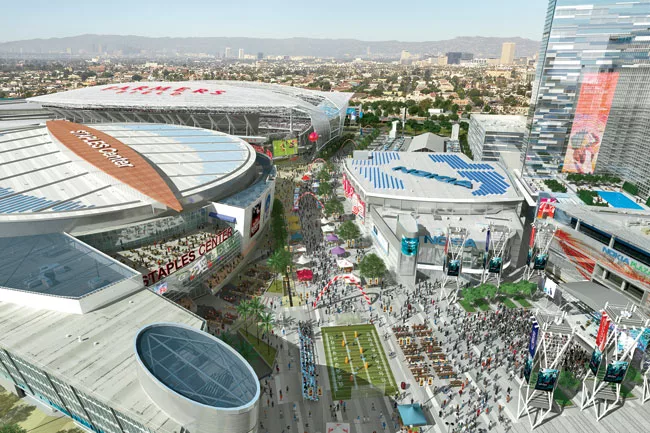
Mankin points out that NBBJ's Staples Center arena, opened in downtown Los Angeles in 1999, became more successful once the Anschutz Entertainment Group (AEG)'s 4 million-square-foot L.A. Live sports-and-entertainment complex rose around it in the following decade. The arena 'works in concert with the adjacent convention center and the Nokia Theatre across the street,' he says.
Now AEG wants to boost L.A. Live with the $1 billion, 78,000-seat Farmers Field, a football stadium designed by Gensler. The developer says it will build the facilility without public money. AEG is competing with Majestic Realty's proposal for an NFL stadium 18 miles east, in the City of Industry. Designed by the sports-facility expert Populous, it is also self-financed. The project that lands a team first will proceed.
Sports facilities do most for cities when they reinforce redevelopment trends already under way. Fans can dine and drink in Denver's downtown LoDo because the adjacent 1995 Coors Field is not isolated from the redeveloped warehouse district by acres of parking. San Francisco's Caltrans commuter-rail station serves the 12-year-old AT&T Park through the South of Market neighborhood that's boomed since the 1990s. Downtown fans filter through Seattle's historic Pioneer Square to reach baseball and football stadiums that cut dramatic silhouettes on the skyline.
Other cities hoping to kindle such synergies with new facilities have garnered citizen support for public financing. In Minneapolis, teams and owners overcame significant taxpayer skepticism by agreeing to cover well over half the cost of renovating the 22-year-old Target Center and building the new $975 million Vikings stadium. The recent collapse of the inflatable roof on the Metrodome, the Vikings' current home, and the team's threat to move, added urgency to the effort. Local governments will lend as much as $145 million to the $537 million Seattle arena project for a site adjacent to the two existing downtown stadiums. Much of that cash will be applied to a variety of off-site improvements.
The ugly financial climate does not mean that stadiums and arenas will be built less expensively, because trends in public expectations and technology are likely to add to costs. Cities are asking for memorable designs. That's why Forest City Ratner hired first Frank Gehry and then SHoP Architects to put a good face on the Barclays Center, the new Brooklyn home for the NBA's Nets (page 100). SHoP has recently been asked to lead a group that will propose a new Major League Soccer stadium for New York City.
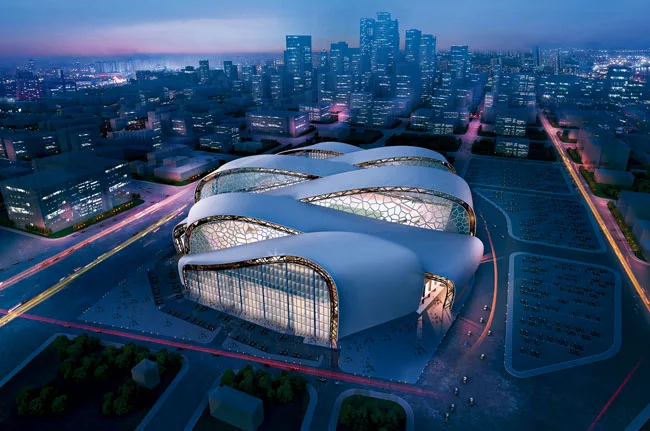
Because the Warriors wanted to build on a 13-acre pier on San Francisco Bay near the Bay Bridge, the team partnered Sn'hetta with AECOM 'to add architectural firepower,' says Warriors president Rick Welts. The Oslo-based Sn'hetta had never worked on a sports building, but designed the immensely popular waterfront Oslo Opera House. Welts was also impressed with 'the extraordinary reviews' for the addition that the firm is designing to the San Francisco Museum of Modern Art. The Warriors have released early studies showing entry and retail pavilions with folded roofs leading to ramps that curve around an oval arena.
As much as half the site may be devoted to plazas and gardens that will be open to the public, rather than to parking.
With fans addicted to mobile devices or inclined to watch on high-definition home screens, teams are using apps and scoreboard bells and whistles to help fill seats. Designers push harder to optimize sightlines and calibrate acoustics to pump up crowd excitement.
Owners are saying goodbye to soggy hot dogs sold in smelly, echoing concrete concourses. Along with luxury boxes, fans are finding a variety of clubs and celebrity-chef restaurants linked to premium seats. With pressure to self-finance, teams and facility owners use these amenities to capture even more of the fans' leisure dollars'but sometimes at the expense of neighborhood businesses, according to David Stone, who leads AECOM's sports practice out of Chicago.
DeMause'who, despite his criticism of stadium deals, nevertheless loves sports'says he has stopped predicting the end of publicly financed sports-venue construction. Facilities continue to be built, even though economists line up against owners' rosy economic forecasts, faltering performance leaves practically new buildings empty, and hoped-for surrounding development is slow to emerge. Despite all these obstacles, big-league sports and urban life seem forever bonded. You can't forget the 'family experience, the tribal connection that you only get by being at the game,' says Stone.
James S. Russell is the architecture critic at Bloomberg News and author of the book The Agile City: Building Well-being and Wealth in an Era of Climate Change.
Looking for a reprint of this article?
From high-res PDFs to custom plaques, order your copy today!