Architectural Record
search
cart
facebook twitter linkedin youtube
  • Sign In
  • Subscribe
  • Sign Out
  • My Account
Architectural Record
  • NEWS
    • Latest News
    • Awards
    • Interviews
    • Obituaries
    • Podcasts
      • Design:Ed Podcast
      • Sponsored Podcasts
  • OPINION
    • Book Reviews / Excerpts
    • Exhibition Reviews
    • Forum
  • EXCLUSIVES
    • Videos
    • Design Vanguard
    • Top 300 Firms
    • Sponsored Content
    • Sponsored eBooks
    • From the Archives
  • CONTINUING ED
    • Editorial Continuing Ed
    • CE Center
    • CE Academies
  • PROJECTS
    • Buildings By Type
    • Reuse & Renovation
    • Museums & Arts Centers
    • Colleges & Universities
    • Multifamily Housing
    • Interiors
    • Lighting
    • Kitchen & Bath
  • HOUSES
    • Record Houses
    • House of the Month
    • Featured Houses
  • PRODUCTS
    • Products by Category
    • Record Products of the Year
    • Latest Products
  • EVENTS
    • Dates & Events
    • Record on the Road
    • Innovation Conference
    • Sustainability in Practice
    • Women In Architecture
    • Webinars
    • Ad Excellence Awards
    • Submit an Event
  • CONNECT
    • Ask RECORD AI
    • Newsletters
    • Contact
    • Advertise
    • Editorial Calendar
    • Store
    • Customer Service
  • SUBMIT
    • Submission Guidelines
    • RECORD Competitions
  • MAGAZINE
    • Subscribe
    • My Account
    • Digital Edition
    • Current Issue
    • Firm Pass
    • Historic Archive

Behemoth on the Beach
By Hattie Hartman
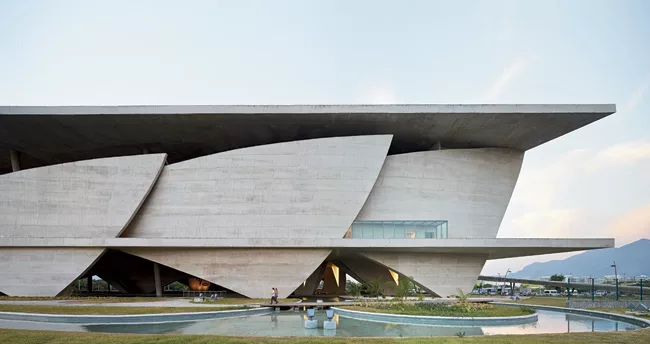
Sail-like sheets of structural concrete enclose theaters and support the elevated spaces.
Behemoth on the Beach
Sail-like sheets of structural concrete enclose theaters and support the elevated spaces.
Photo © Hufton+Crow
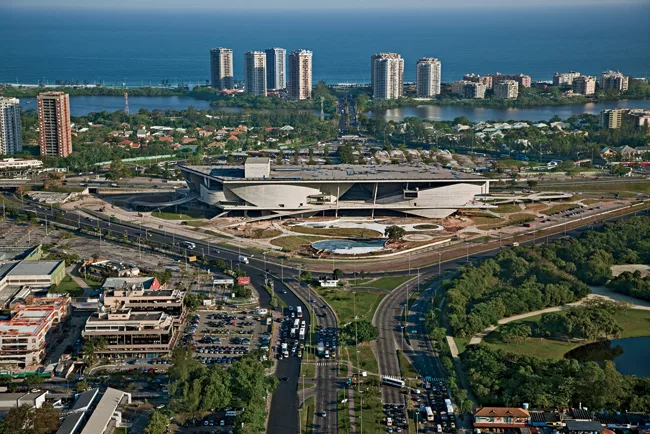
The raised floor plate of Christian de Portzamparc’s Cidade das Artes lifts its public spaces higher than a busy traffic interchange in Rio’s sprawling Barra district, affording views to t
Behemoth on the Beach
The raised floor plate of Christian de Portzamparc’s Cidade das Artes lifts its public spaces higher than a busy traffic interchange in Rio’s sprawling Barra district, affording views to the sea and moun­tains.
Photo © Nelson Kon
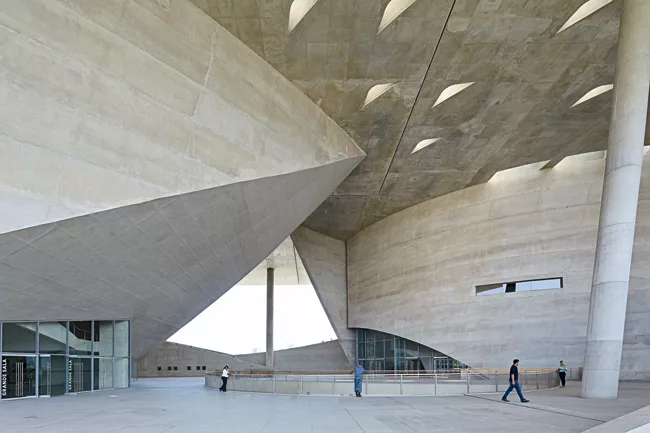
The architects set separate volumes housing different components of the program within the Cidade's single structural frame and allowed open-air public spaces to flow around them.
Behemoth on the Beach
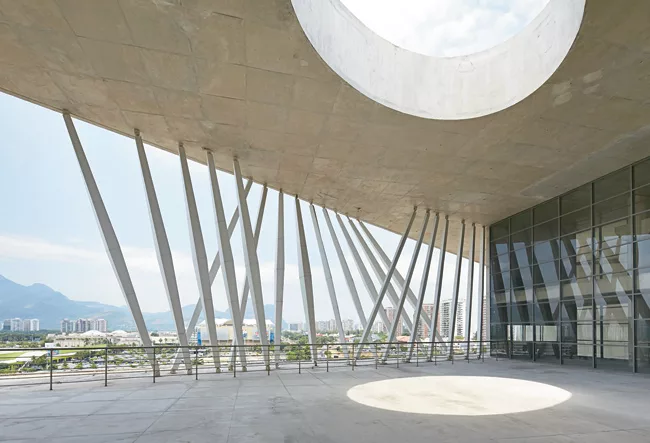
The architects set separate volumes housing different components of the program within the Cidade's single structural frame and allowed open-air public spaces to flow around them.
Photo © Hufton+Crow
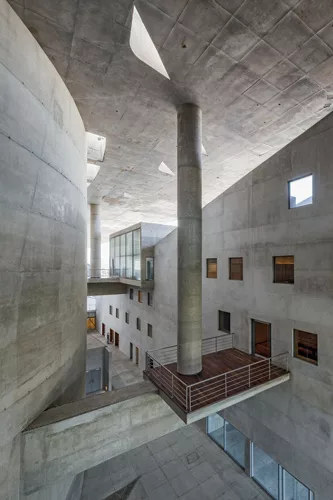
Floating columns distribute the weight of the roof to the enclosed spaces via transfer beams, one of which incorporates a small terrace on which musicians can have a break from the adjacent rehearsal
Behemoth on the Beach
Floating columns distribute the weight of the roof to the enclosed spaces via transfer beams, one of which incorporates a small terrace on which musicians can have a break from the adjacent rehearsal room.
Photo © Nelson Kon
Portzamparc’s firm worked closely with a local team that assured remarkably high-quality concrete work. The open decks inside the imposing structure were designed to provide a rare public space
Behemoth on the Beach
Portzamparc’s firm worked closely with a local team that assured remarkably high-quality concrete work. The open decks inside the imposing structure were designed to provide a rare public space in the sprawling neighborhood.
Photo © Nelson Kon
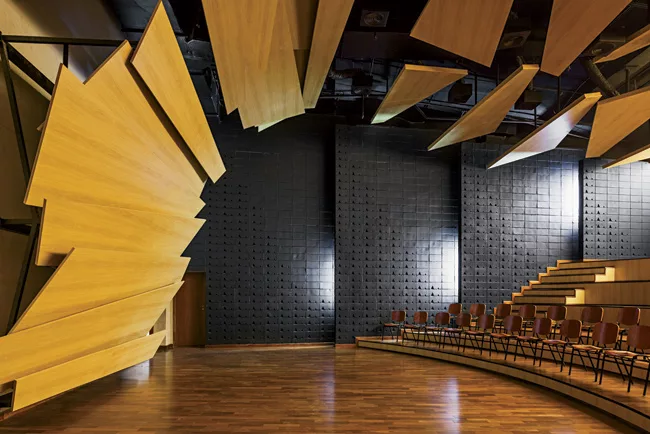
Albert Yaying Xu of Paris-based Xu-Acoustique worked with the architects to design the performance spaces and a rehearsal studio.
Behemoth on the Beach
Albert Yaying Xu of Paris-based Xu-Acoustique worked with the architects to design the performance spaces and a rehearsal studio.
Photo © Hufton+Crow
Sail-like sheets of structural concrete enclose theaters and support the elevated spaces.
The raised floor plate of Christian de Portzamparc’s Cidade das Artes lifts its public spaces higher than a busy traffic interchange in Rio’s sprawling Barra district, affording views to t
The architects set separate volumes housing different components of the program within the Cidade's single structural frame and allowed open-air public spaces to flow around them.
Floating columns distribute the weight of the roof to the enclosed spaces via transfer beams, one of which incorporates a small terrace on which musicians can have a break from the adjacent rehearsal
Portzamparc’s firm worked closely with a local team that assured remarkably high-quality concrete work. The open decks inside the imposing structure were designed to provide a rare public space
Albert Yaying Xu of Paris-based Xu-Acoustique worked with the architects to design the performance spaces and a rehearsal studio.
January 16, 2015

Christian de Portzamparc's massive, much-maligned Cidade das Artes is a grandiose emblem of Rio's ambitions.

Photo © Hufton+Crow
Sail-like sheets of structural concrete enclose theaters and support the elevated spaces.
The raised floor plate of Christian de Portzamparc’s Cidade das Artes lifts its public spaces higher than a busy traffic interchange in Rio’s sprawling Barra district, affording views to the sea and moun­tains.

On first impression, Rio de Janeiro's Cidade das Artes seems an act of architectural hubris and urban lunacy. Opened to the public last year after almost a decade of interrupted construction and cost overruns, it has been mired in criticism as a symbol of economic stratification in a city where an estimated 20 percent of the population resides in favelas.

The Cidade das Artes is the love child of Christian de Portzamparc and Cesar Maia, an ambitious former mayor once determined to put Rio on the global culture map. Maia's vision was for a Cidade da Musica—not Artes—modeled on Portzamparc's Cité de la Musique in Paris. And the architect was no stranger to the city: Elisabeth, his wife of more than 30 years, is a Carioca (a Rio native). When the then mayor summoned Portzamparc urgently to Rio in 2002, Maia announced that they would visit the site by helicopter, without disclosing the location. The helicopter headed west past Zona Sul's well-heeled neighborhoods and finally hovered over a vacant site at a key intersection surrounded by highways in Barra di Tijuca, almost 20 miles west of the city center.

Known colloquially as Barra (sandbar), this 10-mile stretch of beachfront masterplanned by Lúcio Costa in the 1960s has undergone explosive development. Gated condominium complexes and shopping malls cater to Rio's burgeoning upper middle classes. Maia envisioned the Cidade da Musica as a gateway to Barra, a cultural landmark amid urban sprawl in an area devoid of public facilities.

Portzamparc assembled a local team that included two structural engineers who had worked with Oscar Niemeyer and landscape architect Fernando Chacel, a former collaborator of Brazilian landscape architect Roberto Burle-Marx. He was determined to pay homage to Brazilian Modernism, in which, he says, “Structure makes the architecture.”

The nearly 1 million-square-foot complex is set on a concrete plinth 32 feet above the ground on which two auditoria are raised, following what Portzamparc refers to as an “open block principle,” with free volumes contained by a fixed form. The Cidade is a rhomboid structure framed between two horizontal concrete planes. They enclose the two concert halls, a dance studio, movie theaters, rehearsal rooms, restaurants, and a series of ancillary facilities. For Portzamparc, the open block mimics the street by creating semi-public space linking the different programs.

In place of piloti, curving triangular “veils” of post-tensioned structural concrete which enclose the performance halls penetrate the elevated floor slab and extend to the ground to support the building. Lifting the building off the ground creates views of the sea and the surrounding mountains, and distance from the swirling traffic below.

The project brief called for a philharmonic concert hall that could also be adapted for opera, as well as a second, smaller auditorium for chamber music. These technically complex spaces were delivered to a very high standard with the collaboration of acoustician Albert Yaying Xu of Paris-based Xu-Acoustique. But Maia's successor, Eduardo Pais, halted construction on the Cidade da Musica in 2009, wanting to disassociate himself from his predecessor's grandiose scheme. Only when Rio won the Olympics, and a nearby site in Barra was earmarked for the Olympic Park, did Pais acknowledge that the neighborhood's white elephant must be completed. To broaden its audience and strengthen its business plan, the Cidade da Musica was rebranded as the Cidade das Artes, and the Grande Sala designed for symphony and opera is currently programmed for theater, dance, and all forms of music. Portzamparc is delighted that the building is at last operational, but notes, “We delivered a Ferrari concert hall which the client is using as a conventional car.”

The building is a thoughtful response to the original brief, though it is overscaled and overly complex. Portzamparc has designed a forbidding performing-arts complex of Piranesian proportions in an area of Rio where shopping malls are the closest thing to public space. Despite its high-tech concert halls, this is not a forward-looking building. It fails to address critical 21st-century realities such as sustainability or socially inclusive programming. Conceived as permeable by the surrounding city, the entire site is fenced for security.

Yet the very generosity of the building's elevated veranda, with its stunning views of this rapidly growing area of Rio, may be its saving grace. It has already become a popular setting for television advertisements and commercial photography: Brazil's November Vogue featured several fashion spreads with the Cidade das Artes as a backdrop. If supported by wide-ranging programming that draws on Rio's wealth of cultural diversity, the building could evolve into a vibrant venue and attract many different audiences. One can easily envision a samba school rehearsing in the building's plaza-like open spaces. With the right programming, Cidade could serve the city that its architecture keeps at a distance.

Hattie Hartman is an editor at The Architects' Journal in London.

Share This Story

Looking for a reprint of this article?
From high-res PDFs to custom plaques, order your copy today!
Post a comment to this article

Report Abusive Comment

Subscription Center
  • Create an Account
  • Start a Subscription
  • Manage My Account
  • Sign Up for Newsletters
  • Visit Customer Service
  • Update Preferences

More Videos

Sponsored Content

Sponsored Content is a special paid section where industry companies provide high quality, objective, non-commercial content around topics of interest to the Architectural Record audience. All Sponsored Content is supplied by the advertising company and any opinions expressed in this article are those of the author and not necessarily reflect the views of Architectural Record or its parent company, BNP Media. Interested in participating in our Sponsored Content section? Contact your local rep!

close
  • TAMLYN XtremeTrim Exterior Trim
    Sponsored byTamlyn

    Designing Cleaner Panel Facades: Why Exterior Trim Details Matter

  • Building with Vapor Barriers
    Sponsored byReef Industries, Inc.

    Vapor Barriers Help Control Moisture in Tighter Building Designs

  • Duct Interior with Prodeq System
    Sponsored byHenry, a Carlisle Company

    Designing Resilient Water Containment Systems

DESIGN:ED Podcast
Listen to Architectural Record’s DESIGN:ED Podcast

Events

June 10, 2026

Rethinking Stormwater – The Power of Porous Paving

Credits: 1 AIA LU/HSW; 1 AIBD P-CE; 0.1 ICC CEU

Learn how porous paving systems support stormwater management, reduce heat island effects, and enhance sustainable site design performance.

June 11, 2026

Very Early Warning Fire Detection for Mission-Critical Facilities

Credits: 1 AIA LU/HSW; 1 AIBD P-CE; 0.1 ICC CEU

Examine advanced fire detection strategies that support uptime and enhance safety in data centers and other mission-critical facilities.

View All Submit An Event

Products

2026 Architect's Square Foot Costbook

2026 Architect's Square Foot Costbook

See More Products

Popular Stories

Practice Matters illustration

What’s in a (Firm’s) Name? Thinking About Succession and Legacy

Practice Matters illustration

By the Numbers: Counting America's Architects

Riverdale House by Studio Lau

Riverdale House by Studio Lau

House on a Hill

Design Vanguard 2026: Forma

Crane Cove, ONO

Design Vanguard 2026 Winners

Broader Sustainability of CMU - Free Webinar - May 21, 2026

Related Articles

  • The Beach at Expedia Group.

    The Beach at Expedia Group by Surfacedesign

    See More
  • "Disney World on the Hudson" Op-Ed Comes Down on the High Line

    See More
  • Climate Adaptation and Fun on the East River

    See More
×

The latest news and information

#1 Source for Architectural Design, News and Products

SUBSCRIBE
  • RESOURCES
    • Advertise
    • Contact Us
    • Submit
    • Store
  • ACCOUNT CENTER
    • Create an Account
    • Start a Subscription
    • Manage My Account
    • Sign Up for Newsletters
    • Visit Customer Service
    • Update Preferences
  • PRIVACY
    • PRIVACY POLICY
    • TERMS & CONDITIONS
    • DO NOT SELL MY PERSONAL INFORMATION
    • PRIVACY REQUEST
    • ACCESSIBILITY
  • SERVICES
    • Marketing Services
    • Reprints
    • Market Research
    • List Rental
    • Survey/Respondent Access
  • STAY CONNECTED
    • Linkedin
    • Facebook
    • Instagram
    • YouTube
    • X (Twitter)

Copyright ©2026. All Rights Reserved BNP Media, Inc. and BNP Media II, LLC.

Design, CMS, Hosting & Web Development :: ePublishing