Taking the Pulse of Architecture
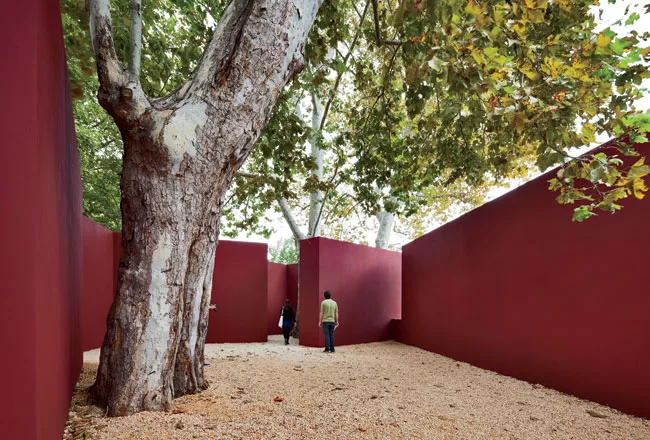
David Chipperfield looks for common ground at the 13th Venice Architecture Biennale.
Almost by definition, the Venice Architecture Biennale is a wildly uneven affair. It combines a main exhibition overseen by a major architect, critic, or curator with a scattered collection of separately organized national pavilions. And it seems to get bigger and flashier with every edition, as ancillary exhibitions, press conferences, and Bellini-soaked parties in rented palazzi sprawl across most of the city of Venice. The odds that these diverse elements will come together to offer a compelling message about architecture, architects, buildings, or cities would seem close to zero.
And yet somehow the Biennale, for my money, is the most reliable barometer of the architecture profession ever invented. Taken together, its attractions suggest in surprisingly clear terms what the world's top architects are working on and at what scale; where they're drawing inspiration from and what they're anxious about; and, most useful of all, how their various theoretical factions and geographical camps are getting along (or failing to).
The 2012 version, running until November 25 and anchored by a thoughtful, beautifully crafted, and rather cautious main show by the 58-year-old British architect David Chipperfield, is no exception. It reveals in almost painfully honest terms the clashing ways that architects are reacting to the two most disruptive forces to hit the profession in decades: the digital revolution on one hand and the global economic crisis on the other.
Those reactions vary tremendously depending on the age of the architects involved. In fact, the deep contradictions that slice through the central exhibition–it is optimistic and fearful, judgmental and carefree, generally handsome but occasionally rough around the edges–can mostly be explained by its generational mix. Chipperfield reserved many slots for older architects, both well-known names like Rafael Moneo, Álvaro Siza, and Zaha Hadid and more obscure figures like Hans Kollhoff and Luigi Snozzi.
In the spirit of Chipperfield's rather open-ended theme for the Biennale, “Common Ground,” these contributors offer work exploring two subjects in particular: the city and architectural history. Their presentations are heavy on hand-drawn sketches and architectural models, a way for Chipperfield to challenge the ubiquity and influence of the computer rendering–and “the image” more broadly. In his introduction to the exhibition catalogue, he writes that he chose “Common Ground” as the theme “in order to question the priorities that seem to dominate our time, priorities that focus on the individual, on privilege, on the spectacular and the special. These priorities seem to overlook the normal, the social, the common.”
Many of the installations he commissioned, with their insistence on safeguarding architectural “quality” (to use a word emphasized in a display by the historian Kenneth Frampton), suggest a circling of the wagons in the face of economic uncertainty and technological upheaval. And there is an inescapable irony in some, if not many, of Chipperfield's choices: To forge links between architecture and the larger society–to explore politics, populism, and the commons of the contemporary city–he recruited many of the very architects and critics who were responsible, in the 1980s and 1990s, for aggressively walling off architecture and architectural theory from those very topics. Thus Peter Eisenman, Jeffrey Kipnis, Bernard Tschumi, and several others are quietly absolved for their earlier sins, which include arguing year after year, in defiantly unreadable prose, that meaningful architectural discourse is something only a handful of privileged initiates deserve access to.
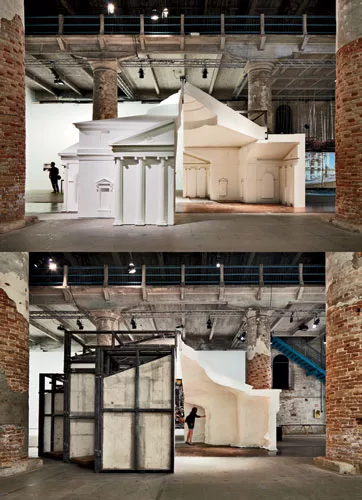
To his credit, Chipperfield sought out collaborators of his own in planning the exhibition, including the London-based critic Kieran Long. The emerging architects they recommended lend the show some much-needed energy and unpredictability. The British firm FAT, for Fashion Architecture Taste, offers a witty study of architectural copying centered around a large model of part of Palladio's Villa Rotonda. The installation suggests how freely architects in their twenties and thirties, so fully at home in a digital world, sample the architectural past. For them, reusing a Palladian detail is not so different from streaming a Truffaut movie on Netflix.
The younger contributors address many of the same themes that the more established ones do. But they do so with an entirely different spirit–and a different agenda. For them, the return to history doesn't represent an attempt to recover architectural standards, as it does for many of the older participants. Instead it's a way to bring variety, irony, and humor back to architecture. If Léon Krier was the invisible figure looking over the shoulders of many of Chipperfield's crew, it was Robert Venturi, Denise Scott Brown, and Charles Moore who inspired the younger participants.
The show is at its best when these two generational camps come together in a single installation. For one room, the 62-year-old Spanish architect and critic Luis Fernández-Galiano hired 200 recent graduates of Spanish architecture schools–giving them perhaps the only paid work in their field many will receive this year as the eurozone crisis grinds on–and asked them to hold models of recent work by older Spanish architects and explain them as visitors walk through. Chipperfield calls the combination of the unemployed architects and the often stunning architectural models “tragic and beautiful,” and he is right.
In the end, the common ground that Chipperfield most noticeably charts is with previous Biennales. In its focus on history and enthusiasm for classical references, this show recalls Paolo Portoghesi's famous 1980 Biennale, “The Presence of the Past,” which helped introduce Postmodern architecture. Chipperfield also explores many of the same ideas that filled the superb 2010 Biennale, organized by Kazuyo Sejima, including the vernacular, the well worn, and the handmade.
The best of the national pavilions offers a crisp, energetic antidote to the sometimes ponderous rooms of the main show. Israel's contribution, organized by Erez Ella, Milana Gitzin-Adiram, and Dan Handel, examines the relationship between the U.S. and Israel since 1973, and in particular the ways in which Israel's shift to American-style capitalism has remade its architecture. The pavilion features the kind of political nuance and sardonic humor lacking elsewhere, with models of settlement architecture in the Occupied Territories and bobble-head dolls of Jimmy Carter, Menachem Begin, and Anwar Sadat.
In a pavilion overseen by Toyo Ito, Japan presents a collaboration by three of its most talented younger architects–Sou Fujimoto, Akihisa Hirata, and Kumiko Inui–on a community center for victims of the 2011 earthquake and tsunami. Delicately beautiful models on rough wooden pedestals chart the evolution of the project, which is now under construction in the flood-ruined town of Rikuzentakata.
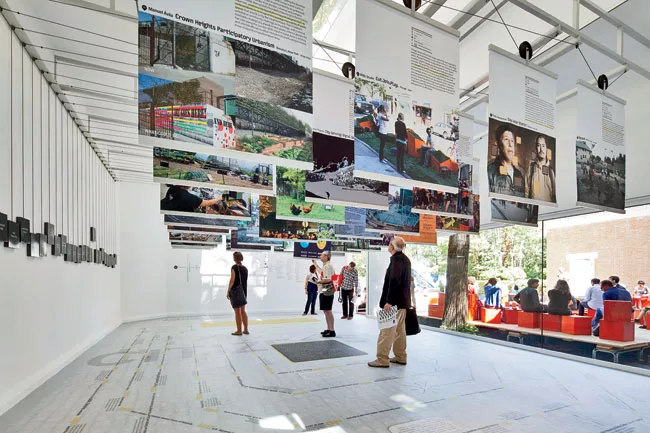
The American pavilion–organized by the Institute for Urban Design and curated by Cathy Lang Ho, David van der Leer, and Ned Cramer–celebrates 124 small-scale, ad hoc, or temporary improvements to U.S. cities. The range of examples is vast and includes Occupy Wall Street (celebrated as an example of instant city-making) and Alice Waters's Edible Schoolyard. The installation itself is saved from feeling hopelessly overcrowded by the smart exhibition design of the firms Freecell and M-A-D Studio.
The national pavilions are often produced by curators in their twenties and thirties, in contrast to the éminences grises typically recruited to direct the main exhibition. The vitality that marks the best of them suggests how much might be gained by handing over curatorial duties for the main Biennale–the whole enchilada–to a younger figure. Alas, the rumor on my last day in Venice–still unconfirmed as this review goes to press–was that the 2014 show will be directed by Rem Koolhaas. As curious as I am to see how he might shake up and reinvent the Biennale, he is hardly an up-and-comer.
Los Angeles Times.
Looking for a reprint of this article?
From high-res PDFs to custom plaques, order your copy today!