Architectural Record
search
cart
facebook twitter linkedin youtube
  • Sign In
  • Subscribe
  • Sign Out
  • My Account
Architectural Record
  • NEWS
    • Latest News
    • Awards
    • Interviews
    • Obituaries
    • Podcasts
      • Design:Ed Podcast
      • Sponsored Podcasts
  • OPINION
    • Book Reviews / Excerpts
    • Exhibition Reviews
    • Forum
  • EXCLUSIVES
    • Videos
    • Design Vanguard
    • Top 300 Firms
    • Sponsored Content
    • Sponsored eBooks
    • From the Archives
  • CONTINUING ED
    • Editorial Continuing Ed
    • CE Center
    • CE Academies
  • PROJECTS
    • Buildings By Type
    • Reuse & Renovation
    • Museums & Arts Centers
    • Colleges & Universities
    • Multifamily Housing
    • Interiors
    • Lighting
    • Kitchen & Bath
  • HOUSES
    • Record Houses
    • House of the Month
    • Featured Houses
  • PRODUCTS
    • Products by Category
    • Record Products of the Year
    • Latest Products
  • EVENTS
    • Dates & Events
    • Record on the Road
    • Innovation Conference
    • Sustainability in Practice
    • Women In Architecture
    • Webinars
    • Ad Excellence Awards
    • Submit an Event
  • CONNECT
    • Ask RECORD AI
    • Newsletters
    • Contact
    • Advertise
    • Editorial Calendar
    • Store
    • Customer Service
  • SUBMIT
    • Submission Guidelines
    • RECORD Competitions
  • MAGAZINE
    • Subscribe
    • My Account
    • Digital Edition
    • Current Issue
    • Firm Pass
    • Historic Archive
Commentary & Criticism

Rumble in the Urban Jungle

By Michael Sorkin
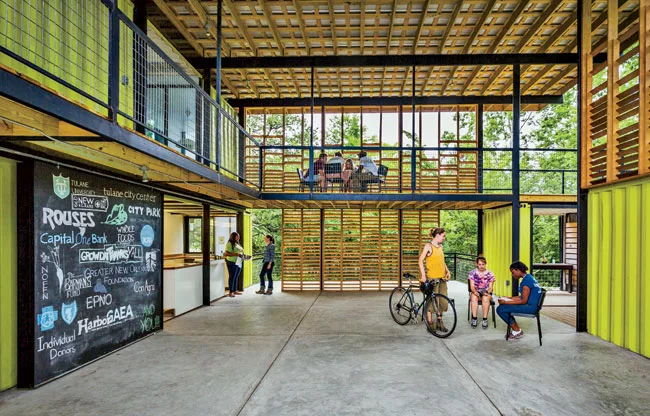
Students at Tulane's design-build program converted a former New Orleans golf course into the 4-acre Grow Dat Youth Farm, which includes a 6,000-square-foot education center made f
Urban Oases
Students at Tulane's design-build program converted a former New Orleans golf course into the 4-acre Grow Dat Youth Farm, which includes a 6,000-square-foot education center made from shipping containers.
Photo © Will Crocker
Urban Oases
Students at Tulane's design-build program converted a former New Orleans golf course into the 4-acre Grow Dat Youth Farm, which includes a 6,000-square-foot education center made from shipping containers.
Photo © Will Crocker
The program teaches high-school students to grow–and cook–fresh produce, and in March it added the Go Dat mobile farmstand, a converted boat trailer with a sail-like canvas roof th
Urban Oases
The program teaches high-school students to grow–and cook–fresh produce, and in March it added the Go Dat mobile farmstand, a converted boat trailer with a sail-like canvas roof that folds down for transit.
Photo © Jason Bethea
Urban Oases
The program teaches high-school students to grow–and cook–fresh produce, and in March it added the Go Dat mobile farmstand, a converted boat trailer with a sail-like canvas roof that folds down for transit.
Photo © Jason Bethea
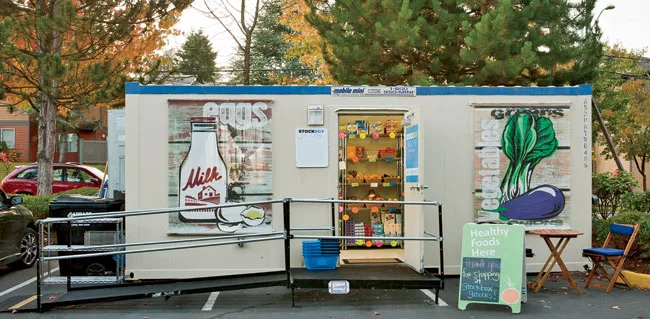
Stockbox began in Seattle's Delridge neighborhood with a mobile construction office turned grocery. When its founders conceived the project, they imagined an itinerant network of temporary markets
Urban Oases
Stockbox began in Seattle's Delridge neighborhood with a mobile construction office turned grocery. When its founders conceived the project, they imagined an itinerant network of temporary markets fanning out across the city's food deserts, but in response to demand, they have begun building larger, permanent stores.
Photo courtesy Stockbox
Urban Oases
Stockbox began in Seattle's Delridge neighborhood with a mobile construction office turned grocery. When its founders conceived the project, they imagined an itinerant network of temporary markets fanning out across the city's food deserts, but in response to demand, they have begun building larger, permanent stores.
Photo courtesy Stockbox
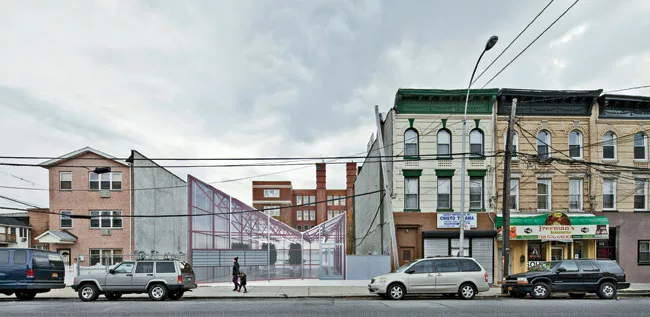
Abruzzo Bodziak Architects has applied the pop-up model to urban agriculture; its design for a hydroponic greenhouse is intended to temporarily fit into the vacant lots that dot low-income nei
Urban Oases
Abruzzo Bodziak Architects has applied the pop-up model to urban agriculture; its design for a hydroponic greenhouse is intended to temporarily fit into the vacant lots that dot low-income neighborhoods in Brooklyn.
Photo courtesy Abruzzo Bodziak Architects
Urban Oases
Abruzzo Bodziak Architects has applied the pop-up model to urban agriculture; its design for a hydroponic greenhouse is intended to temporarily fit into the vacant lots that dot low-income neighborhoods in Brooklyn.
Photo courtesy Abruzzo Bodziak Architects
Students at Tulane's design-build program converted a former New Orleans golf course into the 4-acre Grow Dat Youth Farm, which includes a 6,000-square-foot education center made f
The program teaches high-school students to grow–and cook–fresh produce, and in March it added the Go Dat mobile farmstand, a converted boat trailer with a sail-like canvas roof th
Stockbox began in Seattle's Delridge neighborhood with a mobile construction office turned grocery. When its founders conceived the project, they imagined an itinerant network of temporary markets
Abruzzo Bodziak Architects has applied the pop-up model to urban agriculture; its design for a hydroponic greenhouse is intended to temporarily fit into the vacant lots that dot low-income nei
August 16, 2013

A recent book by New Urbanist authors revives an old battle with Landscape Urbanism.
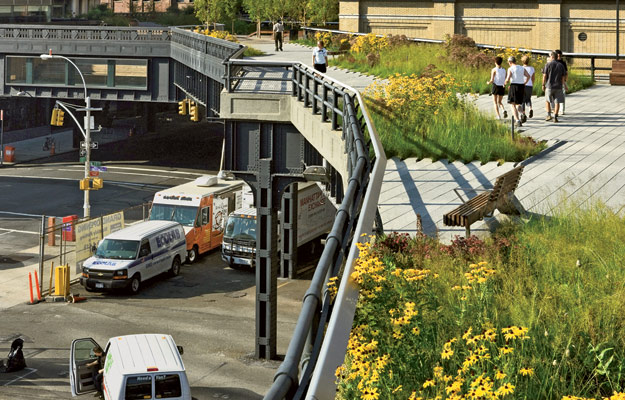
The High Line in New York, designed by James Corner Field Operations with Diller Scofidio + Renfro, is criticized by Andres Duany for being too expensive and over-designed.
Photo © Iwan Baan
The High Line in New York, designed by James Corner Field Operations with Diller Scofidio + Renfro, is criticized by Andres Duany for being too expensive and over-designed.

It's hard to keep up with the musical deck chairs in the disciplines these days. The boundaries of architecture, city planning, urban design, landscape architecture, sustainability, computation, and other fields are shifting like crazy, and one result is endless hybridization–green urbanism begets landscape urbanism, which begets ecological urbanism, which begets agrarian urbanism–each “ism” claiming to have gotten things in just the right balance. While this discussion of the possible weighting and bounding of design's expanded field does keep the juices flowing, it also maintains the fiction that there are still three fixed territories–buildings, cities, and landscapes–that must constantly negotiate their alignment.
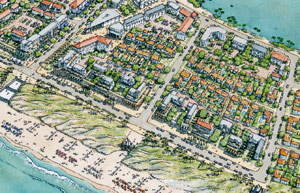
Duany Plater-Zyberk & Company, one of the leading firms in the New Urbanism movement, designed a master plan in 2012 for Costa Verbena in Brazil. The designers say the plan respects the site's topography and its sensitive ecosystems, while applying a traditional street grid.

This has several consequences. The first is that the theoretical autonomy of the individual disciplines remains fundamentally uninfringed. The second is that new forms of a much-needed transdisciplinary practice are stymied by rigid intellectual bureaucracy. And finally, the opportunities for turf warfare are multiplied. A tiny skirmish has just been unleashed by the New Urbanists in the form of a book edited by Andres Duany and Emily Talen–Landscape Urbanism and its Discontents: Dissimulating the Sustainable City–which singles out that inoffensive school of thought for withering opprobrium.

But why? And why now? In their preface, the editors wistfully suggest that this was a book that should have been compiled 15 years ago. They're right: the project is pervaded by the sense that the nag being flogged long since passed through the glue factory. Their critique is antique: Landscape Urbanism is just the continuation of CIAM and its misguided principles by other means. The collection thus winds up as another–and completely unnecessary–iteration of that beloved chestnut, New Urbanism vs. Modernism. The current screed is obsessively focused yet again on what is seen as the leadership role in urbanism of a powerful and invidious cabal at the Harvard Graduate School of Design (GSD), an effete elite that just doesn't get it. This weirdly fetishistic animus has gnawed at Duany's craw for years. What's up with that? Give it a rest!

The anti-intellectual schtick–that those academics are fey and fashionable compromisers without real values–plays repeatedly throughout the book. There's an especially puerile riff by James Howard Kunstler, which reaches the startling conclusion that Harvard is a bulwark of the status quo! Talen bemoans the Landscape Urbanists for their reversion to misconstructions of post-structuralist, Marxist, and ecological discourses as gauzy camouflage for their designs for world domination and weird, uninhabitable cities. That academics would speak in the lingua franca of their own community is hardly more surprising than the New Urbanists' adopting the language of developers. Their book is, indeed, full of hard-nosed whinging about the bottom line, which, in the end, is the only substantial riposte offered to actual “Landscape Urbanist” projects. Duany particularly reviles the High Line, which he thinks would have been better–and cheaper–with Adirondack chairs from Home Depot instead of all that “design.”

Because there's no real case, there are more straw men in this book than at a casting call for The Wizard of Oz. The most cited include GSD professor Charles Waldheim, landscape architects James Corner and the late Ian McHarg, Frederick Law Olmsted, the University of Pennsylvania, and various fellow travelers in the promotion of … what exactly? The foundational offense is clearly Waldheim's statement in his 2006 book The Landscape Urbanism Reader that “Landscape Urbanism describes a disciplinary realignment currently under way in which landscape replaces architecture as the basic building block of contemporary urbanism.” This is simply tendentious, another way of saying, “It's the environment, stupid.” But the Newbies rise to the bait. Let's get ready to rumble!

They've been preparing the battleground for years, insisting that they alone have found the one true condition of equipoise. New Urbanists defend their superior wisdom in three areas: the preferability of the “traditional” city of streets and squares to the universally discredited Corbusian model, a claim to special access to knowledge of sustainability, and a faux-populist derision of practices that are “avant-garde.” None of these arguments is interesting or particularly controversial. No designer of conscience (or consciousness) resists the idea of cities with streets built for people on foot or fails to pay at least lip service to a sustainable–even equitable–environment. Insisting otherwise is just disingenuous.

But there is something interesting going on in thinking about the design of cities, informed by questions of sea-level rise and climate change, massive pollution of air, earth, and water, and a broad realignment of public consciousness about the limited bearing capacity of the earth. Like virtually everyone in the disciplines, both Landscape Urbanists and New Urbanists recognize this and have produced projects that address it. It's the war over formulae that's a waste. The New Urbanists continue to dine out on the enervated notion of a regulating “transect,” a gradated wash of conditions from rural to urban, derived from Patrick Geddes, which they serve up with all the nuance of Creationism.

But “more or less urban” is only one of many ways in which the city can be discussed and the idealist structure of the transect has been thoroughly unpacked by many writers. One key deficit of the New Urbanists' model is that their picturesque conceit is both nonlinear on the ground and disrupted by exceptions in the form of special districts. Landscape Urbanists, though, are excited by such zones of difference, which include “traditional” parks, as well as the “dross-scape” of rail yards, industrial zones, edge-city squalor, and other areas not easily assimilated to the historic order of streets and squares. The recognition that such territories constitute a huge component of the built environment locates an urgent question for design.

While many of the usual New Urbanist suspects contribute to the book, there's a clear divide among them between the unabashed assailants and those with a more conciliatory position, who won't be provoked into a death match. It's entertaining to see how many of the book's essayists tiptoe away from the bluster. Duany wants the High Line and Freshkills Park in New York and Downsview Park in Toronto to be seen as pretentious, but his cohort is unconvinced. Dan Solomon wisely finds these projects not just praiseworthy as places but understands they are simply parks, not “urbanisms.” Likewise, Jason Brody sees the valuable contribution of an evolving set of landscape practices, all of which are engaged in infusing city-making with our increased understanding of the planetary crisis.

If there's a bright spot in the schools and the professions nowadays, it rests in landscape architecture's ability to introduce the urgency of ecological analysis into design's atmosphere and to pioneer forms of representation and discourse that freshly depict territories and phenomena from microclimates to regions. While McHarg may have gotten it wrong in the end, with his overly anthropocentric schema, the ecological insights in his mappings were seminal. The beautiful work done by James Corner and others in bridging the gap between datascapes and landscapes has opened new approaches to planning and building, and been critical in establishing new forms of analysis. We all want to be the mother of the arts, but why can't we just get along?

Contributing editor Michael Sorkin runs the graduate urban design program at CCNY.

Share This Story

Looking for a reprint of this article?
From high-res PDFs to custom plaques, order your copy today!

Post a comment to this article

Report Abusive Comment

Subscription Center
  • Create an Account
  • Start a Subscription
  • Manage My Account
  • Sign Up for Newsletters
  • Visit Customer Service
  • Update Preferences

More Videos

Sponsored Content

Sponsored Content is a special paid section where industry companies provide high quality, objective, non-commercial content around topics of interest to the Architectural Record audience. All Sponsored Content is supplied by the advertising company and any opinions expressed in this article are those of the author and not necessarily reflect the views of Architectural Record or its parent company, BNP Media. Interested in participating in our Sponsored Content section? Contact your local rep!

close
  • TAMLYN XtremeTrim Exterior Trim
    Sponsored byTamlyn

    Designing Cleaner Panel Facades: Why Exterior Trim Details Matter

  • Building with Vapor Barriers
    Sponsored byReef Industries, Inc.

    Vapor Barriers Help Control Moisture in Tighter Building Designs

  • Duct Interior with Prodeq System
    Sponsored byHenry, a Carlisle Company

    Designing Resilient Water Containment Systems

DESIGN:ED Podcast
Listen to Architectural Record’s DESIGN:ED Podcast

Events

June 10, 2026

Rethinking Stormwater – The Power of Porous Paving

Credits: 1 AIA LU/HSW; 1 AIBD P-CE; 0.1 ICC CEU

Learn how porous paving systems support stormwater management, reduce heat island effects, and enhance sustainable site design performance.

June 11, 2026

Very Early Warning Fire Detection for Mission-Critical Facilities

Credits: 1 AIA LU/HSW; 1 AIBD P-CE; 0.1 ICC CEU

Examine advanced fire detection strategies that support uptime and enhance safety in data centers and other mission-critical facilities.

View All Submit An Event

Products

2026 Architect's Square Foot Costbook

2026 Architect's Square Foot Costbook

See More Products

Popular Stories

Practice Matters illustration

What’s in a (Firm’s) Name? Thinking About Succession and Legacy

Coronado Bridge

The Architect’s Guide to San Diego

Practice Matters illustration

By the Numbers: Counting America's Architects

Riverdale House by Studio Lau

Riverdale House by Studio Lau

KRESA by DLR

In Kalamazoo, DLR Group Completes a Mass-Timber Hub for Career and Technical Education Programs

Broader Sustainability of CMU - Free Webinar - May 21, 2026

Related Articles

  • Landscape Design in the Urban Environment

    See More
  • A Stitch in the Urban Fabric: Dallas Celebrates Its New Calatrava Bridge

    See More
  • The Urban Fix

    Review of 'The Urban Fix: Resilient Cities in the War Against Climate Change, Heat Islands and Overpopulation'

    See More

Related Products

See More Products
  • GlobalData_logo_blue_header.png

    Construction in the US - Key Trends and Opportunities to 2023

See More Products
×

The latest news and information

#1 Source for Architectural Design, News and Products

SUBSCRIBE
  • RESOURCES
    • Advertise
    • Contact Us
    • Submit
    • Store
  • ACCOUNT CENTER
    • Create an Account
    • Start a Subscription
    • Manage My Account
    • Sign Up for Newsletters
    • Visit Customer Service
    • Update Preferences
  • PRIVACY
    • PRIVACY POLICY
    • TERMS & CONDITIONS
    • DO NOT SELL MY PERSONAL INFORMATION
    • PRIVACY REQUEST
    • ACCESSIBILITY
  • SERVICES
    • Marketing Services
    • Reprints
    • Market Research
    • List Rental
    • Survey/Respondent Access
  • STAY CONNECTED
    • Linkedin
    • Facebook
    • Instagram
    • YouTube
    • X (Twitter)

Copyright ©2026. All Rights Reserved BNP Media, Inc. and BNP Media II, LLC.

Design, CMS, Hosting & Web Development :: ePublishing