The Legacy of Mayor Mike
After 12 years of astonishing change in New York, Bloomberg earns mixed marks.
| Photo © Flickr User Noel Y.C. |
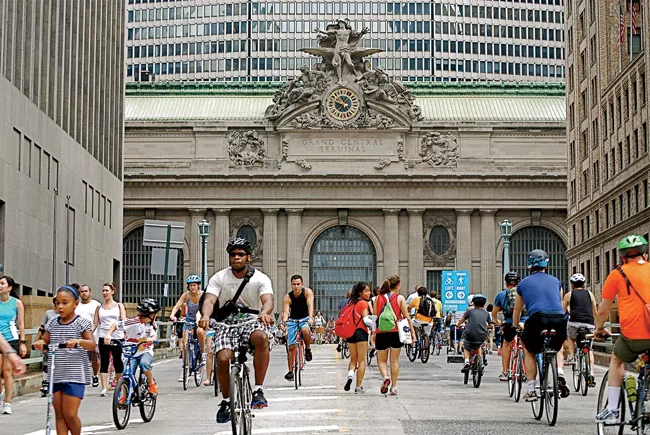
| Nearly seven miles of Manhattan streets are closed to vehicular traffic for annual Summer Streets events, initiated by Bloomberg's administration in 2008. |
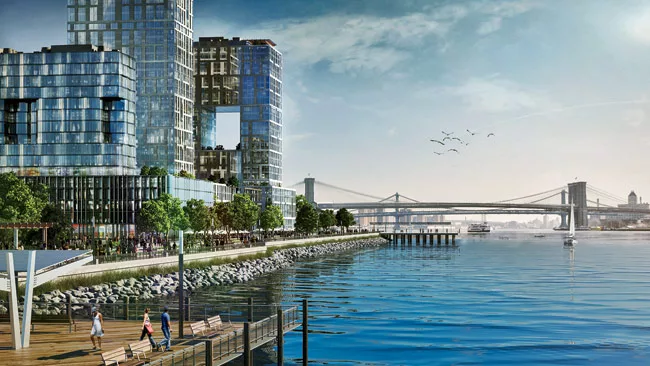
On a steamy afternoon in early August, a who's who of New York architects crowded into a conference room to hear city officials answer questions about Seaport City, a proposed mixed-use development meant to protect Lower Manhattan from flooding. The scope of the project is astounding—adding acres of landfill behind a vast new levee, it could eventually be larger than Battery Park City—but interested firms were given just three weeks to form teams to conduct feasibility studies. The tight deadline was partly a concession to Mother Nature, with rising waters a constant threat to low-lying sections of the city, and partly to Father Bloomberg, the sometimes paternalistic mayor who will leave office and, with it, his ability to reshape the city, in three months.
“Next year could be a huge shock to the system, depending on who is elected,” said Kirsten Sibilia, a principal of Dattner Architects, a Manhattan firm that has completed a number of civic projects during the Bloomberg era, including, in partnership with Grimshaw, the highly praised Via Verde housing complex in the Bronx. During his 12 years in office, the mayor and his team of hard-driving commissioners have added 800 acres of parkland, created 450 miles of bike lanes, and rezoned nearly 40 percent of the city. Some 40,000 new buildings have risen and 750,000 trees have been planted. Among the Bloomberg-backed triumphs are the High Line and Brooklyn Bridge Park, the Barclays Center also in Brooklyn, and the 9/11 memorial (which was in limbo until Bloomberg became head of the National September 11 Memorial & Museum in 2006).
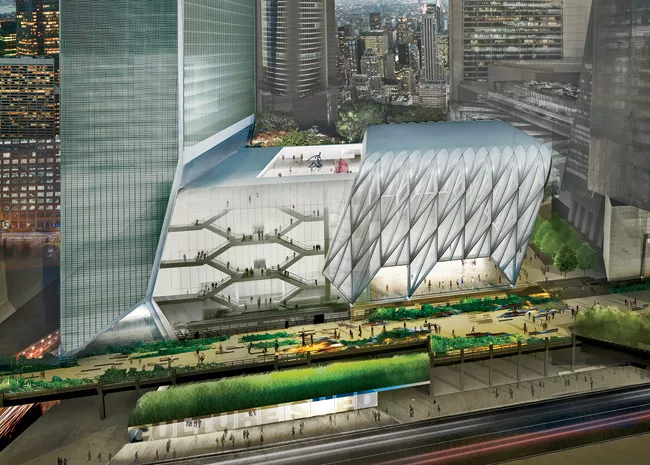
But each of the projects has a downside. The High Line will terminate at the new Hudson Yards development, which looks to be a planning catastrophe, its public spaces afterthoughts among the over-scaled, over-slick towers. Brooklyn Bridge Park, like many other new green spaces, needs significant private funding for maintenance: new condo and hotel buildings along the park's perimeter are intended to provide it. And the Barclays Center rose without the middle-income housing its developer had promised would cover the Atlantic Yards, still an appalling gash of train tracks in an otherwise rebounding borough. The widespread rezoning has allowed for successes, like Hunters Point South in Queens, but also disasters, like the phalanx of 40-story apartment buildings that will deprive Greenpoint, in Brooklyn, of its views and afternoon light.
There were astonishing oversights during the Bloomberg years. One was ignoring the underground hellhole known as Pennsylvania Station, a major portal that is not only unsightly but also unsafe. The current effort to move Madison Square Garden, in order to expand the station now confined to the arena's basement, was spurred by The New York Times's critic Michael Kimmelman and taken up by the City Council. Bloomberg's statements have been equivocal. “Fundamentally, I would like to leave businesses alone,” Bloomberg said when asked about the permit that allows the Garden to remain in place. There was also zero movement on another urgent need—efficient transportation from the city's airports to its population centers.
The mayor's wish to “leave businesses alone” may have sped the closing of St. Vincent's Hospital in Manhattan, now being converted into condos. Meanwhile, the potential demise of Long Island College Hospital in Brooklyn so concerned Bill de Blasio, the Democratic candidate for mayor, that he was arrested at a protest in July. The condo-ization of the city was a constant theme and complaint in the Bloomberg era as income disparities were reflected in housing costs' soaring ever skyward.
But Bloomberg's vision did extend to public projects. He backed the Lakeside Center, a recreation complex by Tod Williams and Billie Tsien in Brooklyn's Prospect Park (scheduled to open in December) and the Cornell/Technion campus to be built on Roosevelt Island, with groundbreaking for the first building, by Morphosis, promised for 2014. Bloomberg also raised the quality of quotidian public buildings, with police stations, firehouses, EMS call centers, and branch libraries benefiting from a Design and Construction Excellence Program that more than lived up to its name. And, according to architects with inside knowledge of city government, he got the Planning, Buildings, Transportation, and Parks departments talking to each other—a big change from what had been a balkanized bureaucracy. According to Andrew Winters, director of capital projects and planning for the Cornell/Technion campus, Bloomberg showed a “fearlessness” in taking on complex building and infrastructure problems.
Yet, despite the fearlessness, a surprising number of initiatives were left—mercifully, in some cases—to the last minute. Among them is the proposed rezoning of the neighborhood around Grand Central Station, which seems more of a giveaway to developers than a solution to an existing problem at a time when the World Trade Center, Hudson Yards, and—possibly—Seaport City would provide millions of square feet of offices.
Other plans that came so late in the mayor's tenure that they face an uncertain fate:
• The completion of a waterfront development in Staten Island, including the world's largest Ferris wheel and a mall with skyline views; the mall would be one of a notable number of New York City waterfront projects by the politically connected SHoP Architects.
• The construction of an immense ice skating center with nine rinks and a 5,000-seat arena in the Bronx's Knightsbridge Armory.
• A micro-units initiative, meant to provide affordable apartments. The first building, by nARCHITECTS, appears to be on track.
• The permanent paving of Times Square's pedestrian-only zones, following a plan by Snøhetta.
And there are the dozens of proposals in the mayor's resiliency report, a response to last year's superstorm Sandy that supplements PlaNYC 2030, an extensive 2007 proposal for greening the city as its population increases. They include surge barriers for Coney Island and echelons of sand dunes for the Rockaways. Perversely, it might have been better if Sandy had hit earlier in Bloomberg's tenure, giving him more time to develop protections. Now it is up to his successors to try to implement his multibillion-dollar plan.
With Bloomberg out of office, there's no telling which proposals will bear fruit. But the number of architects who gathered for the Seaport City meeting was a hopeful sign. Thanks to 12 years in which city government built often and well, many architects are involved in civic projects that they once might have shunned. As Claire Weisz, principal of WXY, says, “Bloomberg's legacy of getting things to happen in the shared public realm is a substantial one.” That legacy is, in fact, more substantial than any one building.
Looking for a reprint of this article?
From high-res PDFs to custom plaques, order your copy today!