Architectural Record
search
cart
facebook twitter linkedin youtube
  • Sign In
  • Subscribe
  • Sign Out
  • My Account
Architectural Record
  • NEWS
    • Latest News
    • Awards
    • Interviews
    • Obituaries
    • Podcasts
      • Design:Ed Podcast
      • Sponsored Podcasts
  • OPINION
    • Book Reviews / Excerpts
    • Exhibition Reviews
    • Forum
  • EXCLUSIVES
    • Videos
    • Design Vanguard
    • Top 300 Firms
    • Sponsored Content
    • Sponsored eBooks
    • From the Archives
  • CONTINUING ED
    • Editorial Continuing Ed
    • CE Center
    • CE Academies
  • PROJECTS
    • Buildings By Type
    • Reuse & Renovation
    • Museums & Arts Centers
    • Colleges & Universities
    • Multifamily Housing
    • Interiors
    • Lighting
    • Kitchen & Bath
  • HOUSES
    • Record Houses
    • House of the Month
    • Featured Houses
  • PRODUCTS
    • Products by Category
    • Record Products of the Year
    • Latest Products
  • EVENTS
    • Dates & Events
    • Record on the Road
    • Innovation Conference
    • Sustainability in Practice
    • Women In Architecture
    • Webinars
    • Ad Excellence Awards
    • Submit an Event
  • CONNECT
    • Ask RECORD AI
    • Newsletters
    • Contact
    • Advertise
    • Editorial Calendar
    • Store
    • Customer Service
  • SUBMIT
    • Submission Guidelines
    • RECORD Competitions
  • MAGAZINE
    • Subscribe
    • My Account
    • Digital Edition
    • Current Issue
    • Firm Pass
    • Historic Archive
Commentary & CriticismOpinion

Lessons from Modernism: Environmental Design Strategies in Architecture 1925-1970

By Fred A. Bernstein
May 16, 2014
Edited by Kevin Bone. Monacelli Press, May 2014, 224 pages, $40.

When Less is More Earth-friendly

By reducing green design to a set of checklists that are then used as shopping lists, LEED and similar environmental rating systems may actually increase consumption. And by turning sustainability into the province of consultants, such systems take the responsibility for making buildings ecologically sound out of the hands of architects.
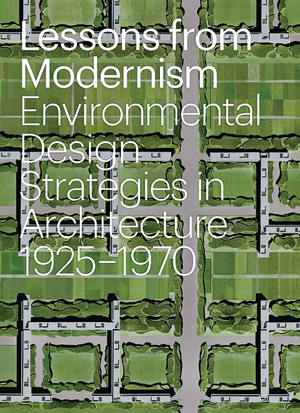
Lessons from Modernism: Environmental Design Strategies in Architecture 1925-1970

It didn’t have to be that way, Kevin Bone makes clear in this important new book. The outgrowth of a 2013 exhibition at New York’s Cooper Union, where Bone is the director of the Institute for Sustainable Design, it demonstrates that many significant Modernist buildings were green by virtue of their small size and sensitive siting. The format of the book is simple: 25 buildings are presented in photographs, renderings, and diagrams showing how the structures relate to sun position and prevailing winds.

The text is slight; it summarizes the relevant characteristics of each building, such as the shading effects of brises-soleil and the heating effects of thermal masses, succinctly. Alvar Aalto’s dwellings at Sunila, Finland, Bone writes, were designed “to take full advantage of the seasonal conditions,” while Frank Lloyd Wright’s Jacobs House II in Madison, Wisconsin, was “a precursor of the 1970s passive-solar movement.”

In a way, the book is as low-tech as the buildings it describes. Computer modeling, which could confirm the underlying ideas of Bone and his collaborators, wasn’t part of this project. But it doesn’t take such technologies to see that small buildings require fewer resources to build and operate. Two Paul Rudolph beach houses included in the book would barely qualify as gazebos in 2014.

“The very argument of Modernism that put forth a case for buildings stripped of excess” and that “declares one should use what one needs, and not more” is the essence of sustainable design, Bone writes. True, there were very un-green aspects to Modernism, including suburbanization and, with it, reliance on the automobile, as David Rifkind points out in an introductory essay. According to Rifkind, “Le Corbusier’s oeuvre demonstrates a paradox common to most of his contemporaries: a passionate concern with certain aspects of sustainability married to a curious disregard for others.” But what really broke the ties between Modernism and sustainability was air-conditioning. As it became affordable in the postwar years, Daniel A. Barber notes in his concluding essay, “the perceived need to mitigate the climatic impacts on building largely evaporated.” Now environmentalism has returned as a goal, but architects too often respond by adding green features to un-green buildings. Respect for the environment demands subtraction, not addition—knowing when to stop, not when to shop.

Share This Story

Looking for a reprint of this article?
From high-res PDFs to custom plaques, order your copy today!

Fred Bernstein studied architecture at Princeton and law at NYU and writes about both subjects.

Post a comment to this article

Report Abusive Comment

Subscription Center
  • Create an Account
  • Start a Subscription
  • Manage My Account
  • Sign Up for Newsletters
  • Visit Customer Service
  • Update Preferences

More Videos

Sponsored Content

Sponsored Content is a special paid section where industry companies provide high quality, objective, non-commercial content around topics of interest to the Architectural Record audience. All Sponsored Content is supplied by the advertising company and any opinions expressed in this article are those of the author and not necessarily reflect the views of Architectural Record or its parent company, BNP Media. Interested in participating in our Sponsored Content section? Contact your local rep!

close
  • TAMLYN XtremeTrim Exterior Trim
    Sponsored byTamlyn

    Designing Cleaner Panel Facades: Why Exterior Trim Details Matter

  • Building with Vapor Barriers
    Sponsored byReef Industries, Inc.

    Vapor Barriers Help Control Moisture in Tighter Building Designs

  • Duct Interior with Prodeq System
    Sponsored byHenry, a Carlisle Company

    Designing Resilient Water Containment Systems

DESIGN:ED Podcast
Listen to Architectural Record’s DESIGN:ED Podcast

Events

June 16, 2026

Focus on the Façade: Exploring Steel, Timber & Fire-Rated Curtain Walls and Channel Glass Systems

Credits: 1 AIA LU/HSW; 1 AIBD P-CE; 0.1 ICC CEU

Explore modern façade and glazing systems that enhance daylighting, fire safety, and thermal performance while expanding architectural design possibilities.

June 18, 2026

Rebooting the Aging Office Building

Credits: 1 AIA LU/HSW; 1 AIBD P-CE; 0.1 ICC CEU; 1 PDH

Explore façade retrofit strategies and award-winning design concepts that can transform aging office buildings into healthier, higher-performing workplaces for today’s hybrid workforce.

View All Submit An Event

Products

2026 Architect's Square Foot Costbook

2026 Architect's Square Foot Costbook

See More Products

Popular Stories

SanDiegoAirport

Top 300 Architecture Firms of 2026

Coronado Bridge

The Architect’s Guide to San Diego

House A on a Hill

Design Vanguard 2026: Santiago Valdivieso

Dusk House

Design Vanguard 2026: ONO

Crystal Bridges Museum of American Art expansion

Safdie Architects Returns to the Crystal Bridges Museum of American Art for Major Expansion

Focus on the Facade - Free Webinar - June 16, 2026

Related Articles

  • Make-It-Right-1.jpg

    Lessons from Brad Pitt’s Failed Architectural Experiment in New Orleans

    See More
  • Lessons from London

    See More
  • Radical Pedagogies.

    Radical Pedagogies Explores Teaching Lessons from the Past

    See More

Related Products

See More Products
  • 3dthinking.jpg

    3D Thinking in Design and Architecture: From Antiquity to the Future

  • ribbonarch.jpg

    Ribbon Architecture: Light, Shadow, and Reflection in Architecture

See More Products
×

The latest news and information

#1 Source for Architectural Design, News and Products

SUBSCRIBE
  • RESOURCES
    • Advertise
    • Contact Us
    • Submit
    • Store
  • ACCOUNT CENTER
    • Create an Account
    • Start a Subscription
    • Manage My Account
    • Sign Up for Newsletters
    • Visit Customer Service
    • Update Preferences
  • PRIVACY
    • PRIVACY POLICY
    • TERMS & CONDITIONS
    • DO NOT SELL MY PERSONAL INFORMATION
    • PRIVACY REQUEST
    • ACCESSIBILITY
  • SERVICES
    • Marketing Services
    • Reprints
    • Market Research
    • List Rental
    • Survey/Respondent Access
  • STAY CONNECTED
    • Linkedin
    • Facebook
    • Instagram
    • YouTube
    • X (Twitter)

Copyright ©2026. All Rights Reserved BNP Media, Inc. and BNP Media II, LLC.

Design, CMS, Hosting & Web Development :: ePublishing