Architectural Record
search
cart
facebook twitter linkedin youtube
  • Sign In
  • Subscribe
  • Sign Out
  • My Account
Architectural Record
  • NEWS
    • Latest News
    • Awards
    • Interviews
    • Obituaries
    • Podcasts
      • Design:Ed Podcast
      • Sponsored Podcasts
  • OPINION
    • Book Reviews / Excerpts
    • Exhibition Reviews
    • Forum
  • EXCLUSIVES
    • Videos
    • Design Vanguard
    • Top 300 Firms
    • Sponsored Content
    • Sponsored eBooks
    • From the Archives
  • CONTINUING ED
    • Editorial Continuing Ed
    • CE Center
    • CE Academies
  • PROJECTS
    • Buildings By Type
    • Reuse & Renovation
    • Museums & Arts Centers
    • Colleges & Universities
    • Multifamily Housing
    • Interiors
    • Lighting
    • Kitchen & Bath
  • HOUSES
    • Record Houses
    • House of the Month
    • Featured Houses
  • PRODUCTS
    • Products by Category
    • Record Products of the Year
    • Latest Products
  • EVENTS
    • Dates & Events
    • Record on the Road
    • Innovation Conference
    • Sustainability in Practice
    • Women In Architecture
    • Webinars
    • Ad Excellence Awards
    • Submit an Event
  • CONNECT
    • Ask RECORD AI
    • Newsletters
    • Contact
    • Advertise
    • Editorial Calendar
    • Store
    • Customer Service
  • SUBMIT
    • Submission Guidelines
    • RECORD Competitions
  • MAGAZINE
    • Subscribe
    • My Account
    • Digital Edition
    • Current Issue
    • Firm Pass
    • Historic Archive
Design Vanguard

Vo Trong Nghia Architects

Applying Japanese training to the vibrant but chaotic conditions of Vietnam, a firm makes the most of two cultures.
By Clifford A. Pearson
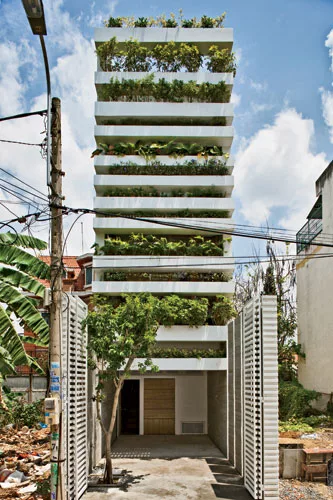
While their city is becoming increasingly dense and polluted, residents of Ho Chi Minh City still love their plants and trees. So Vo designed this 13-foot-wide private house with cantilevered planters
Stacking Green
Vo Trong Nghia Architects
Ho Chi Minh City
While their city is becoming increasingly dense and polluted, residents of Ho Chi Minh City still love their plants and trees. So Vo designed this 13-foot-wide private house with cantilevered planters on the front and back, varying the height between them based on the type of plant and how high it grows.
Photo © Hiroyuki Oki
While their city is becoming increasingly dense and polluted, residents of Ho Chi Minh City still love their plants and trees. So Vo designed this 13-foot-wide private house with cantilevered planters
Stacking Green
Vo Trong Nghia Architects
Ho Chi Minh City
While their city is becoming increasingly dense and polluted, residents of Ho Chi Minh City still love their plants and trees. So Vo designed this 13-foot-wide private house with cantilevered planters on the front and back, varying the height between them based on the type of plant and how high it grows.
Photo © Hiroyuki Oki
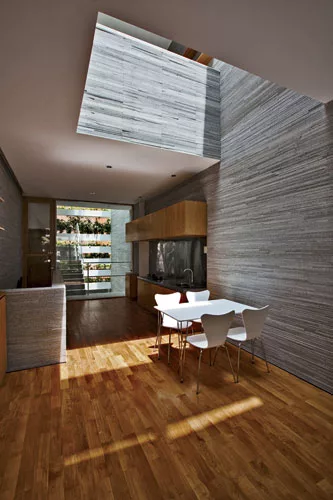
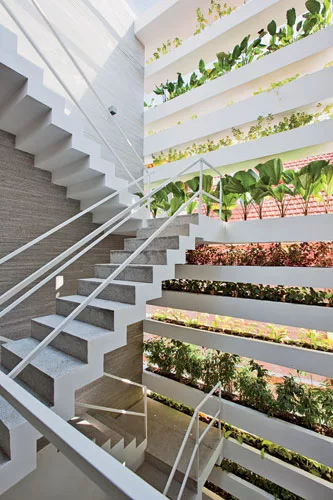
A pair of skylights and light wells give the reinforced-concrete structure the feeling of a traditional courtyard house, while tightly stacked courses of granite add texture to the interior spaces.
Stacking Green
Vo Trong Nghia Architects
Ho Chi Minh City
A pair of skylights and light wells give the reinforced-concrete structure the feeling of a traditional courtyard house, while tightly stacked courses of granite add texture to the interior spaces.
Photo © Hiroyuki Oki
Located in the new town of Binh Duong, a 30-minute drive outside of Ho Chi Minh City, this school uses an S-shaped plan to wrap around a pair of courtyards and provide an uninterrupted circulation loo
Binh Duong School
Vo Trong Nghia Architects
Binh Duong, Vietnam
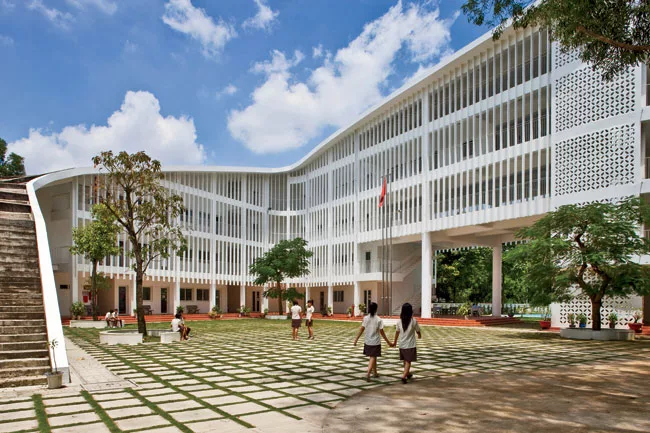
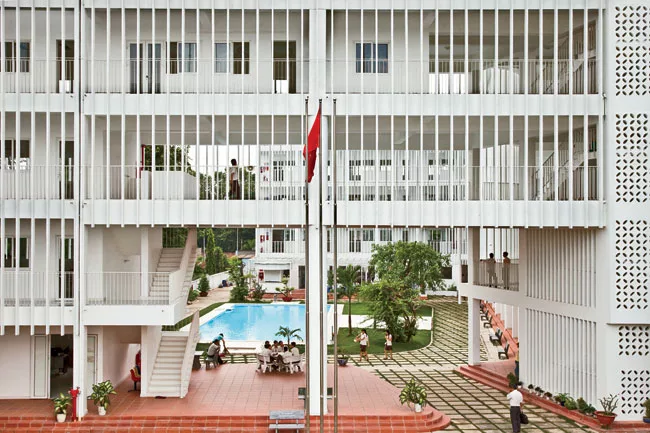
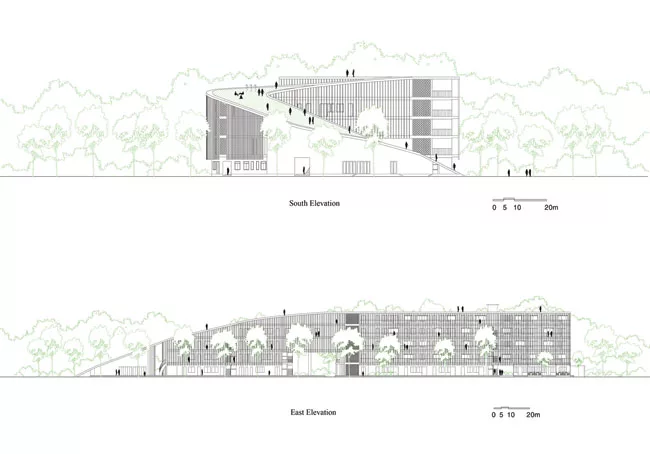
Located in the new town of Binh Duong, a 30-minute drive outside of Ho Chi Minh City, this school uses an S-shaped plan to wrap around a pair of courtyards and provide an uninterrupted circulation loop so students can access the entire complex without getting wet during the rainy season. Precast-concrete louvers protect covered walkways on each floor from the sun and rain, while allowing air to cool these areas. Outdoor stairs at both ends of the building lead to a green roof, while the sloping form reduces the bulk of the structure and keeps its maximum height (five stories) below that of the surrounding forest. Completed in 2011, the school will eventually accommodate 800 students.
Photo © Hiroyuki Oki
Located in the new town of Binh Duong, a 30-minute drive outside of Ho Chi Minh City, this school uses an S-shaped plan to wrap around a pair of courtyards and provide an uninterrupted circulation loo
Binh Duong School
Vo Trong Nghia Architects
Binh Duong, Vietnam
Located in the new town of Binh Duong, a 30-minute drive outside of Ho Chi Minh City, this school uses an S-shaped plan to wrap around a pair of courtyards and provide an uninterrupted circulation loop so students can access the entire complex without getting wet during the rainy season. Precast-concrete louvers protect covered walkways on each floor from the sun and rain, while allowing air to cool these areas. Outdoor stairs at both ends of the building lead to a green roof, while the sloping form reduces the bulk of the structure and keeps its maximum height (five stories) below that of the surrounding forest. Completed in 2011, the school will eventually accommodate 800 students.
Photo © Hiroyuki Oki
Located in the new town of Binh Duong, a 30-minute drive outside of Ho Chi Minh City, this school uses an S-shaped plan to wrap around a pair of courtyards and provide an uninterrupted circulation loo
Binh Duong School
Vo Trong Nghia Architects
Binh Duong, Vietnam
Located in the new town of Binh Duong, a 30-minute drive outside of Ho Chi Minh City, this school uses an S-shaped plan to wrap around a pair of courtyards and provide an uninterrupted circulation loop so students can access the entire complex without getting wet during the rainy season. Precast-concrete louvers protect covered walkways on each floor from the sun and rain, while allowing air to cool these areas. Outdoor stairs at both ends of the building lead to a green roof, while the sloping form reduces the bulk of the structure and keeps its maximum height (five stories) below that of the surrounding forest. Completed in 2011, the school will eventually accommodate 800 students.
Photo © Hiroyuki Oki
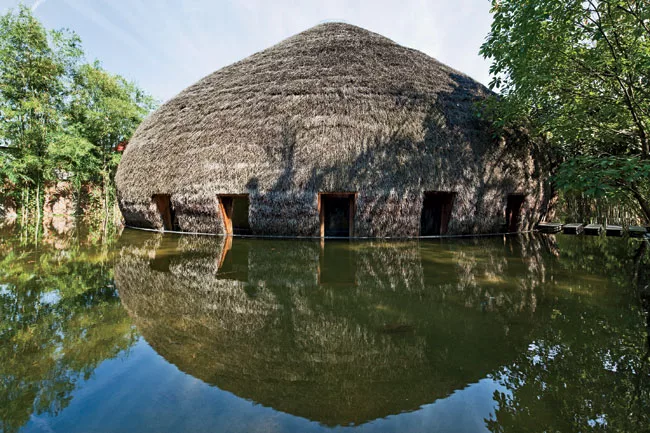
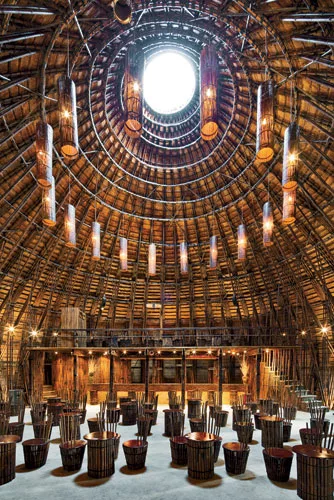
Part of a complex in Binh Duong province that includes the wNw Cafe (following project), this domed bamboo structure was designed as a bar and entertainment space but is now used occasionally by the l
wNw Bar
Vo Trong Nghia Architects
Binh Duong Province, Vietnam
Part of a complex in Binh Duong province that includes the wNw Cafe (following project), this domed bamboo structure was designed as a bar and entertainment space but is now used occasionally by the local community for town meetings and social events. The building's structural frame is made of 48 prefabricated units containing multiple bamboo elements bound together by rope. Fusing traditional construction with a modern design sensibility, the dome spans 50 feet in diameter and rises 33 feet to an open oculus.
Photo © Hiroyuki Oki
Part of a complex in Binh Duong province that includes the wNw Cafe (next slide), this domed bamboo structure was designed as a bar and entertainment space but is now used occasionally by the local co
wNw Bar
Vo Trong Nghia Architects
Binh Duong Province, Vietnam
Part of a complex in Binh Duong province that includes the wNw Cafe (next slide), this domed bamboo structure was designed as a bar and entertainment space but is now used occasionally by the local community for town meetings and social events. The building's structural frame is made of 48 prefabricated units containing multiple bamboo elements bound together by rope. Fusing traditional construction with a modern design sensibility, the dome spans 50 feet in diameter and rises 33 feet to an open oculus.
Photo © Hiroyuki Oki
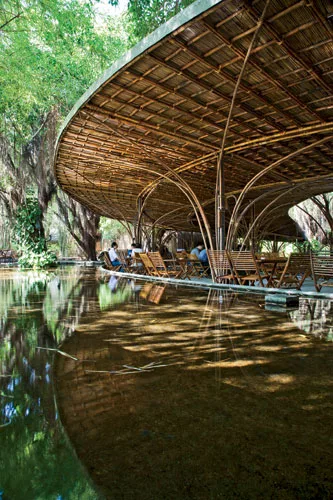
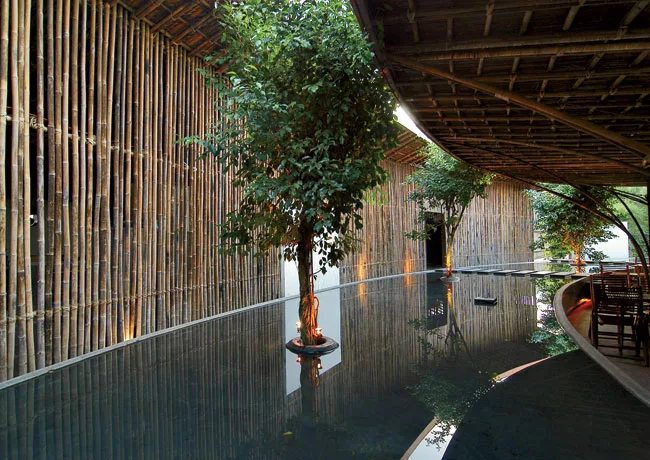
A pair of concentric crescents surrounded by a reflecting pool and nestled one within the other, this caf' in Binh Duong province places customers in a man-made landscape that helps connect interior a
wNw Cafe
Vo Trong Nghia Architects
Binh Duong Province, Vietnam
A pair of concentric crescents surrounded by a reflecting pool and nestled one within the other, this caf' in Binh Duong province places customers in a man-made landscape that helps connect interior and exterior. Vo used computer simulations and aerodynamic design to shape the buildings and maximize the cooling effect of air moving across the water. Roughly 7,000 bamboo elements make up the structure, which is stabilized by wire cables strung from towers rising above the roof.
Photo © Hiroyuki Oki
A pair of concentric crescents surrounded by a reflecting pool and nestled one within the other, this caf' in Binh Duong province places customers in a man-made landscape that helps connect interior a
wNw Cafe
Vo Trong Nghia Architects
Binh Duong Province, Vietnam
A pair of concentric crescents surrounded by a reflecting pool and nestled one within the other, this caf' in Binh Duong province places customers in a man-made landscape that helps connect interior and exterior. Vo used computer simulations and aerodynamic design to shape the buildings and maximize the cooling effect of air moving across the water. Roughly 7,000 bamboo elements make up the structure, which is stabilized by wire cables strung from towers rising above the roof.
Photo © Hiroyuki Oki
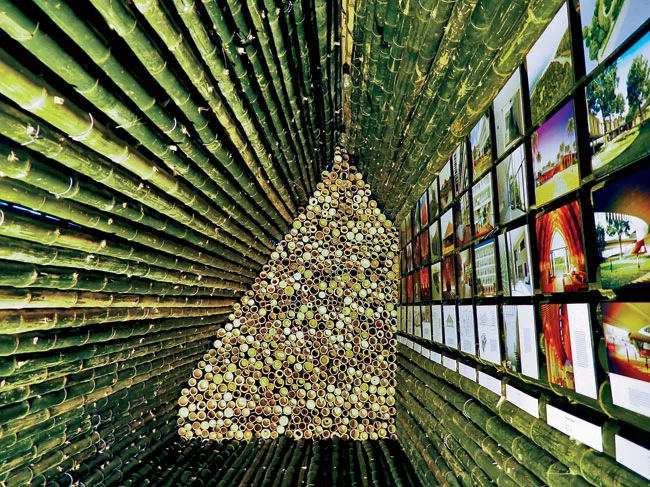
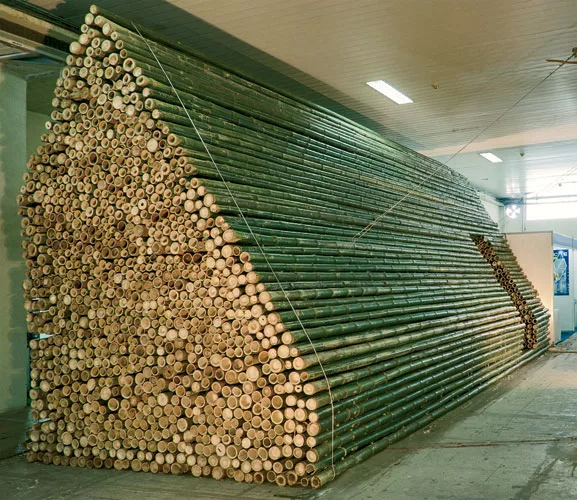
Built in just two days for the Vietnam Architecture Exhibition 2012 in Hanoi in April, this 10-by-28-foot booth gives eloquent testimony to the versatility of bamboo. Vo used 500 pieces of the materia
Bamboo Booth
Vo Trong Nghia Architects
Hanoi
Built in just two days for the Vietnam Architecture Exhibition 2012 in Hanoi in April, this 10-by-28-foot booth gives eloquent testimony to the versatility of bamboo. Vo used 500 pieces of the material in a variety of ways: stacking them as 'bamboo masonry,' corbeling them into a curved arch for the roof, and even fashioning them into wooden nails and wedges, instead of using metal joints. A few strands of steel wire, though, were employed to decrease the deflection of the walls and roof.
Photo courtesy Vo Trong Nghia Architects
Built in just two days for the Vietnam Architecture Exhibition 2012 in Hanoi in April, this 10-by-28-foot booth gives eloquent testimony to the versatility of bamboo. Vo used 500 pieces of the materia
Bamboo Booth
Vo Trong Nghia Architects
Hanoi
Built in just two days for the Vietnam Architecture Exhibition 2012 in Hanoi in April, this 10-by-28-foot booth gives eloquent testimony to the versatility of bamboo. Vo used 500 pieces of the material in a variety of ways: stacking them as 'bamboo masonry,' corbeling them into a curved arch for the roof, and even fashioning them into wooden nails and wedges, instead of using metal joints. A few strands of steel wire, though, were employed to decrease the deflection of the walls and roof.
Photo courtesy Vo Trong Nghia Architects
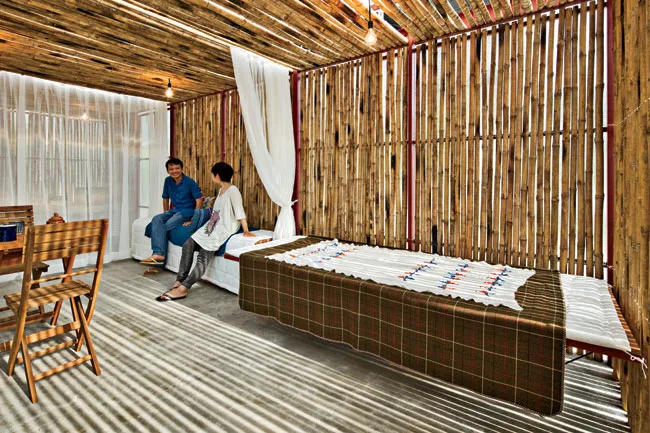
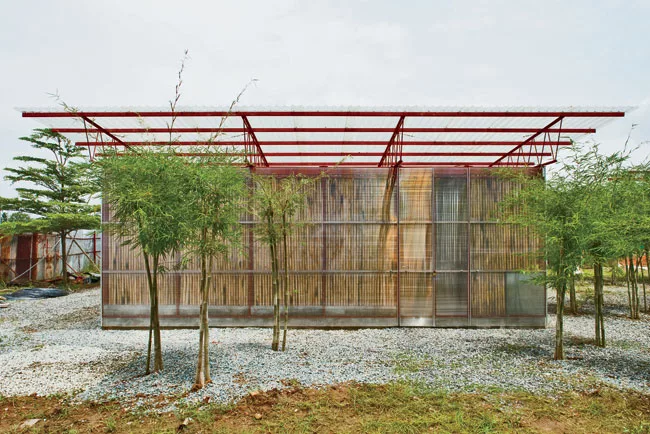
Vo's firm designed this project as a prototype for low-income housing in the Mekong River Delta. In the summer of 2012, a pair of these houses were built for a total of $4,800 on the construction site
Low-Cost House
Vo Trong Nghia Architects
Mekong River Delta
Vo's firm designed this project as a prototype for low-income housing in the Mekong River Delta. In the summer of 2012, a pair of these houses were built for a total of $4,800 on the construction site of a kindergarten in Dong Nai province. The lightweight steel frame with roof-truss beams, translucent polycarbonate wall panels, and bamboo louvers on the inside are easy to assemble and readily available in Vietnam.
Photo courtesy Vo Trong Nghia Architects
Vo's firm designed this project as a prototype for low-income housing in the Mekong River Delta. In the summer of 2012, a pair of these houses were built for a total of $4,800 on the construction site
Low-Cost House
Vo Trong Nghia Architects
Mekong River Delta
Vo's firm designed this project as a prototype for low-income housing in the Mekong River Delta. In the summer of 2012, a pair of these houses were built for a total of $4,800 on the construction site of a kindergarten in Dong Nai province. The lightweight steel frame with roof-truss beams, translucent polycarbonate wall panels, and bamboo louvers on the inside are easy to assemble and readily available in Vietnam.
Photo courtesy Vo Trong Nghia Architects
While their city is becoming increasingly dense and polluted, residents of Ho Chi Minh City still love their plants and trees. So Vo designed this 13-foot-wide private house with cantilevered planters
A pair of skylights and light wells give the reinforced-concrete structure the feeling of a traditional courtyard house, while tightly stacked courses of granite add texture to the interior spaces.
Located in the new town of Binh Duong, a 30-minute drive outside of Ho Chi Minh City, this school uses an S-shaped plan to wrap around a pair of courtyards and provide an uninterrupted circulation loo
Part of a complex in Binh Duong province that includes the wNw Cafe (following project), this domed bamboo structure was designed as a bar and entertainment space but is now used occasionally by the l
Part of a complex in Binh Duong province that includes the wNw Cafe (next slide), this domed bamboo structure was designed as a bar and entertainment space but is now used occasionally by the local co
A pair of concentric crescents surrounded by a reflecting pool and nestled one within the other, this caf' in Binh Duong province places customers in a man-made landscape that helps connect interior a
Built in just two days for the Vietnam Architecture Exhibition 2012 in Hanoi in April, this 10-by-28-foot booth gives eloquent testimony to the versatility of bamboo. Vo used 500 pieces of the materia
Vo's firm designed this project as a prototype for low-income housing in the Mekong River Delta. In the summer of 2012, a pair of these houses were built for a total of $4,800 on the construction site
December 16, 2012

Hanoi / Ho Chi Minh City

It is about 450 miles from Quang Binh province in the middle of Vietnam to Ho Chi Minh City (HCMC), the noisy, frenetic commercial capital in the south. But Vo Trong Nghia's journey from one place to the other has less to do with mileage than it does with the radical change in life experiences that came with the move. Born in rural Quang Binh in a house without electricity, Vo helped care for his family's cows as a boy. Today he and his two partners'Takashi Niwa and Masaaki Iwamoto'run a thriving practice with about 15 people in their HCMC office and 10 in Hanoi. The firm has worked on projects in various parts of Vietnam, designed the country's pavilion at the 2010 Shanghai World Expo, and is even involved in a few projects in Mexico. It's a long way from Quang Binh.

Or not. Vo says that his architecture is rooted in the lessons he learned in his childhood. When you live in a hot, humid place without air-conditioning, you understand the need for shade, water, and natural ventilation. You grasp in a very direct and meaningful way the connection between buildings and their environments. You know the versatility of local materials such as bamboo and how to use them. All of this informs Vo's architecture, whether he is designing a small caf' surrounded by a cooling ring of water, a modern townhouse with stacks of lush planters on the front and back, or a school for 800 students that blurs the boundaries between indoors and out.

On his way from the farm to the city, Vo made a rewarding detour to Japan, where he studied architecture, landscape design, and civil engineering at the University of Tokyo and the Nagoya Institute of Technology on a Japanese-government scholarship. He says he learned about the Japanese 'way of thinking toward climate and natural features' and discovered similarities with that of Vietnam. While in Japan, he met Niwa and then Iwamoto, who became his architectural partners and have moved to Vietnam. Together they are developing a body of work that integrates inexpensive, local materials and traditional skills with contemporary aesthetics and modern methodologies. So they often use bamboo, because it's a fast-growing, sustainable material familiar to local workers, but they usually assemble it off-site as prefabricated units to ensure better quality and accuracy in construction. And Vo looks at landscape in a broad way, examining how even a small project fits into the ecology of the city, as well as its immediate surroundings.

With Vietnam changing rapidly in recent years, Vo has seen the country lose much of its connection to its environment while generating a great deal of pollution. But he thinks architecture and architects can help turn things around and find better ways of building. He always looks for low-cost solutions that rely on working with natural forces rather than overcoming them. The most difficult challenge is changing the way people think, he says. In comparison, technical and money problems are easy.

Right now the firm is working on a kindergarten in Dong Nai province that will allow the students and their teachers to grow food on a long, spiraling green roof; a house in HCMC's Tan Binh district, divided into five parts with small gardens in between; and a restaurant made of bamboo that is located in a botanical garden near Cuernavaca, Mexico. No matter where the project is or how big or small it may be, Vo and his partners apply a design approach shaped by their knowledge of farm sheds in paddy fields, the metabolism of Japanese urbanism, and the need to connect modern life with the environment that will sustain it.

Vo Trong Nghia Architects

FOUNDED: 2006

DESIGN STAFF: 25

PRINCIPAL: Vo Trong Nghia, Takashi Niwa, Masaaki Iwamoto

EDUCATION: Vo: U. of Tokyo, M. Civil Engineering, Landscape, and Civil Design, 2004; Nagoya Institute of Technology, B.A., 2002. Niwa: Tokyo Metropolitan University, M. Engineering, Architecture, 2003; B.A., 2001. Iwamoto: U. of Tokyo, M. Engineering, Architecture, 2008; B.A., 2005.

WORK HISTORY: Vo: Vo Trong Nghia Architects, 2006'present. Niwa: Noriaki Okabe, 2005'10. Iwamoto: Kazuhiko Namba + Kai Workshop, 2008'11.

KEY COMPLETED PROJECTS: Binh Duong School, Binh Duong, Vietnam, 2011; Stacking Green, HCMC, 2011; Vietnam Pavilion, Shanghai, 2010; Bamboo Wing, Vinh Phuc province, 2009; wNw Cafe, Binh Duong province, 2006

KEY CURRENT PROJECTS: Farming Kindergarten, Dong Nai province, 2013; Hill restaurant, Mexico, 2013

WEB SITE: www.votrongnghia


Share This Story

Looking for a reprint of this article?
From high-res PDFs to custom plaques, order your copy today!


Cliff portrait 2 0t5a1761 0031

Contributing editor Clifford Pearson is the co-author, with A. Eugene Kohn, of The World By Design, and writes about architecture and urbanism.

Post a comment to this article

Report Abusive Comment

Subscription Center
  • Create an Account
  • Start a Subscription
  • Manage My Account
  • Sign Up for Newsletters
  • Visit Customer Service
  • Update Preferences

More Videos

Sponsored Content

Sponsored Content is a special paid section where industry companies provide high quality, objective, non-commercial content around topics of interest to the Architectural Record audience. All Sponsored Content is supplied by the advertising company and any opinions expressed in this article are those of the author and not necessarily reflect the views of Architectural Record or its parent company, BNP Media. Interested in participating in our Sponsored Content section? Contact your local rep!

close
  • TAMLYN XtremeTrim Exterior Trim
    Sponsored byTamlyn

    Designing Cleaner Panel Facades: Why Exterior Trim Details Matter

  • Building with Vapor Barriers
    Sponsored byReef Industries, Inc.

    Vapor Barriers Help Control Moisture in Tighter Building Designs

  • Duct Interior with Prodeq System
    Sponsored byHenry, a Carlisle Company

    Designing Resilient Water Containment Systems

DESIGN:ED Podcast
Listen to Architectural Record’s DESIGN:ED Podcast

Events

June 16, 2026

Focus on the Façade: Exploring Steel, Timber & Fire-Rated Curtain Walls and Channel Glass Systems

Credits: 1 AIA LU/HSW; 1 AIBD P-CE; 0.1 ICC CEU

Explore modern façade and glazing systems that enhance daylighting, fire safety, and thermal performance while expanding architectural design possibilities.

June 18, 2026

Rebooting the Aging Office Building

Credits: 1 AIA LU/HSW; 1 AIBD P-CE; 0.1 ICC CEU; 1 PDH

Explore façade retrofit strategies and award-winning design concepts that can transform aging office buildings into healthier, higher-performing workplaces for today’s hybrid workforce.

View All Submit An Event

Products

2026 Architect's Square Foot Costbook

2026 Architect's Square Foot Costbook

See More Products

Popular Stories

Coronado Bridge

The Architect’s Guide to San Diego

SanDiegoAirport

Top 300 Architecture Firms of 2026

Crane Cove, ONO

Design Vanguard 2026 Winners

House on a Hill

Design Vanguard 2026: Forma

House A on a Hill

Design Vanguard 2026: Santiago Valdivieso

Focus on the Facade - Free Webinar - June 16, 2026

Related Articles

  • Stone House

    See More
  • Moongyu Choi+GaA Architects Stacks the Deck With Multi-Layered Designs

    See More
  • Trumpf Campus

    Trumpf Campus by Barkow Leibinger Architects

    See More
×

The latest news and information

#1 Source for Architectural Design, News and Products

SUBSCRIBE
  • RESOURCES
    • Advertise
    • Contact Us
    • Submit
    • Store
  • ACCOUNT CENTER
    • Create an Account
    • Start a Subscription
    • Manage My Account
    • Sign Up for Newsletters
    • Visit Customer Service
    • Update Preferences
  • PRIVACY
    • PRIVACY POLICY
    • TERMS & CONDITIONS
    • DO NOT SELL MY PERSONAL INFORMATION
    • PRIVACY REQUEST
    • ACCESSIBILITY
  • SERVICES
    • Marketing Services
    • Reprints
    • Market Research
    • List Rental
    • Survey/Respondent Access
  • STAY CONNECTED
    • Linkedin
    • Facebook
    • Instagram
    • YouTube
    • X (Twitter)

Copyright ©2026. All Rights Reserved BNP Media, Inc. and BNP Media II, LLC.

Design, CMS, Hosting & Web Development :: ePublishing