Architectural Record
search
cart
facebook twitter linkedin youtube
  • Sign In
  • Subscribe
  • Sign Out
  • My Account
Architectural Record
  • NEWS
    • Latest News
    • Awards
    • Interviews
    • Obituaries
    • Podcasts
      • Design:Ed Podcast
      • Sponsored Podcasts
  • OPINION
    • Book Reviews / Excerpts
    • Exhibition Reviews
    • Forum
  • EXCLUSIVES
    • Videos
    • Design Vanguard
    • Top 300 Firms
    • Sponsored Content
    • Sponsored eBooks
    • From the Archives
  • CONTINUING ED
    • Editorial Continuing Ed
    • CE Center
    • CE Academies
  • PROJECTS
    • Buildings By Type
    • Reuse & Renovation
    • Museums & Arts Centers
    • Colleges & Universities
    • Multifamily Housing
    • Interiors
    • Lighting
    • Kitchen & Bath
  • HOUSES
    • Record Houses
    • House of the Month
    • Featured Houses
  • PRODUCTS
    • Products by Category
    • Record Products of the Year
    • Latest Products
  • EVENTS
    • Dates & Events
    • Record on the Road
    • Innovation Conference
    • Sustainability in Practice
    • Women In Architecture
    • Webinars
    • Ad Excellence Awards
    • Submit an Event
  • CONNECT
    • Ask RECORD AI
    • Newsletters
    • Contact
    • Advertise
    • Editorial Calendar
    • Store
    • Customer Service
  • SUBMIT
    • Submission Guidelines
    • RECORD Competitions
  • MAGAZINE
    • Subscribe
    • My Account
    • Digital Edition
    • Current Issue
    • Firm Pass
    • Historic Archive
Design Vanguard

Go Hasegawa and Associates

Finding inspiration in quirky, leftover urban sites, an architect makes the job of fitting in a defiant act of design.

By Naomi Pollock, FAIA
Go Hasegawa
Photo courtesy Go Hasegawa and Associates
Go Hasegawa
House in Sakuradai
 
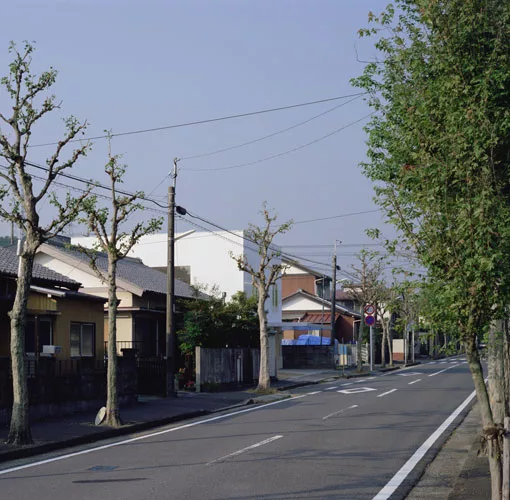
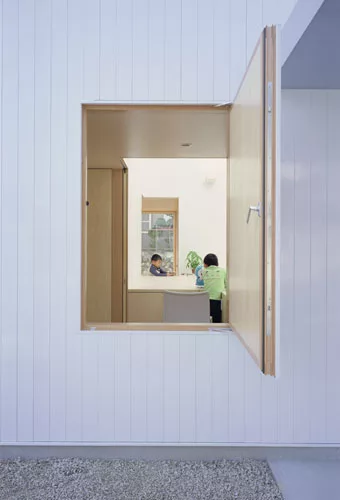
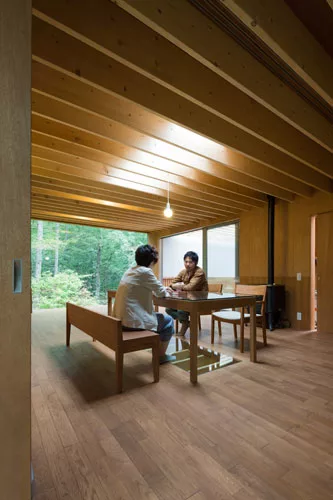
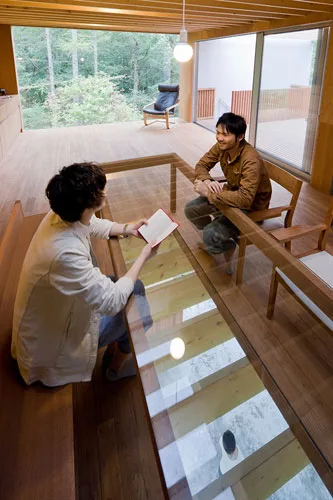
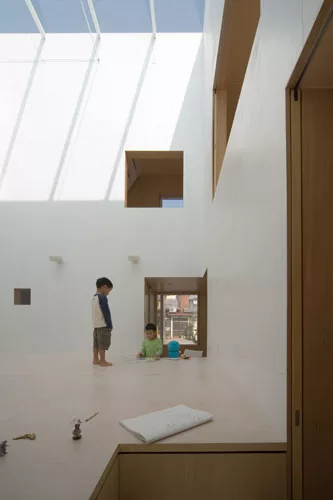
Designed for the architect's sister and her family, this house is located in a quiet residential neighborhood in Nagoya, Japan. Standing in the center of the property, the square two-story house is surrounded by a slot of space containing the entrance path, off-street parking, and gardens. The first floor holds the bedrooms, storage, a study, and a washroom, while the second floor has the living, dining, and kitchen areas in addition to a guest room. All the rooms ring a skylit, double-height void forming the heart of the house. Situated 29 inches above ground level, its floor doubles as a giant table.
 
Photo © Shinkenchiku
Go Hasegawa
House in Sakuradai
 
Designed for the architect's sister and her family, this house is located in a quiet residential neighborhood in Nagoya, Japan. Standing in the center of the property, the square two-story house is surrounded by a slot of space containing the entrance path, off-street parking, and gardens. The first floor holds the bedrooms, storage, a study, and a washroom, while the second floor has the living, dining, and kitchen areas in addition to a guest room. All the rooms ring a skylit, double-height void forming the heart of the house. Situated 29 inches above ground level, its floor doubles as a giant table.
 
Photo © Shinkenchiku
Go Hasegawa
House in Sakuradai
 
Designed for the architect's sister and her family, this house is located in a quiet residential neighborhood in Nagoya, Japan. Standing in the center of the property, the square two-story house is surrounded by a slot of space containing the entrance path, off-street parking, and gardens. The first floor holds the bedrooms, storage, a study, and a washroom, while the second floor has the living, dining, and kitchen areas in addition to a guest room. All the rooms ring a skylit, double-height void forming the heart of the house. Situated 29 inches above ground level, its floor doubles as a giant table.
 
Photo © Shinkenchiku
Go Hasegawa
House in Shakujiikouen
 
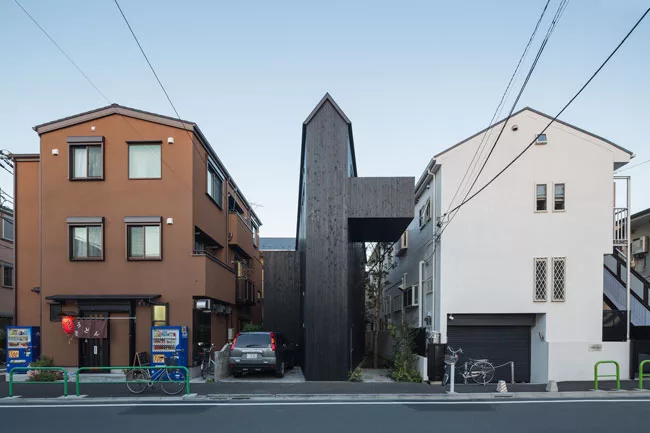
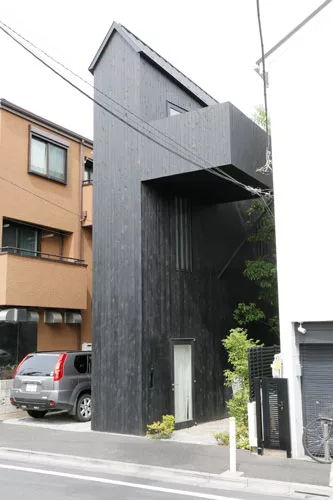
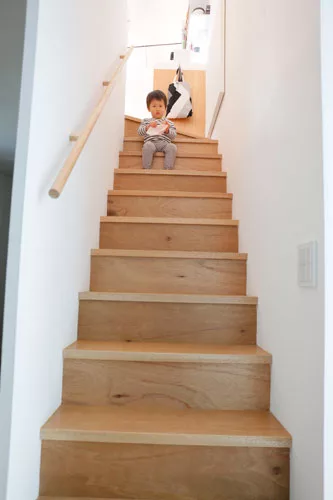
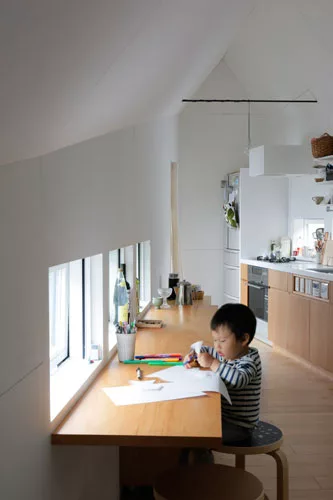
Facing a two-lane street in Tokyo, this house belongs to a professional photographer and her family. While the local vernacular inspired the three-story height and pitched roof, the wedge-shaped footprint maximizes the narrow site. Flanked by off-street parking and a garden, the facade measures a mere 4 feet across.
 
Photo © Shinkenchiku
Go Hasegawa
House in Shakujiikouen
 
Facing a two-lane street in Tokyo, this house belongs to a professional photographer and her family. While the local vernacular inspired the three-story height and pitched roof, the wedge-shaped footprint maximizes the narrow site. Flanked by off-street parking and a garden, the facade measures a mere 4 feet across.
 
Photo courtesy Saori Katayanagi
Go Hasegawa
House in Shakujiikouen
Facing a two-lane street in Tokyo, this house belongs to a professional photographer and her family. While the local vernacular inspired the three-story height and pitched roof, the wedge-shaped footprint maximizes the narrow site. Flanked by off-street parking and a garden, the facade measures a mere 4 feet across.
 
Photo courtesy Saori Katayanagi
Go Hasegawa
House in Shakujiikouen
Facing a two-lane street in Tokyo, this house belongs to a professional photographer and her family. While the local vernacular inspired the three-story height and pitched roof, the wedge-shaped footprint maximizes the narrow site. Flanked by off-street parking and a garden, the facade measures a mere 4 feet across.
 
Photo courtesy Saori Katayanagi
Go Hasegawa
Pilotis in a Forest
 
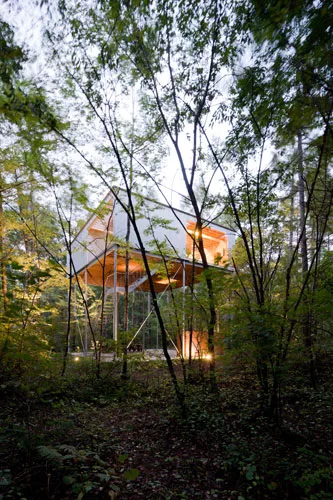
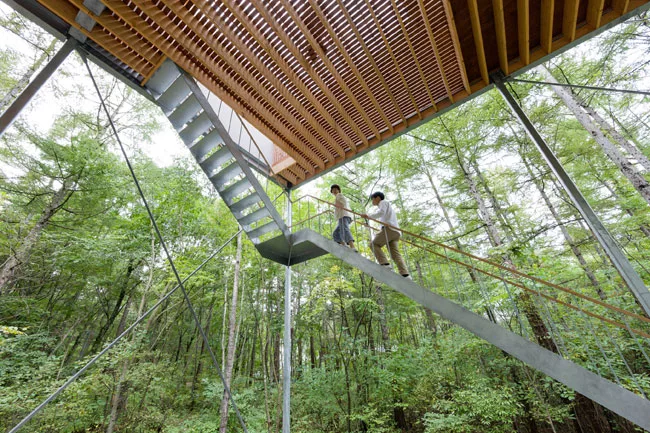
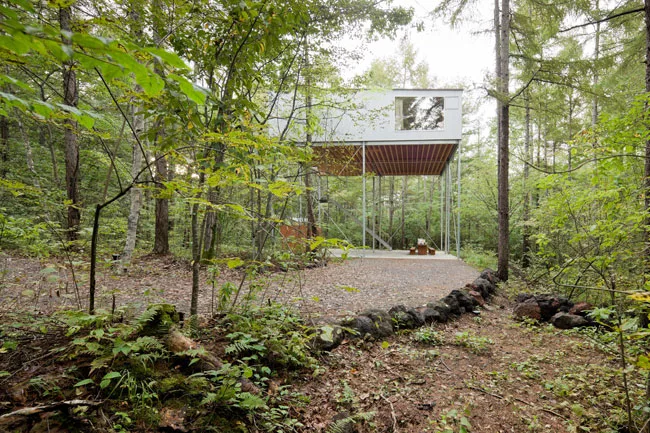
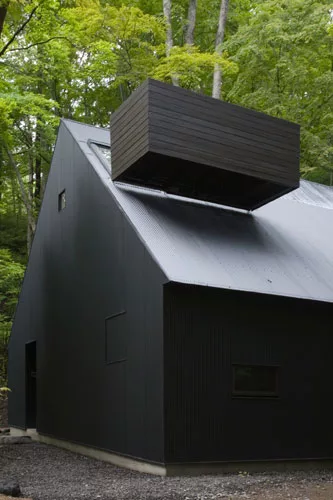
A tree house to top all others, this is a weekend home in densely wooded Nagano Prefecture, Japan. Perched on 21-foot-high columns evoking the surrounding tree trunks, the single-story home contains a combined dining-living-kitchen area, a bedroom, and a bathroom, all arranged in a simple, square plan. While a picture window faces Mount Asama in the distance, the terrace below functions as an outdoor room where the clients can relax in the middle of the forest.
 
Photo © Iwan Baan
Go Hasegawa
Pilotis in a Forest
 
A tree house to top all others, this is a weekend home in densely wooded Nagano Prefecture, Japan. Perched on 21-foot-high columns evoking the surrounding tree trunks, the single-story home contains a combined dining-living-kitchen area, a bedroom, and a bathroom, all arranged in a simple, square plan. While a picture window faces Mount Asama in the distance, the terrace below functions as an outdoor room where the clients can relax in the middle of the forest.
 
Photo © Iwan Baan
A tree house to top all others, this is a weekend home in densely wooded Nagano Prefecture, Japan. Perched on 21-foot-high columns evoking the surrounding tree trunks, the single-story home contains a
Go Hasegawa and Associates
Pilotis in a Forest
A tree house to top all others, this is a weekend home in densely wooded Nagano Prefecture, Japan. Perched on 21-foot-high columns evoking the surrounding tree trunks, the single-story home contains a combined dining-living-kitchen area, a bedroom, and a bathroom, all arranged in a simple, square plan. While a picture window faces Mount Asama in the distance, the terrace below functions as an outdoor room where the clients can relax in the middle of the forest.
Photo © Iwan Baan
Go Hasegawa
Pilotis in a Forest
 
A tree house to top all others, this is a weekend home in densely wooded Nagano Prefecture, Japan. Perched on 21-foot-high columns evoking the surrounding tree trunks, the single-story home contains a combined dining-living-kitchen area, a bedroom, and a bathroom, all arranged in a simple, square plan. While a picture window faces Mount Asama in the distance, the terrace below functions as an outdoor room where the clients can relax in the middle of the forest.
 
Photo © Iwan Baan
Go Hasegawa
Pilotis in a Forest
 
A tree house to top all others, this is a weekend home in densely wooded Nagano Prefecture, Japan. Perched on 21-foot-high columns evoking the surrounding tree trunks, the single-story home contains a combined dining-living-kitchen area, a bedroom, and a bathroom, all arranged in a simple, square plan. While a picture window faces Mount Asama in the distance, the terrace below functions as an outdoor room where the clients can relax in the middle of the forest.
 
Photo © Iwan Baan
Go Hasegawa
House in Kyodo
 
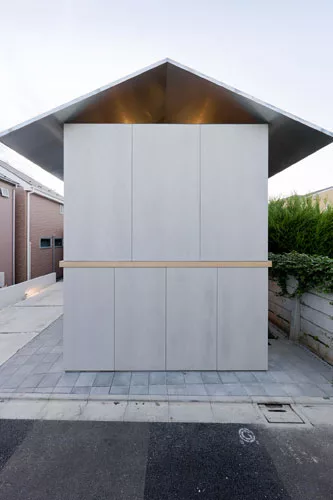
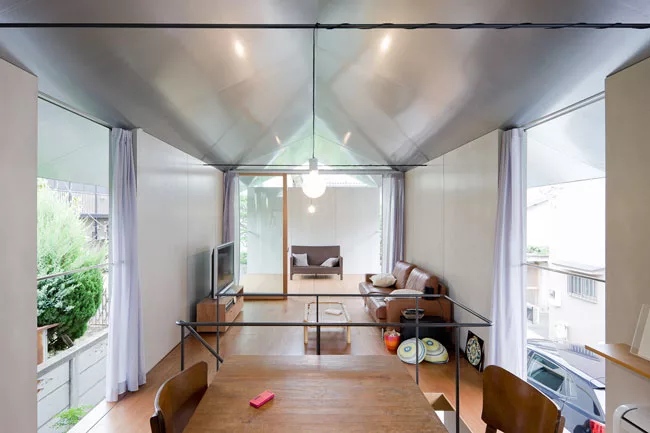
The Tokyo home of a pair of editors, this modest dwelling is a study in contrasts. To house the couple's extensive library, Hasegawa placed floor-to-ceiling bookshelves on the lower level, between programmatic elements such as the entrance, lavatory, study, and bedroom. But upstairs, books are out of sight and daylight bathes a covered terrace, a kitchen, and dining and living areas, thanks to a wafer-thin steel roof that reflects the sun's rays inside. Cement-panel walls alternate with full-height windows to preserve the clients' privacy.
 
Photo © Iwan Baan
Go Hasegawa
House in Kyodo
 
The Tokyo home of a pair of editors, this modest dwelling is a study in contrasts. To house the couple's extensive library, Hasegawa placed floor-to-ceiling bookshelves on the lower level, between programmatic elements such as the entrance, lavatory, study, and bedroom. But upstairs, books are out of sight and daylight bathes a covered terrace, a kitchen, and dining and living areas, thanks to a wafer-thin steel roof that reflects the sun's rays inside. Cement-panel walls alternate with full-height windows to preserve the clients' privacy.
 
Photo © Iwan Baan
Go Hasegawa
House in the Forest
 
Hasegawa's first project on his own, this weekend home for family friends sits between a picturesque river and a heavily trafficked, pedestrian pathway. The architect created a house-within-a-house with a partially glazed pitched roof that allows daylight in but maintains privacy.
 
Photo courtesy Go Hasegawa
Go Hasegawa
Go Hasegawa
Go Hasegawa
Go Hasegawa
Go Hasegawa
Go Hasegawa
Go Hasegawa
Go Hasegawa
Go Hasegawa
Go Hasegawa
A tree house to top all others, this is a weekend home in densely wooded Nagano Prefecture, Japan. Perched on 21-foot-high columns evoking the surrounding tree trunks, the single-story home contains a
Go Hasegawa
Go Hasegawa
Go Hasegawa
Go Hasegawa
Go Hasegawa
December 16, 2014

Tokyo

Tokyo may be among the world’s largest cities, but it has some of the smallest buildings. At critical nodes such as Roppongi and Shinjuku, the city has plenty of skyscrapers and hulking commercial complexes, yet its character is mostly defined by dense, low-scale neighborhoods where the majority of buildings are no more than five stories high. Here, in this paradox of big and little, Go Hasegawa, 37, is finding his design foothold. For Hasegawa, this process is taking place in his modest office atop a five-story walk-up in Harajuku, Tokyo’s pop-culture epicenter. Gazing out from his studio, he can survey the complex cityscape that inspires his architecture but contrasts with the suburban scenery in neighboring Saitama Prefecture, where he grew up.

A typical two-story wooden house, his family home had the usual blend of Japanese and Western elements. “My room was covered with tatami, but I dreamed of flooring,” says the architect with a grin. No doubt having a naval engineer for a father and a painter for a grandfather had an influence on Hasegawa’s decision to study architecture. So, following high school, he entered Tokyo Institute of Technology (TITECH), where he got his undergraduate and master’s degrees.

Under the aegis of Atelier Bow-Wow partner Yoshiharu Tsukamoto, his academic advisor, Hasegawa took part in the investigation of the tiny Tokyo buildings that his mentor terms “pet architecture.” Together with his classmates, Hasegawa biked around town, seeking out and documenting the city’s smallest structures. Through this research, he came to understand the play of scale in the city. Following graduation, he entered the firm of fellow TITECH alum Taira Nishizawa (Design Vanguard 2005). After three years, Hasegawa left to open his own office when family friends asked him to design their weekend getaway. Located in a vacation community in Nagano Prefecture, his clients’ property is sandwiched between a picturesque river and a heavily trafficked pedestrian pathway. Keen to take advantage of the tree-studded site, the architect answered with a house-within-a-house whose partially glazed pitched roof keeps prying eyes out but lets in light and leafy views. “I wanted to use the scale of a house in a new way,” he says.

Be it in the country or the city, Hasegawa often proposes solutions that unite urban, architectural, and furniture elements under a single roof. “In school, we learn about different scales, but I have discovered that we can combine them all in one building,” he says. Creating a house as tall as adjacent apartment buildings, as he did in Shakujiikouen, for example, enabled him to fit it on a narrow site. And incorporating an empty lot effectively augmented the tiny footprint of his House in Gotanda, making it seem bigger. “I want to build positively in such small spaces,” remarks Hasegawa.

Like Tsukamoto, Hasegawa sees potential in urban conditions that others might deem problematic. Instead of trying to conquer a site’s irregular geometry or ignore an area’s architectural vernacular, he works these qualities into his buildings. Though he is still waiting for that large commission, Hasegawa’s small buildings have already begun to have a big impact.

Go Hasegawa and Associates

FOUNDED: 2005

DESIGN STAFF: 5

PRINCIPALS: Go Hasegawa

EDUCATION: Tokyo Institute of Technology, M.Arch., 2002

WORK HISTORY: Taira Nishizawa Architects, 2002–04

KEY COMPLETED PROJECTS: House in Shakujiikouen, Tokyo, 2013; House in Kyodo, Tokyo, 2011; House in Komazawa, Tokyo, 2011; Pilotis in a Forest, Gunma, Japan, 2010; Apartment Building in Nerima, Tokyo, 2010; House in Gotanda, Tokyo, 2006; House in Sakuradai, Nagoya, Japan, 2006

KEY CURRENT PROJECTS: Apartment in Okachimachi, Tokyo, 2014; House in Yokohama, 2015

WEBSITE: WWW.HSGWG.COM

People


Products

 
KEYWORDS: Tokyo

Share This Story

Looking for a reprint of this article?
From high-res PDFs to custom plaques, order your copy today!


Contributing Editor Naomi Pollock, FAIA, is the author of Japanese Design Since 1945: A Complete Sourcebook and the forthcoming Vanishing Japan: Modern Architecture Gone But Not Forgotten,

Post a comment to this article

Report Abusive Comment

Subscription Center
  • Create an Account
  • Start a Subscription
  • Manage My Account
  • Sign Up for Newsletters
  • Visit Customer Service
  • Update Preferences

More Videos

Sponsored Content

Sponsored Content is a special paid section where industry companies provide high quality, objective, non-commercial content around topics of interest to the Architectural Record audience. All Sponsored Content is supplied by the advertising company and any opinions expressed in this article are those of the author and not necessarily reflect the views of Architectural Record or its parent company, BNP Media. Interested in participating in our Sponsored Content section? Contact your local rep!

close
  • TAMLYN XtremeTrim Exterior Trim
    Sponsored byTamlyn

    Designing Cleaner Panel Facades: Why Exterior Trim Details Matter

  • Building with Vapor Barriers
    Sponsored byReef Industries, Inc.

    Vapor Barriers Help Control Moisture in Tighter Building Designs

  • Duct Interior with Prodeq System
    Sponsored byHenry, a Carlisle Company

    Designing Resilient Water Containment Systems

DESIGN:ED Podcast
Listen to Architectural Record’s DESIGN:ED Podcast

Events

June 18, 2026

Rebooting the Aging Office Building

Credits: 1 AIA LU/HSW; 1 AIBD P-CE; 0.1 ICC CEU; 1 PDH

Explore façade retrofit strategies and award-winning design concepts that can transform aging office buildings into healthier, higher-performing workplaces for today’s hybrid workforce.

June 23, 2026

Enhancing Fire Resistance with Advanced PVC Solutions

Credits: 1 AIA LU/HSW; 1 AIBD P-CE; 0.1 ICC CEU; 1 IIBEC CEH

Evaluate advanced PVC solutions that improve fire resistance, support WUI compliance, and enhance resilience in residential and commercial building design.

View All Submit An Event

Products

2026 Architect's Square Foot Costbook

2026 Architect's Square Foot Costbook

See More Products

Popular Stories

SanDiegoAirport

Top 300 Architecture Firms of 2026

Coronado Bridge

The Architect’s Guide to San Diego

Lorcan O' Herilhy

California Architect Lorcan O’Herlihy Has Died, Age 66

CCA, Studio Gang

The Winners of the AIA’s 2026 Architecture Award Range from Collegiate Rowing Hubs to Housing for the Homeless

Dusk House

Design Vanguard 2026: ONO

Rebooting the Aging Office Building - Free Webinar - June 18, 2026

Related Articles

  • Ando Museum

    See More
  • House in Komazawa

    See More
  • Kyoto Hyoto

    An Elaborate Array of Wood and Aluminum-Mesh Panels Fills a Soaring Eatery in Osaka

    See More

Related Products

See More Products
  • sustainable building.jpg

    Sustainable Building Design: Principles and Practice

  • bni book

    BNi Building News Remodeling Costbook 2026 (Print Edition)

See More Products
×

The latest news and information

#1 Source for Architectural Design, News and Products

SUBSCRIBE
  • RESOURCES
    • Advertise
    • Contact Us
    • Submit
    • Store
  • ACCOUNT CENTER
    • Create an Account
    • Start a Subscription
    • Manage My Account
    • Sign Up for Newsletters
    • Visit Customer Service
    • Update Preferences
  • PRIVACY
    • PRIVACY POLICY
    • TERMS & CONDITIONS
    • DO NOT SELL MY PERSONAL INFORMATION
    • PRIVACY REQUEST
    • ACCESSIBILITY
  • SERVICES
    • Marketing Services
    • Reprints
    • Market Research
    • List Rental
    • Survey/Respondent Access
  • STAY CONNECTED
    • Linkedin
    • Facebook
    • Instagram
    • YouTube
    • X (Twitter)

Copyright ©2026. All Rights Reserved BNP Media, Inc. and BNP Media II, LLC.

Design, CMS, Hosting & Web Development :: ePublishing