Architectural Record
search
cart
facebook twitter linkedin youtube
  • Sign In
  • Subscribe
  • Sign Out
  • My Account
Architectural Record
  • NEWS
    • Latest News
    • Awards
    • Interviews
    • Obituaries
    • Podcasts
      • Design:Ed Podcast
      • Sponsored Podcasts
  • OPINION
    • Book Reviews / Excerpts
    • Exhibition Reviews
    • Forum
  • EXCLUSIVES
    • Videos
    • Design Vanguard
    • Top 300 Firms
    • Sponsored Content
    • Sponsored eBooks
    • From the Archives
  • CONTINUING ED
    • Editorial Continuing Ed
    • CE Center
    • CE Academies
  • PROJECTS
    • Buildings By Type
    • Reuse & Renovation
    • Museums & Arts Centers
    • Colleges & Universities
    • Multifamily Housing
    • Interiors
    • Lighting
    • Kitchen & Bath
  • HOUSES
    • Record Houses
    • House of the Month
    • Featured Houses
  • PRODUCTS
    • Products by Category
    • Record Products of the Year
    • Latest Products
  • EVENTS
    • Dates & Events
    • Record on the Road
    • Innovation Conference
    • Sustainability in Practice
    • Women In Architecture
    • Webinars
    • Ad Excellence Awards
    • Submit an Event
  • CONNECT
    • Ask RECORD AI
    • Newsletters
    • Contact
    • Advertise
    • Editorial Calendar
    • Store
    • Customer Service
  • SUBMIT
    • Submission Guidelines
    • RECORD Competitions
  • MAGAZINE
    • Subscribe
    • My Account
    • Digital Edition
    • Current Issue
    • Firm Pass
    • Historic Archive

Three Public Projects by Diébédo Francis Kéré
By William Hanley
Three Public Projects
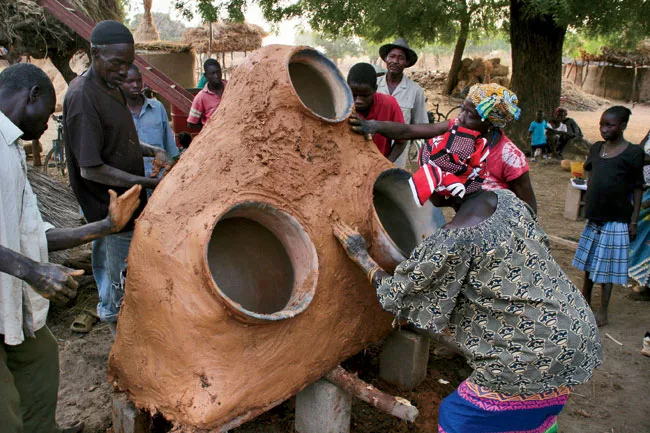
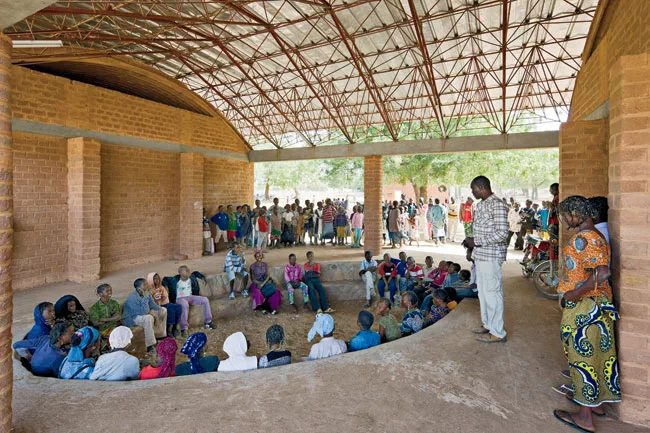
With a women's center, a library, and a secondary school for his native village in rural Burkina Faso, Di'b'do Francis K'r' (standing, in white) is experimenting materials, finding new ways to mitigate the region's harsh climate, and developing techniques for building much faster.
 
Image courtesy Kéré Architecture
Three Public Projects
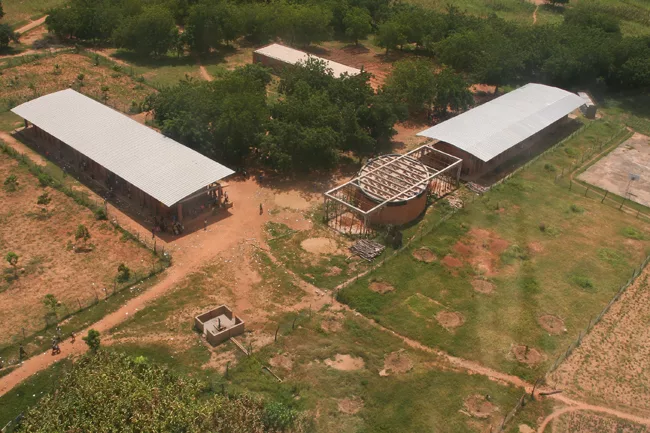
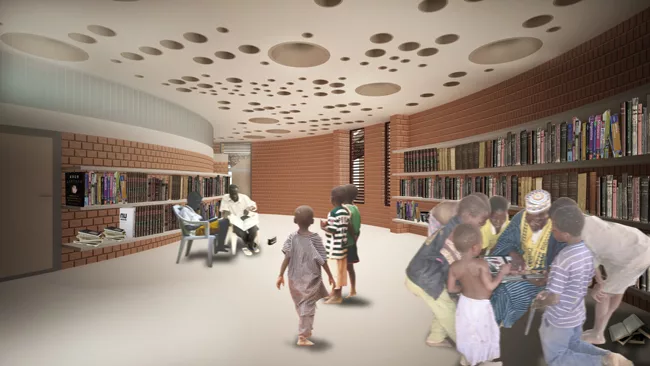
Currently under construction, the $46,536 library stands adjacent to K'r's original primary school and its subsequently built expansions and teacher housing. When completed, the library will serve both students and the public.
 
Image courtesy Kéré Architecture
Three Public Projects
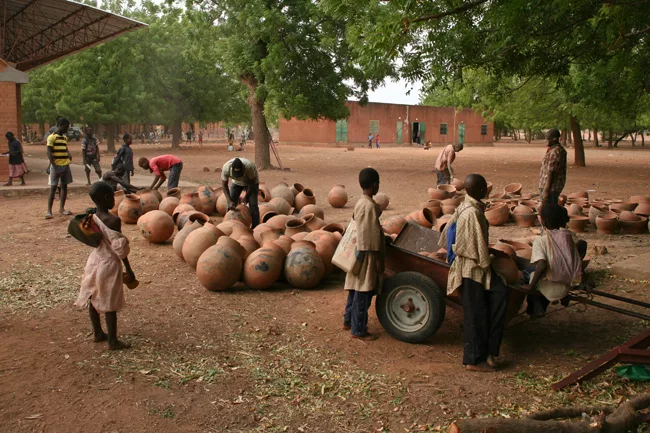
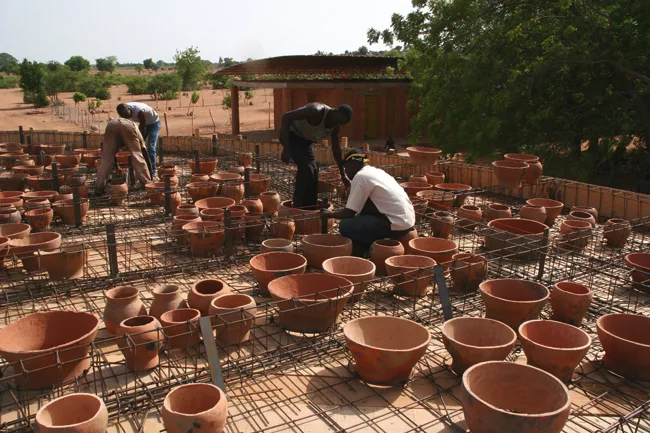
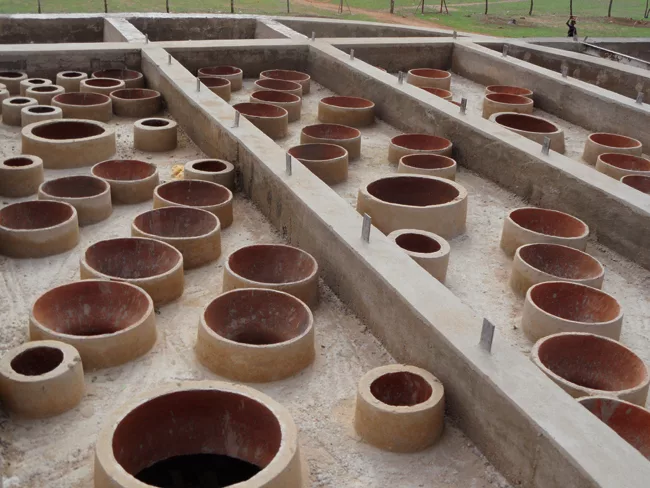
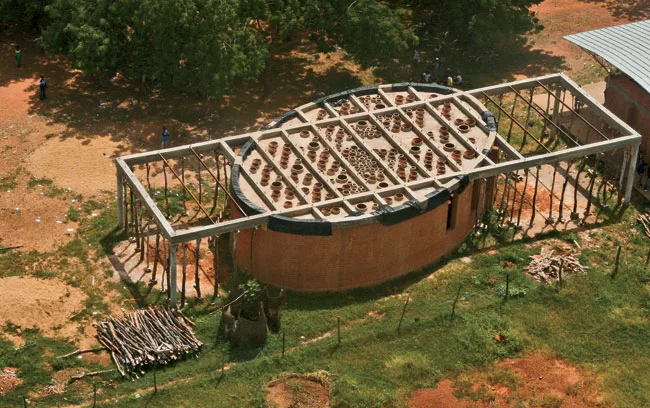
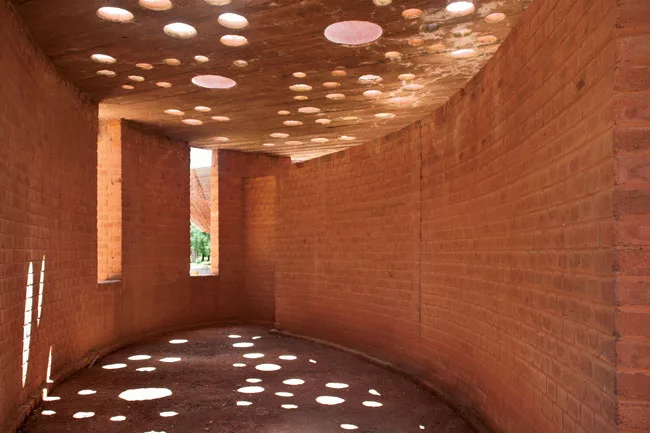
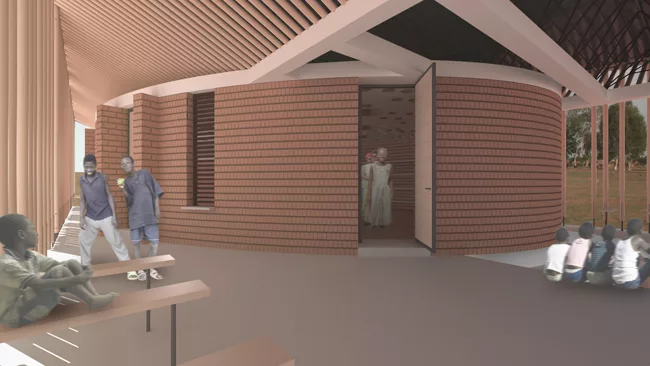
K'r's library floats an iron roof over an oval structure, creating an enclosed space and a shaded outdoor reading area. Perforations in the ceiling made with traditional clay pots provide ventilation to the interior.
 
Image courtesy Kéré Architecture
Three Public Projects
K'r's library floats an iron roof over an oval structure, creating an enclosed space and a shaded outdoor reading area. Perforations in the ceiling made with traditional clay pots provide ventilation to the interior.
 
Image courtesy Kéré Architecture
Three Public Projects
K'r's library floats an iron roof over an oval structure, creating an enclosed space and a shaded outdoor reading area. Perforations in the ceiling made with traditional clay pots provide ventilation to the interior.
 
Image courtesy Kéré Architecture
Three Public Projects
K'r's library floats an iron roof over an oval structure, creating an enclosed space and a shaded outdoor reading area. Perforations in the ceiling made with traditional clay pots provide ventilation to the interior.
 
Image courtesy Kéré Architecture
Three Public Projects
K'r's library floats an iron roof over an oval structure, creating an enclosed space and a shaded outdoor reading area. Perforations in the ceiling made with traditional clay pots provide ventilation to the interior.
 
Image courtesy Kéré Architecture
Three Public Projects
K'r's library floats an iron roof over an oval structure, creating an enclosed space and a shaded outdoor reading area. Perforations in the ceiling made with traditional clay pots provide ventilation to the interior.
 
Image courtesy Kéré Architecture
Three Public Projects
K'r's library floats an iron roof over an oval structure, creating an enclosed space and a shaded outdoor reading area. Perforations in the ceiling made with traditional clay pots provide ventilation to the interior.
 
Image courtesy Kéré Architecture
Three Public Projects
K'r's library floats an iron roof over an oval structure, creating an enclosed space and a shaded outdoor reading area. Perforations in the ceiling made with traditional clay pots provide ventilation to the interior.
 
Image courtesy Kéré Architecture
Three Public Projects
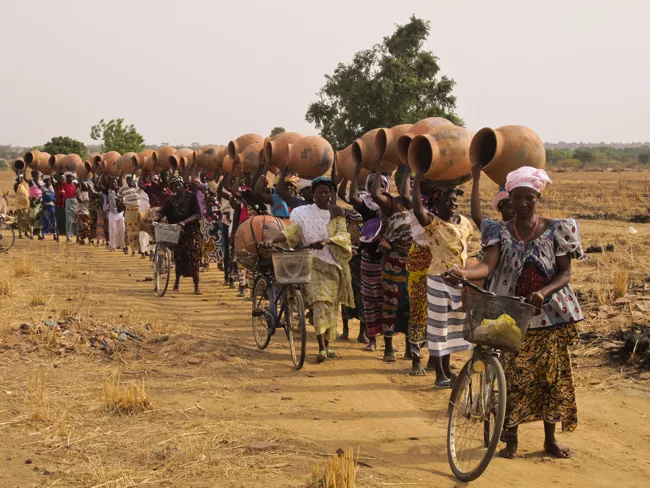
In a region where some 97 percent of the female population over age 15 is illiterate, the cooperatively run center will provide a space for adult-education programs, as well as classes about health, nutrition, and agriculture for 300 village women. K'r' hopes the completed $66,480 project will attract both governmental and nongovernmental organizations to develop programming for the center.
 
Image courtesy Kéré Architecture
Three Public Projects
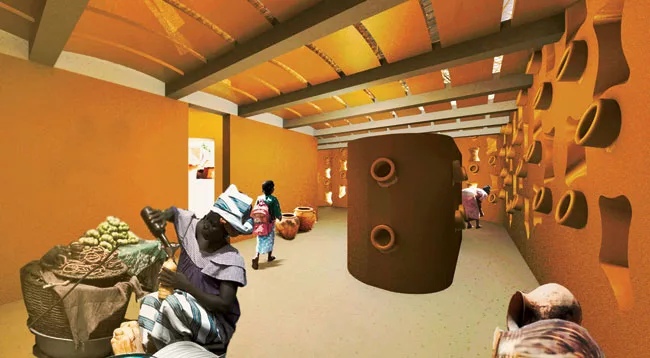
With built-in storage for cereal grains, made from clay pots embedded in the walls, the women's center will foster a growing number of women running small businesses in Gando. An iron roof supported by a timber frame rises above clay-brick ceiling vaults. Gaps in the ceiling allow air to circulate through the interior storage and meeting spaces.
 
Image courtesy Kéré Architecture
Three Public Projects
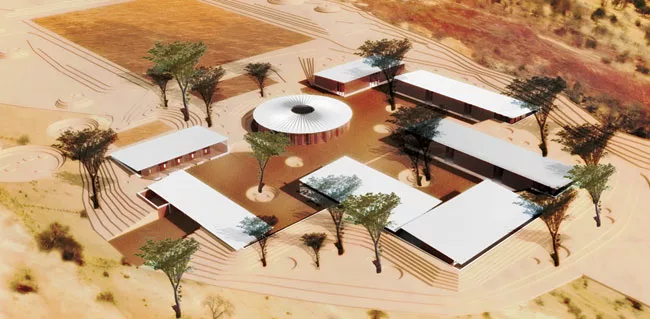
Education at K'r''s already completed primary school will continue at a $46,536 secondary school currently under construction. The plan follows the layout of a traditional Gando compound, with a ring of buildings enclosing an overlapping series of courtyards, some shaded by louvered coverings.
 
Image courtesy Kéré Architecture
Three Public Projects
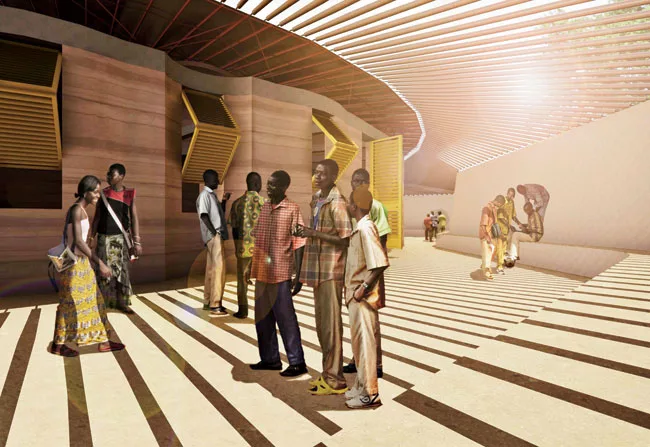
K'r's plan for a secondary school includes air shafts leading from vents in the floor to beds of vegetation'irrigated by a rainwater cistern and a deep well with a wind-powered pump''located outside. As the roof pulls hot air up through a porous ceiling, cooler air from the beds will replace it from below.
 
Image courtesy Kéré Architecture
Three Public Projects
March 16, 2012

Architects & Firms

Kéré Architecture

Gando Village, Burkina Faso

The village of Gando is more than a three-hour drive from the capital of Burkina Faso, Ouagadougou, on occasionally unpaved roads that thread through a landscape of scorched orange dust and isolated trees buffeted by sub-Saharan winds. It's an unlikely place to launch a global design practice, but architect Diébédo Francis Kéré couldn't imagine doing this anywhere else. “In the beginning, I built in Gando because I had a duty to my family,” says Kéré, who grew up in the remote agricultural community of 6,000 people, left to go to study in Germany, and today runs a seven-person office in Berlin. “Now people everywhere know me through this work, so I am getting something back from it.”

His first project for his home village was a clay-brick primary school, which caught the attention of the humanitarian design world—winning the Aga Khan Award for Architecture in 2004—in part because it was built by local people from materials made mostly on-site. “Francis is a great example of someone who works with a community, bringing knowledge, adapting it to the local means, and exchanging it—not just doing charity architecture,” says Andres Lepik, current Loeb Fellow at Harvard's Graduate School of Design and incoming chair of architectural history and curatorial practice at the Technical University of Munich. Lepik featured Kéré's work in the 2010 exhibition Small Scale, Big Change: New Architectures of Social Engagement at New York's Museum of Modern Art. “He also designs beautiful projects, which is important because you're not only providing for a need but creating something of cultural value as well.”

Kéré's three new projects under construction in Gando are funded largely through his foundation and, like the primary school, they employ local labor and materials to create public buildings that arise from the community they serve. “When people make things themselves, they protect them,” says Kéré. The building process also teaches people skills that can be used to maintain the structure and be applied to other projects. With the new projects—a women's center, a library, and a secondary school—Kéré is experimenting. He is rethinking Gando's native materials, finding new ways to mitigate the region's harsh climate, and developing techniques for building much faster.

The 3,900-square-foot Women's Association Center, a cooperative, will provide classrooms, a kitchen, latrines, a meeting room, and a collective storage area for 300 women in the agricultural community. Located next to Kéré's family compound, the building will curve in plan around an old-growth neem tree, a traditional gathering place because of the shade it casts. Benches set into the curving wall allow a group to watch a presenter standing in front of the tree's trunk.

The building's timber frame supports a sweeping roof that references European Modernism, but is made from corrugated iron, a common material in Burkina Faso. Hand-formed earth walls rise to meet it. Clay pots embedded into the walls allow the women who use the center to store surplus grain, which they can later sell. “The pots are made by village women,” Kéré says. “And the idea was to help them run a good business using elements that are familiar.”

Kéré's experiments with using pots as built-in storage led him to devise another use for the nontraditional building material. Adjacent to his primary school, he is currently constructing a 1,600-square-foot library. The oval-shaped, clay-brick building has a concrete ceiling that villagers poured around a cluster of specially made pots with open bases. A rectangular iron roof raised several feet above the ceiling on an open steel rebar structure will extend beyond the oval to shade outdoor reading areas. As the sun heats the metal roof, hot air inside the library will be drawn up through the pots perforating the ceiling, creating a stack effect to cool the interior.

A facade of eucalyptus louvers will enclose the exterior spaces, further shading them from the sun. Eucalyptus grows like a weed in Burkina Faso and is normally used only for firewood, but Kéré has introduced it into his projects as a renewable building material.

Construction of the library was slated to be completed by the end of 2011, but in June of last year, Kéré's father, the head of a family group that extends to hundreds of people in the village, died. As the oldest son of 13 children, Kéré had many ceremonial obligations to perform, which led to several construction delays since the building schedule must work around the agriculture calendar. With work needing to finish before the next rainy season—you can't build with clay in a downpour—and funding for the Women's Center from the German government contingent on an April completion date, Kéré sped up construction on all three projects.

Instead of forming bricks from clay and drying them for a full month, Kéré worked with villagers to develop a process for casting clay like concrete. The method allows two people to pour a mixture of clay, gravel, sand, and cement into iron formwork. The mix sets in one day, and the forms can then be reused. He is putting the system to the test with the new secondary school where the walls will be cast in six-foot sections using two modular forms—one solid, one with space for a window. He expects to complete the walls in less than two months.

The building is the first in a 42,000-square-foot complex that follows the traditional layout of a family compound in Gando, a ring of structures closed to the dusty winds from the east and open to western breezes. His ambitious plans have more than just the backing of his supporters abroad. “When his father died, Francis inherited a lot of responsibility, but also a lot of power,” says Lepik. “He can say, 'We are going to build this,' and command 30 to 40 people.” Even as he works on projects from an exhibition space in Switzerland to an industrial waterfront rehab in China with his Berlin-based practice, Kéré has become leader in his hometown.

People


Products

 
KEYWORDS: Africa Burkina Faso Diebedo Francis Kere humanitarian design

Share This Story

Looking for a reprint of this article?
From high-res PDFs to custom plaques, order your copy today!
Post a comment to this article

Report Abusive Comment

Subscription Center
  • Create an Account
  • Start a Subscription
  • Manage My Account
  • Sign Up for Newsletters
  • Visit Customer Service
  • Update Preferences

More Videos

Sponsored Content

Sponsored Content is a special paid section where industry companies provide high quality, objective, non-commercial content around topics of interest to the Architectural Record audience. All Sponsored Content is supplied by the advertising company and any opinions expressed in this article are those of the author and not necessarily reflect the views of Architectural Record or its parent company, BNP Media. Interested in participating in our Sponsored Content section? Contact your local rep!

close
  • cold storage facility
    Sponsored byCarlisle SynTec Systems

    How Architects Can Design More Continuous Cold Storage Envelopes

  • TAMLYN XtremeTrim Exterior Trim
    Sponsored byTamlyn

    Designing Cleaner Panel Facades: Why Exterior Trim Details Matter

  • Building with Vapor Barriers
    Sponsored byReef Industries, Inc.

    Vapor Barriers Help Control Moisture in Tighter Building Designs

DESIGN:ED Podcast
Listen to Architectural Record’s DESIGN:ED Podcast

Events

June 23, 2026

Enhancing Fire Resistance with Advanced PVC Solutions

Credits: 1 AIA LU/HSW; 1 AIBD P-CE; 0.1 ICC CEU; 1 IIBEC CEH

Evaluate advanced PVC solutions that improve fire resistance, support WUI compliance, and enhance resilience in residential and commercial building design.

June 25, 2026

Designing Glass Railing Systems that Enhance Aesthetics and Meet Code

Credits: 1 AIA LU/HSW; 1 AIBD P-CE; 0.1 ICC CEU

Upon course completion, participants will possess a deeper understanding of glass railings to help ensure that safety, aesthetic, and performance objectives are achieved.

View All Submit An Event

Products

2026 Architect's Square Foot Costbook

2026 Architect's Square Foot Costbook

See More Products

Popular Stories

Lorcan O' Herilhy

California Architect Lorcan O’Herlihy Has Died, Age 66

Obama Presidential Center, Chicago

The Obama Presidential Center Opens on Chicago’s South Side

Spoonbill Ranch

Johnsen Schmaling Architects Integrates Spoonbill Ranch into a Pristine Landscape

Image of Bruce Springsteen Center for American Music

The CookFox-designed Bruce Springsteen Center for American Music Opens in New Jersey

Three Courtyards House

Design Vanguard 2026: Balsa Crosetto Piazzi

Enhancing Fire Resistance with Advanced PVC Solutions - Free Webinar - June 23, 2026

Related Articles

  • Diébédo Francis Kéré

    Interview with Diébédo Francis Kéré on Serpentine 2017 and Future Projects

    See More
  • Newsmaker: Diébédo Francis Kéré

    See More
  • Bringing it All Back Home: Diébédo Francis Kéré’s Atelier

    See More
×

The latest news and information

#1 Source for Architectural Design, News and Products

SUBSCRIBE
  • RESOURCES
    • Advertise
    • Contact Us
    • Submit
    • Store
  • ACCOUNT CENTER
    • Create an Account
    • Start a Subscription
    • Manage My Account
    • Sign Up for Newsletters
    • Visit Customer Service
    • Update Preferences
  • PRIVACY
    • PRIVACY POLICY
    • TERMS & CONDITIONS
    • DO NOT SELL MY PERSONAL INFORMATION
    • PRIVACY REQUEST
    • ACCESSIBILITY
  • SERVICES
    • Marketing Services
    • Reprints
    • Market Research
    • List Rental
    • Survey/Respondent Access
  • STAY CONNECTED
    • Linkedin
    • Facebook
    • Instagram
    • YouTube
    • X (Twitter)

Copyright ©2026. All Rights Reserved BNP Media, Inc. and BNP Media II, LLC.

Design, CMS, Hosting & Web Development :: ePublishing