Architectural Record
search
cart
facebook twitter linkedin youtube
  • Sign In
  • Subscribe
  • Sign Out
  • My Account
Architectural Record
  • NEWS
    • Latest News
    • Awards
    • Interviews
    • Obituaries
    • Podcasts
      • Design:Ed Podcast
      • Sponsored Podcasts
  • OPINION
    • Book Reviews / Excerpts
    • Exhibition Reviews
    • Forum
  • EXCLUSIVES
    • Videos
    • Design Vanguard
    • Top 300 Firms
    • Sponsored Content
    • Sponsored eBooks
    • From the Archives
  • CONTINUING ED
    • Editorial Continuing Ed
    • CE Center
    • CE Academies
  • PROJECTS
    • Buildings By Type
    • Reuse & Renovation
    • Museums & Arts Centers
    • Colleges & Universities
    • Multifamily Housing
    • Interiors
    • Lighting
    • Kitchen & Bath
  • HOUSES
    • Record Houses
    • House of the Month
    • Featured Houses
  • PRODUCTS
    • Products by Category
    • Record Products of the Year
    • Latest Products
  • EVENTS
    • Dates & Events
    • Record on the Road
    • Innovation Conference
    • Sustainability in Practice
    • Women In Architecture
    • Webinars
    • Ad Excellence Awards
    • Submit an Event
  • CONNECT
    • Ask RECORD AI
    • Newsletters
    • Contact
    • Advertise
    • Editorial Calendar
    • Store
    • Customer Service
  • SUBMIT
    • Submission Guidelines
    • RECORD Competitions
  • MAGAZINE
    • Subscribe
    • My Account
    • Digital Edition
    • Current Issue
    • Firm Pass
    • Historic Archive
Architectural Technology

A Prague Stairwell's DNA Structure Revealed
By David Sokol
A Prague Stairwell's DNA Structure Revealed

A Prague Stairwell's DNA Structure Revealed

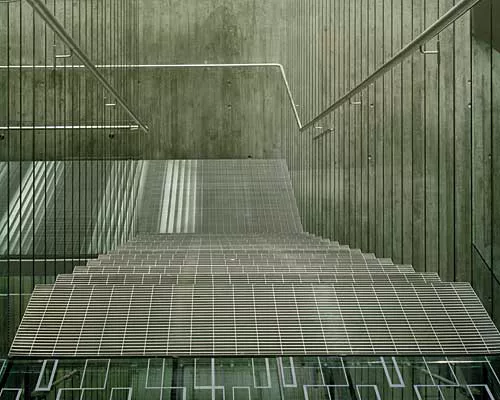
The anti-slip grid of the glass landings (above) is arranged in the manner of the output from a DNA sequence registration machine.

Photo © Filip Slapal
A Prague Stairwell's DNA Structure Revealed

A Prague Stairwell's DNA Structure Revealed

Photo © Filip Slapal

A Prague Stairwell's DNA Structure Revealed

A Prague Stairwell's DNA Structure Revealed

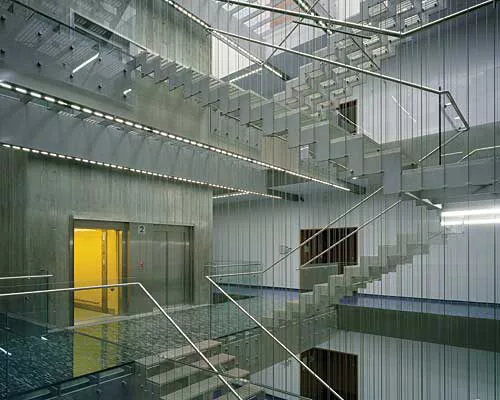
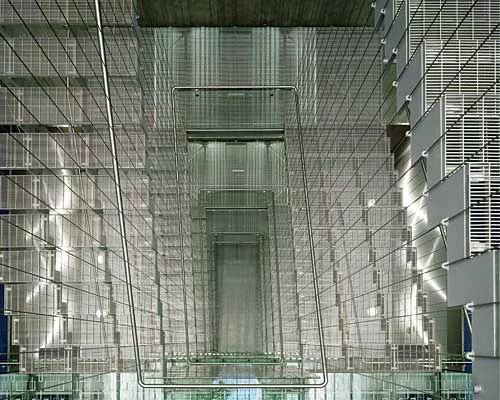
The stairwell's stainless-steel wires (above) run the full length of the building and are held in tension to support the stair's structure. This is especially evident in the bird's-eye view below.

Photo © Filip Slapal
A Prague Stairwell's DNA Structure Revealed

A Prague Stairwell's DNA Structure Revealed

Photo © Filip Slapal
A Prague Stairwell's DNA Structure Revealed
A Prague Stairwell's DNA Structure Revealed

A Prague Stairwell's DNA Structure Revealed

A Prague Stairwell's DNA Structure Revealed

A Prague Stairwell's DNA Structure Revealed
January 1, 2015
When commissioned to design the facade and interior of the Institute of Molecular Genetics for the Czech Academy of Science, the Prague-based firm Studio P-H-A decided to add some bling to biomedicine. Responding to the standard-issue rectilinear volume designed by fellow Czech firm Atelier Ypsilon, architects Jan Sesták and Marek Deyl appended a glittering steel staircase that takes the form of DNA’s double helix.
 
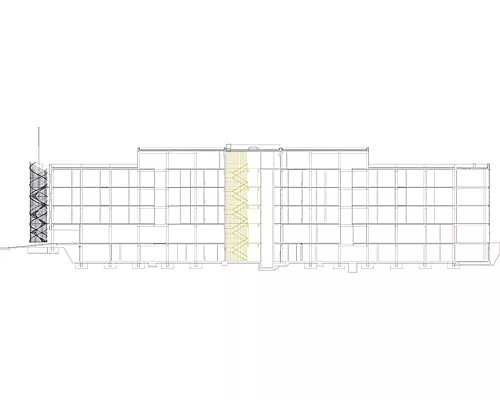
The interior plan of the lab building “is very economical and rational, without any significant centralized space,” Sesták explains, so the architects at Studio P-H-A decided to emphasize the interior’s best feature: a circulation core topped by three off-the-shelf skylights. “The chief aim was to bring daylight as far as the ground level” of the six-story interior, Sesták says, adding that in the absence of more formal social spaces, daylight would induce resident scientists to gather in the generous stairwell.
 
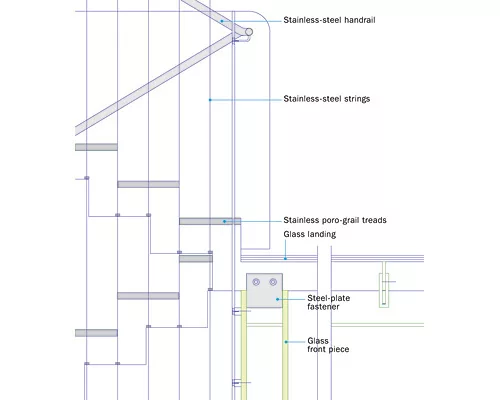
The architects determined that hanging stairs with gridded stainless-steel treads and risers would maximize light penetration. The so-called “poro-grill” was water-jet-cut from sheets and heat-forged. Usually, this kind of stair system is hung with a frame that cradles the steps and keeps feet from landing out of bounds, but Sesták and Deyl eliminated this step of fabrication to avoid the visual obstruction.
 
Instead, Studio P-H-A secured the perimeter by specifying a proprietary Carl Stahl system of steel cables that runs the entire height of the building. Each 0.2-inch tie rod is attached to the ceiling and to stainless-steel tensioners anchored with chemical adhesive to the reinforced-concrete foundation. With slim stainless-steel handrails connected to the tie rods, the cables effectively serve as balusters. The railings are reinforced via additional attachments to the concrete shaft surrounding the stair. And where the railing trails off into intersecting corridors, bonded glass replaces the Carl Stahl balustrade. “Glass was measured on-site and specially manufactured for each position, since the precision of the reinforced-concrete structure was not sufficient,” Sesták points out.
 
In the spirit of transparency, stair landings of Conex bonded safety glass rest within custom-made steel girders. “We desired to give a ‘technological’ impression to the entire structure, which would correspond with the exactness of a scientific institution,” Sesták says. To invoke the correspondence more literally, the glass landings are printed with an antislip grid in a pattern derived from DNA-sequence-registration-machine outputs.
 
Institute employees began moving into the new building in January. Today, a double-layer Barrisol membrane on the skylights diffuses the intense sun, transforming the light into a pleasant blanket flooding the diaphanous stair. Sesták admits the installation’s astounding visual lightness did inspire early feelings of uncertainty among some building users, who were, perhaps, expecting Studio P-H-A’s contribution to be as conservative as the new structure containing it, but the employees now embrace it.


Share This Story

Looking for a reprint of this article?
From high-res PDFs to custom plaques, order your copy today!

David Sokol is a contributing editor to Architectural Record. 

Post a comment to this article

Report Abusive Comment

Subscription Center
  • Create an Account
  • Start a Subscription
  • Manage My Account
  • Sign Up for Newsletters
  • Visit Customer Service
  • Update Preferences

More Videos

Sponsored Content

Sponsored Content is a special paid section where industry companies provide high quality, objective, non-commercial content around topics of interest to the Architectural Record audience. All Sponsored Content is supplied by the advertising company and any opinions expressed in this article are those of the author and not necessarily reflect the views of Architectural Record or its parent company, BNP Media. Interested in participating in our Sponsored Content section? Contact your local rep!

close
  • TAMLYN XtremeTrim Exterior Trim
    Sponsored byTamlyn

    Designing Cleaner Panel Facades: Why Exterior Trim Details Matter

  • Building with Vapor Barriers
    Sponsored byReef Industries, Inc.

    Vapor Barriers Help Control Moisture in Tighter Building Designs

  • Duct Interior with Prodeq System
    Sponsored byHenry, a Carlisle Company

    Designing Resilient Water Containment Systems

DESIGN:ED Podcast
Listen to Architectural Record’s DESIGN:ED Podcast

Events

June 10, 2026

Rethinking Stormwater – The Power of Porous Paving

Credits: 1 AIA LU/HSW; 1 AIBD P-CE; 0.1 ICC CEU

Learn how porous paving systems support stormwater management, reduce heat island effects, and enhance sustainable site design performance.

June 11, 2026

Very Early Warning Fire Detection for Mission-Critical Facilities

Credits: 1 AIA LU/HSW; 1 AIBD P-CE; 0.1 ICC CEU

Examine advanced fire detection strategies that support uptime and enhance safety in data centers and other mission-critical facilities.

View All Submit An Event

Products

2026 Architect's Square Foot Costbook

2026 Architect's Square Foot Costbook

See More Products

Popular Stories

Practice Matters illustration

What’s in a (Firm’s) Name? Thinking About Succession and Legacy

Practice Matters illustration

By the Numbers: Counting America's Architects

House on a Hill

Design Vanguard 2026: Forma

Crane Cove, ONO

Design Vanguard 2026 Winners

House A on a Hill

Design Vanguard 2026: Santiago Valdivieso

Broader Sustainability of CMU - Free Webinar - May 21, 2026

Related Articles

  • view of bridges spanning a river in prague

    Plan to Demolish Landmark Prague Railway Bridge Sparks International Outcry

    See More
  • A Cluster of Hadid Projects Share a Particular Strain of Design DNA

    See More
  • The Hub at London South Bank University

    WilkinsonEyre Built a New Campus Hub within a 50-year-old Structure at London South Bank University

    See More

Related Products

See More Products
  • book3.jpg

    If Architecture is a Language, Then a Building is a Story

  • image7.jpg

    Contemporary Architecture in China Towards A Critical Pragmatism

  • 0470126736.gif

    Modern Sustainable Residential Design: A Guide for Design Professionals

See More Products
×

The latest news and information

#1 Source for Architectural Design, News and Products

SUBSCRIBE
  • RESOURCES
    • Advertise
    • Contact Us
    • Submit
    • Store
  • ACCOUNT CENTER
    • Create an Account
    • Start a Subscription
    • Manage My Account
    • Sign Up for Newsletters
    • Visit Customer Service
    • Update Preferences
  • PRIVACY
    • PRIVACY POLICY
    • TERMS & CONDITIONS
    • DO NOT SELL MY PERSONAL INFORMATION
    • PRIVACY REQUEST
    • ACCESSIBILITY
  • SERVICES
    • Marketing Services
    • Reprints
    • Market Research
    • List Rental
    • Survey/Respondent Access
  • STAY CONNECTED
    • Linkedin
    • Facebook
    • Instagram
    • YouTube
    • X (Twitter)

Copyright ©2026. All Rights Reserved BNP Media, Inc. and BNP Media II, LLC.

Design, CMS, Hosting & Web Development :: ePublishing