Architectural Record
search
cart
facebook twitter linkedin youtube
  • Sign In
  • Subscribe
  • Sign Out
  • My Account
Architectural Record
  • NEWS
    • Latest News
    • Awards
    • Interviews
    • Obituaries
    • Podcasts
      • Design:Ed Podcast
      • Sponsored Podcasts
  • OPINION
    • Book Reviews / Excerpts
    • Exhibition Reviews
    • Forum
  • EXCLUSIVES
    • Videos
    • Design Vanguard
    • Top 300 Firms
    • Sponsored Content
    • Sponsored eBooks
    • From the Archives
  • CONTINUING ED
    • Editorial Continuing Ed
    • CE Center
    • CE Academies
  • PROJECTS
    • Buildings By Type
    • Reuse & Renovation
    • Museums & Arts Centers
    • Colleges & Universities
    • Multifamily Housing
    • Interiors
    • Lighting
    • Kitchen & Bath
  • HOUSES
    • Record Houses
    • House of the Month
    • Featured Houses
  • PRODUCTS
    • Products by Category
    • Record Products of the Year
    • Latest Products
  • EVENTS
    • Dates & Events
    • Record on the Road
    • Innovation Conference
    • Sustainability in Practice
    • Women In Architecture
    • Webinars
    • Ad Excellence Awards
    • Submit an Event
  • CONNECT
    • Ask RECORD AI
    • Newsletters
    • Contact
    • Advertise
    • Editorial Calendar
    • Store
    • Customer Service
  • SUBMIT
    • Submission Guidelines
    • RECORD Competitions
  • MAGAZINE
    • Subscribe
    • My Account
    • Digital Edition
    • Current Issue
    • Firm Pass
    • Historic Archive

Breakthroughs and Obstacles: Architecture's Evolving Complexion

By G. Chaise Nunnally
Breakthroughs & Obstacles

Clockwise: Isham Baker, FAIA; Max Bond, FAIA; Gary Bowden, FAIA; Leon Bridges, FAIA; Stanford Britt, FAIA; Charles Cassell, FAIA

Photomontage © Joe Calviello

Breakthroughs & Obstacles

Clockwise: Robert Coles, FAIA; Peter Cook, AIA; Yolande Daniels, AIA; Paul Devrouax, FAIA; Kathy Dixon, AIA; Richard Dozier, AIA; Darrell Fitzgerald, FAIA

Photomontage © Joe Calviello

Breakthroughs & Obstacles

Clockwise: Philip Freelon, FAIA; Harvey Gantt, FAIA; Mario Gooden, AIA; Bradford Grant, AIA; Maxine Griffith; Rainy Hamilton, Jr., AIA; Henry Hardnett, FAIA

Photomontage © Joe Calviello

Breakthroughs & Obstacles

Clockwise: Wesley Henderson, AIA; Ricardo Herring, FAIA; Major Holland, FAIA; Diane Hoskins, FAIA; Ralph Jackson, FAIA; Phil Craig Johnson, FAIA; Donald King, FAIA

Photomontage © Joe Calviello
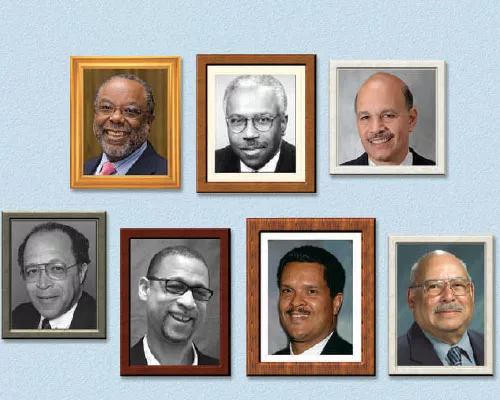
Breakthroughs & Obstacles

Clockwise: Ted Landsmark, Assoc. AIA; David Lee, FAIA; Frank Christopher Lee, FAIA; Kermit Lee, Jr., FAIA; Steven Lewis, AIA; Keith Marrero, AIA; Mortimer Marshall, FAIA

Photomontage © Joe Calviello

Breakthroughs & Obstacles

Clockwise: Charles McAfee, FAIA; Charyl McAfee-Duncan, AIA; Cheryl McAfee-Mitchell, FAIA; Melvin Mitchell, FAIA; Kevin Montgomery, FAIA; Curtis Moody, FAIA; G. Chaise Nunnally

Photomontage © Joe Calviello

Breakthroughs & Obstacles

Clockwise: Michaele Pride, AIA; Marshall Purnell, FAIA; Harry Robinson III, FAIA ; Howard Sims, FAIA; Norma Sklarek, FAIA; William Stanley III, FAIA

Photomontage © Joe Calviello

Breakthroughs & Obstacles

Clockwise: Donald Stull, FAIA; Sharon Sutton, FAIA; Jack Travis, FAIA Roberta Washington, FAIA; Darrell Williams, FAIA; Allison Williams, FAIA; Michael Willis, FAIA; Professor Mabel Wilson; Rodner Wright, AIA

Photomontage © Joe Calviello

Breakthroughs & Obstacles
May 19, 2009
Architecture still suffers from a paucity of African-American practitioners. The statistic that civil rights activist Whitney Young famously cited at the 1968 American Institute of Architects convention — that only 1 percent of registered architects were African-American — has ticked upward only slightly in the four decades since. Today’s percentage is fewer than half the number of blacks in medicine (3.7 percent) and law (3.9 percent).
 
Black architects who have prospered in the field don’t attribute this enduring gap to any single factor. “There are many reasons,” says Phil Freelon, FAIA, principal of Durham, North Carolina—based The Freelon Group. “They have to do with visibility, access to quality primary- and secondary-school education, the rigor of architecture school curricula, the attrition that occurs as a result of this, and other barriers related to internship and licensure that make it difficult for anyone to advance in our profession.”
 
For architects such as Keith Marrero, AIA, who owns a small, successful , minority firm in downtown Greenville, South Carolina, but doesn’t enjoy the same wide renown as Freelon, dialogue about the scarcity of blacks in the profession takes on a more dire tone. “In architecture, there’s not enough opportunity for job growth, responsibility, or promotion in white firms,” he says.
 
Yet even while the number of black architects remains largely unchanged, other aspects of the profession have evolved to the benefit of many black practitioners, especially increasing opportunities in the private sector.
 
For Moody Nolan, the largest black-owned architecture firm in the U.S., with 162 employees, winning the Ohio Environmental Protection Agency headquarters, completed in 1990, marked its transition to private-sector work. When the state opted to use a private developer for the project, Moody was selected to team with the developer because of his firm’s experience with public facilities and his status as a minority owner. The fortuitous teaming led to a 20-year working relationship with the private developer. And principal Curtis Moody, FAIA, credits the partnership to the developer’s recognizing that the capabilities of Moody Nolan were comparable or superior to nonminority firms. From there, Moody says, “We could start making a case in the private sector that we were trusted by this group. You get work not because you meet a certain diversity percentage, but because you’re qualified.”
 
Donald Stull, FAIA, who founded Boston-based Stull and Lee in 1966, says he has noticed the shift more recently — only in the past 10 years or so. And even then, “It came through a slow adjustment of mind-sets in corporate America.” As with Moody Nolan, Stull says success depends on “champions.” Among these patrons, he cites the late Edward Logue as the advocate behind significant public projects, as well as Robert Weinberg, as a private-sector supporter. Weinberg reintroduced Stull to The Beacon Companies, which then hired Stull and Lee for the interior fit-out of Boston’s historic South Station Headhouse in 1986, and Weinberg continued engaging the firm in airport retail master planning after he founded his own company, MarketPlace Development, in 1992.
 
The word-of-mouth marketing and networking that characterize architecture in general still present a barrier to minority firms operating in the private arena. “It’s who you know,” Moody says, “and the majority of people building are not minority.” Stull concurs: “It’s related to the social circles one moves in, and if that’s limited, then capability is limited.”
 
Even so, progress has been great enough that some younger African-American architects may take a postracial view of patronage. “After going to graduate school and being in those circles, it seemed natural to submit to competitions and to get jobs with private clients,” says Yolande Daniels, AIA, cofounder of Studio SUMO, a record 2006 Design Vanguard firm. Two Studio SUMO projects, the museum interior of Mocada, in Brooklyn, New York, and an affordable housing development in Miami, Florida, both involved public funding and actively sought out African-American architects. Yet Daniels and partner Sunil Bald’s recent commissions, such as a renovation of a duplex apartment in New York City completed in 2008, have come from the publications and referrals that fuel all young design firms.
 
As adept design problem-solvers, architects must dedicate the same intellectual and creative energy to solving the profession’s enduring diversity problem. Indeed, individuals and institutional bodies are trying to do so at every stage in the career cycle. Earlier this year, Gensler established its African-American Internship & Scholarship. Columbia University supports professor Mabel Wilson’s HBCU Design Leadership Program, which was launched in fall 2008 by sending Mario Gooden, AIA, then on Yale’s faculty, to teach Tuskegee University architecture students. Firms such as Detroit-based Hamilton Andersen, participate in any number of career fairs and fellowship endowments to expose black youths to architecture. And then there’s the AIA itself, which has adopted a multiyear action plan for diversifying the profession.
 
Even so, the challenge remains for the profession to move toward broader inclusion of black practitioners in its ranks. And to fully appreciate why such a move is imperative, it’s worth understanding that without a confluence of diverse points of view, both architects and clients suffer from a lack of valuable insight.
KEYWORDS: diversity in architecture

Share This Story

Looking for a reprint of this article?
From high-res PDFs to custom plaques, order your copy today!


Post a comment to this article

Report Abusive Comment

Subscription Center
  • Create an Account
  • Start a Subscription
  • Manage My Account
  • Sign Up for Newsletters
  • Visit Customer Service
  • Update Preferences

More Videos

Sponsored Content

Sponsored Content is a special paid section where industry companies provide high quality, objective, non-commercial content around topics of interest to the Architectural Record audience. All Sponsored Content is supplied by the advertising company and any opinions expressed in this article are those of the author and not necessarily reflect the views of Architectural Record or its parent company, BNP Media. Interested in participating in our Sponsored Content section? Contact your local rep!

close
  • cold storage facility
    Sponsored byCarlisle SynTec Systems

    How Architects Can Design More Continuous Cold Storage Envelopes

  • TAMLYN XtremeTrim Exterior Trim
    Sponsored byTamlyn

    Designing Cleaner Panel Facades: Why Exterior Trim Details Matter

  • Building with Vapor Barriers
    Sponsored byReef Industries, Inc.

    Vapor Barriers Help Control Moisture in Tighter Building Designs

DESIGN:ED Podcast
Listen to Architectural Record’s DESIGN:ED Podcast

Events

June 23, 2026

Enhancing Fire Resistance with Advanced PVC Solutions

Credits: 1 AIA LU/HSW; 1 AIBD P-CE; 0.1 ICC CEU; 1 IIBEC CEH

Evaluate advanced PVC solutions that improve fire resistance, support WUI compliance, and enhance resilience in residential and commercial building design.

June 25, 2026

Designing Glass Railing Systems that Enhance Aesthetics and Meet Code

Credits: 1 AIA LU/HSW; 1 AIBD P-CE; 0.1 ICC CEU

Upon course completion, participants will possess a deeper understanding of glass railings to help ensure that safety, aesthetic, and performance objectives are achieved.

View All Submit An Event

Products

2026 Architect's Square Foot Costbook

2026 Architect's Square Foot Costbook

See More Products

Popular Stories

Lorcan O' Herilhy

California Architect Lorcan O’Herlihy Has Died, Age 66

Obama Presidential Center, Chicago

The Obama Presidential Center Opens on Chicago’s South Side

Spoonbill Ranch

Johnsen Schmaling Architects Integrates Spoonbill Ranch into a Pristine Landscape

West Village Penthouse

Design Vanguard 2026: Brent Buck Architects

Trinity University Business & Humanities District

AIA Announces 2026 COTE Top Ten Awardees

Enhancing Fire Resistance with Advanced PVC Solutions - Free Webinar - June 23, 2026

Related Articles

  • Breakthroughs and Obstacles: Prescriptions for Change

    See More
  • TimberTech Advanced PVC -Decking in Mahogany

    Designing for the Future: Resilient Decking for Evolving Architecture

    See More
  • National Archives in Hangzhou, China

    In a New Book, Béatrice Grenier Ponders the Evolving Role of Cultural Infrastructure

    See More

Related Products

See More Products
  • ribbonarch.jpg

    Ribbon Architecture: Light, Shadow, and Reflection in Architecture

  • corp arch.jpg

    Corporate Architecture Building a Brand

  • healthcare.jpg

    Sustainable Healthcare Architecture, 2nd Edition

See More Products

Events

View AllSubmit An Event
  • April 23, 2026

    Propane and the Evolving Energy Landscape

    NOW ON DEMANDCredits: 1 AIA LU/HSW; 1 AIBD P-CE; 0.1 ICC CEUDiscover how propane systems can deliver flexible, resilient, and energy-independent solutions that support high-performance, cost-effective commercial building design.
View AllSubmit An Event
×

The latest news and information

#1 Source for Architectural Design, News and Products

SUBSCRIBE
  • RESOURCES
    • Advertise
    • Contact Us
    • Submit
    • Store
  • ACCOUNT CENTER
    • Create an Account
    • Start a Subscription
    • Manage My Account
    • Sign Up for Newsletters
    • Visit Customer Service
    • Update Preferences
  • PRIVACY
    • PRIVACY POLICY
    • TERMS & CONDITIONS
    • DO NOT SELL MY PERSONAL INFORMATION
    • PRIVACY REQUEST
    • ACCESSIBILITY
  • SERVICES
    • Marketing Services
    • Reprints
    • Market Research
    • List Rental
    • Survey/Respondent Access
  • STAY CONNECTED
    • Linkedin
    • Facebook
    • Instagram
    • YouTube
    • X (Twitter)

Copyright ©2026. All Rights Reserved BNP Media, Inc. and BNP Media II, LLC.

Design, CMS, Hosting & Web Development :: ePublishing