Architectural Record
search
cart
facebook twitter linkedin youtube
  • Sign In
  • Subscribe
  • Sign Out
  • My Account
Architectural Record
  • NEWS
    • Latest News
    • Awards
    • Interviews
    • Obituaries
    • Podcasts
      • Design:Ed Podcast
      • Sponsored Podcasts
  • OPINION
    • Book Reviews / Excerpts
    • Exhibition Reviews
    • Forum
  • EXCLUSIVES
    • Videos
    • Design Vanguard
    • Top 300 Firms
    • Sponsored Content
    • Sponsored eBooks
    • From the Archives
  • CONTINUING ED
    • Editorial Continuing Ed
    • CE Center
    • CE Academies
  • PROJECTS
    • Buildings By Type
    • Reuse & Renovation
    • Museums & Arts Centers
    • Colleges & Universities
    • Multifamily Housing
    • Interiors
    • Lighting
    • Kitchen & Bath
  • HOUSES
    • Record Houses
    • House of the Month
    • Featured Houses
  • PRODUCTS
    • Products by Category
    • Record Products of the Year
    • Latest Products
  • EVENTS
    • Dates & Events
    • Record on the Road
    • Innovation Conference
    • Sustainability in Practice
    • Women In Architecture
    • Webinars
    • Ad Excellence Awards
    • Submit an Event
  • CONNECT
    • Ask RECORD AI
    • Newsletters
    • Contact
    • Advertise
    • Editorial Calendar
    • Store
    • Customer Service
  • SUBMIT
    • Submission Guidelines
    • RECORD Competitions
  • MAGAZINE
    • Subscribe
    • My Account
    • Digital Edition
    • Current Issue
    • Firm Pass
    • Historic Archive
ProjectsBuildings by TypeWorkplace Design

NOAA Inouye Regional Center

From Sea to Shining Sea: Historic hangars at Pearl Harbor have been renovated and expanded as offices and labs for the National Oceanic and Atmospheric Administration.

By Sarah Amelar
NOAA Inouye Regional Center
A new glass-and-steel structure links a pair of 1941 hangars on either side.
 
Photo © Alan Karchmer
NOAA Inouye Regional Center
During the Japanese attack in 1941, planes caught fire in front of one hangar.
 
Photo © Alan Karchmer
NOAA Inouye Regional Center
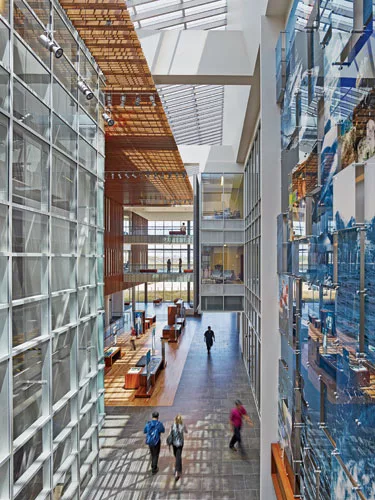
Work areas and walkways overlook the three-story central atrium, creating a sense of openness and transparency. Sun and privacy screens made of ohia wood recall Hawaiian lanais.
 
Photo © Alan Karchmer
NOAA Inouye Regional Center
Open stairways rise through communal spaces, encouraging interaction between departments.
 
Photo © Alan Karchmer
NOAA Inouye Regional Center
The diverse program includes state-of-the-art laboratories.
 
Photo © Alan Karchmer
NOAA Inouye Regional Center
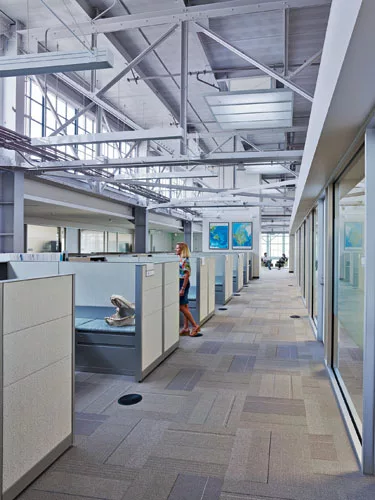
The architects reused most of the 1940s steel structure. Rooftop diffusers as well as clerestory windows bring daylight deep into the building.
 
Photo © Alan Karchmer
NOAA Inouye Regional Center
Image courtesy HOK
NOAA Inouye Regional Center
Image courtesy HOK
NOAA Inouye Regional Center
Image courtesy HOK
NOAA Inouye Regional Center
Image courtesy HOK
NOAA Inouye Regional Center
August 16, 2015

Architects & Firms

HOK

Honolulu

People/Products

The albizia saman tree—with its natural gift for self-cooling—was one of HOK's design inspirations for the Daniel K. Inouye Regional Center, the new home for the National Oceanic and Atmospheric Administration (NOAA) in Hawaii. These broad-canopied trees, which thrive near the building site on Ford Island, off Oahu's coast, capture water vapor as their leaves open and close with changing light. It's hard to imagine a better design influence for a federal agency with a focus on weather and climate.

With NOAA's mission spanning from oceans to skies, its Ford Island facility needed to bring together diverse entities—from the National Weather Service Pacific Region Headquarters and Tsunami Warning Center to national centers for environmental satellites and data, marine fisheries and sanctuaries, oceanic and atmospheric research, and others. 'But NOAA's complexity was just part of the story,' says HOK design principal Paul Woolford. 'We also needed to address the historic site and its existing structures.' Ford Island, today a National Historic Landmark at Pearl Harbor, was a sacred locus for ancient Hawaiian fertility rites before it became the U.S. Navy strategic operations base that the Japanese attacked on December 7, 1941.

The twin hangars that now anchor the Inouye Center narrowly escaped devastation as planes on the tarmac were hit and, nearby, the USS Utah was sunk. The hangars, designed by Detroit-based Albert Kahn, were completed just months before the attack and remained intact. But by 2005, when HOK began exploring ways of repurposing them for NOAA, they were derelict—with smashed windows and leaky roofs. With the airfield inactive for decades, these great sheds stood abandoned. An historic review at the project's onset, though, ensured their survival, with exteriors untouched.

NOAA had come onboard with the goal of consolidating departments, offices, and labs scattered across Oahu. Accommodating 800 employees, HOK's scheme links the historic hangars with a central entry structure, echoing the industrial aesthetic and rectilinear rhythms of the original buildings while distinguishing old from new. Now themes of ocean and air draw you into the 300,000-square-foot build-ing through the new recessed entry bay, with views straight to the water behind, where NOAA's research vessels are moored.

Critical to NOAA's mission is sustainability, and the center—on track for LEED Gold—is particularly innovative in its cooling system. Evoking the albizia samans, it draws on passive means to self-modulate temperature, humidity, and ventilation. Rooftop scoops capture prevailing trade winds, channeling them across point-chilled coils of water from geothermal undersea wells. The heavier, cooled air forms downdrafts, dropping into vertical supply chimneys, while buoyant warmer air rises to exhaust vents. When outside temperatures dip below 65 degrees, the system reverses itself, assisted by heating, instead of cooling, coils. With natural stack and venturi effects, no mechanical fans are needed, though the point-chilling does require conventionally generated energy. As condensation on the coils feeds a graywater system and the roof funnels rainfall into bioswales, no gray- or stormwater leaves the site.

Favoring native materials, HOK paved the forecourt in Hawaiian basalt, leading from a parking lot still studded with aircraft tie-downs from its days as a runway. The volcanic pavers continue into the soaring, skylit, triple-height lobby, alongside ohia, a local hardwood. This central space does double duty for gathering and exhibitions, with displays including live NOAA satellite feeds. Within the flanking hangars, HOK inserted two additional floor levels, reusing the original steel structure, with open work areas, walkways, and stairs overlooking the lobby. Ohia screens—reminiscent of Hawaiian lanais, or porches—veil the glassed-in work floors. Throughout the building, rooftop diffusers, translucent partitions, and multi-height spaces bring daylight deep inside, illuminating a vast footprint of 730 by 270 feet.

Casual communal spaces, generous circulation routes, and clear sight lines—plus an auditorium, library, airy cafeteria, and outdoor deck—foster employee collaboration. 'Geographic proximity is everything,' says site manager Steven Gallagher. 'Pantries are positioned for sharing among departments. Adjacencies lead to interaction without a trip across town.' Now marine-mammal and fisheries teams abut each other; research vessels dock near related labs; and a repurposed aircraft shed houses rehab tanks for endangered monk seals and Hawaiian sea turtles.

Though preservationists were relieved that the hangars survived, the size and prominence of the wind scoops, resembling conventional rooftop HVAC penthouses, have drawn some criticism. Nonetheless, much was saved, revived, and creatively integrated, including original hangar pocket doors, now partially drawn like massive curtains outside new double-glazed facades.

Hawaiian Senator Inouye, who was dedicated to educating children about the ocean, played a key role in realizing this $135 million project. When he died before its completion, it was named in his honor and has already fulfilled such aspirations of his as science and ocean camps for students. 'Many things are possible here that we could never do before, and this design anticipates growth,' says Gallagher. 'Now NOAA is talking about importing this model—for sustainable design, adaptive reuse, and consolidation—to all its centers.'


People

Client:  Naval Facilities Engineering Command (NAVFAC)

Owner: National Oceanic and Atmospheric Administration (NOAA)

Architect:
HOK
One Bush Street, Suite 200
San Francisco, CA 94104
T:  415-243-0555
F:  415-882-7763
hok.com

Personnel in architect's firm who should receive special credit:
Design Principal: Paul Woolford, AIA, LEED AP (registered Architect)
Project Director: Ted Davalos, AIA, LEED AP (registered Architect)
Project Designer: Brigitte Williams
Project Manager: Suk-King Yiu (registered Architect)
Project Manager:  John McGuire (registered Architect)
Project Architect:  Kyle Prenzlow, LEED AP (registered Architect)
Senior Interior Designer:  David Herron, LEED AP
Sustainability Leader: Zorana Bosnic, RIBA, LEED AP BD+C

Architect of record:  HOK

Associate architect(s):  Ferraro Choi & Associates

Principal-in-Charge: Joseph Ferraro
1240 Ala Moana Blvd., Suite 510
Honolulu, HI 96814
T:  808-540-0800
ferrarochoi.com

Interior designer:  HOK

Engineers
Structural: SOHA Engineers
M/E/P: WSP Flack + Kurtz
Civil:  Kennedy Jenks
Geotechnical: Kleinfelder & Geolabs, Inc.
Fire Protection: S.S. Dannaway Associates

Consultant(s):
Landscape: Ki Concepts, LLC

Lighting: HOK

Sustainability: Brightworks Sustainability

Acoustical: Shen Milsom Wilke

Other:
Commissioning: Glumac
Telecommunications/A-V: Shen Milsom Wilke
Food Service: George Matsumoto Associates
Vertical Transportation: Syska Hennessy Group
Exhibit Design: Downstream
Cost Estimating: Davis Langdon
Code Consulting: Rolf Jensen & Associates

General contractor: Walsh Construction

Photographer(s):
Alan Karchmer Architectural Photographer
202-244-7511

Size:

300,000 square feet

Construction cost:

$135 million

Completion date:

January 2014


Products

Structural system
Steel frame, steel trusses, concrete shear walls and steel brace frames.

Exterior cladding
Masonry: Tileco, BASF, Hawaiian Cement

Metal Panels: Metal Sales Manufacturing Corporation

Metal/glass curtain wall: PAC Glazing Solutions, Pacific Aluminum

Rainscreen: Eternit

Wood:  Ohia, Big Island Wood Products

Moisture barrier: W.R. Grace, American Hydrotech, Henrys

Curtain wall: PAC Glazing Solutions, Pacific Aluminum

Other cladding unique to this project: Cast-in-place concrete

Roofing
Built-up roofing: Johns Manville

Metal:  Metal Sales Manufacturing Corporation

Windows
Metal frame: Hope’s Windows Inc.

Glazing
Glass:  Northwestern Industries Inc., PPG

Skylights: Viracon

Insulated-panel or plastic glazing: Sunpal

Doors
Entrances: PAC Glazing Solutions, Pacific Aluminum

Metal doors: Hope’s, Ceco Door, ASSA Abloy, Security Metal Products, Eliason

Wood doors: VT Industries

Fire-control doors, security grilles: Raynor

Hardware
Locksets: RR Brink Locking Systems Inc., Schlage, Yale

Closers: LCN, Norton

Exit devices: DCI

Pulls: Forms + Surfaces

Interior finishes
Acoustical ceilings: Armstrong, Ceilings plus, Geometrik

Suspension grid: Armstrong

Cabinetwork and custom woodwork: Concept Millwork

Paints and stains: PPG

Wall coverings: Carnegie/Xorel

Paneling: Geometrik, Wall Technology

Plastic laminate: Nevamar

Solid surfacing: Thermo Scientific Epoxyn Products, Ceasarstone, Dupon Zodiaqt

Floor and wall tile:  Daltile- core and kitchen, Crossville- core, Spec Ceramics- basalt stone in lobby and public spaces.

Resilient flooring: Burke Flooring, Armstrong

Carpet: Bentley, Tandus

Raised flooring: Tate

Special interior finishes unique to this project: 3-Form

Furnishings
Office furniture: HBF, Keilhauer, Global Industries, Harter, Herman Miller, Knoll, Bernhardt, Versa, Montis, Vitra, Geiger, Brayton International, SafCo, Great Openings, Metro, Bretford, Mecalux

Fixed seating: American Seating Company

Upholstery: Spinney Beck, Momentum, Arc Com, Pallas, Sina Parson, Carnegie

Lighting
Interior ambient lighting: Gammalux, Prudential, Winona, HE Williams, California Accent Lighting, Selux,, EUTRAC, Nordic Aluminum, Litelab, Alkco, Paramount Industries, I Guzzini, Columbia Lighting, Lightalarms

Downlights: Lightolier, Gammalux

Task lighting: Gammalux

Exterior: Kim Lighting, Tokistar Lighting, Visa Lighting, Bega, Exceline, Architectural Area Lighting

Dimming System or other lighting controls: Lutron, Fisher Pierce, Philips, Watt Stopper

Conveyance
Elevators/Escalators: Schindler Elevator Corporation

Plumbing
Zurn, Acorn, Sloan, Toto, Kohler, ProFlo, Elkay, Chicago Faucets, Brasscraft, ISE, Fisher Hamilton, Advance Tabco, Just, Symmons, Florestone, Haws

Energy
Energy management or building automation system: Johnson Controls

Photovoltaic system: Solar Thermal system: Spower, Hanson Tanks, Advanced Mechanical Technologies, Tyfocor/ Sentinel

Other unique products that contribute to sustainability:
Passive Cooling Units: Innovent Air Handling Equipment

Skylight Diffusers: 3Form, Project Management Inc.

 
KEYWORDS: Hawaii

Share This Story

Looking for a reprint of this article?
From high-res PDFs to custom plaques, order your copy today!

Sarah Amelar is a Los Angeles–based contributing editor at Architectural Record.

Post a comment to this article

Report Abusive Comment

Subscription Center
  • Create an Account
  • Start a Subscription
  • Manage My Account
  • Sign Up for Newsletters
  • Visit Customer Service
  • Update Preferences

More Videos

Sponsored Content

Sponsored Content is a special paid section where industry companies provide high quality, objective, non-commercial content around topics of interest to the Architectural Record audience. All Sponsored Content is supplied by the advertising company and any opinions expressed in this article are those of the author and not necessarily reflect the views of Architectural Record or its parent company, BNP Media. Interested in participating in our Sponsored Content section? Contact your local rep!

close
  • TAMLYN XtremeTrim Exterior Trim
    Sponsored byTamlyn

    Designing Cleaner Panel Facades: Why Exterior Trim Details Matter

  • Building with Vapor Barriers
    Sponsored byReef Industries, Inc.

    Vapor Barriers Help Control Moisture in Tighter Building Designs

  • Duct Interior with Prodeq System
    Sponsored byHenry, a Carlisle Company

    Designing Resilient Water Containment Systems

DESIGN:ED Podcast
Listen to Architectural Record’s DESIGN:ED Podcast

Events

June 10, 2026

Rethinking Stormwater – The Power of Porous Paving

Credits: 1 AIA LU/HSW; 1 AIBD P-CE; 0.1 ICC CEU

Learn how porous paving systems support stormwater management, reduce heat island effects, and enhance sustainable site design performance.

June 11, 2026

Very Early Warning Fire Detection for Mission-Critical Facilities

Credits: 1 AIA LU/HSW; 1 AIBD P-CE; 0.1 ICC CEU

Examine advanced fire detection strategies that support uptime and enhance safety in data centers and other mission-critical facilities.

View All Submit An Event

Products

2026 Architect's Square Foot Costbook

2026 Architect's Square Foot Costbook

See More Products

Popular Stories

Practice Matters illustration

What’s in a (Firm’s) Name? Thinking About Succession and Legacy

Coronado Bridge

The Architect’s Guide to San Diego

Practice Matters illustration

By the Numbers: Counting America's Architects

Riverdale House by Studio Lau

Riverdale House by Studio Lau

House on a Hill

Design Vanguard 2026: Forma

Broader Sustainability of CMU - Free Webinar - May 21, 2026

Related Articles

  • Trauma & Critical Care Building, Community Regional Medical Center

    See More
  • Dixie Regional Medical Center

    See More
  • St. Mary's Hospital and Regional Medical Center, 'The Century Project'

    See More
×

The latest news and information

#1 Source for Architectural Design, News and Products

SUBSCRIBE
  • RESOURCES
    • Advertise
    • Contact Us
    • Submit
    • Store
  • ACCOUNT CENTER
    • Create an Account
    • Start a Subscription
    • Manage My Account
    • Sign Up for Newsletters
    • Visit Customer Service
    • Update Preferences
  • PRIVACY
    • PRIVACY POLICY
    • TERMS & CONDITIONS
    • DO NOT SELL MY PERSONAL INFORMATION
    • PRIVACY REQUEST
    • ACCESSIBILITY
  • SERVICES
    • Marketing Services
    • Reprints
    • Market Research
    • List Rental
    • Survey/Respondent Access
  • STAY CONNECTED
    • Linkedin
    • Facebook
    • Instagram
    • YouTube
    • X (Twitter)

Copyright ©2026. All Rights Reserved BNP Media, Inc. and BNP Media II, LLC.

Design, CMS, Hosting & Web Development :: ePublishing