Architectural Record
search
cart
facebook twitter linkedin youtube
  • Sign In
  • Subscribe
  • Sign Out
  • My Account
Architectural Record
  • NEWS
    • Latest News
    • Awards
    • Interviews
    • Obituaries
    • Podcasts
      • Design:Ed Podcast
      • Sponsored Podcasts
  • OPINION
    • Book Reviews / Excerpts
    • Exhibition Reviews
    • Forum
  • EXCLUSIVES
    • Videos
    • Design Vanguard
    • Top 300 Firms
    • Sponsored Content
    • Sponsored eBooks
    • From the Archives
  • CONTINUING ED
    • Editorial Continuing Ed
    • CE Center
    • CE Academies
  • PROJECTS
    • Buildings By Type
    • Reuse & Renovation
    • Museums & Arts Centers
    • Colleges & Universities
    • Multifamily Housing
    • Interiors
    • Lighting
    • Kitchen & Bath
  • HOUSES
    • Record Houses
    • House of the Month
    • Featured Houses
  • PRODUCTS
    • Products by Category
    • Record Products of the Year
    • Latest Products
  • EVENTS
    • Dates & Events
    • Record on the Road
    • Innovation Conference
    • Sustainability in Practice
    • Women In Architecture
    • Webinars
    • Ad Excellence Awards
    • Submit an Event
  • CONNECT
    • Ask RECORD AI
    • Newsletters
    • Contact
    • Advertise
    • Editorial Calendar
    • Store
    • Customer Service
  • SUBMIT
    • Submission Guidelines
    • RECORD Competitions
  • MAGAZINE
    • Subscribe
    • My Account
    • Digital Edition
    • Current Issue
    • Firm Pass
    • Historic Archive
ProjectsBuildings by TypeCivic Architecture

Anaheim Regional Transportation Intermodal Center

Transportation Bubble: HOK's Anaheim Regional Transportation Intermodal Center (ARTIC) launches the automobile-centric Southern California city into a new age of public transportation.

By Russell Fortmeyer
Anaheim Regional Transportation Intermodal Center
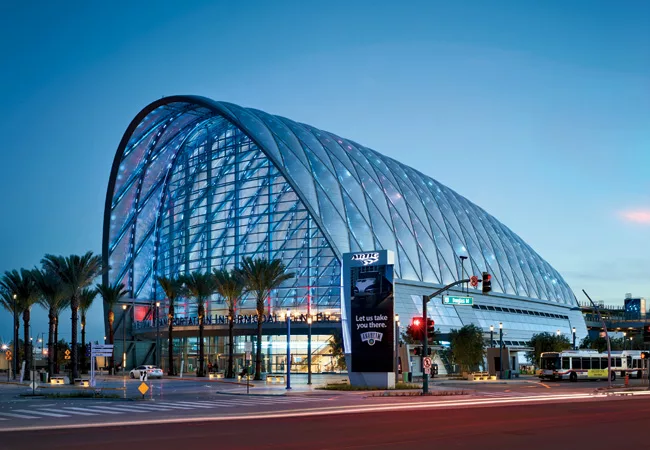
Anaheim’s new transit hub greets travelers with a soaring, light-filled building designed for Amtrak service, regional and local trains and buses, and potential high-speed rail.
 
Photo © John Linden
Anaheim Regional Transportation Intermodal Center
Anaheim’s new transit hub greets travelers with a soaring, light-filled building designed for Amtrak service, regional and local trains and buses, and potential high-speed rail.
 
Photo © John Linden
Anaheim Regional Transportation Intermodal Center
The textural vault-shaped structure maintains a dynamic transparency during evening hours as LEDs mounted on the interior diagrid framework illuminate the ETFE pillows in lively gradations of shifting hues.
 
Photo © John Linden
Anaheim Regional Transportation Intermodal Center
Centrally located stairs and escalators carry passengers and visitors to a second-level restaurant area and third-floor mezzanine, where they will find waiting rooms and a covered bridge to the train platforms. Overhead, the building’s structure is revealed, appearing like a space-age version of a Gothic cathedral’s ribbed vaults.
 
Photo © John Linden
Anaheim Regional Transportation Intermodal Center
Image courtesy HOK
Anaheim Regional Transportation Intermodal Center
Image courtesy HOK
Anaheim Regional Transportation Intermodal Center
Image courtesy HOK
Anaheim Regional Transportation Intermodal Center
March 16, 2015

Architects & Firms

HOK

Anaheim, California

Video

People/Products

When the City of Anaheim launched a design competition in 2009 for a new transit hub, city leaders wanted an iconic structure. In the Southern California home of Disneyland, itself a celebration of mobility and fantasy, the Anaheim Regional Transportation Intermodal Center, or ARTIC, is a soaring, optimistic expression of the potential for public transportation in this capital of car culture.

Designed by the Los Angeles office of HOK, the 67,000-square-foot ARTIC formally opened to the public in December. With an ethylene tetrafluoroethylene (ETFE) cladding around a steel shell, the exuberant form of the ARTIC fits in with such nearby megastructures as Angel Stadium, home of the Los Angeles Angels baseball team—with an oversized structural 'A' signpost planted amid a sea of parking—and the squat, multiuse Honda Center arena. But in terms of design, it is in a class by itself.

Though the ARTIC now serves passengers of the region's Amtrak and Metrolink trains, as well as local and regional bus lines, it will also accommodate the long-intended but still unpredictable plan to bring high-speed rail through California. “One of the key tenets of transportation architecture is that you have commuters using the building regularly, but also people who will pass through it only once,” says Ernest Cirangle, FAIA, the Los Angeles'based design principal. “The building needs to be very clear, intuitive, and simple in terms of the flow of people.”

That flow of people comes from all sides of the building. On the north, a parking lot transitions into a shared pedestrian and driveway space leading to the main entrance, a 120-foot-tall cable-hung glass curtain wall that allows views both into the main public hall of the center and, once inside, views north to the San Bernardino Mountains. Tapered, vertical box-section steel girts on the inside wall support the glass with custom armatures, resisting lateral loads like wind, while the tensioned-cable system supports the dead loads of the glass. A similar system supports the south facade's glazed curtain wall. Both curtain walls feature glass louvers for mixed-mode ventilation, part of the environmental strategy the design team is counting on to achieve a LEED Platinum target.

On the ground floor, ticket booths and a convenience store form the backdrop for casual tables and chairs scattered across the terrazzo floor. Doors on the east and west provide access to bus stops on either side. Escalators in the center lead to a second level that will eventually feature full-service restaurants. Another set of escalators takes visitors to the third level, or mezzanine, which features small waiting rooms. From there, passengers can walk outside across a covered bridge to the train platforms. The soaring shell structure provides the space, daylight, and views to the outside that allow for clarity and continuous wayfinding.

Only on the underside of the shell does the glistening form of the building start to reveal its construction, as the steel tube arches organized in a diagrid pattern appear like a space-age version of the ribbed vaults in a Gothic cathedral. The steel girts at the curtain walls also stiffen the arches, acting somewhat like spokes on a bicycle wheel to prevent the arches from deforming.

Inspired by great transit halls of the past as well as the historic hangars for dirigibles found throughout Southern California, ARTIC takes its form from a catenary arch rotated to form a torus and then cut. Bruce Gibbons, the building's structural engineer and managing principal of Thornton Tomasetti's Los Angeles office, investigated several technical solutions for the building to find the most efficient, simplest shape. “It's like a doughnut with a catenary section. Then we took a small bite out of it and that resulted in the pure shell,” Gibbons says. Buttresses concealed in metal cladding connect the shell to the ground. A combination of shop and field welds connect the individual steel members forming the arches.

The integration of the facade structure and the arch structure emerged from Gibbons's early involvement in the competition phase. At that time, the design team quickly settled on the use of ETFE as the main enclosure system for the shell due to the benefits of the material's light weight and daylighting characteristics. The ETFE pillows forming the envelope consist of three layers, with an approximate 75 percent frit on the outer layer and then two constantly pressurized internal cavities created on either side of the middle layer. Kurt Komraus, the facade consultant for the project and an associate at the Los Angeles office of Buro Happold, detailed the envelope from the model drawings and performance criteria Thornton Tomasetti had developed through the design development phase. “Distilling the software model geometry down to 9,000 data points gave the whole team a common language for locating our systems,” says Komraus.

The ARTIC's ETFE pillows take complex forms to match the arch's curves. Each pillow is sized differently, with slightly smaller bottom layers to prevent puckering under tension. Rectangular steel “stools” welded to the top of the arch's tubular members provide the platform for a two-layer aluminum extrusion for clamping the edges of each pillow, while also forming a stormwater gutter system on the exterior.

Although it's not the first project to use an ETFE cladding system in Southern California, the sleek, comfortable quality of the great hall has become its own tourist attraction. The City even touts it on billboards around area freeways. It's not uncommon to see a family of bicyclists make a detour from the public path along the adjacent Santa Ana River to check out the building and find that, unlike the area's other attractions, it's free to enter.

Three videos produced by the City of Anaheim discuss the structure, skin, and occupant comfort strategies for the new Anaheim Regional Transportation Intermodal Center (ARTIC).


People

Formal name of building:
Anaheim Regional Transportation Intermodal Center (ARTIC)

Location:
Anaheim, CA

Completion Date:
12/2014

Gross square footage:
67,000 sf

Total project cost:
$185 M

Total construction cost:
$132 M

Owner:
City of Anaheim

Architect:
HOK
9530 Jefferson Blvd.
Culver City, CA 90232
(t) 310-838-9555
(f) 310-838-9586

Personnel in architect's firm who should receive special credit:
Ernest Cirangle, FAIA, RA, LEED® BD+C Design Principal
Albert Kaneshiro, AIA, RA, LEED® BD+C Project Manager
Kazem Toossi, AIA, RA, LEED® GA Project Architect

Team
Hector Ayala, Edith Bailon, Erika Casillas, Ed Diamante, Jessica Ginther, Carl Johnson, Erik Jones, Stephanie Kotowski, Terry Mattison, Pearl McLin, Barbara Ostroff, Aneirin Owens, Dave Salela, KwangHyun Song, Aida Staugaard, Suren Sumian, Silvia Trigueros, Jamila Valero

Interior designer:
HOK

Engineers:
Rail and Civil Engineer: Parsons Brinckerhoff
Structural Engineer: Thornton Tomasetti
Enclosure Engineer: BuroHappold Engineering
MEP: BuroHappold Engineering

Consultant(s):
Landscape: SWA
Lighting: HLB
Acoustical: Newson Brown
Wayfinding: Selbert Perkins Design

Construction Manager:
STV

General contractor:
Clark Construction Group

Photographer(s):
Photo: John Linden
818-888-8544

Size:

67,000 square feet

Project Cost:

$185 million

Construction Cost:

$132 million


Products

Structural system
Steel Frame
Manufacturer of any structural components unique to this project: Beck Steel

Exterior cladding
Metal Panels: Woodbridge Glass, Werner Systems and Centria.
Metal/glass curtain wall: Wausau, Viracon
Precast concrete: Structure Cast
Moisture barrier: Tremco
Curtain wall: Wausau, Viracon
Other cladding unique to this project: Kalzip

Roofing
Built-up roofing: Sarnafil
Metal: Kalzip
Other: ETFE (Ethylene Tetrafluoroethylene); manufactured and installed by Vector Foiltec

Windows
Metal frame: Western Integrated Materials, Inc.

Glazing
Glass: Viracon

Doors
Entrances: Stanley
Metal doors: Security Metal Products Corp.
Wood doors: VT Industries
Sliding doors: Hufcor
Fire-control doors, security grilles: The Cookson Co.
Upswinging doors, other: Sectional roll-up doors by Raynor; Overhead Coiling Doors by The Cookson Co.

Hardware
Locksets: Schlage
Closers: LCN, Dorma
Exit devices: Von Duprin, C.R. Laurence Co.
Pulls: C.R. Laurence Co.

Interior finishes
Acoustical ceilings: Ceilings Plus, Certainteed
Suspension grid: Certainteed
Cabinetwork and custom woodwork: Day Star
Paints and stains: Sherwin Willams, Scuffmaster, Tnemec (Steel Coating)
Wall coverings: MARLITE (FRP), Wall Technology / Carnegie (Fabric Wrapped Panels), Korogaurd (Wall Protection)
Paneling: Wall Panel System, Forms & Surface (Glass Insert), Gentas (Phenolic Panel Insert)
Plastic laminate: Pionite, Formica
Solid surfacing: Cambria Quartz
Special surfacing: Terroxy (Epoxy Terrazzo Flooring)
Floor and wall tile: American Olean (Support Space Restroom Floor & Walls), RBC Tile & Stone (Mosaic Glass Wall Tile ' Public Restroom Walls), Crossville (Wall Tile ' Public Restroom Walls)
Resilient flooring: DEX-O-TEX, ARMSTRONG
Carpet: Mannington Commercial
Special interior finishes unique to this project: Roller Window Shades: Hunter Douglas

Furnishings
Office furniture: Owner Supplied
Reception furniture: Day Star (Custom Millwork)
Fixed seating: Forms and Surfaces
Chairs: Grand Rapids
Tables: Forms and Surfaces
Other furniture:
Laptop Stations: Herman Miller
Metal Lockers: ASI Storage Solutions
Recycle Bins: Forms and Surfaces

Lighting
Interior ambient lighting: Insight Lighting, IO lighting, Neoray
Downlights: IO lighting, luxor
Exterior: Birthwood Lighting, Lumec, Winona Lighting, USAI, SeLux, Hess, Philips Gardco
Dimming System or other lighting controls: Acuity Brands Co.

Conveyance
Elevators/Escalators: Tompkins / Mid-Amarican Elevator Co.
Accessibility provision: Dock Lift by Kelley

Plumbing
Ferguson, Elkay, Kohler, Watts, Sloan, Kingston, Florestone, Chicago Faucets

Energy
Energy management or building automation system: Climatec Building Technologies Group, Acuity Brands Co.
Photovoltaic system: Installed by Baker mfg : Sharp, power-one, Bentek Solar

 
KEYWORDS: California

Share This Story

Looking for a reprint of this article?
From high-res PDFs to custom plaques, order your copy today!

Russell fortmeyer
Russell Fortmeyer, a contributing editor to RECORD, is a Los Angeles-based sustainability principal at Arup and adjunct professor at the University of Southern California School of Architecture.

Post a comment to this article

Report Abusive Comment

Subscription Center
  • Create an Account
  • Start a Subscription
  • Manage My Account
  • Sign Up for Newsletters
  • Visit Customer Service
  • Update Preferences

More Videos

Sponsored Content

Sponsored Content is a special paid section where industry companies provide high quality, objective, non-commercial content around topics of interest to the Architectural Record audience. All Sponsored Content is supplied by the advertising company and any opinions expressed in this article are those of the author and not necessarily reflect the views of Architectural Record or its parent company, BNP Media. Interested in participating in our Sponsored Content section? Contact your local rep!

close
  • TAMLYN XtremeTrim Exterior Trim
    Sponsored byTamlyn

    Designing Cleaner Panel Facades: Why Exterior Trim Details Matter

  • Building with Vapor Barriers
    Sponsored byReef Industries, Inc.

    Vapor Barriers Help Control Moisture in Tighter Building Designs

  • Duct Interior with Prodeq System
    Sponsored byHenry, a Carlisle Company

    Designing Resilient Water Containment Systems

DESIGN:ED Podcast
Listen to Architectural Record’s DESIGN:ED Podcast

Events

June 10, 2026

Rethinking Stormwater – The Power of Porous Paving

Credits: 1 AIA LU/HSW; 1 AIBD P-CE; 0.1 ICC CEU

Learn how porous paving systems support stormwater management, reduce heat island effects, and enhance sustainable site design performance.

June 11, 2026

Very Early Warning Fire Detection for Mission-Critical Facilities

Credits: 1 AIA LU/HSW; 1 AIBD P-CE; 0.1 ICC CEU

Examine advanced fire detection strategies that support uptime and enhance safety in data centers and other mission-critical facilities.

View All Submit An Event

Products

2026 Architect's Square Foot Costbook

2026 Architect's Square Foot Costbook

See More Products

Popular Stories

Practice Matters illustration

What’s in a (Firm’s) Name? Thinking About Succession and Legacy

Coronado Bridge

The Architect’s Guide to San Diego

Practice Matters illustration

By the Numbers: Counting America's Architects

Riverdale House by Studio Lau

Riverdale House by Studio Lau

KRESA by DLR

In Kalamazoo, DLR Group Completes a Mass-Timber Hub for Career and Technical Education Programs

Broader Sustainability of CMU - Free Webinar - May 21, 2026

Related Articles

  • FXFOWLE and Cooper Carry-designed $1B Atlanta Intermodal Project Wins Federal Acceleration

    See More
  • NOAA Inouye Regional Center

    See More
×

The latest news and information

#1 Source for Architectural Design, News and Products

SUBSCRIBE
  • RESOURCES
    • Advertise
    • Contact Us
    • Submit
    • Store
  • ACCOUNT CENTER
    • Create an Account
    • Start a Subscription
    • Manage My Account
    • Sign Up for Newsletters
    • Visit Customer Service
    • Update Preferences
  • PRIVACY
    • PRIVACY POLICY
    • TERMS & CONDITIONS
    • DO NOT SELL MY PERSONAL INFORMATION
    • PRIVACY REQUEST
    • ACCESSIBILITY
  • SERVICES
    • Marketing Services
    • Reprints
    • Market Research
    • List Rental
    • Survey/Respondent Access
  • STAY CONNECTED
    • Linkedin
    • Facebook
    • Instagram
    • YouTube
    • X (Twitter)

Copyright ©2026. All Rights Reserved BNP Media, Inc. and BNP Media II, LLC.

Design, CMS, Hosting & Web Development :: ePublishing