Claremont University Campus Center
Screening Room: A college consolidates administration services under one warehouse's roof, gaining light and levity with a sculptural cedar skin.
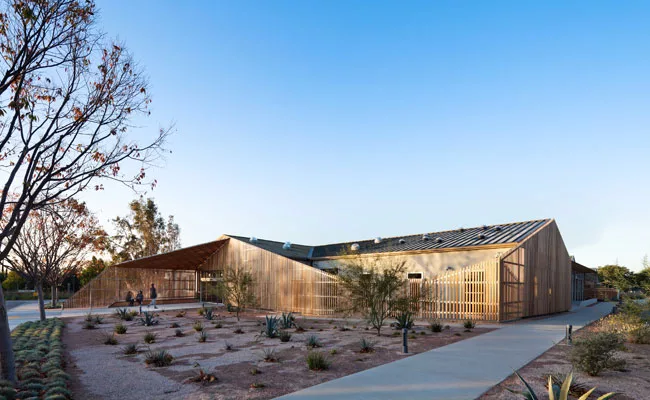
LTL adapted a maintenance building at the edge of Claremont’s campus into an administrative center. A 740-foot-long cedar screen defines the building entrance and weaves inside to frame a reception area and café.
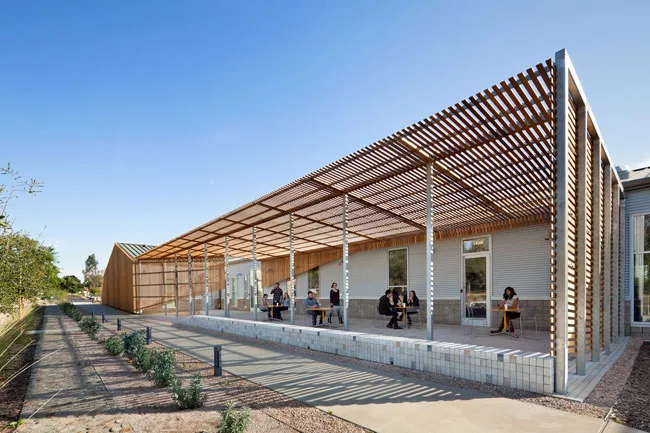
LTL adapted a maintenance building at the edge of Claremont’s campus into an administrative center. A 740-foot-long cedar screen defines the building entrance and weaves inside to frame a reception area and café.
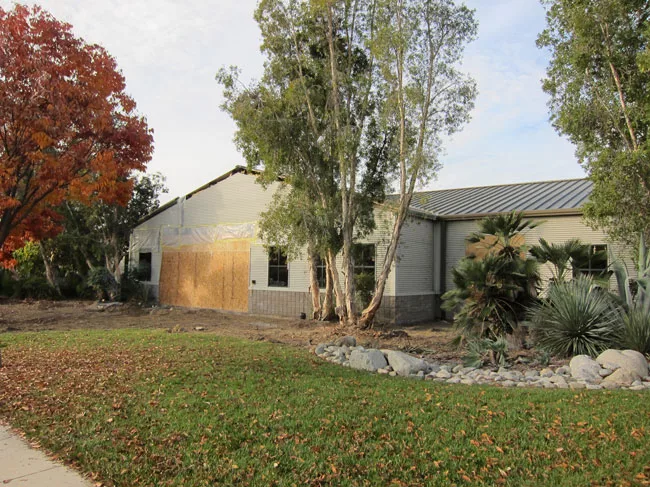
While the original 42,000-square-foot maintenance building (shown here) wasn’t particularly pleasing to the eye, reusing it was a major aspect of the sustainability strategy. The cedar screen creates a new image.
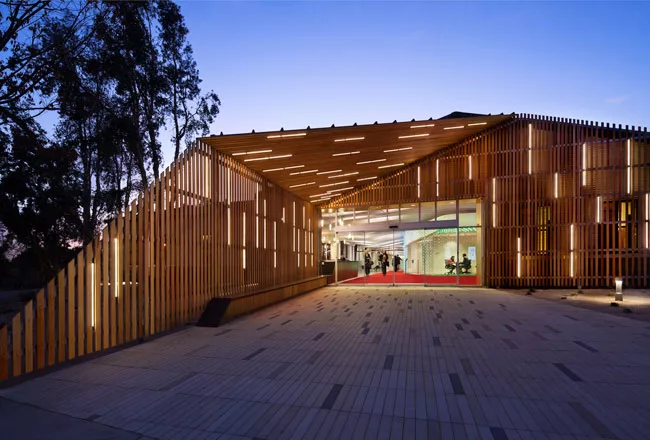
The cedar screen is embedded with LED lights, which are illuminated at night.
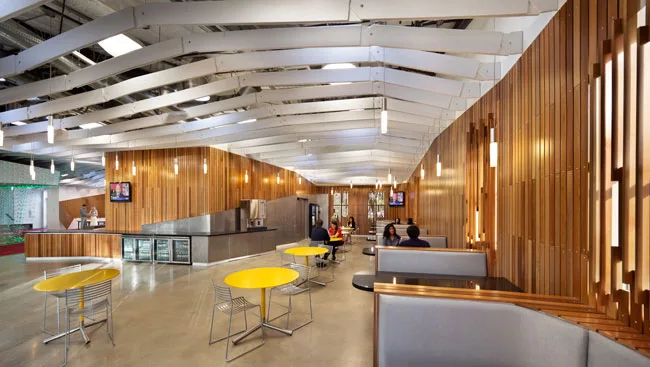
Recycled plastic baffles form a cloud ceiling throughout the building. Skylights provide natural illumination until the evening, when dimmable fluorescent lights gradually get brighter.
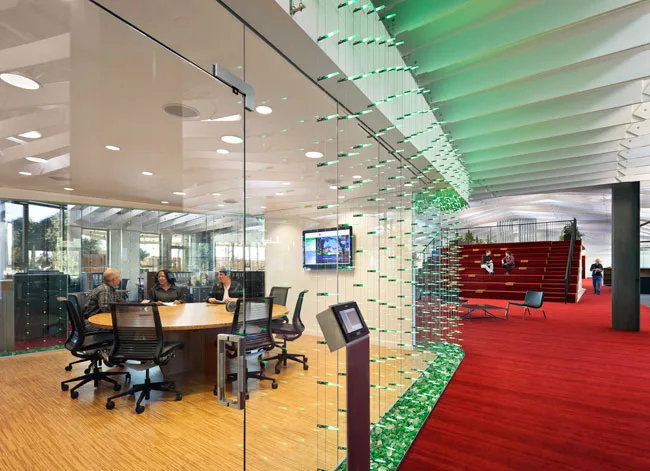
Artist Jason Krugman designed a “digital garden” made of over 6,000 motion-detecting LED modules that shift from blue to green and surround the central core.
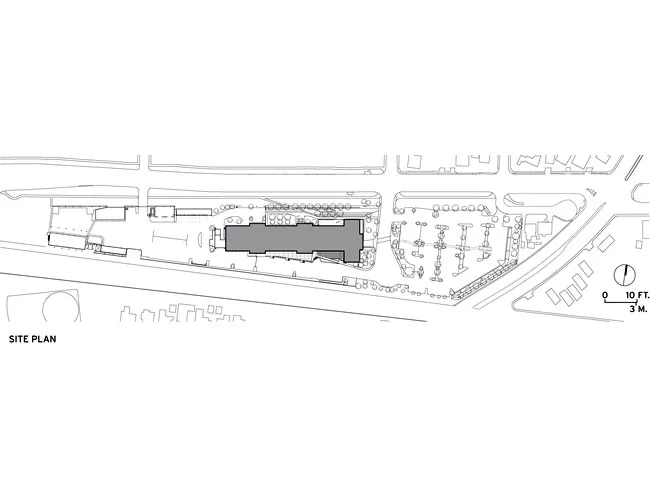
Image courtesy Lewis.Tsurumaki.Lewis Architects
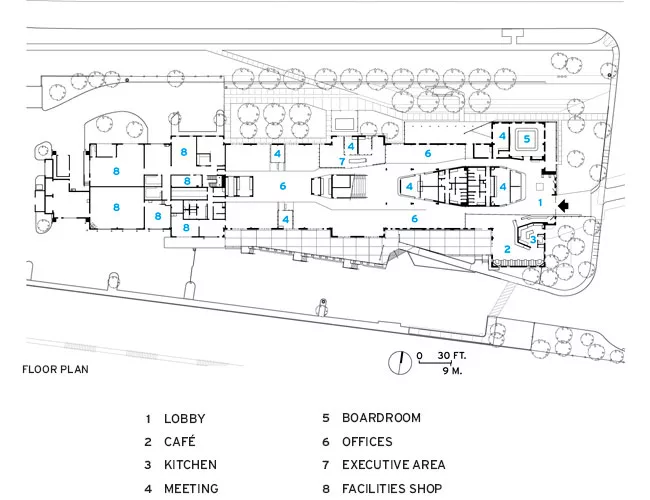
Image courtesy Lewis.Tsurumaki.Lewis Architects
Architects & Firms
Claremont, California
Founded in 1925, the Claremont Colleges occupy a connected series of leafy, low-rise campuses about 30 miles from downtown Los Angeles. It's not in the heart of this stereotypically collegiate setting but along its less handsome southern edge, near a commuter rail line and adjacent to a large surface parking lot, that the New York firm Lewis.Tsurumaki.Lewis Architects (LTL) has completed its first West Coast project.
The firm's brief was straightforward: Take the scattered offices of the Claremont University Consortium (CUC)'which is essentially the back-of-house administrative arm of the colleges, responsible for everything from payroll to campus security'and bring them together under one roof. The architects were also asked not to build a new facility from scratch but to reuse an existing steel-framed warehouse.
Only a decade old, the warehouse was no campus landmark; rather, it was an anonymous and utilitarian structure. That fact, and the building's location far from the center of campus, which is dotted with early-20th-century landmarks by Myron Hunt set into landscapes by the great Ralph Cornell, gave LTL broad leeway in reimagining the structure for its new use. Still, the budget was hardly lavish. Construction costs, according to the architects, were roughly $7.5 million, or $180 per square foot, with total costs of about $10 million.
LTL, founded in 1997 by twin brothers Paul and David Lewis and a third partner, Marc Tsurumaki, has made a specialty of such projects in the last few years. In Austin, Texas, the architects restored and expanded an 1851 brick building to house an arts center. At the University of Wyoming they took two levels of open space inside an existing college of education building and created a new student lounge.
For the CUC's 100 employees, LTL pursued a design strategy that is contextual and works against the idea of context at the same time. A ribbonlike cedar screen is the clearest sign of this attitude. It begins outside the building, wrapping a new entrance canopy and following the pitched-roof profile of the structure underneath. It then slips inside the building to frame an information desk and caf' before heading back outside to cover more of the exterior and a large patio facing south.
The screen, embedded with vertical LED lights, is a flexible rather than monolithic skin. Its slats are spaced more widely apart wherever it runs past a window, to allow more light to penetrate. Elsewhere it moves away from the building to form new pockets of contained outdoor space.
The inside of the building trades the crisp, sure forms of the exterior for a brighter and busier aesthetic. Near the main entrance, suspended in front of some glass-walled conference rooms, is a green LED light sculpture by Brooklyn-based artist Jason Krugman. A red carpet runs through the whole space, rising to cover a set of bleacherlike stairs in the middle of the building that provides a gathering place for large meetings and casual gatherings. A small kitchen is tucked away underneath.
In the same way that the cedar screen outside both traces and cloaks the shell of the older building, an undulating suspended ceiling hides and exposes the ductwork overhead. Made of hundreds of small baffles wrapped in recycled white felt, it gives the interior of the building a spatial complexity that the original warehouse likely never had. More than 150 cylindrical skylights bring enough sunlight into the space to make artificial lighting unnecessary on clear days.
There is a long history in Southern California of talented young architects using warehouse conversions as vehicles for architectural experimentation. Frank Gehry, Eric Owen Moss, and Morphosis all used such projects in the 1980s as manifestos for a freewheeling but economical new style.
The goal at Claremont was less about aggressive form-making than material richness'almost to the point of gluttony'and competing pattern. LTL has skinned the interiors three very different ways: the floor with its red carpet; the walls with the cedar screen; and the ceiling with the white baffles. Each dimension is an aggregation and exploration of a single material.
Set against the design's obvious interest in economy and frankness, this boldness of color and pattern creates a pleasing architectural dissonance. Call it raucous pragmatism.
Christopher Hawthorne is the architecture critic of the Los Angeles Times and the coauthor, with Alanna Stang, of The Green House: New Directions in Sustainable Architecture (Princeton Architectural Press, 2010).
Location: Claremont, California
Completion Date: August 2011
Gross square footage: 41,050 sq. ft.
Cost: $8 million
People
Owner:
Architect:
Personnel in architect's firm who should receive special credit:
Engineer(s):
Consultant(s): Lighting: Lumen Architecture
Photographer(s): |
ProductsSkylights: Solatube Workstations: Plyboo Lighting: Lutron |
Looking for a reprint of this article?
From high-res PDFs to custom plaques, order your copy today!