Architectural Record
search
cart
facebook twitter linkedin youtube
  • Sign In
  • Subscribe
  • Sign Out
  • My Account
Architectural Record
  • NEWS
    • Latest News
    • Awards
    • Interviews
    • Obituaries
    • Podcasts
      • Design:Ed Podcast
      • Sponsored Podcasts
  • OPINION
    • Book Reviews / Excerpts
    • Exhibition Reviews
    • Forum
  • EXCLUSIVES
    • Videos
    • Design Vanguard
    • Top 300 Firms
    • Sponsored Content
    • Sponsored eBooks
    • From the Archives
  • CONTINUING ED
    • Editorial Continuing Ed
    • CE Center
    • CE Academies
  • PROJECTS
    • Buildings By Type
    • Reuse & Renovation
    • Museums & Arts Centers
    • Colleges & Universities
    • Multifamily Housing
    • Interiors
    • Lighting
    • Kitchen & Bath
  • HOUSES
    • Record Houses
    • House of the Month
    • Featured Houses
  • PRODUCTS
    • Products by Category
    • Record Products of the Year
    • Latest Products
  • EVENTS
    • Dates & Events
    • Record on the Road
    • Innovation Conference
    • Sustainability in Practice
    • Women In Architecture
    • Webinars
    • Ad Excellence Awards
    • Submit an Event
  • CONNECT
    • Ask RECORD AI
    • Newsletters
    • Contact
    • Advertise
    • Editorial Calendar
    • Store
    • Customer Service
  • SUBMIT
    • Submission Guidelines
    • RECORD Competitions
  • MAGAZINE
    • Subscribe
    • My Account
    • Digital Edition
    • Current Issue
    • Firm Pass
    • Historic Archive
ProjectsBuildings by TypeMuseums & Art Centers

Archaeology Museum of Álava

By David Cohn
The courtyard entrance to the museum is shared with that of the Fournier Museum of Playing Cards, housed in the renovated 16th-century Bendana Palace.
Archaeology Museum of Álava
Mangado and Associates
Vitoria, Spain
The courtyard entrance to the museum is shared with that of the Fournier Museum of Playing Cards, housed in the renovated 16th-century Bendaña Palace.
Photo © Roland Halbe
Windows reflecting the cityscape have deep reveals punched in the bronze-clad surface of the museum's concrete-and-steel structure.
Archaeology Museum of Álava
Mangado and Associates
Vitoria, Spain
Windows reflecting the cityscape have deep reveals punched in the bronze-clad surface of the museum's concrete-and-steel structure.
Photo © Roland Halbe
The Archaeological Museum of 'lava is embedded within the medieval core of Vitoria. Francisco Mangado conceived the 64,583-square-foot space as a bronze-clad 'coffer' for archaeological treasures. Gal
Archaeology Museum of Álava
Mangado and Associates
Vitoria, Spain
The Archaeological Museum of 'lava is embedded within the medieval core of Vitoria. Francisco Mangado conceived the 64,583-square-foot space as a bronze-clad 'coffer' for archaeological treasures. Galleries receive daylight through the vertical glass shafts puncturing the roof.
Photo © Roland Halbe
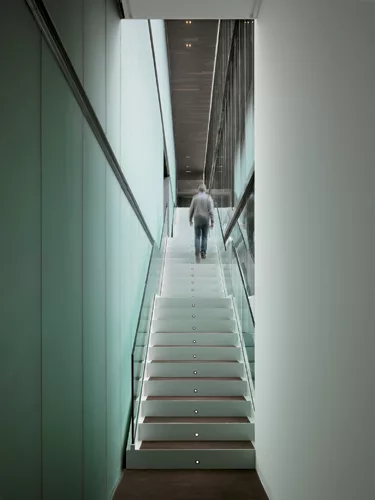
The main entrance from the courtyard provides glimpses of the cascading stair along the west elevation. Glass planks admit light to the research areas below.
Archaeology Museum of Álava
Mangado and Associates
Vitoria, Spain
The main entrance from the courtyard provides glimpses of the cascading stair along the west elevation. Glass planks admit light to the research areas below.
Photo © Roland Halbe
The jagged wing of the museum shapes the space at the entrance court to make the approach more intimate.
Archaeology Museum of Álava
Mangado and Associates
Vitoria, Spain
The jagged wing of the museum shapes the space at the entrance court to make the approach more intimate.
Photo © Roland Halbe
The major stair rises across the glazed court elevation, while a translucent and mirrored-glass wall separates the stair from the galleries.
Archaeology Museum of Álava
Mangado and Associates
Vitoria, Spain
The major stair rises across the glazed court elevation, while a translucent and mirrored-glass wall separates the stair from the galleries.
Photo © Roland Halbe
Mangado has inserted five glazed light shafts that project like periscopes above the roof and descend through three levels of the galleries.
Archaeology Museum of Álava
Mangado and Associates
Vitoria, Spain
Mangado has inserted five glazed light shafts that project like periscopes above the roof and descend through three levels of the galleries.
Photo © Roland Halbe
The light shafts provide luminescent backdrops for the archaeological contents of the museum, further dramatized by the dark wenge wood floors and ceilings.
Archaeology Museum of Álava
Mangado and Associates
Vitoria, Spain
The light shafts provide luminescent backdrops for the archaeological contents of the museum, further dramatized by the dark wenge wood floors and ceilings.
Photo © Roland Halbe
Archaeology Museum of Alava
Archaeology Museum of Álava
Mangado and Associates
Vitoria, Spain
Image courtesy Mangado and Associates
Archaeology Museum of Alava
Archaeology Museum of Álava
Mangado and Associates
Vitoria, Spain
Image courtesy Mangado and Associates
Archaeology Museum of Alava
Archaeology Museum of Álava
Mangado and Associates
Vitoria, Spain
Image courtesy Mangado and Associates
Archaeology Museum of Alava
Archaeology Museum of Álava
Mangado and Associates
Vitoria, Spain
Image courtesy Mangado and Associates
Archaeology Museum of Alava
Archaeology Museum of Álava
Mangado and Associates
Vitoria, Spain
Image courtesy Mangado and Associates
Archaeology Museum of Alava
Archaeology Museum of Álava
Mangado and Associates
Vitoria, Spain
Image courtesy Mangado and Associates
Archaeology Museum of Alava
Archaeology Museum of Álava
Mangado and Associates
Vitoria, Spain
Image courtesy Mangado and Associates
The courtyard entrance to the museum is shared with that of the Fournier Museum of Playing Cards, housed in the renovated 16th-century Bendana Palace.
Windows reflecting the cityscape have deep reveals punched in the bronze-clad surface of the museum's concrete-and-steel structure.
The Archaeological Museum of 'lava is embedded within the medieval core of Vitoria. Francisco Mangado conceived the 64,583-square-foot space as a bronze-clad 'coffer' for archaeological treasures. Gal
The main entrance from the courtyard provides glimpses of the cascading stair along the west elevation. Glass planks admit light to the research areas below.
The jagged wing of the museum shapes the space at the entrance court to make the approach more intimate.
The major stair rises across the glazed court elevation, while a translucent and mirrored-glass wall separates the stair from the galleries.
Mangado has inserted five glazed light shafts that project like periscopes above the roof and descend through three levels of the galleries.
The light shafts provide luminescent backdrops for the archaeological contents of the museum, further dramatized by the dark wenge wood floors and ceilings.
Archaeology Museum of Alava
July 16, 2011

Architects & Firms

Mangado and Associates

Vitoria, Spain

Francisco “Patxi” Mangado, the 54-year-old Spanish architect, compares his bronze-clad Archaeological Museum of Álava in Vitoria, Spain, to a “coffer guarding a treasure.” He has developed this apparently simple conceit at a number of different levels in the work, so that it acquires a sensual resonance that reaches beyond words to convey his poetic intent.

The “coffer” is composed of three gallery levels housing the permanent collection, with floors, walls, and ceilings finished in dark wenge wood. Five narrow glass shafts bring in daylight, descending from the roof to pierce all three floors at different angles. The galleries, featuring regional relics from prehistoric times to the Middle Ages, evoke an unexplored archaeological site, an underground mine, or a sunken ship. As visitors wander among the translucent shafts, spotlights tripped by movement sensors illuminate objects and vitrines. “The interior couldn’t simply be a well-organized space or a handsome play of forms,” Mangado explains. “It had to be capable of suggesting places and people with, say, a small fragment of clay that speaks to us of fragility and time.”

The architect uses the contrast between the building’s bronze and glass skin and its setting within Vitoria’s medieval core to further develop his evocation of archaeological layering. A quiet city of 230,000, Vitoria is the capital of the Basque region, with a rich history dating back to the sixth century AD. The museum, a mixed concrete-and-steel-frame structure, is part of an ongoing effort by local authorities to rehabilitate the medieval center, which has been in decline through most of the 20th century. Located on one of its livelier streets lined with bars, old shops, and a few monumental buildings, the museum adjoins the 16th-century Bendaña Palace. In 1994 the palace was renovated to house the Fournier Museum of Playing Cards as the town’s homage to a well-known local industry. The two museums now share a common entry court.

The Archaeological Museum stands out in a respectful yet contemporary manner in the stone-and-brick neighborhood. The vertical vanes of bronze convey solidity and depth despite the fact that the cladding is a nonstructural skin. The luxurious industrial material subtly harks back to the ancient civilizations of the Bronze Age, while the patina that bronze acquires through the years offers yet another mark of time.

This skin is not uniform. The two sides of the entry court — the main facade and a side wing that houses temporary exhibitions and offices — are sheathed in a glass curtain wall, luminous and open in contrast to the bronze-clad walls facing the surrounding streets. The burnished coffer seems to glow from within, particularly when approached from the entry courtyard. Here visitors see an interior stair with clear glass balustrades that floats up past the three gallery levels. The wall between the stair and the galleries is finished in translucent glass backed by mirrored glass so that the core appears to be a void of light held within a bronze cage. 

On the two sides of the building facing back streets, the skin presents a virtually closed surface of bronze vanes (designed in part for their resistance to graffiti). Large windows deeply set in handsome cedar surrounds puncture the bronze; the thick exterior walls contain interior display cases. Inside the galleries, these windows, boring through the walls, offer a counterpoint to the vertical light shafts. The windows frame surprisingly intimate glimpses of rundown buildings across the narrow streets of the old neighborhood.

Mangado’s mastery of spatial organization reveals itself in other details, such as the light trench that separates the entry from the court. It brings light into the underground research library, and is spanned, like a castle moat, by a wood-paved entry bridge. The irregular jogs of the side wing help modulate the spatial experience of entering the building from the street.

Based in nearby Pamplona, Patxi Mangado has achieved prominence in Spain for civic works such as his Baluarte Auditorium and Congress Center in his native city [record, March 2005, page 78] or his Spanish Pavilion at the Expo Zaragosa of 2008. Like his other projects, the Archaeological Museum exemplifies Mangado’s identification with the Modern movement that many Spanish architects have maintained with great vitality over the last few decades. In all of his work Mangado upholds the ideals of a functional layout and structural logic of 20th-century masters, and applies them to expressive ends chiefly through the sensual qualities of the materials he chooses and his manipulation of volumes in space.

David Cohn, who received his M.Arch. from Columbia University, is a Madrid-based correspondent for RECORD.

Total construction cost: €9 million

Architect:
Mangado y Asociados
Vuelta del Castillo, 5, Ático
31007 Pamplona (Navarra)
Spain
Phone: +34 948 276202
Fax: +34 948 176505

People

Owner
Diputación Foral de Álava (Provincial Government of Álava)

Architect
Mangado y Asociados
Vuelta del Castillo, 5, Ático
31007 Pamplona (Navarra)
Spain
Phone: +34 948 276202
Fax: +34 948 176505

Personnel in architect's firm who should receive special credit:
Architects and work direction: Francisco Mangado

Collaborators (architecture): Jose Gastaldo, Richard Král’ovič, Eduardo Pérez de Arenaza

Engineer(s)
Structural engineering: NB 35 SL Ingenieros

Mechanical engineering: Iturralde y Sagüés Ingenieros / César Martín

Quantity surveyor: Laura Montoya López de Heredia

Consultant(s)
Museography and Exhibition Assembly: Empty

General contractor: UTE Arqueología (Dragados SA, Lagunketa SA)

Photographer(s)
Roland Halbe
www.rolandhalbe.com
contact@rolandhalbe.de
phone: +49 711 6074073
fax: +49 711 6074178

Pedro Pegenaute
www.pedropegenaute.es
estudio@pedropegenaute.es
phone     +34 660 683 447

CAD system, project management, or other software used:
AUTOCAD


Products

Structural system
Metal structure: Goros, Talleres La Casilla

Concrete structures and formworks: Estructuras de hormigón Onarri SL

Post-tensioned elements: CTT Stronghold SA

Exterior cladding
Masonry: Iberdouro

Bronze panels on façade: Dragados and Lagunketa, Connectic

Supplier of bronze: KME Locsa

Metal: Goros

Bronze cladding: Connectic

Glass: Etxeglass

Wood: Tarimas y parquets Gamiz SA

EIFS, ACM, or other:Gabiria

Moisture barrier: Alimco

Roofing
Built-up roofing:Pavimentos de Tudela

Windows
Wood frame: Tarimas y Parquets Gamiz S.A.

Metal frame: Inoxfelgon

Glazing
Glass: Etxeglass, Secrisa

Doors
Metal doors: Lama

Wood doors:Gamiz

Sliding doors: Dorma

Fire doors: Noratek, VTL

Sliding doors: Dorma

Extension jamb kits: Oca Industrial

Hardware
Locksets: Lama

Exit devices:SVC

Security devices: SVC, Tecdoa

Other special hardware: Domotic control: Tecdoa

Interior finishes
Partitions: Fejeme Norte, Aisnor

False ceilings: Fejeme Norte, Aisnor

Wall coverings: Wood: Tarimas y Parquets Gamiz S.A.

Paneling: Tatec

Floor and wall tile: Resins in flooring: Oca Industrial SA

Furnishings
Office furniture: Urretabizkaia, Ofita, Kemen Haworth

Reception furniture: Mobaux

Fixed seating: Dynamobel

Other furniture:
Wings of exposure: Empty

Mobile shelving: Grupo EUN

Lighting
Interior ambient lighting: Eskoop, Ca2L

Downlights:Eskoop, Ca2L

Exterior:Eskoop, Ca2L

Conveyance
Elevators/Escalators: Electra Vitoria

Plumbing
Rabsal

Add any additional building components or special equipment that made a significant contribution to this project:
Electricity, public-address system, voice, data: Eskoop

Air conditioning: Venticlima

Fire detection, access control: SVC

Fire network: Rabsal

Metalwork (stainless): Inoxfelgon, Calderería César

Metalwork (iron): Vemsa, Talleres Ral, Lama

Paints: Adok

Prefabricated concrete elements: Pavimentos de Tudela

Monolayer application: Armentia

Polyurethane application: Gabiria

Sandwich roof, Tramex_ Oli-Cer

Brick: Jorge Fernández

Tiles: Disdelan

Deployee: Veca-Tech

Lifeline: Proteclan

Soundproofing: Sico Ayala

Masonry workers: Oberduoro

Companies that worked with COMSA at the start of construction:
Demolition and digging: Excavaciones P. Fernández SA

Fibercement dismantling: Cespa Conten

Micropilotis: Perforaciones y Sondeos SA

Masonry: Construcciones Subhani SL

Scaffolding: Nopin Alavesa SA

Post-tensioned elements: CTT Stronghold SA

Damp-proofing: Alimco SL

Insulation: Aislamientos Vascos Isocas SL

KEYWORDS: Spain

Share This Story

Looking for a reprint of this article?
From high-res PDFs to custom plaques, order your copy today!
David Cohn is a Madrid-based architecture critic and international correspondent for Architectural Record. His latest book, Spain: Modern Architectures in History, was released in 2025.

Post a comment to this article

Report Abusive Comment

Subscription Center
  • Create an Account
  • Start a Subscription
  • Manage My Account
  • Sign Up for Newsletters
  • Visit Customer Service
  • Update Preferences

More Videos

Sponsored Content

Sponsored Content is a special paid section where industry companies provide high quality, objective, non-commercial content around topics of interest to the Architectural Record audience. All Sponsored Content is supplied by the advertising company and any opinions expressed in this article are those of the author and not necessarily reflect the views of Architectural Record or its parent company, BNP Media. Interested in participating in our Sponsored Content section? Contact your local rep!

close
  • cold storage facility
    Sponsored byCarlisle SynTec Systems

    How Architects Can Design More Continuous Cold Storage Envelopes

  • TAMLYN XtremeTrim Exterior Trim
    Sponsored byTamlyn

    Designing Cleaner Panel Facades: Why Exterior Trim Details Matter

  • Building with Vapor Barriers
    Sponsored byReef Industries, Inc.

    Vapor Barriers Help Control Moisture in Tighter Building Designs

DESIGN:ED Podcast
Listen to Architectural Record’s DESIGN:ED Podcast

Events

June 18, 2026

Rebooting the Aging Office Building

Credits: 1 AIA LU/HSW; 1 AIBD P-CE; 0.1 ICC CEU; 1 PDH

Explore façade retrofit strategies and award-winning design concepts that can transform aging office buildings into healthier, higher-performing workplaces for today’s hybrid workforce.

June 23, 2026

Enhancing Fire Resistance with Advanced PVC Solutions

Credits: 1 AIA LU/HSW; 1 AIBD P-CE; 0.1 ICC CEU; 1 IIBEC CEH

Evaluate advanced PVC solutions that improve fire resistance, support WUI compliance, and enhance resilience in residential and commercial building design.

View All Submit An Event

Products

2026 Architect's Square Foot Costbook

2026 Architect's Square Foot Costbook

See More Products

Popular Stories

SanDiegoAirport

Top 300 Architecture Firms of 2026

Lorcan O' Herilhy

California Architect Lorcan O’Herlihy Has Died, Age 66

Coronado Bridge

The Architect’s Guide to San Diego

CCA, Studio Gang

The Winners of the AIA’s 2026 Architecture Award Range from Collegiate Rowing Hubs to Housing for the Homeless

Dusk House

Design Vanguard 2026: ONO

Rebooting the Aging Office Building - Free Webinar - June 18, 2026

Related Articles

  • State Museum of Archaeology

    State Museum of Archaeology

    See More
  • Museum of Contemporary Art of Rome (MACRO)

    See More
×

The latest news and information

#1 Source for Architectural Design, News and Products

SUBSCRIBE
  • RESOURCES
    • Advertise
    • Contact Us
    • Submit
    • Store
  • ACCOUNT CENTER
    • Create an Account
    • Start a Subscription
    • Manage My Account
    • Sign Up for Newsletters
    • Visit Customer Service
    • Update Preferences
  • PRIVACY
    • PRIVACY POLICY
    • TERMS & CONDITIONS
    • DO NOT SELL MY PERSONAL INFORMATION
    • PRIVACY REQUEST
    • ACCESSIBILITY
  • SERVICES
    • Marketing Services
    • Reprints
    • Market Research
    • List Rental
    • Survey/Respondent Access
  • STAY CONNECTED
    • Linkedin
    • Facebook
    • Instagram
    • YouTube
    • X (Twitter)

Copyright ©2026. All Rights Reserved BNP Media, Inc. and BNP Media II, LLC.

Design, CMS, Hosting & Web Development :: ePublishing