Wilkhahn Japan
Noiz creates an illusion of midday for the sunlight-starved Wilkhahn Japan showroom in Tokyo.
Tokyo, Japan
Noiz
Milan-based architect Matteo Thun strives to “respect the soul of a place.” So when the German fashion giant Hugo Boss tapped him to design a new concept shop that would showcase all of its tony brands within a gutted former food market in New York City’s Meatpacking District, he developed a program influenced by the site’s gritty past and urban locale. Thun’s design for the store also reflects the corporate image he began crafting with his architecture in 2006 for the Switzerland-based headquarters of the company’s Strategic Business unit. There, he devised a daylight-filled, low-lying building that nestles into a bucolic setting—its glazed curtain wall enveloped by a wooden latticelike “super” structure evocative of the surrounding vineyards.

Once upon a time there were two German brothers-in-law, Christian Wilkening and Friedrich Hahne, who founded
a furniture factory at the edge of a forest. For years their modest venture crafted high-quality wood chairs, until war intervened and the carpenters had to close shop. Fortunately, the founders’ sons brought the firm back to life and over time grew it into the high-end office-furniture manufacturer that bears a composite of their family names. To celebrate the German company’s 100th anniversary in 2007, the Tokyo-based subsidiary, Wilkhahn Japan, decided to upgrade its headquarters. Though palatial in comparison with its previous location, the new place was as dark as the Black Forest. But thanks to Tokyo-based Noiz Architects, this story has a happy ending.
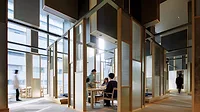
Facing an internal courtyard, the 6,351-square-foot space sits on the third floor of a design-oriented commercial building in the heart of the city—a common condition in Tokyo, where the demand for street frontage far exceeds the supply. Aside from an angled plate-glass entrance, it is essentially devoid of windows and natural light. Yet this deficit did not faze the architects. Envisioning sunshine streaming down between trees, they created a lighting scheme meant to mimic clusters of the sun’s rays, and used the contrast of light and dark to differentiate the main programmatic components: a display gallery, corporate offices, and a fully functioning conference room.
To organize the cavernous interior, the architects first devised a modular system derived from standard Japanese construction measurements, a technique that Noiz principal Keisuke Toyoda perfected during his four-year stint working for Tadao Ando. For Wilkhahn Japan, this entailed blanketing the floor plane with a 2-foot (.6 m) grid and establishing a virtual ceiling plane 8 feet (2.4 m) from the ground. Suggested by soffit edges and paint-color changes, this imaginary line divides the orderly cosmos of chairs and tables arranged neatly below from the snarl of exposed pipes and ducts lurking in semidarkness above. “Horizontality is the given nature of this space and also its preexisting condition,” explains Toyoda.
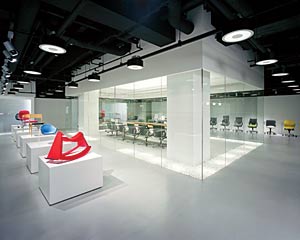
To expand the room vertically without denying its innate character, the architects created five “courtyards” that fit neatly within the plan coordinates but transcend the implied overhead boundary. Lit from above, each boxy volume seems magically open to the sky. Measuring 1,744 square feet, the largest contains the conference room. Intended for meetings with visitors and clients as well as staff use, it had to be enclosed with glass to limit sound transmission, and equipped with roll screens for visual privacy. Adorned with a subtle imprint of beech trees, the shades descend in unison, turning the meeting room into an artificial forest clearing bathed in man-made sunlight. The only other glass walls sequester the office zone at the rear of the room.
The centerpiece of the entire composition, the conference room glows with an intensity ranging from 800 to 1,500 lux thanks to its dual lighting systems: fluorescent tube fixtures in the middle and track-mounted metal-halide lamps concealed by a dropped soffit at the perimeter. Encased in reflective boxes, the latter mainly brighten the ceiling but also illuminate the work surface below, while the track-mounted fixtures direct their narrow beams only on the band of white gravel marking the edge of the conference-area floor. Handpicked by Noiz employees during a company outing in the country, the rocks shimmer under the spell of the bright light.
By comparison, the levels of illumination in the surrounding gallery are diffuse and, ranging from 300 to 500 lux, relatively dark. While track-mounted spotlights focus attention on the displayed products, large, bucket-shaped metal-halide lamps provide ambient light. Distributed evenly around the gallery, the fixtures’ glass bottoms appear coplanar with the invisible ceiling. Normally recessed, each one is wrapped with a steel cylinder that conceals its inner workings and imparts a clean, functional look consistent with the über Minimal Wilkhahn aesthetic.
To present Wilkhahn’s furnishings with precision, the architects opted for whiter-than-white light throughout the project—choosing lamps with color temperatures above 5,000 Kelvin that mimic the midday sun. But the absence of pigment is not limited to illumination. “We tried to erase the color of the architecture as much as possible,” says Toyoda. Against the backdrop of a monochromatic material palette—black and white paint, gray carpet and concrete-resin floor, and slivers of stainless steel to mask the glass walls’ green edges—they hoped that the hues of Wilkhahn’s products would really shine.
This sensitive approach meant Noiz had to lower the volume on its own dynamic design sensibility. A reference to an appreciation of new musical forms, the firm name is a reminder to look anew, says Toyoda, who founded the firm with his wife Jia-Shuan Tsai in 2006. Yet even muted, the architecture shows Wilkhahn in a new light.
Looking for a reprint of this article?
From high-res PDFs to custom plaques, order your copy today!