Architectural Record
search
cart
facebook twitter linkedin youtube
  • Sign In
  • Subscribe
  • Sign Out
  • My Account
Architectural Record
  • NEWS
    • Latest News
    • Awards
    • Interviews
    • Obituaries
    • Podcasts
      • Design:Ed Podcast
      • Sponsored Podcasts
  • OPINION
    • Book Reviews / Excerpts
    • Exhibition Reviews
    • Forum
  • EXCLUSIVES
    • Videos
    • Design Vanguard
    • Top 300 Firms
    • Sponsored Content
    • Sponsored eBooks
    • From the Archives
  • CONTINUING ED
    • Editorial Continuing Ed
    • CE Center
    • CE Academies
  • PROJECTS
    • Buildings By Type
    • Reuse & Renovation
    • Museums & Arts Centers
    • Colleges & Universities
    • Multifamily Housing
    • Interiors
    • Lighting
    • Kitchen & Bath
  • HOUSES
    • Record Houses
    • House of the Month
    • Featured Houses
  • PRODUCTS
    • Products by Category
    • Record Products of the Year
    • Latest Products
  • EVENTS
    • Dates & Events
    • Record on the Road
    • Innovation Conference
    • Sustainability in Practice
    • Women In Architecture
    • Webinars
    • Ad Excellence Awards
    • Submit an Event
  • CONNECT
    • Ask RECORD AI
    • Newsletters
    • Contact
    • Advertise
    • Editorial Calendar
    • Store
    • Customer Service
  • SUBMIT
    • Submission Guidelines
    • RECORD Competitions
  • MAGAZINE
    • Subscribe
    • My Account
    • Digital Edition
    • Current Issue
    • Firm Pass
    • Historic Archive
ProjectsBuildings by TypeInterior DesignHospitality ProjectsWood ProjectsRecord Interiors

Record Interiors 2026

An Elaborate Array of Wood and Aluminum-Mesh Panels Fills a Soaring Eatery in Osaka

Osaka, Japan
By Naomi Pollock, FAIA
Kyoto Hyoto
Photo © Forward Stroke
Kyoto Hyōto restaurant.
April 6, 2026

Architects & Firms

Manabu Chiba Architects
✕
Image in modal.

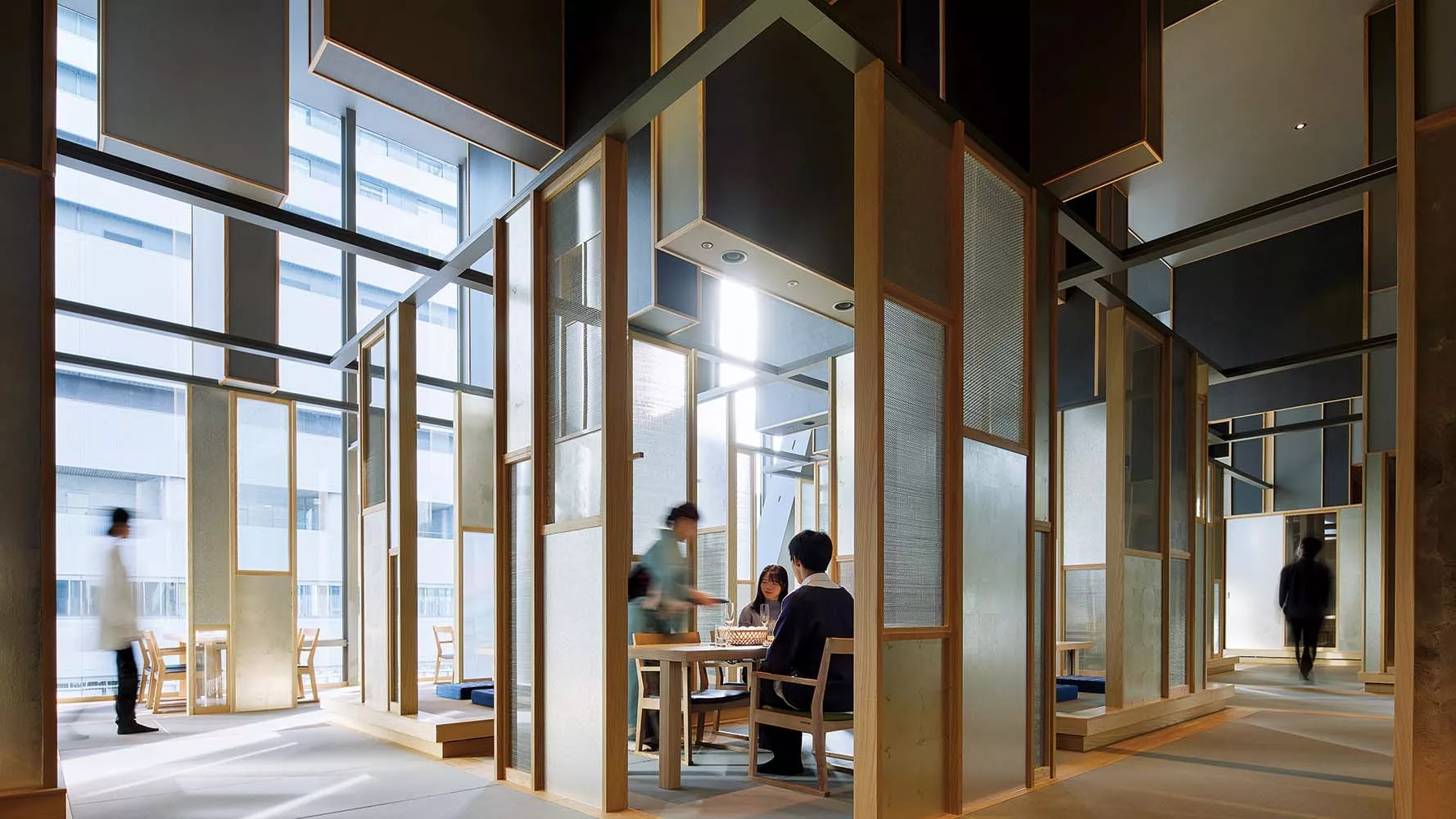
The Osaka outpost of Kyoto Hyōto restaurant serves up traditional Japan—with a contemporary twist. Patrons do shed their street shoes at the door and then dine on shabu-shabu hot pot while seated on tatami mats. Yet these activities take place in an open, airy space where the ceiling soars to 23 feet and, instead of the usual shoji paper, industrial-strength aluminum honeycomb panels—here arranged in a dazzling array of heights and sizes—are the house specialty.

The latest collaboration between the Tokyo architect Manabu Chiba and a Kyoto-based restaurateur, the 3,400-square-foot project is located on the 12th floor of a commercial high-rise adjacent to Osaka Station. Leaving the city’s hustle and bustle behind, a 7-footsquare sliding wood door greets customers. It leads to the restaurant’s foyer, flanked by small rooms for shoe storage and for the cashier. From there, the angled entry portal reorients guests toward the 100-person dining area, bathed in daylight by full-height windows at lunch, and city lights at night. Food is prepped for tabletop cooking in the adjacent, square kitchen.
Kyoto Hyoto
1

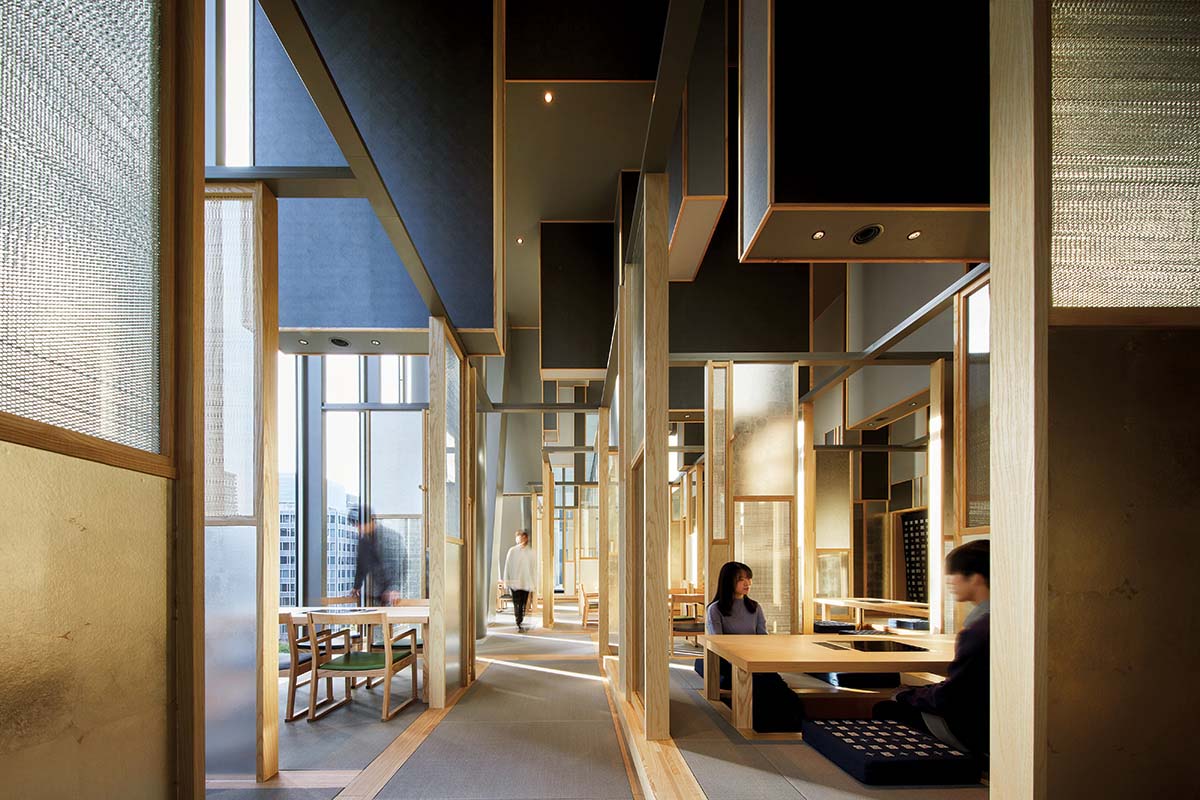
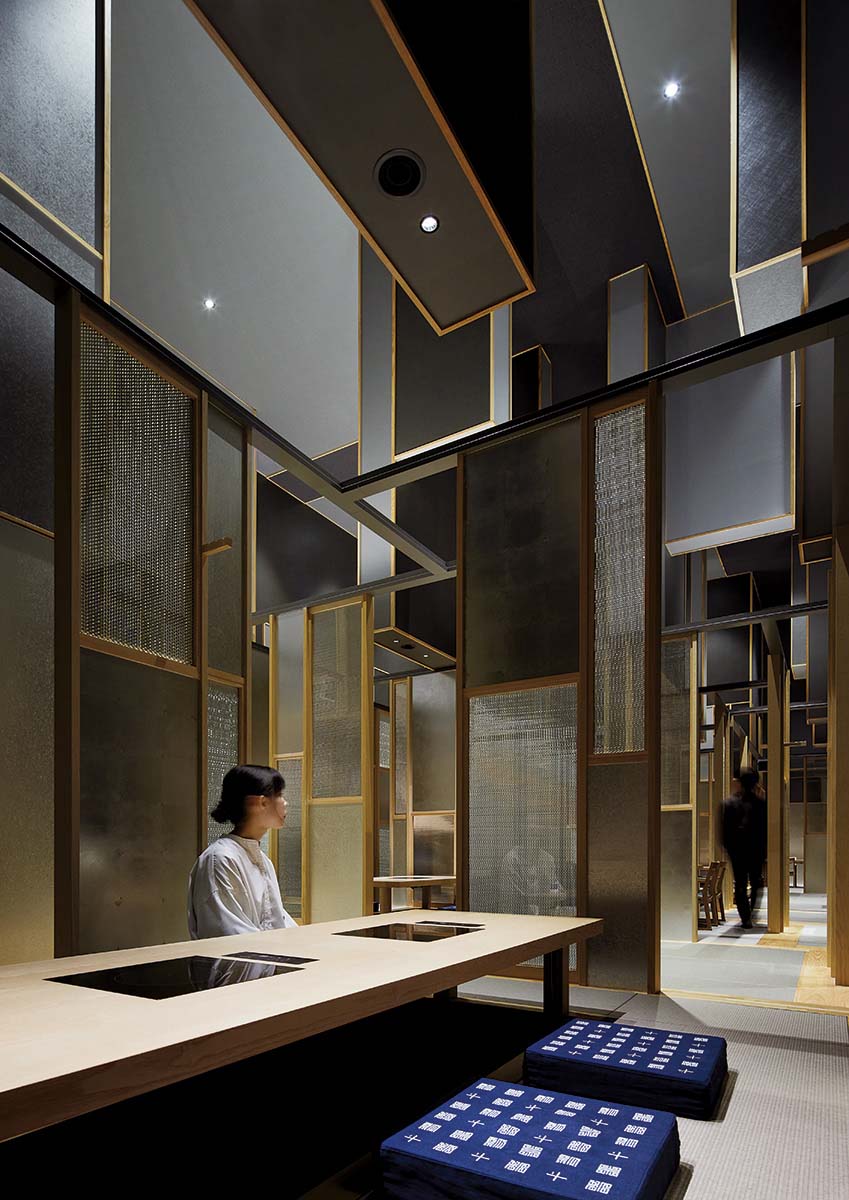
Evoking traditional Japanese rooms separated by sliding shoji, private dining areas are divided by honeycomb panels (1 & 2). Photos © Forward Stroke, click to enlarge.
Kyoto Hyoto
2

Evoking the fluidity of Japanese interiors subdivided by movable walls, the tatami-covered dining area holds a combination of lightly partitioned expandable private rooms and open clusters of table-and-chair seating. Ranging from 130 to 65 square feet, the individual rooms center on low tables where guests stir the pot from cloth-covered zabuton cushions. Thanks to horigotatsu openings in the tatami, they can discreetly stretch out their legs under the table. For those who’d rather not dine at floor level, there is the table-and-chair option. But Chiba, who designed the blond ash-wood furnishings throughout, notes that their eating and sitting surfaces are lower than most. And sled-shaped bases prevent chair legs from puncturing the delicate mats.

Like tatami, some materials used in Japan require periodic replacement—a practice built into the restaurant’s removable metallic wall panels. Anticipating the inevitable wear and tear caused by soup spills and roving food trays, the panels range in size, but all are small enough to be swapped out by a single carpenter. They are arranged randomly, yielding a medley of silvery surfaces that gently delineate one space from another. Reminiscent of historic post-and-beam construction, a three-dimensional ash-wood framework holds the panels in place and is anchored to the concrete slab below the straw-mat flooring.

The panel materials consist of off-the-rack silver washi wallpaper and aluminum honeycomb normally found inside furniture or an airplane fuselage. “It looks like a collection of small windows that reflects light in a beautiful way,” remarks Chiba. Sandwiched between glass sheets, these tiny cellular openings are transparent when seen head-on but block sightlines when viewed at an angle. This balance of enclosure and exposure is particularly well suited to restaurants, says Chiba. “You want to enjoy time with your friends while sharing the space with many people,” he explains. For the wallpapered panels, the architect chose three different tones and textures. When these wear out, the surfaces can be redone with whatever silver shades are available. The more varied, the less obvious the repairs.

Some of the private rooms have the 7-foot-high ceilings typical of floor-based tatami spaces. Elsewhere, Chiba mitigated the restaurant’s double height with an assortment of T- and L-shaped boxes suspended from the building’s concrete slab and steel structure above. Supported internally with thin steel frames, the boxes are made of ash wood and paper cladding. They conceal ducts and hold downlights while imparting a shadowy mood to the room’s upper reaches. “It feels like you’re in a forest with big trees,” muses the architect. More than the boxes themselves, it is the openings in between that create this distinctive atmosphere.

Untouchable yet effective, voids of all types have long fascinated Chiba, who works them into his designs regularly. Gaps and glitches, such as the required slots of space between buildings, or narrow walks leading to hidden shrines and temples, relieve the stress of Japan’s densely built environment. But openings at any scale leave room for the imagination to run and the body to relax—essential ingredients for savoring sips of sake and simmered slices of meat.
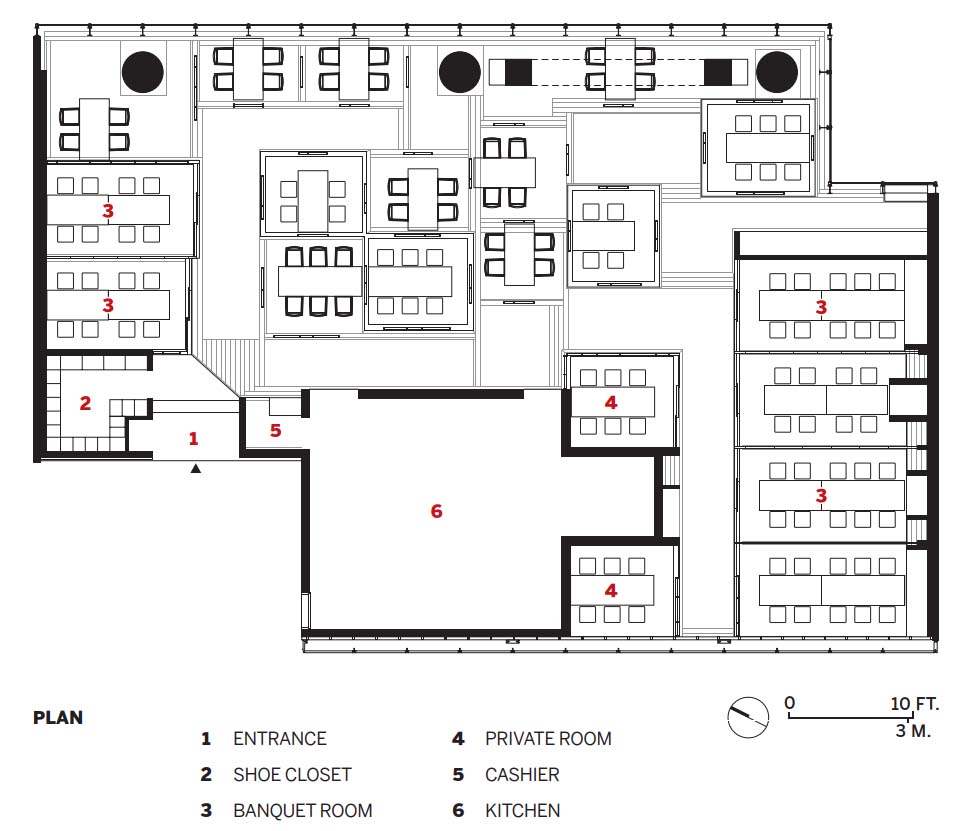
Kyoto Hyoto

Image courtesy Manabu Chiba Architects

Back to Record Interiors 2026

Credits

Architect:
Manabu Chiba Architects

Engineer:
Kankyo Engineering (MEP)

Consultant:
Izumi Okayasu Lighting Design

General Contractor:
CA Leading

Client:
Mihaku

Size:
3,400 square feet

Cost:
$1.98 million (construction)

Completion:
December 2025


Sources

Wallcoverings:
Kamism, Sangetsu, Sincol, Lilycolor

Lighting:
Daiko

Honeycomb Glass:
Hollander Glass

Acoustical Ceilings:
Yoshino Gypsum


Looking for quick answers on architecture and design topics?
Try Ask RECORD, our new smart AI search tool.
Ask RECORD →

KEYWORDS: Japan restaurants timber construction

Share This Story

Looking for a reprint of this article?
From high-res PDFs to custom plaques, order your copy today!

Contributing Editor Naomi Pollock, FAIA, is the author of Japanese Design Since 1945: A Complete Sourcebook and the forthcoming Vanishing Japan: Modern Architecture Gone But Not Forgotten,

Post a comment to this article

Report Abusive Comment

Subscription Center
  • Create an Account
  • Start a Subscription
  • Manage My Account
  • Sign Up for Newsletters
  • Visit Customer Service
  • Update Preferences

More Videos

Sponsored Content

Sponsored Content is a special paid section where industry companies provide high quality, objective, non-commercial content around topics of interest to the Architectural Record audience. All Sponsored Content is supplied by the advertising company and any opinions expressed in this article are those of the author and not necessarily reflect the views of Architectural Record or its parent company, BNP Media. Interested in participating in our Sponsored Content section? Contact your local rep!

close
  • TAMLYN XtremeTrim Exterior Trim
    Sponsored byTamlyn

    Designing Cleaner Panel Facades: Why Exterior Trim Details Matter

  • Building with Vapor Barriers
    Sponsored byReef Industries, Inc.

    Vapor Barriers Help Control Moisture in Tighter Building Designs

  • Duct Interior with Prodeq System
    Sponsored byHenry, a Carlisle Company

    Designing Resilient Water Containment Systems

DESIGN:ED Podcast
Listen to Architectural Record’s DESIGN:ED Podcast

Events

June 16, 2026

Focus on the Façade: Exploring Steel, Timber & Fire-Rated Curtain Walls and Channel Glass Systems

Credits: 1 AIA LU/HSW; 1 AIBD P-CE; 0.1 ICC CEU

Explore modern façade and glazing systems that enhance daylighting, fire safety, and thermal performance while expanding architectural design possibilities.

June 18, 2026

Rebooting the Aging Office Building

Credits: 1 AIA LU/HSW; 1 AIBD P-CE; 0.1 ICC CEU; 1 PDH

Explore façade retrofit strategies and award-winning design concepts that can transform aging office buildings into healthier, higher-performing workplaces for today’s hybrid workforce.

View All Submit An Event

Products

2026 Architect's Square Foot Costbook

2026 Architect's Square Foot Costbook

See More Products

Popular Stories

SanDiegoAirport

Top 300 Architecture Firms of 2026

Coronado Bridge

The Architect’s Guide to San Diego

Crane Cove, ONO

Design Vanguard 2026 Winners

House on a Hill

Design Vanguard 2026: Forma

House A on a Hill

Design Vanguard 2026: Santiago Valdivieso

Focus on the Facade - Free Webinar - June 16, 2026

Related Articles

  • Z House

    L/AND/A Fills a Fixer-Upper Townhouse in Brooklyn with Light, Air, and Elegant Details

    See More
  • Nancy Friend Pritzker Psychiatry Building.

    A Soaring, Light-Filled Atrium Is at the Heart of this San Francisco Facility Serving Mental Health Needs

    See More
  • 325 Binney Street atrium, Cambridge

    A Soaring Atrium Anchors NBBJ’s New Cambridge Headquarters for Moderna

    See More

Related Products

See More Products
  • book3.jpg

    If Architecture is a Language, Then a Building is a Story

See More Products
×

The latest news and information

#1 Source for Architectural Design, News and Products

SUBSCRIBE
  • RESOURCES
    • Advertise
    • Contact Us
    • Submit
    • Store
  • ACCOUNT CENTER
    • Create an Account
    • Start a Subscription
    • Manage My Account
    • Sign Up for Newsletters
    • Visit Customer Service
    • Update Preferences
  • PRIVACY
    • PRIVACY POLICY
    • TERMS & CONDITIONS
    • DO NOT SELL MY PERSONAL INFORMATION
    • PRIVACY REQUEST
    • ACCESSIBILITY
  • SERVICES
    • Marketing Services
    • Reprints
    • Market Research
    • List Rental
    • Survey/Respondent Access
  • STAY CONNECTED
    • Linkedin
    • Facebook
    • Instagram
    • YouTube
    • X (Twitter)

Copyright ©2026. All Rights Reserved BNP Media, Inc. and BNP Media II, LLC.

Design, CMS, Hosting & Web Development :: ePublishing