Architectural Record
search
cart
facebook twitter linkedin youtube
  • Sign In
  • Subscribe
  • Sign Out
  • My Account
Architectural Record
  • NEWS
    • Latest News
    • Awards
    • Interviews
    • Obituaries
    • Podcasts
      • Design:Ed Podcast
      • Sponsored Podcasts
  • OPINION
    • Book Reviews / Excerpts
    • Exhibition Reviews
    • Forum
  • EXCLUSIVES
    • Videos
    • Design Vanguard
    • Top 300 Firms
    • Sponsored Content
    • Sponsored eBooks
    • From the Archives
  • CONTINUING ED
    • Editorial Continuing Ed
    • CE Center
    • CE Academies
  • PROJECTS
    • Buildings By Type
    • Reuse & Renovation
    • Museums & Arts Centers
    • Colleges & Universities
    • Multifamily Housing
    • Interiors
    • Lighting
    • Kitchen & Bath
  • HOUSES
    • Record Houses
    • House of the Month
    • Featured Houses
  • PRODUCTS
    • Products by Category
    • Record Products of the Year
    • Latest Products
  • EVENTS
    • Dates & Events
    • Record on the Road
    • Innovation Conference
    • Sustainability in Practice
    • Women In Architecture
    • Webinars
    • Ad Excellence Awards
    • Submit an Event
  • CONNECT
    • Ask RECORD AI
    • Newsletters
    • Contact
    • Advertise
    • Editorial Calendar
    • Store
    • Customer Service
  • SUBMIT
    • Submission Guidelines
    • RECORD Competitions
  • MAGAZINE
    • Subscribe
    • My Account
    • Digital Edition
    • Current Issue
    • Firm Pass
    • Historic Archive
Projects

California Academy of Sciences

Renzo Piano designs a living, breathing building in San Francisco's Golden Gate Park for the California Academy of Sciences.

By Clifford A. Pearson
January 19, 2009

Architects & Firms

Renzo Piano Building Workshop


San Francisco, California

To support the expansive roof, RPBW designed a set of four masonry structures—one at each corner—incorporating two of the original academy’s Neoclassical limestone walls in the northeast structure and using poured concrete for the others. Although not immediately apparent, memory informs Piano’s modern machine—in the building’s Neoclassical symmetry and its slender, steel hypostyle colonnades on each facade. Inside, the central piazza—partially covered by a “spider’s web” of cables, rods, and glass—recalls the old academy’s central courtyard, while re-creations of the institution’s barrel-vaulted African Hall and Doric-columned Steinhart Arch serve as touchstones for returning visitors.
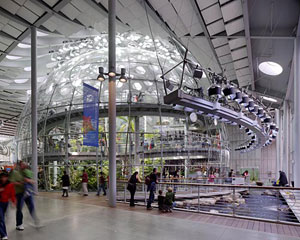
California Academy of Sciences

The public enters the building from the north up a stepped podium, while the academy’s staff and research personnel cross a short bridge over a man-made ravine on the south. (By carving out earth for the ravine, RPBW brought daylight into the building’s two lower floors.) The solar canopy wrapping around the building’s perimeter provides a shaded transition space between indoors and out, in the process converting the sun’s rays into electricity. “It works just like the leaves of a tree,” explains Piano. On the west, an outdoor sculpture by Maya Lin helps tie the building to its park setting; a second piece by Lin—on the east—will open on Earth Day 2009.

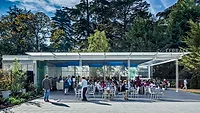
In the northeast-corner structure, the architects inserted the rebuilt African Hall along with its original dioramas, and in the northwest one they placed the museum café and store. The southeast and southwest blocks house research and administration spaces, some of which the public can look into and see that the building is more than just a museum. Between the masonry structures on each corner, RPBW created a pair of enormous exhibition halls with the glass-wrapped piazza in the middle. Daylight and air enter from the 35-foot-high glass walls on the east and west, as well as from the piazza.

Anchoring the halls are two 90-foot-diameter spheres: an aluminum-clad one housing the new Morrison Planetarium, and a steel-frame one containing a four-story rain-forest exhibition accessed by a steel ramp fabricated by a company that works mostly on roller coasters. Underneath the central piazza and running up to the edge of each giant sphere, the enormous tanks of the Steinhart Aquarium take visitors into an underwater world filled with sharks, fish, and the largest artificial coral reef in the world. Light from the piazza and circular skylights above provide enough daylight to keep all the water creatures happy (and alive). The New York firm Thinc Design led the exhibition-design team and worked with Urban A&O [record, December 2008, page 80] on the Water Planet exhibit in the aquarium.

“In the past, science museums were kingdoms of darkness,” states Piano. “You would wander from one dark gallery to another, looking for the dinosaurs and then the dioramas.” At the California Academy of Sciences, though, daylight animates the major spaces—changing the visitor experience from one of trekking through the jungles of science to that of surfing the broad seas of knowledge. By necessity, the planetarium and African Hall block out most sunlight; but they’re the exceptions.

In spirit, the academy recalls Cedric Price’s unrealized 1961 design for a Fun Palace in London: a giant glass-and-steel box filled with spaces for all sorts of entertainment activities. While the academy doesn’t have the gantry cranes Price envisioned rearranging prefabricated components and modules inside his palace, its large halls accommodate rotating exhibitions, and its planted roof changes color and character with the seasons. In places, the academy building seems too accommodating and its relationship with the past a bit forced. For example, the freestanding Steinhart Arch doesn’t really feel at home inside its new setting, and a re-created swamp exhibit with its seahorse railing reads as an act of artificial preservation. But the building’s inclusiveness in programming speaks to Piano’s notion of a “soft” machine.

Explaining his reaction to the completed building, Piano says he was most excited when he visited the observation deck on the green roof as the sun was setting. “I was up there with my son and we saw the skylights pop open to let air into the building. It was like watching an animal come alive and breath.”

KEYWORDS: San Francisco

Share This Story

Looking for a reprint of this article?
From high-res PDFs to custom plaques, order your copy today!

Cliff portrait 2 0t5a1761 0031

Contributing editor Clifford Pearson is the co-author, with A. Eugene Kohn, of The World By Design, and writes about architecture and urbanism.

Post a comment to this article

Report Abusive Comment

Subscription Center
  • Create an Account
  • Start a Subscription
  • Manage My Account
  • Sign Up for Newsletters
  • Visit Customer Service
  • Update Preferences

More Videos

Sponsored Content

Sponsored Content is a special paid section where industry companies provide high quality, objective, non-commercial content around topics of interest to the Architectural Record audience. All Sponsored Content is supplied by the advertising company and any opinions expressed in this article are those of the author and not necessarily reflect the views of Architectural Record or its parent company, BNP Media. Interested in participating in our Sponsored Content section? Contact your local rep!

close
  • TAMLYN XtremeTrim Exterior Trim
    Sponsored byTamlyn

    Designing Cleaner Panel Facades: Why Exterior Trim Details Matter

  • Building with Vapor Barriers
    Sponsored byReef Industries, Inc.

    Vapor Barriers Help Control Moisture in Tighter Building Designs

  • Duct Interior with Prodeq System
    Sponsored byHenry, a Carlisle Company

    Designing Resilient Water Containment Systems

DESIGN:ED Podcast
Listen to Architectural Record’s DESIGN:ED Podcast

Events

June 11, 2026

Very Early Warning Fire Detection for Mission-Critical Facilities

Credits: 1 AIA LU/HSW; 1 AIBD P-CE; 0.1 ICC CEU

Examine advanced fire detection strategies that support uptime and enhance safety in data centers and other mission-critical facilities.

June 16, 2026

Focus on the Façade: Exploring Steel, Timber & Fire-Rated Curtain Walls and Channel Glass Systems

Credits: 1 AIA LU/HSW; 1 AIBD P-CE; 0.1 ICC CEU

Explore modern façade and glazing systems that enhance daylighting, fire safety, and thermal performance while expanding architectural design possibilities.

View All Submit An Event

Products

2026 Architect's Square Foot Costbook

2026 Architect's Square Foot Costbook

See More Products

Popular Stories

Practice Matters illustration

What’s in a (Firm’s) Name? Thinking About Succession and Legacy

Coronado Bridge

The Architect’s Guide to San Diego

Practice Matters illustration

By the Numbers: Counting America's Architects

Crane Cove, ONO

Design Vanguard 2026 Winners

House on a Hill

Design Vanguard 2026: Forma

Broader Sustainability of CMU - Free Webinar - May 21, 2026

Related Articles

  • California Academy of Sciences

    See More
  • California Academy of Sciences Project Portfolio

    See More
  • The Terrace, California Academy of Sciences

    The Terrace, California Academy of Sciences

    See More

Related Products

See More Products
  • 1444336282.gif

    The Handbook of Interior Design

See More Products
×

The latest news and information

#1 Source for Architectural Design, News and Products

SUBSCRIBE
  • RESOURCES
    • Advertise
    • Contact Us
    • Submit
    • Store
  • ACCOUNT CENTER
    • Create an Account
    • Start a Subscription
    • Manage My Account
    • Sign Up for Newsletters
    • Visit Customer Service
    • Update Preferences
  • PRIVACY
    • PRIVACY POLICY
    • TERMS & CONDITIONS
    • DO NOT SELL MY PERSONAL INFORMATION
    • PRIVACY REQUEST
    • ACCESSIBILITY
  • SERVICES
    • Marketing Services
    • Reprints
    • Market Research
    • List Rental
    • Survey/Respondent Access
  • STAY CONNECTED
    • Linkedin
    • Facebook
    • Instagram
    • YouTube
    • X (Twitter)

Copyright ©2026. All Rights Reserved BNP Media, Inc. and BNP Media II, LLC.

Design, CMS, Hosting & Web Development :: ePublishing