Architectural Record
search
cart
facebook twitter linkedin youtube
  • Sign In
  • Subscribe
  • Sign Out
  • My Account
Architectural Record
  • NEWS
    • Latest News
    • Awards
    • Interviews
    • Obituaries
    • Podcasts
      • Design:Ed Podcast
      • Sponsored Podcasts
  • OPINION
    • Book Reviews / Excerpts
    • Exhibition Reviews
    • Forum
  • EXCLUSIVES
    • Videos
    • Design Vanguard
    • Top 300 Firms
    • Sponsored Content
    • Sponsored eBooks
    • From the Archives
  • CONTINUING ED
    • Editorial Continuing Ed
    • CE Center
    • CE Academies
  • PROJECTS
    • Buildings By Type
    • Reuse & Renovation
    • Museums & Arts Centers
    • Colleges & Universities
    • Multifamily Housing
    • Interiors
    • Lighting
    • Kitchen & Bath
  • HOUSES
    • Record Houses
    • House of the Month
    • Featured Houses
  • PRODUCTS
    • Products by Category
    • Record Products of the Year
    • Latest Products
  • EVENTS
    • Dates & Events
    • Record on the Road
    • Innovation Conference
    • Sustainability in Practice
    • Women In Architecture
    • Webinars
    • Ad Excellence Awards
    • Submit an Event
  • CONNECT
    • Ask RECORD AI
    • Newsletters
    • Contact
    • Advertise
    • Editorial Calendar
    • Store
    • Customer Service
  • SUBMIT
    • Submission Guidelines
    • RECORD Competitions
  • MAGAZINE
    • Subscribe
    • My Account
    • Digital Edition
    • Current Issue
    • Firm Pass
    • Historic Archive
Projects

California Academy of Sciences

Renzo Piano designs a living, breathing building in San Francisco's Golden Gate Park for the California Academy of Sciences.

By Clifford A. Pearson
January 19, 2009

Architects & Firms

Renzo Piano Building Workshop
 

San Francisco, California

Renzo Piano calls his new building for the California Academy of Sciences a “soft machine.” “It sounds better in Italian, because machine brings to mind the process of making and Leonardo in his workshop,” he explains, pronouncing the Italian word macchina. The architect and his team at the Renzo Piano Building Workshop (RPBW) conceived of the 410,000-square-foot project as a manifestation of the academy’s mission to study, store, and exhibit the wonders of natural science. “It’s a machine for preserving nature,” says Piano. Great idea. But this is a big machine, at a key location in Golden Gate Park, and it needs to engage a lot of different people: the 10-year-old kid looking for the live penguins, the 40-year-old ichthyologist working there, and the romantic couple sitting on a bench in the adjacent plaza, called the Music Concourse.
California Academy of Sciences

Part museum and part research-and-storage institute, the academy occupies the site of its predecessor—an 11-building complex erected piecemeal from 1916 to 1976 and damaged beyond repair by the Loma Prieta earthquake in 1989. It faces Herzog & de Meuron’s de Young Museum [record, November 2005, page 104] across the Music Concourse, creating a dialogue between equally famous foreign architects working on public buildings of equal scale. While Jacques Herzog and Pierre de Meuron wrapped their museum in an array of copper panels (dimpled, bubbled, and flat), and Piano surrounded his with extremely clear, low-iron glass, both projects attach themselves to the park—the de Young with fingers of landscaped space entwined with gallery wings, and the academy with enormous, floor-to-ceiling views outside. The firms’ very different approaches to similar sets of issues makes this pairing one of the most fascinating in the country—on par with Kahn and Ando in Fort Worth. When asked about the academy’s relationship with the de Young, Piano says he didn’t think about it much. “This is what you get when you are yourself and they are themselves.”

Piano’s initial sketch for the academy shows a long, undulating roof in section: Where large programmatic elements sit, it rises up to accommodate them, and where less is needed, it dips down. “So it becomes organic,” states the architect. “At first, I wanted to do the roof as a wood structure, to build it like the keel of a boat,” he explains. In the end, though, it was made of steel, in part to limit the number of trees cut down. From the start of the project, Piano collaborated with Chong Partners (now Stantec), even bringing designers from the San Francisco firm to work in his Genoa office for certain periods.

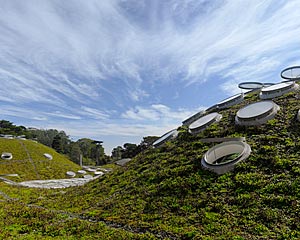
Piano saw the roof as a metaphor for the entire project. “I saw it as topography,” he adds. “The idea was to cut a piece of the park, push it up 35 feet—to the height of the old buildings—and then put whatever was needed underneath.” From the beginning, he envisioned a green roof that would be an extension of the park and serve as a thermal buffer for the spaces below. “Twenty-first-century architecture must be about sustainability,” he asserts. “This isn’t a moralistic stance; it’s simply what architecture must be.”

For an institution devoted to the natural sciences, such an attitude was particularly important. The building, which received a LEED Platinum rating after it opened at the end of September, employs an impressive range of green strategies, including recycling 90 percent of the demolition waste from the old buildings; using recycled material for all of its structural steel; incorporating insulation made from recycled blue jeans; employing heat-recovery systems to capture and use heat generated by HVAC equipment; using radiant heating in floors; ensuring that 90 percent of regularly occupied space has access to daylight; naturally ventilating almost the entire building (see sidebar, page66); and reducing the need for potable water by using low-flow plumbing fixtures and reclaimed water from the City of San Francisco.

The green roof, which bulges to form seven hills, plays a critical role in the building’s sustainable-design performance—reducing storm-water runoff by 98 percent, providing thermal insulation, and creating a 2.5-acre habitat for 1.7 million native-Californian plants and all kinds of insects and birds. The undulating roof incorporates glass panels above part of a central piazza and small circular skylights set into the various “hills.” The skylights, which are controlled by an automated system, all open and close to naturally ventilate the spaces underneath. A solar canopy wrapping around the perimeter of the building contains more than 55,000 photovoltaic cells that can generate 213,000 kilowatt hours each year (at least 5 percent of the academy’s energy needs). According to Arup, which provided sustainability-consulting services, as well as structural and mechanical engineering, the building will consume 30 to 35 percent less energy than required by California’s already strict building code.

KEYWORDS: San Francisco

Share This Story

Looking for a reprint of this article?
From high-res PDFs to custom plaques, order your copy today!

Cliff portrait 2 0t5a1761 0031

Contributing editor Clifford Pearson is the co-author, with A. Eugene Kohn, of The World By Design, and writes about architecture and urbanism.

Post a comment to this article

Report Abusive Comment

Subscription Center
  • Create an Account
  • Start a Subscription
  • Manage My Account
  • Sign Up for Newsletters
  • Visit Customer Service
  • Update Preferences

More Videos

Sponsored Content

Sponsored Content is a special paid section where industry companies provide high quality, objective, non-commercial content around topics of interest to the Architectural Record audience. All Sponsored Content is supplied by the advertising company and any opinions expressed in this article are those of the author and not necessarily reflect the views of Architectural Record or its parent company, BNP Media. Interested in participating in our Sponsored Content section? Contact your local rep!

close
  • TAMLYN XtremeTrim Exterior Trim
    Sponsored byTamlyn

    Designing Cleaner Panel Facades: Why Exterior Trim Details Matter

  • Building with Vapor Barriers
    Sponsored byReef Industries, Inc.

    Vapor Barriers Help Control Moisture in Tighter Building Designs

  • Duct Interior with Prodeq System
    Sponsored byHenry, a Carlisle Company

    Designing Resilient Water Containment Systems

DESIGN:ED Podcast
Listen to Architectural Record’s DESIGN:ED Podcast

Events

June 10, 2026

Rethinking Stormwater – The Power of Porous Paving

Credits: 1 AIA LU/HSW; 1 AIBD P-CE; 0.1 ICC CEU

Learn how porous paving systems support stormwater management, reduce heat island effects, and enhance sustainable site design performance.

June 11, 2026

Very Early Warning Fire Detection for Mission-Critical Facilities

Credits: 1 AIA LU/HSW; 1 AIBD P-CE; 0.1 ICC CEU

Examine advanced fire detection strategies that support uptime and enhance safety in data centers and other mission-critical facilities.

View All Submit An Event

Products

2026 Architect's Square Foot Costbook

2026 Architect's Square Foot Costbook

See More Products

Popular Stories

Practice Matters illustration

What’s in a (Firm’s) Name? Thinking About Succession and Legacy

Coronado Bridge

The Architect’s Guide to San Diego

Practice Matters illustration

By the Numbers: Counting America's Architects

House on a Hill

Design Vanguard 2026: Forma

Crane Cove, ONO

Design Vanguard 2026 Winners

Broader Sustainability of CMU - Free Webinar - May 21, 2026

Related Articles

  • California Academy of Sciences Project Portfolio

    See More
  • California Academy of Sciences

    See More
  • The Terrace, California Academy of Sciences

    The Terrace, California Academy of Sciences

    See More

Related Products

See More Products
  • 1444336282.gif

    The Handbook of Interior Design

See More Products
×

The latest news and information

#1 Source for Architectural Design, News and Products

SUBSCRIBE
  • RESOURCES
    • Advertise
    • Contact Us
    • Submit
    • Store
  • ACCOUNT CENTER
    • Create an Account
    • Start a Subscription
    • Manage My Account
    • Sign Up for Newsletters
    • Visit Customer Service
    • Update Preferences
  • PRIVACY
    • PRIVACY POLICY
    • TERMS & CONDITIONS
    • DO NOT SELL MY PERSONAL INFORMATION
    • PRIVACY REQUEST
    • ACCESSIBILITY
  • SERVICES
    • Marketing Services
    • Reprints
    • Market Research
    • List Rental
    • Survey/Respondent Access
  • STAY CONNECTED
    • Linkedin
    • Facebook
    • Instagram
    • YouTube
    • X (Twitter)

Copyright ©2026. All Rights Reserved BNP Media, Inc. and BNP Media II, LLC.

Design, CMS, Hosting & Web Development :: ePublishing