Architectural Record
search
cart
facebook twitter linkedin youtube
  • Sign In
  • Subscribe
  • Sign Out
  • My Account
Architectural Record
  • NEWS
    • Latest News
    • Awards
    • Interviews
    • Obituaries
    • Podcasts
      • Design:Ed Podcast
      • Sponsored Podcasts
  • OPINION
    • Book Reviews / Excerpts
    • Exhibition Reviews
    • Forum
  • EXCLUSIVES
    • Videos
    • Design Vanguard
    • Top 300 Firms
    • Sponsored Content
    • Sponsored eBooks
    • From the Archives
  • CONTINUING ED
    • Editorial Continuing Ed
    • CE Center
    • CE Academies
  • PROJECTS
    • Buildings By Type
    • Reuse & Renovation
    • Museums & Arts Centers
    • Colleges & Universities
    • Multifamily Housing
    • Interiors
    • Lighting
    • Kitchen & Bath
  • HOUSES
    • Record Houses
    • House of the Month
    • Featured Houses
  • PRODUCTS
    • Products by Category
    • Record Products of the Year
    • Latest Products
  • EVENTS
    • Dates & Events
    • Record on the Road
    • Innovation Conference
    • Sustainability in Practice
    • Women In Architecture
    • Webinars
    • Ad Excellence Awards
    • Submit an Event
  • CONNECT
    • Ask RECORD AI
    • Newsletters
    • Contact
    • Advertise
    • Editorial Calendar
    • Store
    • Customer Service
  • SUBMIT
    • Submission Guidelines
    • RECORD Competitions
  • MAGAZINE
    • Subscribe
    • My Account
    • Digital Edition
    • Current Issue
    • Firm Pass
    • Historic Archive
Projects

Contemporary Jewish Museum

Daniel Libeskind superimposes the present on the past at the San Francisco Contemporary Jewish Museum.

By Sarah Amelar
January 19, 2009

Architects & Firms

Studio Libeskind

San Francisco, California

The building relies not only on the sharp-edged diagonals—sometimes a shortcut to dynamism and architectural self-assertion—that have been a mainstay in Libeskind’s work, but also on abundant calligraphic symbols, some more convincing than others. Beyond the vertical yud (housing a gift shop below and a gallery above, at the building’s west end) and the horizontal chet (containing community and exhibition spaces that spike above the original roof plane), the entry hall greets visitors with another spelled-out symbol: the Hebrew word PaRDeS, in jagged, fluorescent-illuminated letters across a 140-foot-long, canted wall. As an acronym, the letters refer to four levels of scriptural interpretation; as a word, they allude to paradise. Not readily legible, it’s explained on a wall plaque. In like spirit, the auditorium’s ceiling bears crisscrossing lines, taken from a 15th-century map of routes to the Holy Land, but who would guess it?
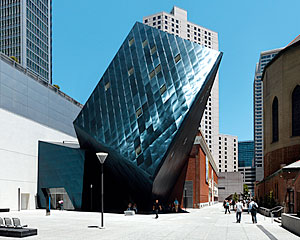
Contemporary Jewish Museum

These abstract symbols elude deciphering, even for people familiar with Hebrew (or Renaissance migration paths). The notion of generating architecture from letters has even seemed hokey to some visitors. But is this symbolism meant to be subliminal? Or karmic? “Neither,” says Libeskind, who similarly based his Danish Jewish Museum on the word mitzvah, meaning “good deed.” “There is a mystery about the text. The Hebrew alphabet isn’t just a set of signs—each letter has divine meaning,” the architect maintains, adding that every character not only tells a story, but is also intrinsically spatial. “Though,” he advises, “it’s best not to think about it too much—better just to experience the spaces.”

On its own physical terms, free from the weighty promise of hidden meaning, the museum offers a small collection of largely successful spaces. Roughly half the size of Libeskind’s original scheme, the CJM is modest in program: the entry hall, auditorium, and museum store, plus a gallery, café, and education/activity rooms at grade; and two second-floor galleries. In contrast to Berlin’s intentionally dark and disturbing Jewish Museum, marked by severe spatial fragmentation and an unrelenting sense of void, San Francisco’s offers a more luminous and fluid spatial sequence.

Most striking are the entry hall and Yud Gallery. Two-hundred-feet long and 50-feet high, the reception hall is entered along the power station’s long, south side, through existing ornate portals. Libeskind, working with WRNS Studio, replicated the industrial steel catwalks and trusses of this former battery hall, leaving the brick shell’s interior exposed, in counterpoint to his own white drywalled surfaces. He laced together old and new with steel I-beams that shored up the shell during construction and now provide seismic bracing. Maximizing daylight, the original skylights are restored and the high windows now extend to the floor. The web of structural and mechanical elements, high overhead, evokes an energy plant’s industrial innards, while the play of daylight and complex shadows animates the canted PaRDeS Wall.

A grand stair, paved in white terrazzo, leads up to the second level. Around the stairwell, the prismatic convergence of diagonals recalls such Libeskind work as the Denver Art Museum [record, January 2007, page 84], but this calmer, tuned-down version (likely the fortuitous result of cutbacks in the scheme) benefits from the absence of exuberant excess. And since Wolf requested 90-degree walls in the galleries, her museum avoids the challenges of Libeskind’s Denver or Royal Ontario museums, where dramatic diagonals compete with the art. The CJM galleries—comprising only 9,500 square feet—are reasonably proportioned, allowing for varied arrangements of temporary partitions.

While the activity and education rooms, sequestered to the ground floor’s darker center, retain a community-basement feel, the Yud Gallery on the second floor has a magical quality. Like a sculpture (though, one might argue, a self-indulgent one, given its limited use as a gallery), this 2,200-square-foot space fills the peaked upper half of the yud rhomboid, where 36 deep-set windows penetrate the slanting walls. Daylight, entering like confetti from multiple angles, casts fleeting diamond shapes. (This compelling effect is eclipsed only by utilitarian suspended track lighting.) Here, wisely, the museum will exhibit only sound pieces and host musical performances, wedding parties, and other receptions.

The interior, in contrast to the museum’s more jarring exterior, mediates subtly between old and new. Logically relating to the eclectic and encroaching urban context, the radical exterior juxtapositions also enable the museum to elbow out its territory—not merely asserting identity, but calling attention to itself in shining blue steel. The interior journey is more nuanced, never losing touch with the former battery hall, powerfully visible from second-floor overlooks. The emphatic exterior allows the architecture to be less aggressive, more gracious and self-confident inside, breathing chai into the power station’s once withering remains.

Sarah Amelar is a contributing editor at RECORD.

KEYWORDS: San Francisco

Share This Story

Looking for a reprint of this article?
From high-res PDFs to custom plaques, order your copy today!
Sarah Amelar is a Los Angeles–based contributing editor at Architectural Record.

Post a comment to this article

Report Abusive Comment

Subscription Center
  • Create an Account
  • Start a Subscription
  • Manage My Account
  • Sign Up for Newsletters
  • Visit Customer Service
  • Update Preferences

More Videos

Sponsored Content

Sponsored Content is a special paid section where industry companies provide high quality, objective, non-commercial content around topics of interest to the Architectural Record audience. All Sponsored Content is supplied by the advertising company and any opinions expressed in this article are those of the author and not necessarily reflect the views of Architectural Record or its parent company, BNP Media. Interested in participating in our Sponsored Content section? Contact your local rep!

close
  • TAMLYN XtremeTrim Exterior Trim
    Sponsored byTamlyn

    Designing Cleaner Panel Facades: Why Exterior Trim Details Matter

  • Building with Vapor Barriers
    Sponsored byReef Industries, Inc.

    Vapor Barriers Help Control Moisture in Tighter Building Designs

  • Duct Interior with Prodeq System
    Sponsored byHenry, a Carlisle Company

    Designing Resilient Water Containment Systems

DESIGN:ED Podcast
Listen to Architectural Record’s DESIGN:ED Podcast

Events

June 10, 2026

Rethinking Stormwater – The Power of Porous Paving

Credits: 1 AIA LU/HSW; 1 AIBD P-CE; 0.1 ICC CEU

Learn how porous paving systems support stormwater management, reduce heat island effects, and enhance sustainable site design performance.

June 11, 2026

Very Early Warning Fire Detection for Mission-Critical Facilities

Credits: 1 AIA LU/HSW; 1 AIBD P-CE; 0.1 ICC CEU

Examine advanced fire detection strategies that support uptime and enhance safety in data centers and other mission-critical facilities.

View All Submit An Event

Products

2026 Architect's Square Foot Costbook

2026 Architect's Square Foot Costbook

See More Products

Popular Stories

Coronado Bridge

The Architect’s Guide to San Diego

Practice Matters illustration

What’s in a (Firm’s) Name? Thinking About Succession and Legacy

Practice Matters illustration

By the Numbers: Counting America's Architects

Inward House

Inward House by VeeV Design Studio

Riverdale House by Studio Lau

Riverdale House by Studio Lau

Broader Sustainability of CMU - Free Webinar - May 21, 2026

Related Articles

  • Contemporary Jewish Museum

    See More
  • Contemporary Jewish Museum Project Portfolio

    See More
  • anoha-jewish-museum-berlin-news-olson-kundig_archrecord_1170_ss_01.jpg

    Olson Kundig's ANOHA Children’s Museum Opens at Jewish Museum Berlin

    See More

Related Products

See More Products
  • image7.jpg

    Contemporary Architecture in China Towards A Critical Pragmatism

  • book5.jpg

    Contemporary Market Architecture Planning and Design

  • Architectural Record - February 2026

    Architectural Record February 2026 Issue

See More Products
×

The latest news and information

#1 Source for Architectural Design, News and Products

SUBSCRIBE
  • RESOURCES
    • Advertise
    • Contact Us
    • Submit
    • Store
  • ACCOUNT CENTER
    • Create an Account
    • Start a Subscription
    • Manage My Account
    • Sign Up for Newsletters
    • Visit Customer Service
    • Update Preferences
  • PRIVACY
    • PRIVACY POLICY
    • TERMS & CONDITIONS
    • DO NOT SELL MY PERSONAL INFORMATION
    • PRIVACY REQUEST
    • ACCESSIBILITY
  • SERVICES
    • Marketing Services
    • Reprints
    • Market Research
    • List Rental
    • Survey/Respondent Access
  • STAY CONNECTED
    • Linkedin
    • Facebook
    • Instagram
    • YouTube
    • X (Twitter)

Copyright ©2026. All Rights Reserved BNP Media, Inc. and BNP Media II, LLC.

Design, CMS, Hosting & Web Development :: ePublishing