Architectural Record
search
cart
facebook twitter linkedin youtube
  • Sign In
  • Subscribe
  • Sign Out
  • My Account
Architectural Record
  • NEWS
    • Latest News
    • Awards
    • Interviews
    • Obituaries
    • Podcasts
      • Design:Ed Podcast
      • Sponsored Podcasts
  • OPINION
    • Book Reviews / Excerpts
    • Exhibition Reviews
    • Forum
  • EXCLUSIVES
    • Videos
    • Design Vanguard
    • Top 300 Firms
    • Sponsored Content
    • Sponsored eBooks
    • From the Archives
  • CONTINUING ED
    • Editorial Continuing Ed
    • CE Center
    • CE Academies
  • PROJECTS
    • Buildings By Type
    • Reuse & Renovation
    • Museums & Arts Centers
    • Colleges & Universities
    • Multifamily Housing
    • Interiors
    • Lighting
    • Kitchen & Bath
  • HOUSES
    • Record Houses
    • House of the Month
    • Featured Houses
  • PRODUCTS
    • Products by Category
    • Record Products of the Year
    • Latest Products
  • EVENTS
    • Dates & Events
    • Record on the Road
    • Innovation Conference
    • Sustainability in Practice
    • Women In Architecture
    • Webinars
    • Ad Excellence Awards
    • Submit an Event
  • CONNECT
    • Ask RECORD AI
    • Newsletters
    • Contact
    • Advertise
    • Editorial Calendar
    • Store
    • Customer Service
  • SUBMIT
    • Submission Guidelines
    • RECORD Competitions
  • MAGAZINE
    • Subscribe
    • My Account
    • Digital Edition
    • Current Issue
    • Firm Pass
    • Historic Archive
Residential ArchitectureRecord Houses

#house#1.130

Down the Garden Path: A house on a tight suburban site provides a series of choreographed views through landscaped spaces and pavilion-like rooms.

By David Cohn
Set on a quarter-acre suburban plot bordered by existing houses belonging to the client’s mother and sister (top and far left in photo), the new house steps up and down in response to the slopin
#house#1.130
Estudio Entresitio
Madrid
Set on a quarter-acre suburban plot bordered by existing houses belonging to the client’s mother and sister (top and far left in photo), the new house steps up and down in response to the sloping site. Operable metal louvers on the south facade protect living spaces from the full impact of the sun, while solar panels on the roof over the living room reduce fossil-fuel consumption.
Photo © Roland Halbe
With its glazed walls and vistas across light wells and terraces, the dining room looks as if it were a freestanding pavilion in an abstract garden.
#house#1.130
Estudio Entresitio
Madrid
With its glazed walls and vistas across light wells and terraces, the dining room looks as if it were a freestanding pavilion in an abstract garden.
Photo © Roland Halbe
With its glazed walls and vistas across light wells and terraces, the dining room looks as if it were a freestanding pavilion in an abstract garden.
#house#1.130
Estudio Entresitio
Madrid
With its glazed walls and vistas across light wells and terraces, the dining room looks as if it were a freestanding pavilion in an abstract garden.
Photo © Roland Halbe
The architect used texture as an important element, matching smooth glass balustrades and translucent polycarbonate panels at the entry.
#house#1.130
Estudio Entresitio
Madrid
The architect used texture as an important element, matching smooth glass balustrades and translucent polycarbonate panels at the entry.
Photo © Roland Halbe
The architect used texture as an important element, specifying corrugated concrete on the south side of the house.
#house#1.130
Estudio Entresitio
Madrid
The architect used texture as an important element, specifying corrugated concrete on the south side of the house.
Photo © Roland Halbe
Vertical louvers help protect the south side of the house.
#house#1.130
Estudio Entresitio
Madrid
Vertical louvers help protect the south side of the house.
Photo © Roland Halbe
The house's steel structure extends beyond the living room to cover a porch topped by planting beds.
#house#1.130
Estudio Entresitio
Madrid
The house's steel structure extends beyond the living room to cover a porch topped by planting beds.
Photo © Roland Halbe
The house's steel structure extends beyond the living room to cover a porch topped by planting beds.
#house#1.130
Estudio Entresitio
Madrid
The house's steel structure extends beyond the living room to cover a porch topped by planting beds.
Photo © Roland Halbe
Over part of the south-facing terrace, cross beams serve as a pergola outside, while casting shadows indoors.
#house#1.130
Estudio Entresitio
Madrid
Over part of the south-facing terrace, cross beams serve as a pergola outside, while casting shadows indoors.
Photo © Roland Halbe
#house#1.130
#house#1.130
Estudio Entresitio
Madrid
Image courtesy Estudio Entresitio
#house#1.130
#house#1.130
Estudio Entresitio
Madrid
Image courtesy Estudio Entresitio
#house#1.130
#house#1.130
Estudio Entresitio
Madrid
Image courtesy Estudio Entresitio
#house#1.130
#house#1.130
Estudio Entresitio
Madrid
Image courtesy Estudio Entresitio
#house#1.130
#house#1.130
Estudio Entresitio
Madrid
Image courtesy Estudio Entresitio
#house#1.130
#house#1.130
Estudio Entresitio
Madrid
Image courtesy Estudio Entresitio
#house#1.130
#house#1.130
Estudio Entresitio
Madrid
Image courtesy Estudio Entresitio
Set on a quarter-acre suburban plot bordered by existing houses belonging to the client’s mother and sister (top and far left in photo), the new house steps up and down in response to the slopin
With its glazed walls and vistas across light wells and terraces, the dining room looks as if it were a freestanding pavilion in an abstract garden.
The architect used texture as an important element, matching smooth glass balustrades and translucent polycarbonate panels at the entry.
The architect used texture as an important element, specifying corrugated concrete on the south side of the house.
Vertical louvers help protect the south side of the house.
The house's steel structure extends beyond the living room to cover a porch topped by planting beds.
Over part of the south-facing terrace, cross beams serve as a pergola outside, while casting shadows indoors.
#house#1.130
#house#1.130
#house#1.130
#house#1.130
#house#1.130
#house#1.130
#house#1.130
April 16, 2014

Architects & Firms

estudio_entresitio

Madrid

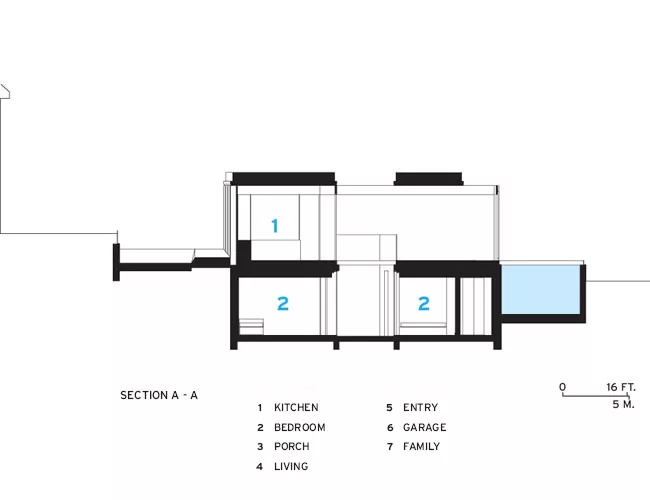
The interweaving of indoor and outdoor spaces in #house#1.130, by Madrid architect Estudio Entresitio, recalls the condensed landscapes of classical Chinese gardens in Suzhou: tightly framed vistas are crossed in close succession by multiple spatial events–glazed pavilions, light wells, bridges, terraces, beds of vegetation, a covered pathway angling slightly out of view. Like many of those Chinese gardens, this 6,200-square-foot house is shoehorned onto a small site (in this case, a quarter-acre plot in a leafy Madrid suburb) and hemmed in on either side by neighboring houses (occupied by the client's mother and sister, respectively). So the house turns inward, its principal spaces and circulation paths looking back and forth among themselves. The project's odd name is a code the architect uses to maintain the client's anonymity.

The parcel originally formed part of the yard of the mother's rather conventional mansion, an oasis of greenery that the architect felt was important “to give back to the site,” says José María Hurtado, a partner in Entresitio together with his sister, María Hurtado (currently teaching at the New Jersey Institute of Technology), and César Jiménez. The firm kept the house low to the ground, following the 10-foot slope down from the street, and covered its various levels—including the main roof—with planting beds.

Hurtado explains that interior spaces were placed “in their best location,” in terms of orientation and views. The larger footprint of the lower floor, housing bedrooms and the garage, forms a kind of plinth, topped with terraces and planting areas that serve the living spaces above. Living spaces are aligned along the long southern exposure, with large windows protected by motorized vertical louvers that the architect custom-designed (it also served as a contractor for the house). The kitchen and other service spaces are located on the northern facade, where translucent polycarbonate panels enclose the staircase and garage.

The architect divided the upper floor into two zones, with the main entry in between. The living room overlooks the trees at the back of the parcel. At the front, the dining room—an almost independent pavilion of floor-to-ceiling glass—is set in a handsome court with a covered terrace and pool presided over by one of the site's original holm oak trees. Connected by indoor and outdoor passages, and separated by a terrace and light well to the lower level, the two zones are given a sense of unity by the regular rhythm of the exposed steel crossbeams supporting the roof. These extend beyond the walls in many places to form pergolas and create a counter-rhythm to the staccato shadow patterns cast by the vertical louvers.

On the lower levels, the light trenches that cut into the terrain follow and reinforce the paths of circulation spaces inside. They bring daylight to the children's bedrooms under the dining room wing and to the servants' quarters in the basement, under the master bedroom. “Most of the bedrooms are like cabins in a garden, with a patio on one side and greenery on the other,” Hurtado explains. On both of the main floors, the various spaces push in and out at different angles along the southern facade. With its white metal louvers and white corrugated concrete walls (finely cast using formwork invented by the architect to match the vertical striation of the louvers), the overall composition of setbacks and pavilions recalls a whitewashed village on a hillside, an effect that should become more pronounced as the rooftop gardens grow.

The ribbons of greenery, which extend below-grade to the light wells and run up a ramp to the roof, are just one element in the design's multidimensional knitting together of inside and out. In its first proposal to the client, the architect developed this strategy even more intensely. It was based on a honeycomb of hexagonal rooms and patios that was systematically distorted in size and shape according to programmatic requirements. Each distortion created adjustments in adjacent hexagons, following a mathematical system known as a Voronoi diagram. The proposal pursued a line of investigation that the architect had begun in previous projects, such as the San Blas Health Care Center in Madrid, where it scattered 14 miniature patios through a matrix of corridors, waiting areas, and examination rooms.

When the client balked at this radical design, the team eliminated the interior patios and transformed spaces into more conventional rectangular rooms, although the jostling of volumes and angled walls retains traces of the bubble-like hexagons, transmitting a sense of pressure and distortion, like puzzle pieces pushed together on an undersized game board.

While the complexity of the design produces a few awkward spots–excessively long and narrow corridors on the bedroom level, for example, and a rather tight entry foyer–its spatial richness compensates for these drawbacks.

With its roots in the hexagonal plan, the project belongs to a growing trend in Spain of designs based on the conglomeration of independent cellular units, as seen in Luis Mansilla and Emilio Tuñón's MUSAC Museum in León, Spain. This cellular strategy actually dates back to Spain's Organicist movement in the late 1950s and '60s, when architects such as Fernando Higueras and the team of Ramón Vázquez Molezún and José A. Corrales, inspired by Frank Lloyd Wright, built houses with spreading, horizontal plans that fused landscape and building. But while the Organicists used the extended eaves of low hip roofs to create deeply shaded spaces as a response to Spain's harsh summers, the stark white forms and sheer glazed walls of the #house#1.130 are closer to the original spirit of the Modern movement, their clearly modeled volumes resplendent under a nourishing sun.

Completion Date: April 2013

Size: 6,200 square feet

Total construction cost: withheld

Architect:
estudio.entresitio
www.entresitio.com
estudio@entresitio.com
Madrid: Gran Vía 33, 7ºI
28013 Madrid, Spain
+34 91 7010330
New York: 134 West 86th st #4A
NY, NY10024
+1 917 870 1092

People

Owner: private client

Architect:
estudio.entresitio
www.entresitio.com
estudio@entresitio.com
Madrid: Gran Vía 33, 7ºI
28013 Madrid, Spain
+34 91 7010330
New York: 134 West 86th st #4A
NY, NY10024
+1 917 870 1092

Personnel in architect's firm who should receive special credit:
Architects (design team):
María Hurtado de Mendoza, César Jiménez de Tejada, José María Hurtado de Mendoza, Alvar Ruiz

(Internal collaborators entresitio: Miguel Crespo, Marco Plazzogna, Anne-Dorothée Herbot, Mia Molato)

Engineer(s):
Structure : María José Camporro

EMP consultant: Geasyt SA

Construction supervisor: Guillermo Parilla

Consultant(s):
Landscape: Planta paisajistas. www.plantapaisajistas.com

General contractor:
Triplicado SL: María Hurtado de Mendoza, César Jiménez de Tejada, José María Hurtado de Mendoza

Photographer(s):
Roland Halbe
www.rolandhalbe.de


Products

Structural system
Striped white concrete walls
Metal roof structure made of steel sheet beams (12mm)

Manufacturer of any structural components unique to this project:
Structure contractor: Teycisa.
Plastic striped formwork sheet: LHV Formliner. Grupo Valero. http://www.grupovalero.com
White self compacting concrete: Cemex. www.cemex.com
Metal structure: Ceme SL

Exterior cladding
Metal/glass enclosure:
Aluminum frames Minimal windows: www.minimal-windows.com

Contractor:  Carpinterias GIC Teofilo SL. www.teofilosl.es

Other cladding unique to this project:
Polycarbonate panels: Danpalon system. Palplastic, www.palplastic.es

Permeable wall: fix and moveable white metal shutters: Concordio Pérez S.L.. Locksmith

Roofing
Green roof mw. Aimad S.L.

Doors
Wood work Intrama SA

 
KEYWORDS: Madrid Spain

Share This Story

Looking for a reprint of this article?
From high-res PDFs to custom plaques, order your copy today!
David Cohn is a Madrid-based architecture critic and international correspondent for Architectural Record. His latest book, Spain: Modern Architectures in History, was released in 2025.

Post a comment to this article

Report Abusive Comment

Subscription Center
  • Create an Account
  • Start a Subscription
  • Manage My Account
  • Sign Up for Newsletters
  • Visit Customer Service
  • Update Preferences

More Videos

Sponsored Content

Sponsored Content is a special paid section where industry companies provide high quality, objective, non-commercial content around topics of interest to the Architectural Record audience. All Sponsored Content is supplied by the advertising company and any opinions expressed in this article are those of the author and not necessarily reflect the views of Architectural Record or its parent company, BNP Media. Interested in participating in our Sponsored Content section? Contact your local rep!

close
  • TAMLYN XtremeTrim Exterior Trim
    Sponsored byTamlyn

    Designing Cleaner Panel Facades: Why Exterior Trim Details Matter

  • Building with Vapor Barriers
    Sponsored byReef Industries, Inc.

    Vapor Barriers Help Control Moisture in Tighter Building Designs

  • Duct Interior with Prodeq System
    Sponsored byHenry, a Carlisle Company

    Designing Resilient Water Containment Systems

DESIGN:ED Podcast
Listen to Architectural Record’s DESIGN:ED Podcast

Events

June 16, 2026

Focus on the Façade: Exploring Steel, Timber & Fire-Rated Curtain Walls and Channel Glass Systems

Credits: 1 AIA LU/HSW; 1 AIBD P-CE; 0.1 ICC CEU

Explore modern façade and glazing systems that enhance daylighting, fire safety, and thermal performance while expanding architectural design possibilities.

June 18, 2026

Rebooting the Aging Office Building

Credits: 1 AIA LU/HSW; 1 AIBD P-CE; 0.1 ICC CEU; 1 PDH

Explore façade retrofit strategies and award-winning design concepts that can transform aging office buildings into healthier, higher-performing workplaces for today’s hybrid workforce.

View All Submit An Event

Products

2026 Architect's Square Foot Costbook

2026 Architect's Square Foot Costbook

See More Products

Popular Stories

Coronado Bridge

The Architect’s Guide to San Diego

SanDiegoAirport

Top 300 Architecture Firms of 2026

Crane Cove, ONO

Design Vanguard 2026 Winners

House on a Hill

Design Vanguard 2026: Forma

House A on a Hill

Design Vanguard 2026: Santiago Valdivieso

Focus on the Facade - Free Webinar - June 16, 2026

Related Articles

  • House-Photographer-II

    House for a Photographer II

    See More
  • Galland House - House of the Month -

    See More

Related Products

See More Products
  • biogenic.jpg

    Manual of Biogenic House Sections

  • iconic house.jpg

    The Iconic House

See More Products
×

The latest news and information

#1 Source for Architectural Design, News and Products

SUBSCRIBE
  • RESOURCES
    • Advertise
    • Contact Us
    • Submit
    • Store
  • ACCOUNT CENTER
    • Create an Account
    • Start a Subscription
    • Manage My Account
    • Sign Up for Newsletters
    • Visit Customer Service
    • Update Preferences
  • PRIVACY
    • PRIVACY POLICY
    • TERMS & CONDITIONS
    • DO NOT SELL MY PERSONAL INFORMATION
    • PRIVACY REQUEST
    • ACCESSIBILITY
  • SERVICES
    • Marketing Services
    • Reprints
    • Market Research
    • List Rental
    • Survey/Respondent Access
  • STAY CONNECTED
    • Linkedin
    • Facebook
    • Instagram
    • YouTube
    • X (Twitter)

Copyright ©2026. All Rights Reserved BNP Media, Inc. and BNP Media II, LLC.

Design, CMS, Hosting & Web Development :: ePublishing