Architectural Record
search
cart
facebook twitter linkedin youtube
  • Sign In
  • Subscribe
  • Sign Out
  • My Account
Architectural Record
  • NEWS
    • Latest News
    • Awards
    • Interviews
    • Obituaries
    • Podcasts
      • Design:Ed Podcast
      • Sponsored Podcasts
  • OPINION
    • Book Reviews / Excerpts
    • Exhibition Reviews
    • Forum
  • EXCLUSIVES
    • Videos
    • Design Vanguard
    • Top 300 Firms
    • Sponsored Content
    • Sponsored eBooks
    • From the Archives
  • CONTINUING ED
    • Editorial Continuing Ed
    • CE Center
    • CE Academies
  • PROJECTS
    • Buildings By Type
    • Reuse & Renovation
    • Museums & Arts Centers
    • Colleges & Universities
    • Multifamily Housing
    • Interiors
    • Lighting
    • Kitchen & Bath
  • HOUSES
    • Record Houses
    • House of the Month
    • Featured Houses
  • PRODUCTS
    • Products by Category
    • Record Products of the Year
    • Latest Products
  • EVENTS
    • Dates & Events
    • Record on the Road
    • Innovation Conference
    • Sustainability in Practice
    • Women In Architecture
    • Webinars
    • Ad Excellence Awards
    • Submit an Event
  • CONNECT
    • Ask RECORD AI
    • Newsletters
    • Contact
    • Advertise
    • Editorial Calendar
    • Store
    • Customer Service
  • SUBMIT
    • Submission Guidelines
    • RECORD Competitions
  • MAGAZINE
    • Subscribe
    • My Account
    • Digital Edition
    • Current Issue
    • Firm Pass
    • Historic Archive
Residential ArchitectureRecord Houses

House for a Photographer II

Carlos Ferrater draws on Spain's modern and vernacular traditions with a weekend house for a photographer.
By David Cohn
House for a Photographer II
Photo © Alejo Bague
House for a Photographer II
Carlos Ferrater, with Carlos Escura
Alcanar, Spain


House for a Photographer II
Photo © Alejo Bague
House for a Photographer II
Carlos Ferrater, with Carlos Escura
Alcanar, Spain
House for a Photographer II
Photo © Alejo Bague
House for a Photographer II
Carlos Ferrater, with Carlos Escura
Alcanar, Spain
House for a Photographer II
Photo © Alejo Bague
House for a Photographer II
Carlos Ferrater, with Carlos Escura
Alcanar, Spain
House for a Photographer II
Photo © Alejo Bague
House for a Photographer II
Carlos Ferrater, with Carlos Escura
Alcanar, Spain
House for a Photographer II
Photo © Alejo Bague
House for a Photographer II
Carlos Ferrater, with Carlos Escura
Alcanar, Spain
House for a Photographer II
Photo © Alejo Bague
House for a Photographer II
Carlos Ferrater, with Carlos Escura
Alcanar, Spain
House for a Photographer II
Photo © Alejo Bague
House for a Photographer II
Carlos Ferrater, with Carlos Escura
Alcanar, Spain
House for a Photographer II
Image courtesy Carlos Ferrater, with Carlos Escura
House for a Photographer II
Carlos Ferrater, with Carlos Escura
Alcanar, Spain
House for a Photographer II
Image courtesy Carlos Ferrater, with Carlos Escura
House for a Photographer II
Carlos Ferrater, with Carlos Escura
Alcanar, Spain
House for a Photographer II
April 1, 2009

Record Houses 2009
Villa 1 Vienna Way Residence House for a Photographer II Dutchess County Guest House Brick-Weave House Upstate New York House N House YTL Residence Desert City House House Ijburg House in Carapicuiba House in Garrison House on TownLine Road Pencalenick House Ventana Canyon House


Alcanar, Spain

Carlos Ferrater, with Carlos Escura

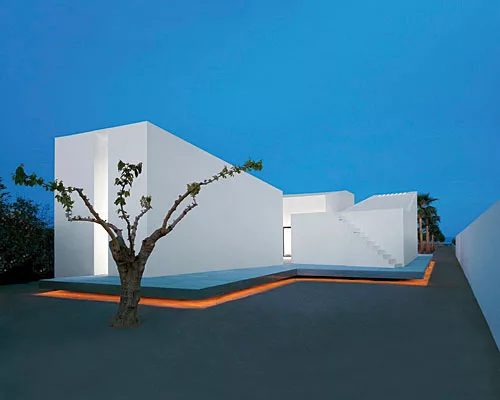
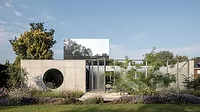
On the Costa del Azahar, 135 miles southwest of Barcelona, the Modernist summer house has a distinguished pedigree all its own. With its masonry construction, angled roofs, and organic cluster of one-room pavilions, architect Carlos Ferrater’s weekend house for a couple in Alcanar adheres partly to a tradition dating back to the first beach houses of José Luis Sert in the 1930s, and renewed by José Antonio Coderch in the 1950s and ’60s. Sert, in such works as his 1935 weekend houses in Garraf, explored a rugged Mediterranean alternative to the machine aesthetic of Northern European Modernists. Coderch reinvestigated the trend with his 1952 Ugalde House, where he used vernacular construction methods to create a fusion between the wild coastal landscape and his abstract, fluid forms.

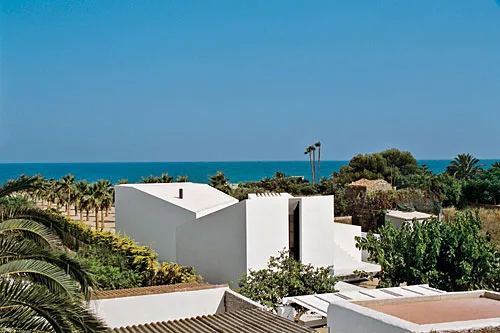
In Alcanar, Ferrater has created his own particular interpretation of this tradition in a home he built for his brother, José Manuel Ferrater. He describes the locale, with its fertile gardens, orchards, and rice fields, as “the perfect union between nature and agriculture. And I think architecture, at least here, is born from this symbiosis.” To illustrate this observation, he points to his treatment of the former garden that the house occupies. In keeping with current Spanish coastal zoning, the house is set far back from the water, and because of periodic flooding, its pavilions stand on a platform 20 inches above the ground. Ferrater has framed the long space between house and shore with low concrete walls (which divert floodwaters without blocking views), and populated its sandy, gravel floor with stately rows of palms. “It’s a way of replicating the agricultural order with a very architectonic salon,” he explains. “Those palms, planted in formation, are like the rows of lettuce and tomatoes next door.”

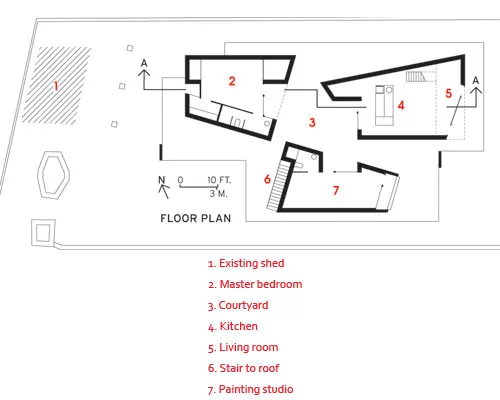
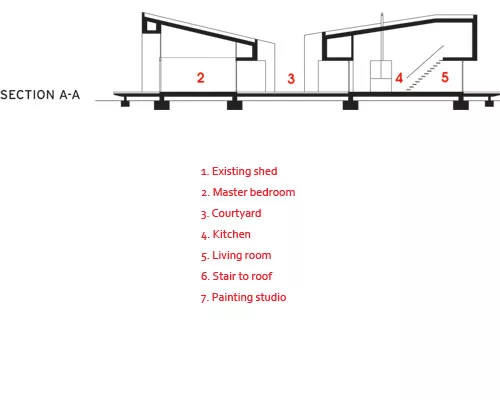
For the house itself, Ferrater struck a similar balance between architectural grandeur and the informality of weekend living. The three pavilions, housing, respectively, a living-dining-kitchen area, a master bedroom, and an artist’s studio with a sleeping alcove for guests, scarcely occupy 1,000 square feet of floor area, yet their ceilings reach up to 16 feet high—taller than their modest width in many places.

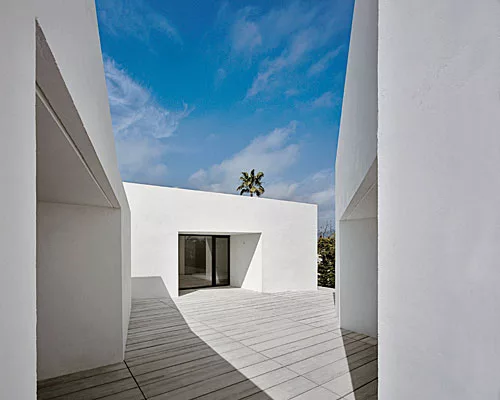
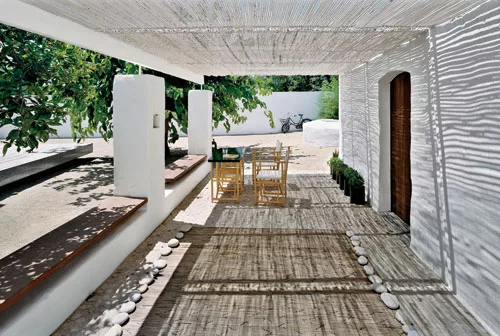
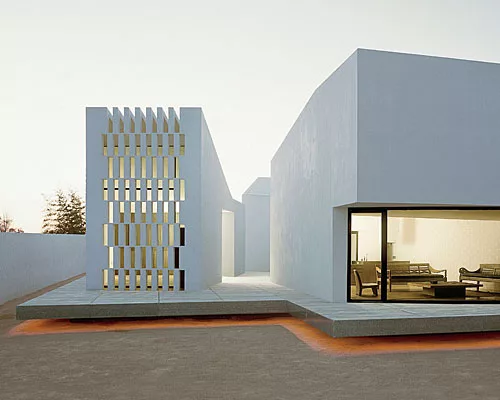
Ferrater has shaped the pavilions for both functional reasons and to add to the complexity and richness of their sculptural forms. He arranged them around a central outdoor living space where access to all three is concentrated (insects and summer showers are not a problem in this semi-arid climate). This space is protected from the northern winds of the mestral by the rising profile of the bedroom pavilion, while the roof of the art studio to the south descends to create a mix of sun and shade. The position and shape of the pavilions direct the views between them, as well as the route of access from the front of the house. Their large, glazed openings offer alternative glimpses through the complex; the converging angles and rising roof of the bedroom pavilion, for example, focus views to the lemon tree behind it. Around the central space, Ferrater organized the openings orthogonally and gave them a uniform height of 7 feet, to create a sense of human scale and unity.

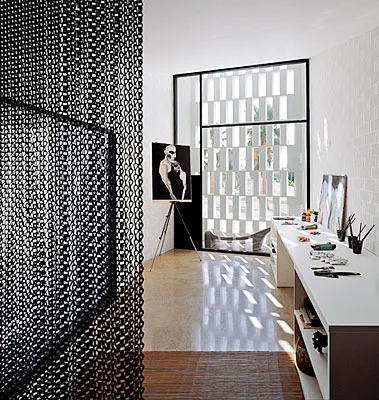
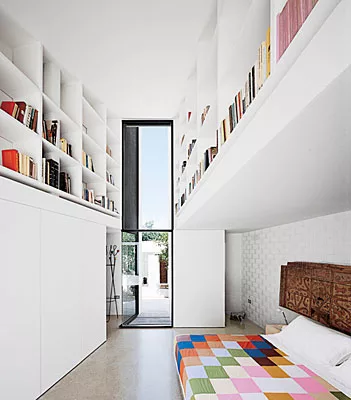
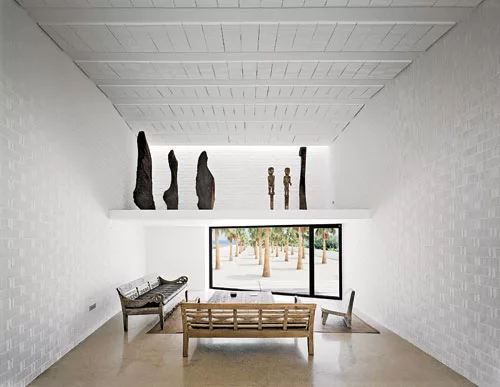
These doors are deeply recessed in the volumes, creating useful service spaces inside the perimeter walls. Ferrater also activates the upper spaces of the interiors: The high viewing slot of the bedroom is lined with bookcases, and a concrete shelf across the front of the living room, raked with light from the clerestory, displays a selection of volcanic rocks and sculptures from Southeast Asia. The couple collected most of the furniture on their travels, including sofas from Indonesia, fabrics from Thailand, and miniature benches and chairs from Africa—“no designer furniture,” Ferrater notes.

Ferrater worked with a small local builder on the house. Like Sert and Coderch before him, the architect used traditional construction techniques, such as shallow brick roof vaults known as “bovedillas,” although he mixes these with concrete slabs and lintels as needed. The crisp stucco finishes of the masonry exteriors emphasize purely formal qualities, but in the interiors, he exposes the patterned texture of the low-fired hollow brick of the walls and ceiling vaults, painting them white. Floors are terrazzo, and the planks of the exterior platform are of board-formed precast concrete, owing to its resistance to moisture. An exterior stair at the back of the studio leads up to a lookout and solarium on the roof, which was finished with precast-concrete tiles made on the site.

Ferrater likes to say that the house is a kind of portrait of his client and his lifestyle. But like the vernacular techniques he uses, these concerns are also the raw material for the more personal creative project of his design, which comes to focus around the sophisticated formal play between the pavilions. Architecture is born from its circumstances, as he observes, but it can also dignify and transcend them.

Looking for quick answers on architecture and design topics?
Try Ask RECORD, our new smart AI search tool.
Ask RECORD →

KEYWORDS: Spain

Share This Story

Looking for a reprint of this article?
From high-res PDFs to custom plaques, order your copy today!
David Cohn is a Madrid-based architecture critic and international correspondent for Architectural Record. His latest book, Spain: Modern Architectures in History, was released in 2025.

Post a comment to this article

Report Abusive Comment

Subscription Center
  • Create an Account
  • Start a Subscription
  • Manage My Account
  • Sign Up for Newsletters
  • Visit Customer Service
  • Update Preferences

More Videos

Sponsored Content

Sponsored Content is a special paid section where industry companies provide high quality, objective, non-commercial content around topics of interest to the Architectural Record audience. All Sponsored Content is supplied by the advertising company and any opinions expressed in this article are those of the author and not necessarily reflect the views of Architectural Record or its parent company, BNP Media. Interested in participating in our Sponsored Content section? Contact your local rep!

close
  • cold storage facility
    Sponsored byCarlisle SynTec Systems

    How Architects Can Design More Continuous Cold Storage Envelopes

  • TAMLYN XtremeTrim Exterior Trim
    Sponsored byTamlyn

    Designing Cleaner Panel Facades: Why Exterior Trim Details Matter

  • Building with Vapor Barriers
    Sponsored byReef Industries, Inc.

    Vapor Barriers Help Control Moisture in Tighter Building Designs

DESIGN:ED Podcast
Listen to Architectural Record’s DESIGN:ED Podcast

Events

June 18, 2026

Rebooting the Aging Office Building

Credits: 1 AIA LU/HSW; 1 AIBD P-CE; 0.1 ICC CEU; 1 PDH

Explore façade retrofit strategies and award-winning design concepts that can transform aging office buildings into healthier, higher-performing workplaces for today’s hybrid workforce.

June 23, 2026

Enhancing Fire Resistance with Advanced PVC Solutions

Credits: 1 AIA LU/HSW; 1 AIBD P-CE; 0.1 ICC CEU; 1 IIBEC CEH

Evaluate advanced PVC solutions that improve fire resistance, support WUI compliance, and enhance resilience in residential and commercial building design.

View All Submit An Event

Products

2026 Architect's Square Foot Costbook

2026 Architect's Square Foot Costbook

See More Products

Popular Stories

SanDiegoAirport

Top 300 Architecture Firms of 2026

Coronado Bridge

The Architect’s Guide to San Diego

Lorcan O' Herilhy

California Architect Lorcan O’Herlihy Has Died, Age 66

CCA, Studio Gang

The Winners of the AIA’s 2026 Architecture Award Range from Collegiate Rowing Hubs to Housing for the Homeless

Dusk House

Design Vanguard 2026: ONO

Rebooting the Aging Office Building - Free Webinar - June 18, 2026

Related Articles

  • House for a Musher

    See More
  • Ditmas Park Renovation

    In Brooklyn, Ben Herzog Architect Revamps a Traditional House for a Young Family

    See More
  • House S-D

    Dhoore Vanweert’s House for a Retired Couple Brings Modernist Geometry to a Belgian Suburb

    See More

Related Products

See More Products
  • WC_-SCA.png

    Building Great Schools for a Great City

  • 0470126736.gif

    Modern Sustainable Residential Design: A Guide for Design Professionals

See More Products
×

The latest news and information

#1 Source for Architectural Design, News and Products

SUBSCRIBE
  • RESOURCES
    • Advertise
    • Contact Us
    • Submit
    • Store
  • ACCOUNT CENTER
    • Create an Account
    • Start a Subscription
    • Manage My Account
    • Sign Up for Newsletters
    • Visit Customer Service
    • Update Preferences
  • PRIVACY
    • PRIVACY POLICY
    • TERMS & CONDITIONS
    • DO NOT SELL MY PERSONAL INFORMATION
    • PRIVACY REQUEST
    • ACCESSIBILITY
  • SERVICES
    • Marketing Services
    • Reprints
    • Market Research
    • List Rental
    • Survey/Respondent Access
  • STAY CONNECTED
    • Linkedin
    • Facebook
    • Instagram
    • YouTube
    • X (Twitter)

Copyright ©2026. All Rights Reserved BNP Media, Inc. and BNP Media II, LLC.

Design, CMS, Hosting & Web Development :: ePublishing