This website requires certain cookies to work and uses other cookies to help you have the best experience. By visiting this website, certain cookies have already been set, which you may delete and block. By closing this message or continuing to use our site, you agree to the use of cookies. Visit our updated privacy and cookie policy to learn more.
This Website Uses Cookies By closing this message or continuing to use our site, you agree to our cookie policy. Learn MoreThis website requires certain cookies to work and uses other cookies to help you have the best experience. By visiting this website, certain cookies have already been set, which you may delete and block. By closing this message or continuing to use our site, you agree to the use of cookies. Visit our updated privacy and cookie policy to learn more.
Out from the Shadows: Finding useful public space in an unlikely location, Toronto transforms a highway underpass into a lively park that glows at night.
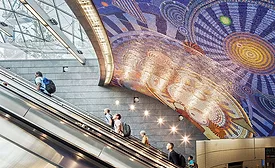
Dark and neglected 'that's the kind of derelict space that lurks below most highways and elevated roadways. Cities in the process of densifying, however, can no longer afford to ignore such concrete underbellies. Toronto, which has been busy completing 70,000 residential units between 2008 and 2012'mostly condominium apartments'recently opened Underpass Park, a gutsy template that repairs a previously marginalized urban zone in the city's East End neighborhood.
The industrial yellow-brick building one block north of Toronto’s Dundas Square in the heart of the city has been home to the Ryerson University School of Image Arts since the late 1960s.
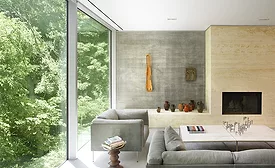
Located in Toronto’s Summerhill neighborhood, this single-family 4,000-square-foot, four-story house overlooks a forested ravine to the south, taking advantage of views of the city skyline during the winter months and the lush ravine in summer months.
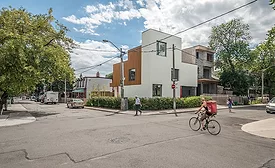
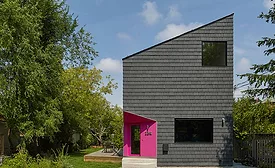
According to architect Donald Chong, when his clients wanted to build a house in The Beaches, a popular Toronto neighborhood, “they were committed to the idea that they could live well in a compact square footage.
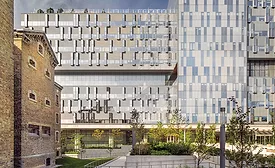
For nearly half a century, the Royal Conservatory, Canada’s venerable music education institution, has occupied a distinctive late-19th-century masonry building at the northern edge of the University of Toronto campus on Bloor Street, one of the city’s major east-west thoroughfares.
A 1,539-square-foot pavilion housing restrooms, a planned café, and mechanical services for the park, including a UV storm-water-filtration system in the basement.
A three-level public library that extends the original neoclassical library building from 1912 with a 12,000-square-foot addition, for a total of 25,000 square feet.
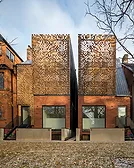
The Galley House emerged out of the context of studying patterns of the evolving typological landscape in Toronto, and the desire over the past century to maintain natural light within spaces affected by an urban block-type progressively becoming more dense and refined.