This website requires certain cookies to work and uses other cookies to help you have the best experience. By visiting this website, certain cookies have already been set, which you may delete and block. By closing this message or continuing to use our site, you agree to the use of cookies. Visit our updated privacy and cookie policy to learn more.
This Website Uses Cookies By closing this message or continuing to use our site, you agree to our cookie policy. Learn MoreThis website requires certain cookies to work and uses other cookies to help you have the best experience. By visiting this website, certain cookies have already been set, which you may delete and block. By closing this message or continuing to use our site, you agree to the use of cookies. Visit our updated privacy and cookie policy to learn more.
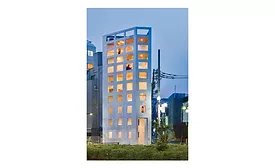
Site size: 806 square feet Project size: 2,314 square feet Program: The client requested a mixed-use building containing retail on the ground floor and living space above. Location: A shopping street in downtown Tokyo that had been in decline is now undergoing a rapid transformation, with numerous building renovation and infrastructure projects under way, including widening the sidewalk. Solution: The four-story building contains a noodle shop on the ground floor, the client's residence on the second floor, and a pair of duplex two-bedroom rental units on the third and fourth floors. The architects sought to create a 'moderate conspicuousness' for
Tokyo may be among the world’s largest cities, but it has some of the smallest buildings. At critical nodes such as Roppongi and Shinjuku, the city has plenty of skyscrapers and hulking commercial complexes, yet its character is mostly defined by dense, low-scale neighborhoods where the majority of buildings are no more than five stories high.
Architect Jun Aoki's new facade for Louis Vuitton in Tokyo's Ginza district is a glowing tour de force that sets the shop apart from the Matsuya Department Store that houses it.
Despite Japan's energy belt-tightening, triggered by the Great Eastern Japan Earthquake of 2011, dazzling lighting effects still bedeck most luxury boutiques in Tokyo's Ginza shopping district.
Since opening in 2005, Teikyo University Elementary School had outgrown its quarters in one of the university’s existing buildings. The school wanted to give each department its own space while keeping the atmosphere warm and intimate, despite the increase in size. The architects created a cedar-clad, reinforced-concrete schoolhouse with a rakish steel roof.
Bookstores may be closing right and left in cities all over the world, but in January 2012 Tokyo welcomed Daikanyama Tsutaya Books with an enthusiastic embrace.
The compact site, located along on a narrow, one-lane street, is situated in a relatively verdant residential district in Tokyo in a neighborhood that contains a mixture of detached houses and low-rise condominiums.