When the grandchildren of Dwight D. Eisenhower approved a compromise design last week, it seemed likely that Frank Gehry’s memorial to the 34th president would finally get built—perhaps even in time for the 75th anniversary of D-Day, on June 6, 2019.
Since its founding in 1919, the powerhouse law firm Covington has produced alumni ranging from Dean Acheson, President Truman’s Secretary of State, to former Attorney General Eric Holder, and it has an enviable client list within the Beltway.
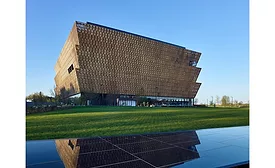
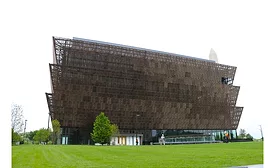
Though the scaffolding on the National Museum of African American History and Culture’s new building on the Mall in Washington, D.C. has been down for some time, allowing the public full view of its three-tiered, crown-shaped exterior of bronze-colored cast-aluminum panels, on Thursday, a small group of journalists was given a tour of its nearly complete interiors, where installation of exhibits has already begun.
The United States got in and out of World War I in well under two years. The U.S. World War I Centennial Commission hopes it can move as quickly. Yesterday, it chose a design for the National World War I Memorial by Joseph Weishaar, a 2013 graduate of the Fay Jones School of Architecture at the University of Arkansas.
Surface Tension: A progression of materials from rough poplar bark to smooth bronze panels takes clients through a storefront shop to the inner sanctum of a dermatologist and a plastic surgeon.
Beauty may be skin-deep, but David Jameson's design for the offices of a dermatologist and a plastic surgeon reaches beneath the surface, peeling back layers of intrigue. Inspired by the structure of a tree'with its rough bark on the outside and smoother rings closer to the core' the Washington, D.C.'based architect organized the 3,770-square-foot facility as a progression of spaces wrapped in increasingly refined materials.
With the selection of five finalists for its memorial competition, the United States World War I Centennial Commission seems to be moving closer to a showdown with preservation groups.
A design proposal called Remembrance and Reflection. The rules of an architecture competition can affect which design wins and even how it is received. That’s why opponents of the controversial Dwight D. Eisenhower Memorial fault not just Frank Gehry’s design but the format of the competition that led to its selection.