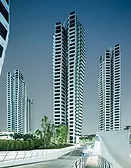
The towers that comprise Zaha Hadid's latest project may look precarious, but they are certainly not faulty: “They change shape and geometry as you move up,” explains project director Michele Pasca di Magliano.
Zaha Hadid reduced the size and toned down the expression of her initial design for the 2020 Tokyo Olympic Stadium, but it is still garnering criticism. In the latest round of public outcry over Tokyo’s 2020 Olympic Stadium, architect Arata Isozaki has stepped into the ring, joining a coterie of illustrious architects opposed to the project’s development. Though he favored the initial helmet-shaped scheme that landed the London architect Zaha Hadid the commission, the revised design has Isozaki deeply concerned. He convened last week with Hadid associate Satoshi Ohashi at a public forum in Tokyo intended to give both parties
Since the Guggenheim museum announced plans for its Frank Gehry-designed satellite in Abu Dhabi eight years ago, the project has been part of debates and protests concerning the treatment of migrant construction workers and the role of architects in their safety and well being.
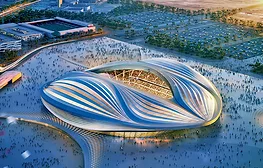
Image courtesy Zaha Hadid Architects A rendering of Hadid Al Wakrah Stadium in Qatar. A lawsuit brought by Zaha Hadid against The New York Review of Books and its architecture critic, Martin Filler, has prompted Filler to correct the record. In a book review published in June, Filler accused Hadid of being indifferent to the deaths of 1,000 workers during construction of her Al Wakrah Stadium in Qatar, a venue for the 2020 FIFA World Cup, based on comments the architect had made to The Guardian newspaper in February 2014. In a letter posted on the NYRB website on Monday
Protestors gather around the National Stadium on Saturday, hoping to save it from demolition. On Saturday, placard-wearing protestors took to the streets of central Tokyo and peacefully encircled the 50,000-seat Kasumigaoka National Stadium designed by Mitsuo Katayama and erected for the 1964 Olympics. In preparation for hosting the games again in 2020, the vintage structure is being readied for demolition followed by replacement with a futuristic, Zaha Hadid-designed arena several times its size. But a collection of architects and lay people alike are hoping to convince the Japan Sport Council (JSC) to do otherwise. Japan does not have a great
Baku, Azerbaijan Zaha Hadid Architects November 2013 Photography by Iwan Baan The unbridled swooping forms and blinding brightness of the glass-fiber-reinforced plastic exterior carry through to the building’s interiors, where floors merge into walls, stairs, and ceilings. Shooting this project, I wanted to capture how it connects each visitor to the landscape. The cultural center peers up from the earth and wraps around the gardens before disappearing back into the ground again. When visitors aren't resting against the sloping sides, you'll find them inquisitively making their way around the structure, trying to figure out where the building starts and the
The new national stadium of Japan, by Zaha Hadid Architects, will be built for the 2020 summer Olympics in Tokyo. In September, the International Olympic Committee (IOC) announced the host city for the Games of the XXXII Olympiad in 2020. A town with a good track record, Tokyo beat out Istanbul and Madrid and took the prize for the third time. The city was first selected for the 1940 summer games, which were canceled due to World War II. Tokyo’s second win was for the 1964 summer Olympics. Symbolizing the end of Japan’s post–World War II reconstruction, new athletic facilities
Zaha Hadid Architects Serpentine Sackler Gallery London Zaha Hadid Architects’ first permanent structure in London—a restaurant building made from tensile fabric, steel, and glass—has something of the appearance of a carnival tent.
 RSS
RSS