This website requires certain cookies to work and uses other cookies to help you have the best experience. By visiting this website, certain cookies have already been set, which you may delete and block. By closing this message or continuing to use our site, you agree to the use of cookies. Visit our updated privacy and cookie policy to learn more.
This Website Uses Cookies By closing this message or continuing to use our site, you agree to our cookie policy. Learn MoreThis website requires certain cookies to work and uses other cookies to help you have the best experience. By visiting this website, certain cookies have already been set, which you may delete and block. By closing this message or continuing to use our site, you agree to the use of cookies. Visit our updated privacy and cookie policy to learn more.
Dramatically framed by Morphosis’s glassy Federal Building looming behind it, the revived Strand theater, a gleaming red experimental performance space and education center for the American Conservatory Theater (A.C.T.) designed by Skidmore, Owings & Merrill, clicks into its site on San Francisco’s Market Street like one of the final pieces of a complex puzzle.
A ribbon of glass, steel, and wood floats through a hilly landscape, serving a nonprofit foundation dedicated to bringing people closer to art, nature, and faith.
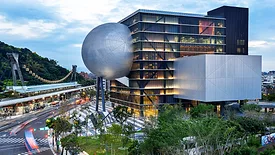
Any Way You Cut It: A Pritzker Prize–winning architect carves tunnels through a concrete-and-glass box to create a bold theater complex for a burgeoning district in Shanghai.
A Pritzker Prize–winning architect carves tunnels through a concrete-and-glass box to create a bold theater complex for a burgeoning district in Shanghai.
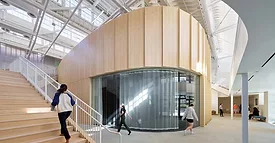
Architect William Rawn is often asked about the 85-foot-long undulating glass facade at his recently completed Ruth Caplin Theatre on the campus of the University of Virginia (UVA), in Charlottesville. People wonder, he says, if it was inspired by Thomas Jefferson’s serpentine brick walls that are part of the so-called Lawn—the complex of 18th-century structures and grounds at the university’s historic heart.
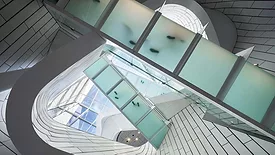
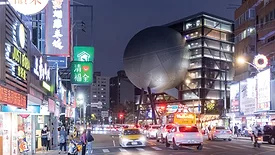
Toyo Ito at the theater construction site. Displaying architecture in a gallery is always a challenge. This is especially true with a building still under construction. And even more so when that building is Taiwan’s National Taichung Theater—unarguably Tokyo architect Toyo Ito’s most ambitious project to date. Taking Ito’s structural know-how and spatial ingenuity to new limits, this extraordinary complex appears as a rectangular block. But contained within is a spectacular 3D grid of tubular voids hinted at by the hourglass-shaped cutouts that define the elevations. Expanding and contracting, the hollows accommodate the various programmatic pieces, including a 2014-seat theater,