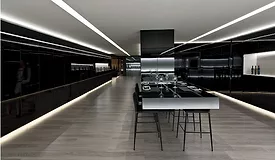
A striking mix of glossy black walls and white light, the Vegamar Selección, a wine boutique on an exclusive shopping street in Valencia, Spain, was given the black-tie treatment by architect Fran Silvestre and interior designer Andrés Alfaro Hofmann to meet the client's ambition to achieve an image of sophistication and quality.
Walking into a Camper shoe store, one never knows what to expect. The family-run manufacturer and retailer of casual footwear, based in Majorca, Spain, and now in its third generation, has commissioned more than 20 designers to realize a startling range of concepts for its 360-odd outlets worldwide. A furry canopy of shaggy red fringe arches over the ceiling of a store in São Paulo designed by Marko Brajovic. The walls of a New York shop by Nendo's Oki Sato are covered with a grid of projecting cast resin shoes, with a few real shoes on display among them. Konstantin
A scattershot architecture show sprawls through two grand Venetian palaces during the Biennale. Installation by the University of Houston at Time Space Existence. Time Space Existence, one of the officially-sponsored collateral events of the Venice Architecture Biennale, is a sprawling exhibition presenting projects and installations by more than 100 architects from around the world. It winds through the salons and backrooms of two grand Venetian palaces on the Grand Canal, the Palazzo Bembo and the Mora. Related links Venice Dispatch: Golden Lions for Phyllis Lambert and Korean Pavilion Venice Dispatch: Highlights from the National Pavilions Venice Dispatch: U.S.
Antoni Gaudî's vision for the lighting of the Temple Expiatori de la Sagrada Familia in Barcelona is taking shape under architect Jordi Faulî and Anoche.
The interweaving of indoor and outdoor spaces in #house#1.130, by Madrid architect Estudio Entresitio, recalls the condensed landscapes of classical Chinese gardens in Suzhou: tightly framed vistas are crossed in close succession by multiple spatial events–glazed pavilions, light wells, bridges, terraces, beds of vegetation, a covered pathway angling slightly out of view.