Video by Danny Forster Design Studio + dbox Rem Koolhaas has won the chance to redesign a large swath of Miami Beach. In a late Wednesday night vote, city commissioners chose a team led by Koolhaas to enlarge the Miami Beach Convention Center and redevelop its 52-acre site, a project that the Miami Herald called “the most important development deal in the history of Miami Beach.” Koolhaas beat out his onetime employee Bjarke Ingels, who had described their competition for the $1 billion-plus project as “oedipal.”The selection appeared to hinge less on architecture than on cost and other factors. Koolhaas’s
This summer may be the busiest of Andy Klemmer’s life. Two buildings for which his firm, the New York-based Paratus Group, serves as project director—the Pérez Miami Art Museum, by Herzog & de Meuron, and an addition to the Kimbell Museum, in Fort Worth, by Renzo Piano—are racing toward fall openings, turning the New Yorker into a Florida-Texas commuter. Photo courtesy Paratus Group Andy Klemmer He founded the company in 1997, the year Frank Gehry’s Guggenheim Bilbao, for which he served as owner’s rep, debuted. Subsequent projects have included SANAA’s Glass Pavilion at the Toledo Museum of Art as well
Designed by HWKN, Fire Island's New Pines Pavilion impresses. HWKN's Fire Island Pines Pavilion. In Fire Island Pines, the storied gay resort town 50 miles from Manhattan, the talk last weekend—somewhat surprisingly—was about architecture. At Whyte Hall, a community center designed by architect Scott Bromley (who got his start creating sets for Studio 54), Christopher Rawlins signed copies of his book about Horace Gifford, the designer of dozens of houses in the Pines in the 1960s and 70s. As Rawlins proves in his book, Fire Island Modernist, Gifford’s houses, though deferential to their natural surroundings, are based on serious architectural
Diller Scofidio + Renfro, H3 Hardy Collaboration, SHoP Architects, and SOM propose plans to relocate the famed New York City arena and redesign Penn Station. Penn Station 3.0Diller Scofidio + RenfroNew York City At a much-anticipated forum in Manhattan today, four firms presented plans for moving New York’s Madison Square Garden away from its current location above cramped and claustrophobic Pennsylvania Station. Their proposals included schemes for a new transportation hub that could rise on the station's site. Surprisingly, each firm chose a different location for the reimagined Garden. Diller Scofidio + Renfro placed their arena above the Farley Post
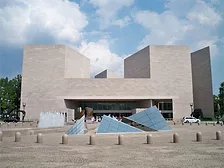
A confidant of I. M. Pei, Perry Chin was asked to consult on plans to give Pei’s East Building of the National Gallery in Washington new heating, cooling, security, and fire safety systems.
Game Changer: Columbia University's quirky but tough field house bridges the divide between its gritty surroundings and the athletic playing fields beyond.
There are few American campuses more urban than Columbia University's; even its athletic fields are in Manhattan, grouped together in the cramped Baker Athletics Complex at the island's northern tip.
As a new exhibition at New York's Center for Architecture explores the 26-acre development, RECORD spoke with Bill Pedersen, whose firm Kohn Pedersen Fox is responsible for its master plan. Design in the Heart of New York, an exhibition at the Center for Architecture in Manhattan, includes many new renderings of the Hudson Yards development.
Image courtesy Davidson Rafailidis/Storefront for Art and Architecture MirrorMirror, reflective tents by Davidson Rafailidis, will be on view in front of the New Museum beginning May 4. New York’s answer to London Design Week, a festival called NYCxDesign (pronounced “NYC by Design”) will run from May 10 to 21, coinciding with and building on the Frieze New York art fair (May 10-13) and the International Contemporary Furniture Fair (May 18-21). The brainchild of city council president and New York City mayoral candidate Christine Quinn, NYCxDesign won’t be creating events so much as positioning them under the new umbrella. “In the
Daniel Burnham's 1905 Wanamaker’s building reflected in the facade of Fumihiko Maki's new 51 Astor Place. The base of Gwathmey Siegel's 2005 Sculpture for Living is visible on the right. New York City is reaching a tipping point, architecturally. The city has the chance to go the way of London and Paris, where carefully chosen bits of contemporary architecture enliven an urban fabric that remains largely intact, or the way of Shanghai and Dubai, where relentless repetition of glass facades leads to a numbing sameness. Several recent developments suggest that New York, for all its attention to the built environment—and